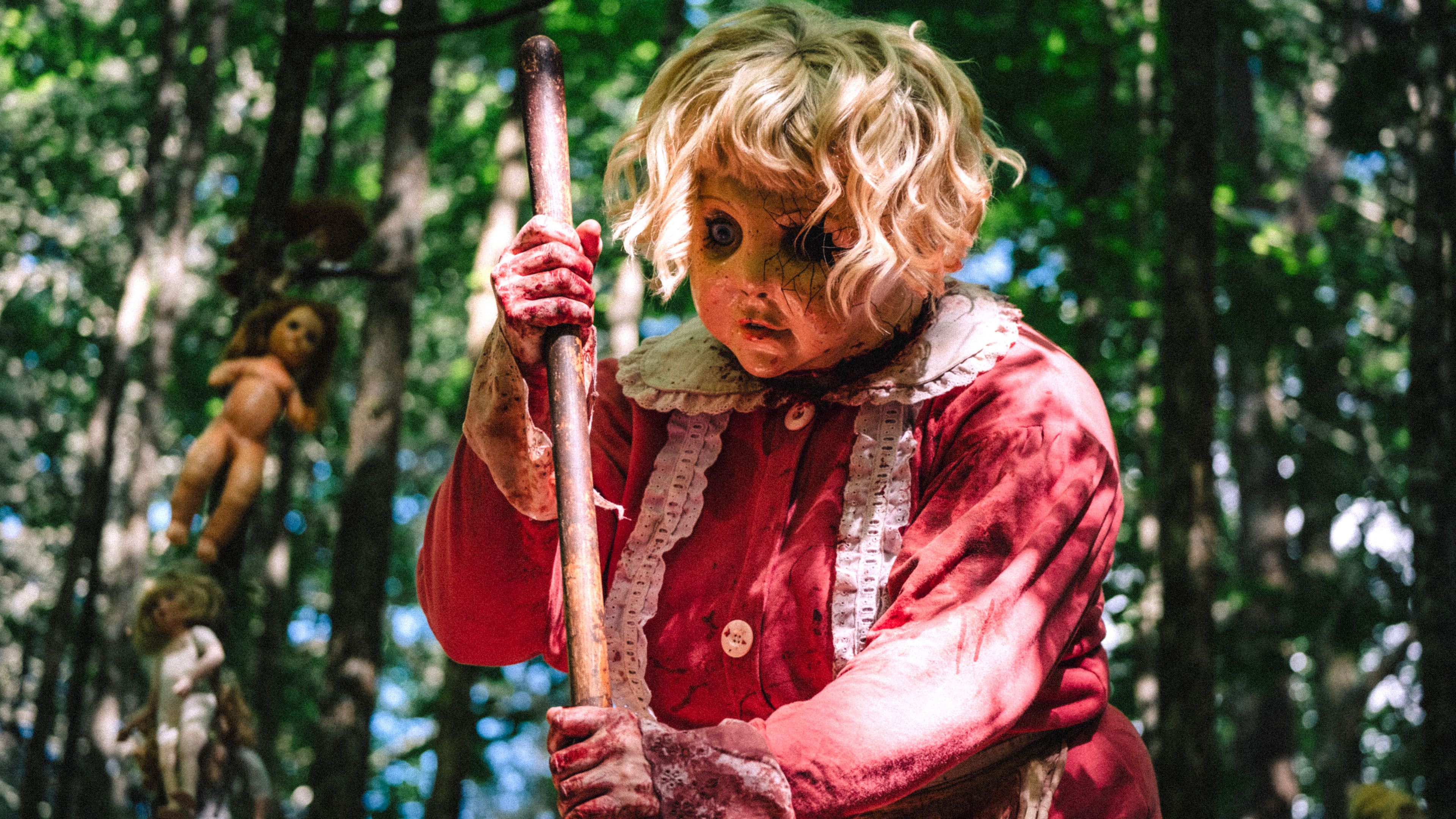
For years, slasher movies seemed stuck in a rut, either disappointing remakes of old favorites or attempts to copy the clever, scary style of Scream. Lately, though, filmmakers have been focusing on simpler, more direct horror, leading to successes like the popular Terrifier films, Ti West’s retro-inspired X, and the new take on Friday the 13th, In a Violent Nature.
Rod Blackhurst’s new film, Dolly, tries to capitalize on a current horror trend, but ultimately falls short. Like Damien Leone, Blackhurst aims for extreme thrills and achieves that in some ways. However, Dolly lacks self-awareness or a consistent tone, preventing it from reaching the same level as other films in the genre.
Dolly Starts Curiously & Quickly Devolves Into Dull Tropes
The short film Babygirl inspires Dolly, which begins with Macy and her boyfriend, Chase, getting ready for a camping trip in Tennessee. Chase is planning to propose, and Macy suspects it’s coming – she’s excited but also worried about whether she’s ready to be a good wife and stepmother. Both are feeling anxious about the trip, but for different reasons.
Right before something important happens, Macy and Chase are targeted by a terrifying figure named Dolly, who hides a disfigured face behind a porcelain doll mask. When Dolly kidnaps Macy and leaves Chase for dead, Macy must fight to survive and escape Dolly’s house before she’s turned into another one of Dolly’s broken ‘toys’.
Director Brian Blackhurst, known for his Emmy-nominated Netflix documentary Amanda Knox and the film Night Swim, clearly loves the gritty, throwback style of grindhouse cinema. He shot his new slasher thriller on 16mm film to give it a visual feel reminiscent of films like Robert Rodriguez and Quentin Tarantino’s Grindhouse and Rob Zombie’s Firefly trilogy.
Beyond simply evoking nostalgia for classic horror, Dolly initially stands out due to director Michael Russo’s distinctive visual style. The first half of the film is visually striking, blending old-fashioned editing techniques – like iris transitions used for Macy’s first and final days in the killer’s house – with modern CGI. However, this stylish approach doesn’t quite carry through into the second half, leaving the film feeling less impactful overall.
The biggest problem with Dolly is its weak script. Expanding a short film into a full-length movie is challenging, and while Blackhurst and Weavil add some interesting elements, the story feels underdeveloped. The film hints at a dark past for Dolly and presents a strong, capable lead character who fits well alongside iconic ‘final girls’ like Laurie Strode and Sidney Prescott.
As the story becomes mainly about Macy trying to escape, and Dolly’s cruel treatment of her, the plot becomes repetitive and fails to develop either character in a meaningful way. The villain, Dolly, hints at being sympathetic – she simply wants to be a mother – which could have created an interesting contrast with Macy’s own uncertainties about taking on that role with Chase’s daughter, but this potential isn’t fully explored.
Blackhurst and Weavil clearly aimed for a more in-depth analysis of Dolly by dividing it into chapters based on its core ideas. However, their frequent shifts in focus – changing chapters almost every ten minutes – actually hindered their progress and made the approach ineffective, preventing any single concept from being fully explored.
Despite having potential for deeper themes, the film Dolly mostly delivers the expected gore and violence of the genre, but without any sense of enjoyment. While some of the kills are effectively brutal thanks to impressive practical effects, other scenes are just relentlessly grim and lack the playful humor found in similar movies, resulting in an unbalanced and unpleasant tone.
 Courtesy of John Blazzi.
Despite its flaws, Dolly manages to stay somewhat engaging thanks to its actors, especially Fabianne Therese as Macy and Max the Impaler as Dolly. Therese, who has a long history of strong performances in horror films like John Dies at the End and Starry Eyes, is particularly good at portraying Macy’s fear while also showing her determination to survive.
Max the Impaler, in their first acting role as Dolly, delivers a surprisingly subtle performance. They avoid portraying the killer as simply violent or deranged, instead focusing on Dolly’s complex emotions. The moments where Dolly shows fear and a desire to protect Macy are just as powerful as her cruelest actions, and Max conveys all of this remarkably, often without saying anything at all.
Despite its flaws, calling Dolly a truly bad movie feels harsh. The slasher thriller features a good cast, moments of stylish filmmaking, and some genuinely shocking scenes. However, it struggles to consistently blend these elements into a cohesive whole. If a sequel does happen, it has enough promising ideas to build on and potentially be much stronger.
Dolly hits theaters on March 6.
Read More
- Gold Rate Forecast
- What is Omoggle? The AI face-rating platform taking over Twitch
- Scientology speedrun trend escalates as viewers map out Hollywood facility
- Man pulls car with his manhood while on fire to raise awareness for prostate cancer
- Wartales Curse of Rigel DLC Guide – Best Tips, POIs & More
- Detonate codes (December 2025)
- Steam Drops 24 Free Downloads In Limited-Time Giveaway
- The Boys Confirm Why People Still Look Up to Homelander
- How To Grow Money Trees In Animal Crossing: New Horizons
- Bithumb’s Dance with Fate: Court Halts Ban, But BTC Blunder Looms
2026-03-04 01:11