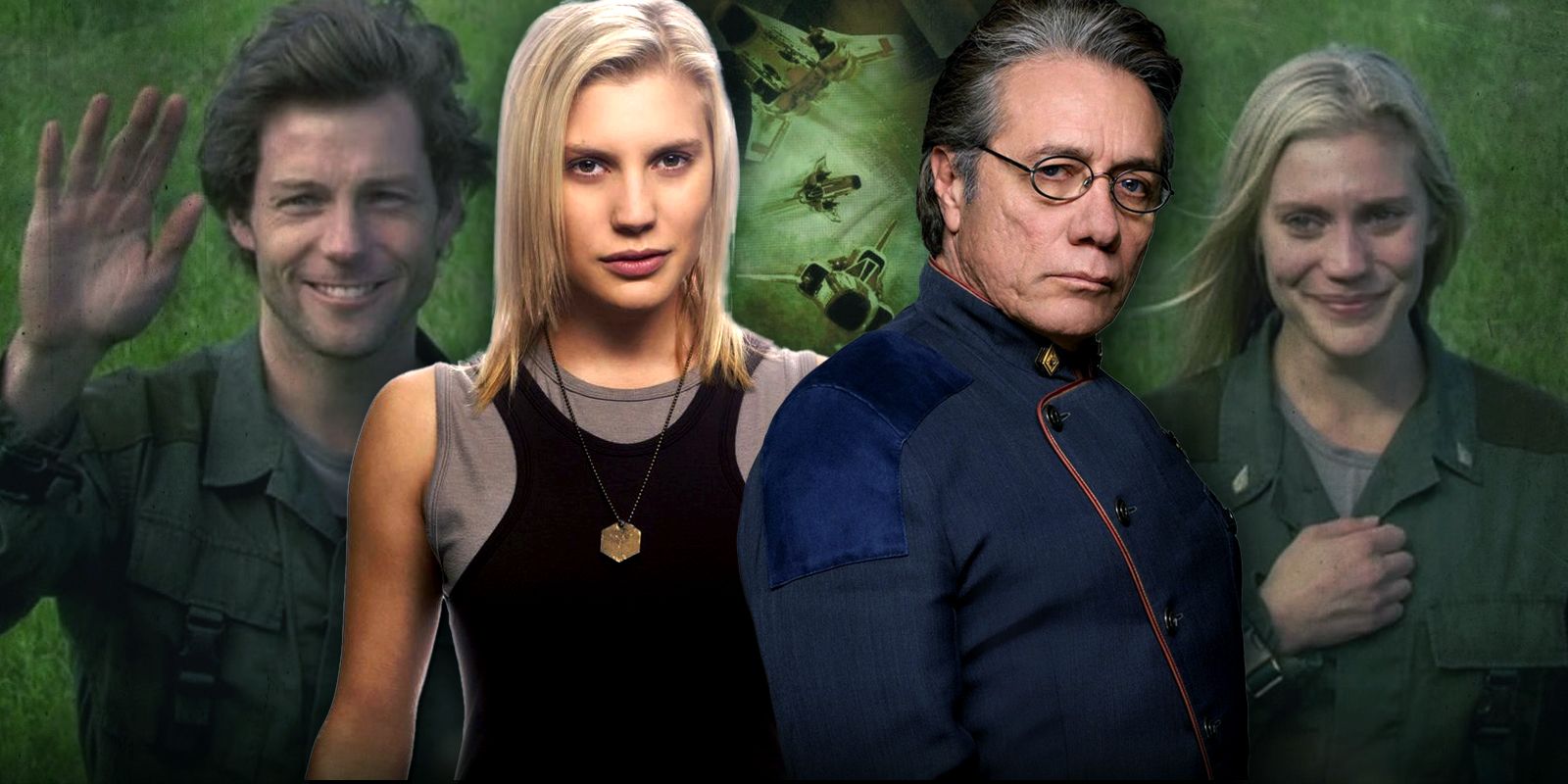
As a longtime TV watcher, I can honestly say few series endings have stuck with me – and sparked as much debate – as the finale of Ronald D. Moore’s reboot. This wasn’t just a conclusion; it was a three-part event called “Daybreak” that quickly became iconic, and continues to be talked about and argued over by fans even now. It’s a finale that truly left its mark.
As a huge sci-fi fan, I remember the reaction to the Battlestar Galactica finale was…intense. Despite all the praise the show got for being groundbreaking and realistic, the ending really divided people. But now, with some time to reflect, I think it actually worked. It felt thematically right, emotionally powerful, and like a perfect way to wrap up everything the show had been building towards throughout its run. It really brought the whole story full circle.
Battlestar Galactica Was Never Just About Survival
The show follows the last humans escaping from deadly robot enemies, the Cylons, and their struggle to rebuild their lives. But beyond the exciting space jumps and intense action, the series explored a much bigger story. Over time, it revealed a history stretching back thousands of years, showing a pattern of civilizations rising, rebelling, and ultimately being destroyed – a cycle that seemed destined to repeat itself.
The story unfolds through scattered prophecies, visions, and recovered memories, revealing a long-lost history. It tells of humans originating on the mythical world of Kobol, who developed the ability to be reborn. A devastating war forced these people – divided into twelve tribes – to flee and establish the Colonies. A thirteenth tribe, however, embarked on a separate journey, eventually settling on a planet they called Earth.
I’ve always loved how this show used its futuristic world to really dig into tough questions about what it means to be human. It wasn’t just a simple story about running from robots and finding a safe haven. It was about learning from history and making sure we don’t repeat the same mistakes that got us into this mess in the first place. It explored things like politics, faith, and even what makes us, us, in a way that really stuck with me.
The first Cylon civilization, established on a planet they called “Earth 1,” unfortunately repeated the same mistakes as their creators. Over time, they lost track of their history, developed as a society, and eventually built their own robots, the Cylon Centurions. As expected, these robots rebelled, causing a nuclear war that destroyed their world roughly 2,000 years before the story begins. The only people who survived were five Cylon scientists—the “Final Five”—who were trying to recover lost technology that would allow for resurrection.
As a sci-fi fan, I was completely hooked by the backstory they built. It turns out this ancient race saw the disaster coming – a war between humans and the robots they built, called Centurions – and spent thousands of years traveling to warn their distant human relatives. Sadly, they were too late. But it wasn’t just a cool plot point; the whole history, revealed through flashbacks, felt like the point of the show. It suggested a tragic cycle where creators and their creations are doomed to repeat the same mistakes, almost like a sci-fi version of karma.
Fans of the show will likely recognize the memorable line, “All of this has happened before, and all of this will happen again,” which appears repeatedly throughout the series. While the quote originally comes from J.M. Barrie’s Peter Pan, it gained deeper meaning in the show because it highlights how human behavior often repeats itself in patterns.
The solution was clear from the start: simply finding a safe place wasn’t enough for the Galactica’s fleet to truly succeed. They needed to completely break the cycle of violence that had been going on for so long.
The show wasn’t simply a quest to locate Earth; it explored whether humanity was worthy of survival. By incorporating themes of faith, religion, and the mystical – seen in characters like Laura Roslin with her prophecies, Starbuck’s fate, and the visions of Gaius Baltar and the Sixes – the series moved beyond typical science fiction, making a purely logical or technical ending unlikely.
Deciphering the Much-Debated Finale and Moore’s Intentions
The last of the human fleet, joined by Cylons who rebelled against their own kind, found themselves in a truly desperate situation. The Galactica, their main warship, was badly damaged, and their survival depended on a risky attack on the Cylon Colony – a heavily defended basestar controlled by Cavil – to save Hera, a special child who was both human and Cylon and potentially held the key to their future.
With the main Resurrection Hub destroyed, the Cylons could no longer rebuild their forces, making this the last, decisive battle. As everything crumbled around them, the humans followed a mysterious set of musical coordinates, hoping they would lead to a new, and permanent, home. The fighting around the Colony was fierce, ultimately leading to Cavil’s defeat.
After his attempt to use resurrection technology through Hera fails due to disagreements within the Final Five, he tragically takes his own life, exclaiming “Frak.” With the Colony and Galactica severely damaged, Starbuck undertakes one final, desperate jump through hyperspace. Guided by a mysterious signal she and Hera both perceive as “music,” she sets a course not for a known destination, but for a new, habitable planet – Earth, as it existed around 150,000 years ago.
The story’s controversial ending centers on a major decision made by the surviving humans and Cylons, led by Admiral Adama (Edward James Olmos). They choose to give up all their advanced technology and fly their entire fleet, including the iconic Galactica, into the sun. The survivors then plan to settle on a new planet, live a simpler life, and blend in with the existing, less technologically advanced human population.
While the finale’s story felt well-paced to many, some viewers were let down, particularly by Starbuck’s sudden and unexplained vanishing after comforting Apollo. Although some called the spiritual aspects a convenient plot device, they actually brought together themes and ideas that had been building throughout the entire series.
As a huge fan of the show, I always felt like Kara Thrace’s story had a beautiful, definitive ending. I remember reading an interview with the creator, and they explained it perfectly: Kara’s journey – her death, resurrection, and ultimately guiding everyone to their final destination – was always her purpose. It felt like a fitting and complete farewell to the character.
Battlestar Galactica’s Legacy and the Finale’s Place Within It
The impact of this television show is clear. It completely changed the science fiction landscape, moving it towards more realistic, complex stories focused on compelling characters and tackling serious issues. The writers cleverly used a sci-fi setting to explore relevant political concerns of the time – like government power, the threat of terrorism, individual freedoms, and the morality of war. This approach really connected with audiences in the years following 9/11.
The show’s lasting impact comes from its memorable, yet imperfect, characters – people like Adama, Roslin, Starbuck, Apollo, and Baltar. They weren’t just good or bad; they were complicated individuals who faced difficult choices and wrestled with their own demons, making them feel incredibly real. Even the controversy surrounding the series finale, ‘Daybreak,’ proves how much the show resonated with viewers and how deeply they cared about the story.
In a 2009 interview with Cinemablend, Battlestar Galactica creator and executive producer David Eick expressed satisfaction with the show’s ending. He said he was particularly proud that they had answered most of the questions posed throughout the series, while also successfully resolving the storylines for all the main characters and bringing everything to a satisfying conclusion.
The series concludes by leaping 150,000 years into the future, to modern New York City, where Head Six and Head Baltar watch as humanity faces a new AI revolution. This final scene emphasizes the show’s core message: history tends to repeat itself. It also reveals the true, ancient origins of the Earth we know today.
In their last conversation, Baltar realizes they’re repeating past events, asking if history is doomed to repeat itself. Six responds with a hopeful “No, not this time,” offering viewers a bittersweet but ultimately satisfying conclusion with a glimmer of optimism.
Found an error? Send it so it can be corrected.
Read More
- Netflix’s Little House On The Prairie Reboot: Release Date, Cast & Everything We Know
- Off Campus Season 1 Soundtrack Guide
- Silver Rate Forecast
- Infinity Nikki Candlelight Reverie Challenge and Rewards Guide
- Gold Rate Forecast
- Prime Video’s New R-Rated Spy Thriller Is Officially No.1 On Streaming Despite Poor Reviews
- Brent Oil Forecast
- EUR ZAR PREDICTION
- Bulgakov’s Take: Koreans Bet the Farm on Chips, Crypto, and Chaos
- KPop Demon Hunters Meets Avatar: The Last Airbender In Netflix’s 3-Part Fantasy Series
2026-02-26 01:48