I really enjoy epilogues, though it depends on the story. They’re perfect for fantasy novels, giving a satisfying conclusion to a long series. But in movies like Marvel films, they can feel unnecessary and just add a lot of extra time – especially when you’re watching on TV and it breaks up the ending with commercials, like with the long epilogue in Avengers: Endgame.
Television often feels like a perfect fit for wrap-up episodes. However, beyond the British tradition of Christmas specials, we rarely see shows conclude with a focus on simply spending time with characters, rather than pushing the plot forward. This makes me wonder if some viewers of A Knight of the Seven Kingdoms might find this week’s finale a bit anticlimactic. The main storyline really wrapped up in episode five, and this final episode mostly consists of tying up loose ends and giving the characters a peaceful farewell.
I really think “The Morrow” feels like the perfect ending to this story – the kind of epilogue you rarely get with fantasy TV shows, and something the ending of The Hedge Knight novella didn’t quite have. If, like me, you’ve been enjoying the relaxed, character-focused moments – I personally loved “The Squire” the most this season – then you’ll appreciate this finale. It gives us another half-hour to just hang out with Dunk, Egg, and the others before we have to say goodbye for a while.
Now that Prince Baelor has unexpectedly died, two major questions remain. Will Ser Duncan face consequences for starting the violent clash? And will Prince Aegon be permitted to continue as his assistant?
To start, Ser Duncan won’t face any further consequences for the events of the trial by combat. The gods have made their judgment, and he’s legally cleared. However, not everyone is satisfied with how the trial unfolded.
Prince Valarr Targaryen (Oscar Morgan), Baelor’s son, is shocked and furious when he sees Ser Duncan mourning at his father’s funeral pyre. Young Baelor had the potential to be a truly great king. Valarr bitterly asks Duncan, “Why take him and not you?” Baelor’s brother, Maekar – the one who ultimately killed the opponent – worries that Duncan’s actions will alter how history remembers things. He fears people will say, “If Baelor were king, this wouldn’t have happened,” every time something goes wrong.
Despite everything, Prince Maekar still wants Ser Duncan to train Aegon as a squire. However, there are a few requirements: Dunk would have to pledge his loyalty to the Targaryens and move to Maekar’s home at Summerhall, where the royal family would finish his knightly training. Duncan, though, is looking forward to going back to a simpler life as a traveling knight. He unintentionally upsets a nearby Egg by muttering, “I think I’ve had enough of princes.”
Dunk’s stubbornness won’t continue for long—season two of the show is already being filmed. He starts to reconsider his position after meeting Aegon’s brother, Daeron, who, while drunk, points out that even the notoriously bad Aerion was once a decent child. Daeron sarcastically suggests they’ll “make a man” out of Egg as well. And so, Ser Duncan realizes his duty: to ensure the potential future king understands the hardships of life, like eating simple food and sleeping in basic accommodations—inns, stables, or even outdoors when necessary.
However, the way the story concludes isn’t the main point of “The Morrow.” This episode functions like a good epilogue, catching up with the supporting characters and showing how the recent events have impacted them. It also reflects on the hero’s emotional state and where he stands now.
We’re treated to some charming and humorous moments with Raymun Fossoway, now a successful knight who has married the redhead he had an affair with. (She quickly announced a pregnancy, leaving him with little choice!) He even repurchases one of Ser Duncan’s horses – Sweetfoot, Ser Arlan’s former riding horse – and then gives it to Raymun, ensuring the animal enjoys its retirement in an orchard.
We also see a lively farewell from Lyonel Baratheon, who is thrilled with the trial’s outcome. He enthusiastically asks Ser Duncan to join him in the Stormlands for a life of leisure – hunting, sailing, and enjoying themselves. He jokingly promises to treat Duncan like a brother, but adds a crude threat: if Duncan refuses, he’ll treat him like a brother anyway, meaning he’ll still be critical and demanding. This really highlights Dunk’s dilemma. Just as he can’t be indebted to the Targaryens, he’s not a good fit for becoming close friends with a rebellious Baratheon who is pleased about Baelor’s death. Dunk refuses to be manipulated or used as a tool by the nobility.
The episode’s title comes from a phrase Ser Arlan of Pennytree often said to Dunk: “What will tomorrow bring?” This question is what Ser Duncan is wrestling with – he’s unsure of his place in life. He unexpectedly became a squire to a man who never actually knighted him, as a flashback reveals. When Dunk suggests he might have a larger purpose, Prince Maekar dismisses the idea, pointing out there are plenty of wandering knights already. This leaves Dunk wondering what he’s truly capable of.
The solution to a mystery might appear in a story Ser Arlan of Pennytree recounts just before he dies. He describes an old knightly tradition: hammering a penny into a tree as a pledge to come back after being summoned to war. Although Dunk doesn’t have a home or a lord, he still nails a penny to the tree where he slept at Ashford Meadow, symbolically claiming all of Westeros as his territory and marking his presence.
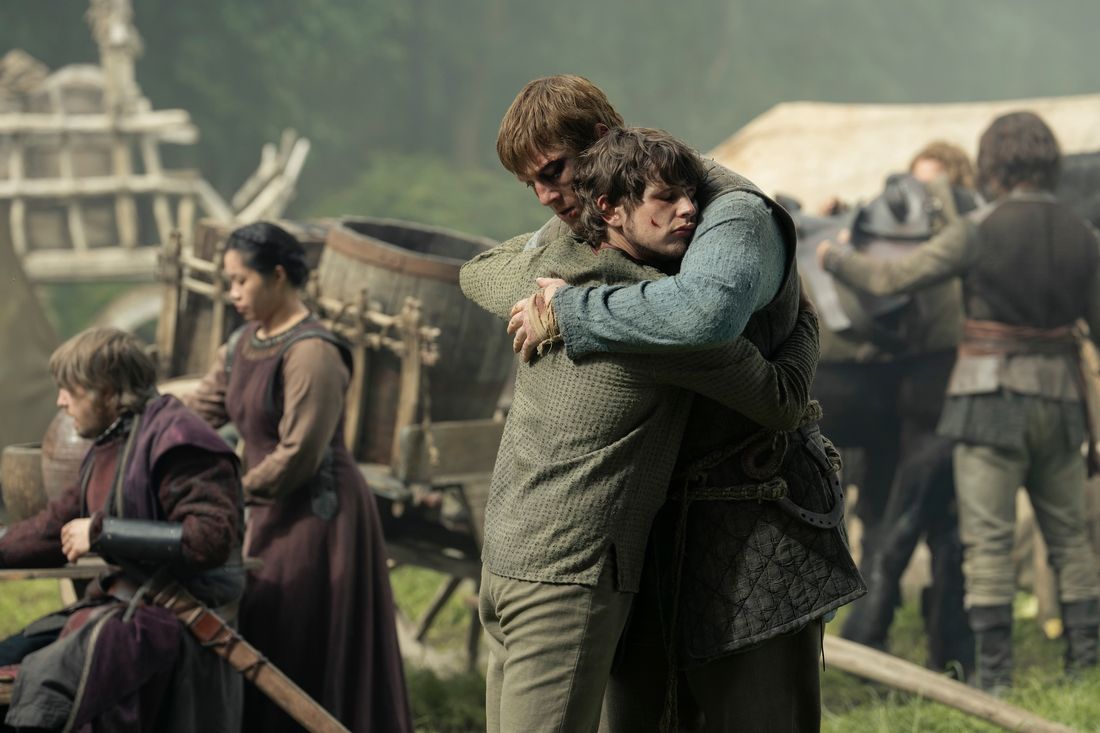
Egg arrives just as Dunk is packing up and preparing to leave. At first, Dunk doesn’t treat Egg like a prince, but rather like a new, inexperienced assistant. However, their friendly relationship quickly returns as they ride off together, trying to decide on their next destination – perhaps Dorne, known for its entertaining puppet shows.
The story wraps up nicely with Egg playfully correcting that Westeros actually has nine kingdoms, not seven, which is reflected in the new title card: “A Knight of the Nine Kingdoms.” This ties in surprisingly well with the closing credits song, the working-class anthem “Sixteen Tons.” Despite having a learned prince as his assistant, Dunk remains a common man, simply trying to improve life in the realm, no matter how large it may be.
A Few Clouts on the Ear
The final scene beautifully shows Ser Arlan’s spirit departing, allowing Ser Duncan to forge his own path and continue the story.
Here’s something to note for the second season: The mid-credits scene shows Prince Maekar didn’t actually give Egg permission to leave with Dunk. While he never directly says ‘yes’ in The Hedge Knight, I don’t want to reveal any future storylines for seasons two and beyond.
A key difference from The Hedge Knight was the storyline about the tournament master trying to rig a jousting match for Dunk. While this plot didn’t really lead anywhere, it served a purpose. It kept the audience wondering how Dunk would do in the tournament, making his eventual arrest even more unexpected. It also highlighted a major theme of the season: the declining morality of the nobility in Westeros, showing they often lack both honor and wealth.
One of the most humorous scenes in the series occurs when Lyonel encounters Duncan’s injuries. After examining them, the Baratheon family’s maester admits he can’t treat them. Lyonel immediately retorts with a crude joke about the maester’s skills, then assures Dunk he’s perfectly alright, dismissing the maester as incompetent.
I’ve noted previously that the TV adaptation of A Knight of the Seven Kingdoms improves on the original story by giving the character of Egg more depth. The same goes for Ser Lyonel and Ser Raymun – they’re so memorable that I’m curious if the showrunners will find a way to include them in season two, even though they don’t appear in the novella The Sworn Sword or the third book, The Mystery Knight. Interestingly, none of the scenes featuring these characters in this week’s finale are present in George R.R. Martin’s Dunk and Egg stories either.
Before we wait (hopefully until 2027!) for season two, I wanted to share that The Sworn Sword is my favorite of the Dunk and Egg stories. It has a stronger storyline while still being a fun, relaxed read. However, I’m concerned six half-hour episodes won’t be enough to do it justice. I’m hoping they’ll add more episodes instead of making each one longer. One of the best things about this show is how concise it is – the episodes are perfectly paced and leave you wanting more.
Read More
- Netflix’s Little House On The Prairie Reboot: Release Date, Cast & Everything We Know
- Off Campus Season 1 Soundtrack Guide
- Silver Rate Forecast
- Prime Video’s New R-Rated Spy Thriller Is Officially No.1 On Streaming Despite Poor Reviews
- Gold Rate Forecast
- Brent Oil Forecast
- EUR ZAR PREDICTION
- EUR USD PREDICTION
- KPop Demon Hunters Meets Avatar: The Last Airbender In Netflix’s 3-Part Fantasy Series
- Bulgakov’s Take: Koreans Bet the Farm on Chips, Crypto, and Chaos
2026-02-23 06:56