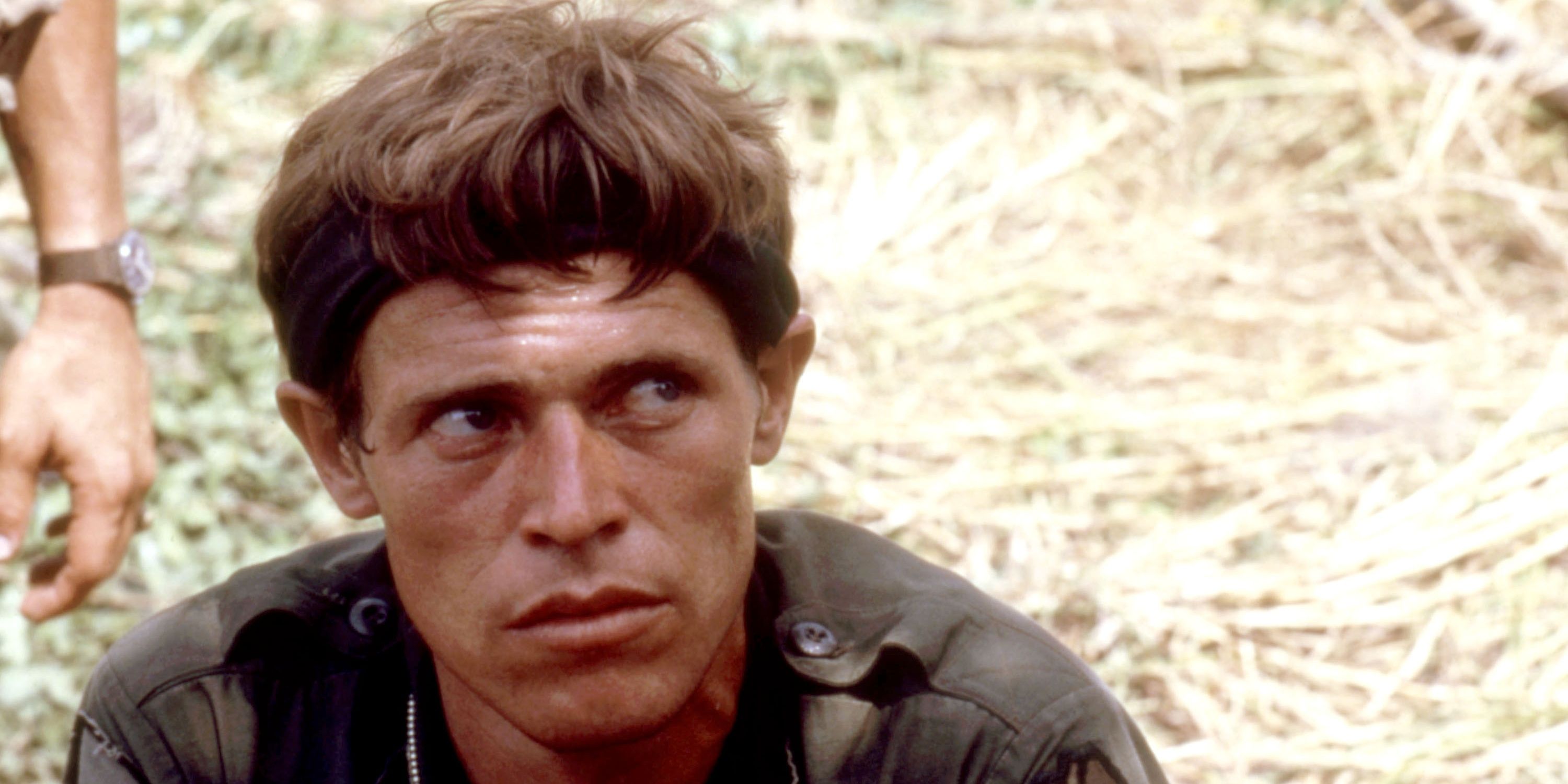
Willem Dafoe has been a familiar face in Hollywood for many years. He’s celebrated for his incredible acting skills, especially his knack for playing captivating and memorable villains, which has earned him fans of all kinds – from those who just enjoy a good movie to serious film buffs. Many know him today as Norman Osborn, the Green Goblin, from the Spider-Man films, but he’s also been in popular franchises like John Wick, The Boondock Saints, Beetlejuice, and even the animated classic Finding Nemo.
Willem Dafoe began his acting career in 1980 with a small, uncredited role in the film Heaven’s Gate. Over the next few years, he steadily gained momentum, and in 1986, he landed a significant part as Sergeant Elias in Platoon, a film about the Vietnam War. This role was a turning point for Dafoe, establishing him as a serious talent in Hollywood.
Platoon is an Anti-War Film Based on the Director’s Personal Experiences
Oliver Stone wrote and directed Platoon, drawing on his own time as an American infantryman in the war. This personal connection makes the film particularly powerful in showing the brutal realities of combat through the eyes of a soldier questioning the purpose of the war. The film is part of a trilogy completed by Born on the Fourth of July (1989) and Heaven & Earth (1993), both also directed by Stone.
The film Platoon boasts a strong cast, including Tom Berenger, Willem Dafoe, Charlie Sheen, Keith David, Kevin Dillon, and Johnny Depp. The story centers on Chris Taylor (Charlie Sheen), a new American soldier who finds himself with the 25th Infantry Division, led by the inexperienced Lieutenant Wolfe (Mark Moses). Wolfe depends heavily on the guidance of Staff Sgt. Barnes (Tom Berenger) and Sgt. Elias (Willem Dafoe), the platoon’s squad leader.
Taylor is caught between the conflicting leadership styles of Barnes and Elias. They disagree on everything from how to run the platoon to what’s right and wrong, and even the ethics of the war itself. Barnes is a harsh and unforgiving leader who will do anything to achieve his goals. After a soldier is killed, Barnes loses control and, during a brutal interrogation, publicly murders the wife of a village chief as a warning to the others.
Unlike some of his fellow soldiers, Elias is a gentle and empathetic man who consistently doubts the purpose and violence of the war. He secretly leads a group within the platoon who use marijuana to deal with the stress of combat. Elias frequently intervenes when Barnes and his followers become excessively cruel, such as after Barnes kills the village chief’s wife. He isn’t afraid to challenge authority either, even questioning Captain Wolfe’s inaction when Barnes crosses the line.
Elias serves as the platoon’s moral center, and the soldiers who are decent, compassionate, and level-headed look to him for guidance. As the story progresses, Barnes becomes increasingly concerned that Elias might reveal his crimes – the murder of innocent Vietnamese civilians – which creates a lot of conflict between them. Ultimately, when Elias gets separated from the group, Barnes seizes the chance to shoot him and leaves him to die, falsely telling the others that Elias was killed in action.
Elias’ Death Solidified Willem Dafoe as a Hollywood Legend
Barnes rejoined the platoon to help with the helicopter evacuation after abandoning Elias. He told Taylor that Elias had died in battle, hoping to cover up what he’d done. As the helicopter lifted off, the soldiers were shocked to see Elias appear from the jungle, being chased by North Vietnamese soldiers. It became clear Barnes had lied about Elias being dead, but they were powerless to help him from the air.
Elias desperately runs for his life, fueled by sheer willpower, but he is fatally shot by North Vietnamese soldiers. The scene is incredibly hard to watch, yet strangely captivating – a difficult combination that the film Platoon portrays brilliantly. The focus remains entirely on Elias as he struggles to survive, repeatedly taking enemy fire.
He’s hit, falling to the ground, but Elias fights through the pain and gets back up, determined to keep moving. A second shot brings him down again, but he won’t give up. Ultimately, he’s forced to crawl, desperately trying to escape the soldiers, but there’s nowhere to hide and too many enemies surrounding him. The camera stays focused on him, making the audience viscerally experience every hit he takes.
The sound of the helicopter overhead marks Elias’s final moments. He falls to his knees, reaching for the sky as if hoping for rescue, but ultimately collapses, lifeless and abandoned. This scene evokes a powerful reaction from the audience – screams, tears, and a desperate desire for Barnes to face consequences, as Elias’s fate is directly caused by Barnes’s actions.
The scene is incredibly shocking and emotionally devastating, but understanding the full story behind it makes it even more impactful. Elias represents the film’s moral center – he’s a compassionate character who recognizes the senselessness of war and challenges the unethical actions of his unit. His needless death at the hands of a fellow soldier powerfully underscores the war’s pointless brutality.
Elias never should have been in a war zone, but fate put him there, and his tragic death reinforces how brutal and chaotic war is – a place where terrible people commit even worse acts. The story shows that, with characters like Barnes, it doesn’t matter if someone is an ally or an enemy; anyone who stands in the way will suffer. Willem Dafoe’s powerful acting is crucial to the impact of this scene and the entire story, solidifying its place as a standout within the genre.
Read More
- Netflix’s Little House On The Prairie Reboot: Release Date, Cast & Everything We Know
- Off Campus Season 1 Soundtrack Guide
- YouTuber arrested after viral AI bodycam videos spark real police complaints
- Silver Rate Forecast
- Prime Video’s New R-Rated Spy Thriller Is Officially No.1 On Streaming Despite Poor Reviews
- Brent Oil Forecast
- Gold Rate Forecast
- Bulgakov’s Take: Koreans Bet the Farm on Chips, Crypto, and Chaos
- Peaky Blinders: The Immortal Man’s Tommy Shelby Is a Better Father Than Michael Corleone
- EUR ZAR PREDICTION
2026-02-01 07:39