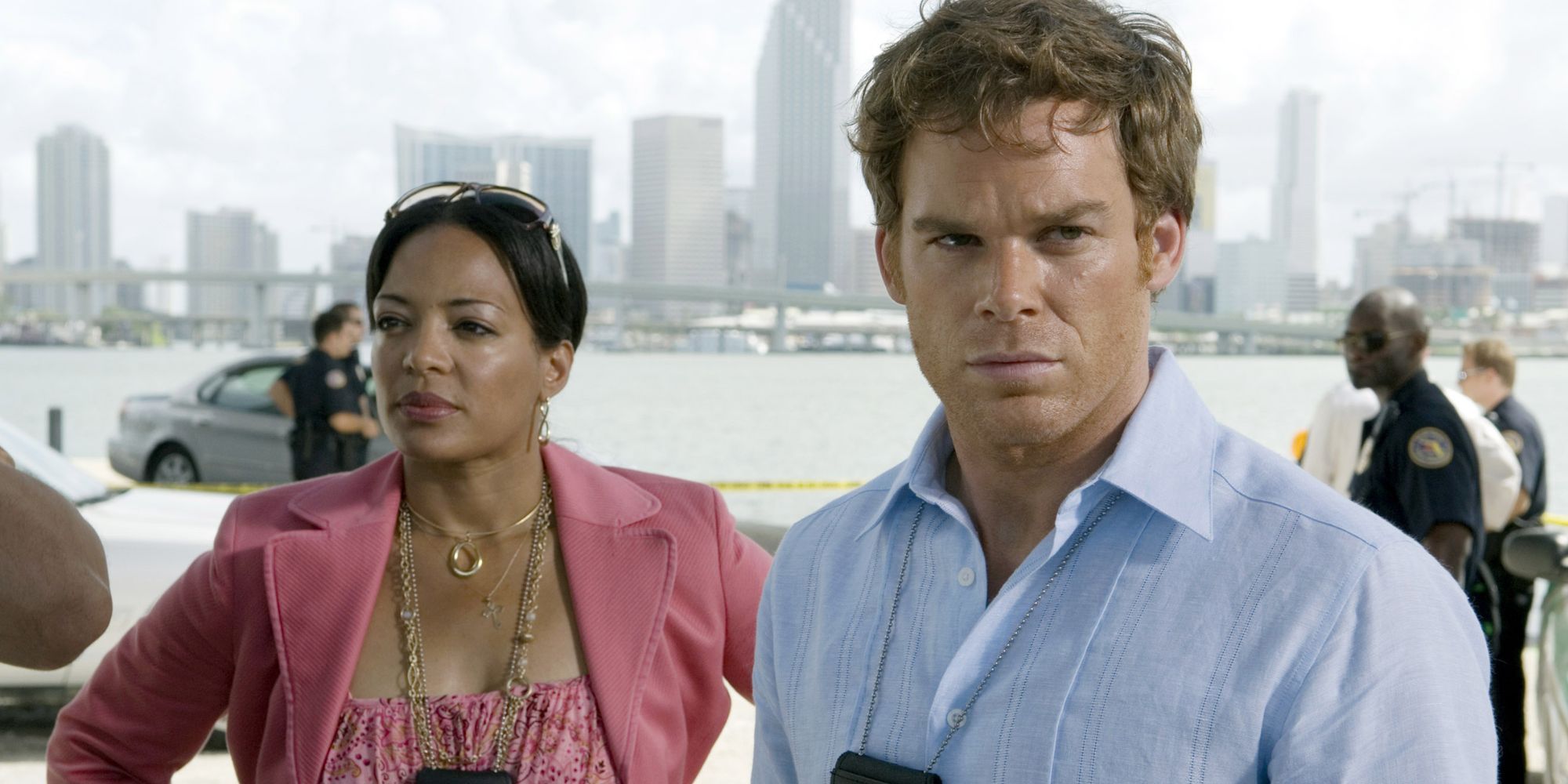
Even though it first aired twenty years ago, the Showtime series Dexter remains remarkably good. Based on Jeff Lindsay’s novels, the show about a killer who targets other killers continues to be a compelling watch. And since it ended in 2013, Dexter has spawned three successful spin-off series.
Even though it was popular, Dexter wasn’t without its flaws. Some aspects, like the technology and dialogue, haven’t aged well and don’t always make logical sense.
Dexter’s Pilot Centered Around a Problematic Work Environment
The first episode of Dexter brilliantly introduced the world of a serial killer who operates as a vigilante, but it’s difficult to watch due to the character of Vince Masuka. Masuka, a crime scene analyst, appears from the very beginning of the show and remains a consistent character throughout the series. Unfortunately, his constant sexual harassment, which wouldn’t be acceptable in today’s work environments, was often played for comedic effect.
During his debut, the character went too far by sexually objectifying the victim of a serial killer. While this might have been seen as stress relief within the context of the job at the time, today’s viewers would likely find it unacceptable in a TV show.
The Flashbacks of “Popping Cherry” Did Not Stand the Test of Time
The title of Dexter‘s third episode, “Popping Cherry,” is immediately unsettling. In this episode, Dexter commits murder for the first time with deliberate intent. He also discovers that Harry’s caretaker is intentionally poisoning him and decides to intervene.
Although the episode is generally good, the flashbacks haven’t aged well compared to today’s TV production standards. Rather than cast a younger actor, the show simply put Michael C. Hall in a wig. Other shows have portrayed this same moment with different actors, which makes these scenes feel strangely unsettling.
Debra Is Highly Unethical In “Easy As Pie”
Dexter is accustomed to the questionable methods of the Miami Metro police, but Deb’s involvement with Anton Briggs, a confidential informant working with Detective Joey Quinn, creates a difficult situation. Confidential informants often lack control over how they’re used, and even though Quinn didn’t officially register Briggs, the police still exploited him.
Deb and Briggs become a couple in Episode 7, but their relationship isn’t equal – she holds more power. Considering current discussions about police behavior, Deb’s actions would likely be heavily criticized today.
Lila Becomes a Stereotypical “Crazy” Female Character In “Morning Comes”
Throughout much of Season 2, Lila provided a unique and compelling viewpoint regarding Dexter. The season delves into his attempts at rehabilitation through a support group. However, things become complicated when Dexter begins a relationship with Lila, as her own mental health deteriorates.
In the eighth episode, “Morning Comes,” Lila deliberately sets her apartment on fire, hoping to manipulate Dexter into staying with her. This act turns her into the season’s antagonist, unfortunately reinforcing the tired trope of a woman driven to extremes by a man. Despite the season’s overall quality, it presented a negative portrayal of its female characters.
Dexter Kills Off Rita In a Dated Plot Twist
The end of Season 4 left viewers reeling. The episode, “The Getaway,” was shocking, not just because Rita died, but how it happened. It initially appears Dexter successfully killed the Trinity killer, but he comes home to the devastating discovery that the killer had already murdered Rita before Dexter even arrived.
Despite the episode being well-received by critics, it still relied on a common trope: killing off a main character’s love interest to drive the story forward. Rita’s death mirrored Dexter’s own birth circumstances, creating a similar origin for their son, Harrison. While her death had a lasting impact on the series, it felt…
Deb’s Love Confession to Dexter Was a Choice
Fans strongly disliked the romantic storyline between Deb and her adopted brother, Dexter. It felt particularly odd given that the actors who played them, Michael C. Hall and Jennifer Carpenter, were themselves married and divorced during the show’s run. Many viewers cherished the sibling bond between Dexter and Deb, and felt the romantic turn was a disappointing betrayal of that relationship.
Since Deb revealed her romantic feelings for Dexter in Season 7, Episode 8, “Argentina,” that storyline has become increasingly awkward for viewers. While premium cable often pushes boundaries, this felt like a step too far for a show where their relationship was best suited as a friendship.
The Series Finale Was Wrong on Many Levels
The series finale of Dexter is widely considered one of the worst in television history. A major point of criticism is Dexter’s decision to leave his son after his sister, Deb, died. Fans were particularly upset by this act of abandonment, especially considering Dexter’s own difficult childhood experience with being left alone.
While recognizing this rejection is harmful, it still doesn’t explain Dexter’s puzzling choice. He essentially turns Harrison into a mirror image of himself, despite desperately wanting to avoid that outcome.
Found an error? Send it so it can be corrected.
Read More
- Off Campus Season 1 Soundtrack Guide
- X-Men ’97 Finally Gave Gambit the Hero Moment He Deserved
- Chainsaw Man Volume 24’s Cover Art Reveals a Brand-New Denji
- 46 Years Later, The Mandalorian & Grogu Answers A Major Empire Strikes Back Question
- HoI4 fans harsh reactions to the announcement of another DLC pack
- 10 Worst End-Game Couples In Sitcom History
- Gold Rate Forecast
- Emily Henry Says to ‘Trust the Vision’ For Beach Read Adaptation
- DoorDash responds after customer uses AI to make food look bad and get a refund
- Katanire’s Yae Miko Cosplay: Genshin Impact Masterpiece
2026-05-05 17:38