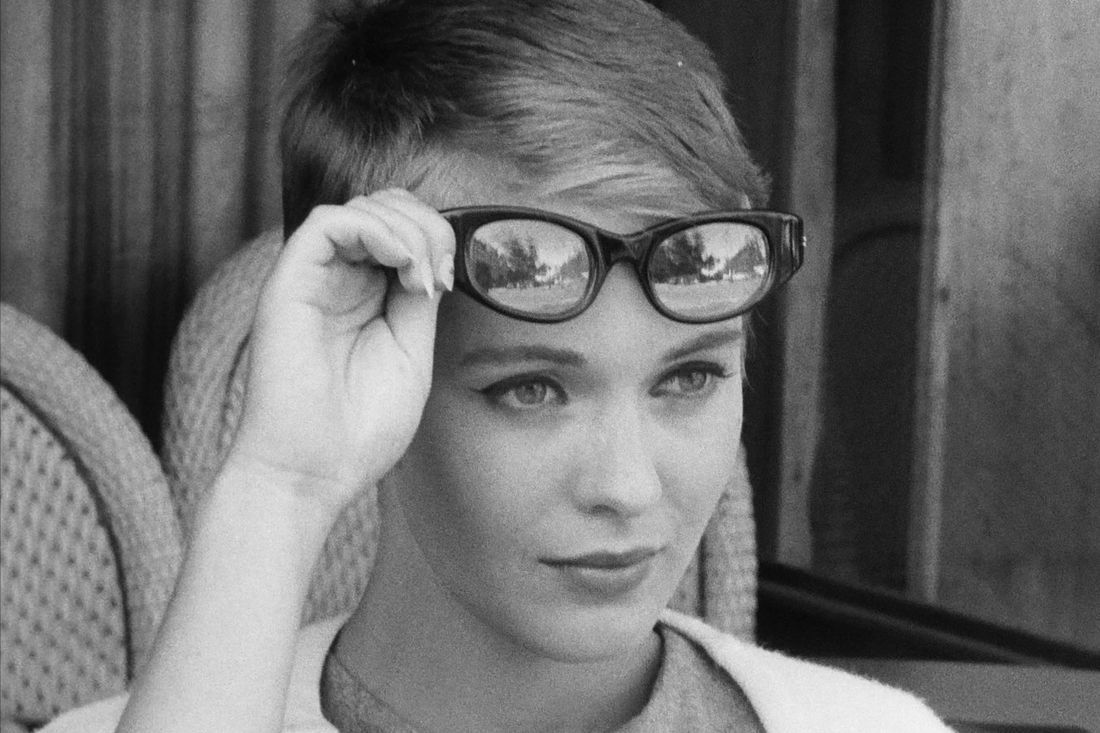
In the final scene of Richard Linklater’s Nouvelle Vague, Jean-Luc Godard (played by Guillaume Marbeck) jokingly asks his friends, “Is it a piece of garbage or a load of garbage?” as they watch his debut film, Breathless. His colleagues, including writer Suzanne Schiffman (Jodie Ruth-Forest) and fellow filmmaker François Truffaut (Adrien Rouyard), pile on with equally critical comments. This moment mirrors an earlier scene where the group mocks a 1959 film after its premiere. Now, they’re playfully criticizing their own work, revealing a bit of uncertainty about what they’ve actually created. Linklater’s film depicts the making of Breathless and pays homage to the groundbreaking French New Wave movement. However, it’s also very much a Linklater film—a story about a group of friends simply spending time together and working on a project.
It’s strangely fitting – and yet unexpected – how perfectly Godard’s first film captures his style. After sixty-five years, Breathless is firmly established as one of the most important and influential works of the 20th century. Though it hasn’t received quite as much formal recognition as Orson Welles’s Citizen Kane (it never ranked among the top ten in Sight & Sound’s prestigious “Greatest Films of All Time” poll, which initially propelled Kane to fame), Breathless is likely the second most significant debut film ever made. It’s a landmark achievement, no matter how you view it. Bernardo Bertolucci famously compared Godard to Christ, suggesting that cinema was fundamentally changed by his work – meaning that everything before Breathless is different from everything after it.
While Breathless wasn’t the film that launched the French New Wave, director Jean-Luc Godard felt he was a bit behind the curve. By the time he started filming, filmmakers like Truffaut and Resnais had already gained recognition with films like The 400 Blows and Hiroshima Mon Amour. Chabrol had even directed two successful movies and helped launch Eric Rohmer’s career. So, why did Breathless have such a strong impact, and why does it still resonate with audiences today? Director Richard Linklater, who extensively researched the film’s production, admits, “I still don’t know.” He adds, “I know more about this film than anyone should. I know every detail – the lenses, the number of takes, even the exact time each shot was filmed. After all our research, I’m even more amazed by it. It shouldn’t work, but it does – it’s a cinematic miracle.”
One of the surprising things about the film Breathless is that it shouldn’t really work, but that’s a big part of what makes it so successful. Film scholar Dudley Andrew explains that the film’s impact came from its sheer boldness and Godard’s willingness to break with filmmaking traditions. Despite the rebellious spirit of the French New Wave, many of its directors ultimately created fairly conventional movies with clear storylines, developed characters, and polished visuals. It’s not surprising that some of them became mainstream. Godard, however, completely disregarded traditional storytelling. Breathless follows Michel Poiccard, a small-time criminal, after he steals a car and accidentally shoots a police officer. The film then depicts his aimless few days in Paris with his girlfriend, Patricia. Instead of a thrilling chase, the film focuses on their casual interactions – lying around, walking the streets, and having random conversations while people around them stare at both them and the camera. The characters lack depth and the film avoids traditional continuity. As Time magazine noted when the film was released, Godard created something like an improvised epic, a stream of images that connect through the logic of a dream.
While many films from the New Wave movement are now considered classics, Breathless still feels remarkably unconventional and daring. According to film expert Andrew, directors like Truffaut worked within established filmmaking processes, while Godard actively rebelled against them. He disregarded traditional budgets and schedules, intentionally doing things differently and shocking audiences. A key example is his pioneering use of jump cuts – abrupt transitions within a single shot – which compressed time, disoriented viewers, and created a uniquely jerky, fast-paced rhythm. Though inspired by a technique used in Jean Rouch’s 1959 film Moi, Un Noir, Godard’s implementation of jump cuts caused considerable chaos during editing. Rumor had it that he was breaking all the rules, leaving people both shocked and apprehensive.
The film Breathless is defined by its rebellious and unconventional spirit. Director Jim McBride, who saw it as a young man, remembers it having a defiant energy. Years later, he directed an American remake starring Richard Gere and Valerie Kaprisky, though he initially didn’t appreciate Godard’s original. He was shocked by its abrupt style, but a second viewing helped him understand and admire the film. At the time, McBride wasn’t planning a career in filmmaking, but the freedom expressed in films like Breathless inspired him to take classes and explore avant-garde and cinema verité styles. This led to his 1967 mockumentary, David Holzman’s Diary, which became a key work in underground cinema. His 1983 remake of Breathless, initially disliked by critics but now gaining a dedicated following, is a wild and stylish film – a stark contrast to the more raw and understated approach of Godard’s original.
The early films of Truffaut and Resnais were brilliant, but Godard’s Breathless felt different. It wasn’t polished or overly serious; it had a raw, energetic quality, almost like a home movie made with friends. This accessibility is likely why it inspired so many aspiring filmmakers. If the New Wave movement aimed to make cinema feel modern, vibrant, and human, Breathless perfectly embodies that spirit – it feels genuinely handmade. Director Richard Linklater recalls using a quote from Godard while filming his first feature, Slacker, and even included it later in Nouvelle Vague. The quote goes: “Someone asks Godard what he’s filming, and he replies, ‘A documentary about Belmondo and Seberg acting out a fiction.’ I told my actors on Slacker they were playing themselves within a fictional scenario. I didn’t use a traditional script, just notes, and realized, That’s a great way to work.”
While Breathless is well-loved, many Jean-Luc Godard fans actually prefer films like Contempt (a personal favorite, along with Passion), Vivre Sa Vie, or Week-end. Pierrot le Fou came closest to making the Sight & Sound Top Ten, nearly breaking into it in 1972. Interestingly, Breathless isn’t entirely typical of Godard’s work. It doesn’t feature his frequent collaborator Anna Karina, and lacks the experimental structure, on-screen text, and strong political themes that define much of his other films. Perhaps this uniqueness is part of its appeal. Similar to how Citizen Kane gained prestige because Orson Welles never replicated its impact, Breathless stands out in Godard’s filmography. He never created another movie quite like it.
I always understood Godard’s comment about Breathless – how he thought he was making a tough gangster film like Scarface but ended up with something dreamlike and strange like Alice in Wonderland – to mean he’d accidentally stumbled into something unexpected. But Linklater made me see it differently. Apparently, Godard was intentionally unconventional throughout the whole process. He wasn’t trying to fit into any mold, and he was fully aware of that. A friend of mine who later worked with him told me how incredibly free-form his shoots were. Crews would sometimes wait for days while Godard figured out what he even wanted to film – he just didn’t have a rigid plan!
Despite breaking many of the rules of typical thrillers, Breathless still feels energetic and exciting, though in a completely unique way. It lacks traditional suspense, action, or a strong plot, but we still feel the exhilarating freedom of the main character’s life. We don’t necessarily care about what happens in the story, but the character’s rebellious spirit feels genuine. As Jean de Baroncelli noted in Le Monde, the character isn’t a cold criminal, but a lost young man with a heart and soul – someone relatable enough to evoke sympathy. His flaws – his madness, brutality, cynicism, and even his occasional tenderness – are simply amplified versions of the struggles many young people face, a kind of eternal romanticism. This contrasts sharply with Bosley Crowther’s review in The New York Times, where he described the character as a rude, arrogant, and shockingly immoral criminal, unconcerned with violence or responsibility. However, these seemingly opposite interpretations actually reveal the same thing: both critics were captivated by the character’s unrestrained nature, which ultimately reflects the director Godard’s own bold and unconventional filmmaking style.
Zoey Deutch brilliantly portrays Jean Seberg in Linklater’s film, and Linklater himself is captivated by the chemistry between Seberg and Belmondo, finding them utterly mesmerizing. Seberg’s character, Patricia, is a young American living in France who’s drawn to a charming but flawed man who fancies himself a gangster and is obsessed with Humphrey Bogart. While her performance in Breathless isn’t traditionally polished, it’s remarkably memorable. She clearly struggles with the French language and often seems lost, perhaps even wishing she could immediately contact her agent. But much like Belmondo’s raw energy, Seberg’s endearing awkwardness feels completely natural and is amplified by his charisma. They’re a truly iconic pair, almost like the first couple of modern cinema.
The connection between Michel and Patricia, while seemingly a cultural exchange, is actually a complicated cycle. Michel’s love for American films is surprisingly rooted in his appreciation for classic French cinema. As Andrew points out, the French actor Jean Gabin popularized a cool, tough style in films like Le Jour Se Leve, Pepe le Moko, and Le Quai Des Brumes in the 1930s. This style then heavily influenced Humphrey Bogart in Hollywood. In Breathless, Belmondo deliberately copies Bogart’s signature lip-rubbing gesture. This can be seen as Belmondo taking that persona back to France. At the film’s end, after Seberg betrays him, she calmly performs the same gesture – the very last image of the movie. Is she, in turn, reclaiming it for herself?
The American fascination with the film Breathless might stem from its unique history. Director Richard Linklater was hesitant to remake it, fearing criticism from the French, who felt the film was overly discussed and represented only a small part of their cinematic heritage. He believes they allowed him to proceed because of the weight of the film’s legacy. Interestingly, the French filmmakers of the 1950s and 60s, including those associated with Cahiers du Cinéma, were strong supporters of American cinema and used it to challenge the established French filmmaking style. Breathless itself clearly showcases these American influences, highlighting the movement’s international roots – which perhaps explains its global appeal.
Read More
- United Airlines can now kick passengers off flights and ban them for not using headphones
- Crimson Desert: Disconnected Truth Puzzle Guide
- All 9 Coalition Heroes In Invincible Season 4 & Their Powers
- Mewgenics vinyl limited editions now available to pre-order
- Assassin’s Creed Shadows will get upgraded PSSR support on PS5 Pro with Title Update 1.1.9 launching April 7
- Grey’s Anatomy Season 23 Confirmed for 2026-2027 Broadcast Season
- Viral Letterboxd keychain lets cinephiles show off their favorite movies on the go
- Does Mark survive Invincible vs Conquest 2? Comics reveal fate after S4E5
- How to Get to the Undercoast in Esoteric Ebb
- Crimson Desert Guide – How to Pay Fines, Bounties & Debt
2025-12-04 21:57