Big game updates always get players talking! As soon as the servers are back up, online communities like Discord and Reddit fill with quick reactions, funny memes, and lively discussions. While it might seem like everyone is complaining, this intense reaction actually shows how much players care about the game. It’s easy to care a lot about something, and much harder to simply not care at all. Sharing these experiences – whether it’s getting excited about improvements or upset about changes to favorite strategies – is what builds a game’s community and helps it evolve.
Key Takeaways
- Channel your frustration into feedback: Passionate player reactions are a sign of an invested community, providing developers with the crucial information they need to balance and improve the game.
- Treat every update as a new challenge: Learning to adapt to a shifting meta pushes you to master new strategies and skills, ultimately making you a more versatile and resilient player.
- Form your own opinion first: Before getting swept up in the online debate, give yourself time to actually play the update and decide how the changes feel to you, as your personal experience is what matters most.
Why Do We Love to Hate Game Updates?
Whenever a big update drops for a game, things quickly get interesting. One moment you’re excited to see what’s new, and the next you’re reading complaints online about changes to weapons or maps. This emotional swing is something most dedicated gamers know well – we get frustrated, voice our opinions, but still keep coming back. What is it about the games we love that creates this pattern?
Honestly, a big reason these game updates hit so hard is because we get invested. I mean, I’ve spent countless hours learning every little thing about my favorite characters or tweaking my perfect loadout in Warzone. So when things suddenly change, it feels like all that effort was for nothing! It messes with the comfort and skill I’ve built up. But it actually shows how much I care about the game, you know? I saw one player describe a tough update as “absolute suffering,” but then said they still loved it! That’s what keeps me coming back – that weird mix of frustration and genuine love for the game.
Honestly, as a fan, one of the coolest things about big game launches is how we all experience it together. It’s like when something goes wrong – everyone’s on Discord or Twitter letting off steam, and it actually brings us closer. We’re all bonding over the same issues, turning individual frustrations into a big group chat. It’s more than just complaining, though! The developers actually listen to what we’re saying, using our feedback to improve the game with each update. It’s a cycle where we react, they adjust, and hopefully, the game gets better for everyone. And if I’m being real, a little bit of drama just makes it all more exciting!
The Thrill of a Tough Fight
Okay, let’s be real – I get super annoyed when a game update makes things harder, but honestly, it’s because I like a challenge. I mean, who doesn’t remember that feeling of finally taking down a boss after days of trying? Or nailing that perfect shot after so many fails? It’s frustrating, yeah, but that feeling of accomplishment is what keeps me hooked. When developers drop a big update, they’re basically giving us a new, tougher goal. They’re tweaking weapons, changing how the game is played, or adding stuff that forces me to learn new strategies. It messes with my comfy routines, but that’s often a good thing!
When a game changes – like when your favorite weapons become less powerful or enemies get smarter – it can be frustrating. It feels like your skills aren’t enough anymore, and old strategies don’t work. But that frustration is actually a good thing. It pushes you to learn, improve, and find new ways to win. We might initially get angry about these changes, but eventually, we start to appreciate the new challenge. We’ll complain and share our struggles, but we keep playing, determined to figure things out. This cycle of difficulty and eventual success is what makes gaming so rewarding. The real fun isn’t just about winning; it’s about conquering something that seemed impossible at first.
Why We Crave a Good Challenge
We don’t usually choose the easiest option when playing games because a good challenge is truly captivating. It draws us in, creating a feeling of complete focus – almost like everything else disappears. This intense engagement, sparked by difficult opponents or puzzles, is much more rewarding than simply watching something. It taps into our natural desire to compete, to push ourselves, and to see what we’re capable of. Ultimately, a worthwhile challenge acknowledges our skills while still asking us to grow.
The Sweet Satisfaction of Victory
There’s a wonderful feeling when you overcome a tough challenge. It’s not just happiness – your brain actually releases dopamine, a chemical that makes it feel incredibly rewarding. This is why winning can be so addictive! But more than that, achieving something difficult gives you a real sense of pride and accomplishment. You didn’t just get lucky; you succeeded because of your skills, hard work, and determination. That feeling of truly earning your progress is what makes all the effort worthwhile, turning frustration into a triumphant story. It’s what makes victories memorable – like finally beating that incredibly difficult level you’ve been stuck on.
The Emotional Rollercoaster of a Major Patch
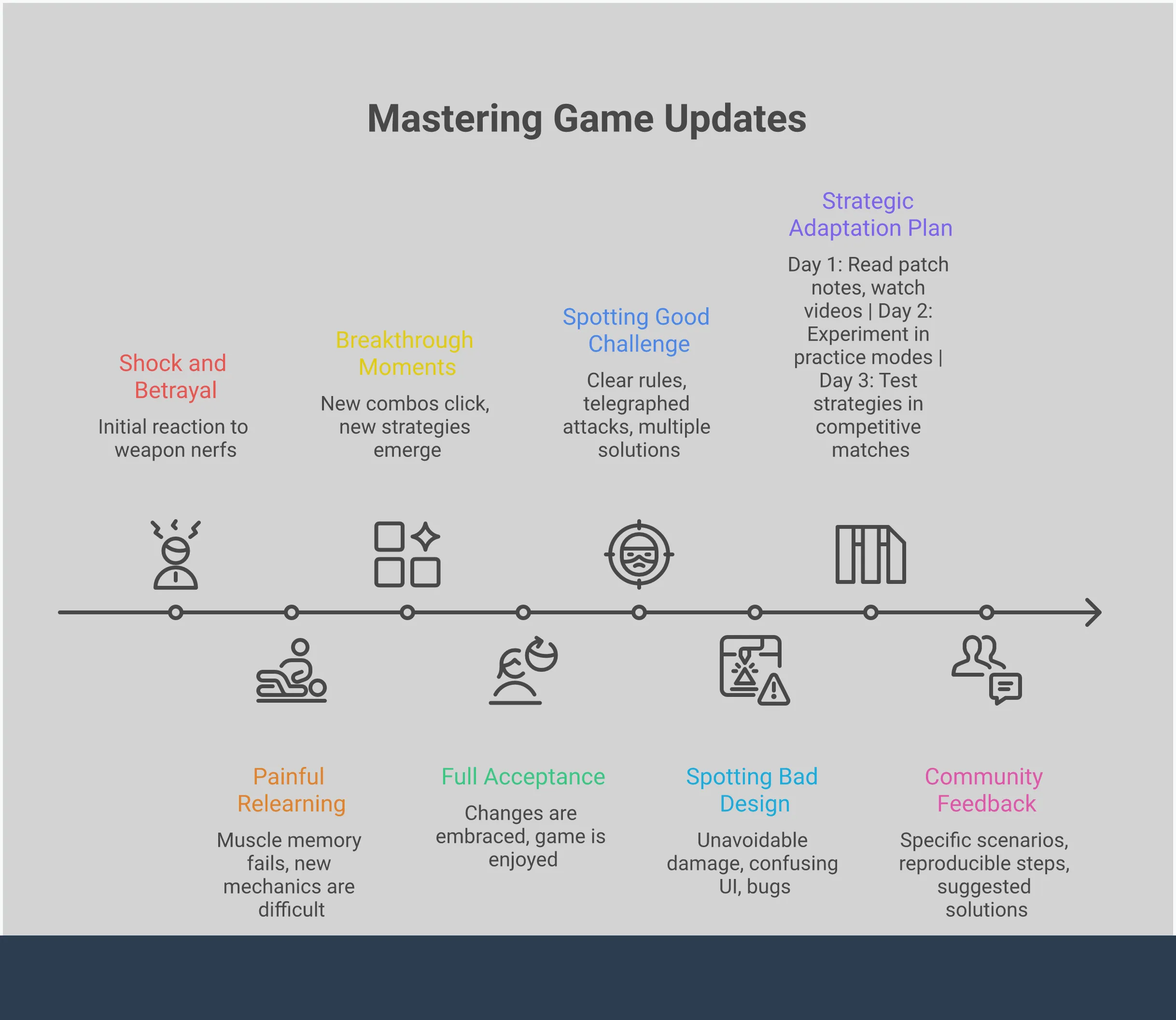
Most dedicated gamers have been there: you excitedly log in after a big game update, eager to play, but everything feels unfamiliar. Your favorite weapons handle differently, the game world has been redesigned, and there’s a lot to learn. It’s a disorienting experience that usually leads to a specific series of feelings, following a common four-step pattern.
It’s a common experience for gamers to initially react with frustration to changes in a game, but eventually come to accept – and even appreciate – the new way things are. We’ve all likely complained about a character being weakened or struggled with a redesigned area. However, this cycle of upset and adaptation is actually what keeps games engaging. It pushes us to learn new tactics, adjust our playstyle, and rediscover our love for the game. It’s a messy, annoying, yet ultimately rewarding process that transforms familiarity into a fresh challenge. Let’s explore this familiar gamer experience, step by step.
Stage 1: “They Changed WHAT?!”
Okay, so you just jump into a new patch, right? And immediately, your brain just…stops. It’s that feeling when you read the notes (or just ignore them and learn the hard way) and realize the thing you loved about your character? Totally gutted. Everything feels different, nothing works like it used to. Honestly, it’s a mix of being totally lost and feeling kinda betrayed. I remember one update where someone described it as ‘absolute suffering,’ and that’s so accurate. You’re trying to do things the old way, your hands just automatically go for what used to work, and it’s just…not there anymore. It’s a real loss, and everyone’s venting about it online – forums, Twitter, everywhere. It’s just raw, unfiltered reaction at that point.
Stage 2: The Painful Learning Curve
After the initial surprise fades, the true challenge starts. You’ll need to break old habits and completely relearn how to play. Expect to struggle with new enemies, confusing interfaces, and feeling like a novice again. It’s often frustrating, and you might even question the game’s changes. Each update brings fresh hurdles, requiring you to try out different strategies and equipment just to keep up. This is when you’re likely scrambling for online guides on the latest optimal setups or asking others for help with new boss battles.
Stage 3: Finally Getting the Hang of It
After a lot of practice and problem-solving, everything suddenly makes sense. You finally master a new move, find the best sequence of actions, or realize how different abilities work well together in the updated system. The initial frustration fades, replaced by a feeling of satisfaction. This is when things ‘click’ and you start to understand the reasoning behind the changes. It takes time to adjust, but as you become more comfortable, you begin to enjoy the added layers of strategy and detail. This is also when valuable feedback from players really starts to show results, because your experience starts to match what the developers were aiming for.
Stage 4: Appreciating the New Normal
Over time, the changes become essential to the game, feeling completely natural and integrated into how you play. You might even realize the game is improved! The update has revitalized the world, offering new challenges and possibilities. This stage is about appreciating how far the game has come – it’s a constant process of getting better and preventing things from becoming repetitive. You begin to notice the finer details, like how well the music complements the new areas, and feel prepared for future content.
The Dev’s Dilemma: Balancing Fun and Frustration
Every time a game update feels frustrating, remember there’s a development team trying to strike a delicate balance. They want to keep the game exciting by adding new challenges, but it’s easy to cross the line between difficult and unfair. Developers understand that changing a game is risky – they need to innovate without upsetting players who already enjoy it.
The difference between a great game update and a terrible one often comes down to balance. When something feels too hard or a favorite item is weakened too much, it’s tempting to think the developers don’t understand the game. But usually, they’re intentionally trying to challenge us, encouraging us to find new ways to play and experience the satisfaction of learning something new. Their biggest task is ensuring that the difficulty feels rewarding, so initial annoyance transforms into a feeling of genuine achievement.
How to Make a Challenge Feel Fair
A satisfying challenge feels respectful of your abilities and time. Think of it like a boss in Diablo 4 where you can learn to avoid attacks – it’s different from an enemy that just hits you with unavoidable damage. When a challenge feels fair, you know any failures are due to your own actions, meaning you can improve, adapt, and try again. The rules are clear, and success is possible. But unfair challenges feel arbitrary and frustrating. They depend on luck or punish you with things you can’t react to, turning what could be fun into a discouraging obstacle that makes you want to quit.
Using Player Feedback to Make Things Better
Developers pay close attention to what players are saying online – in places like Reddit and Discord – after a game update. While they can’t fix everything immediately, community feedback is crucial for understanding what’s successful and what needs improvement. This feedback loop is a key part of making games, helping developers see issues from many different viewpoints. Whether you report a bug or share a funny observation, your input helps them refine the game and create an experience players will enjoy.
When Devs Finally Fix What’s Broken
It’s incredibly rewarding for developers when they resolve a significant issue that players have been vocal about. Seeing patch notes acknowledge and address player concerns feels like a real win. The most successful developers are open about why they make changes – whether it’s balancing a character or squashing a bug. This transparency is crucial for building trust and demonstrating a commitment to the game’s future. When developers actively listen to and use player feedback, it transforms a negative experience into a positive, collaborative effort to improve the game for everyone.
Why a Little Controversy Can Be a Good Thing
It may seem counterintuitive, but strong reactions from players after a major update aren’t necessarily a bad thing. While developers don’t want to upset their community, lots of discussion – even angry comments online – can actually show that players are deeply invested in the game. Consider this: people don’t get upset about things they don’t care about. If an update comes out and no one reacts at all, that’s a much bigger problem.
Look, as a gamer, I’ve seen it a million times: when something causes a stir, that’s when the real talk starts, and that’s a good thing. It makes both us players and the devs really think about what’s working and what’s not. Like, is this new overpowered strategy actually fair? Does this update feel like a slap in the face to all the hours I’ve put in? That first wave of angry comments? It’s usually the first step towards making the game even better. It’s a bit of a chaotic process, sure, but it ultimately makes the game – and the community around it – stronger.
Passionate Reactions Mean Players Care
Look, when I get really upset about a change to a gun I love or a map I’ve spent ages learning, it’s not just me being a whiner. It means I care about the game, you know? I’ve put so many hours into mastering everything, figuring out the best gear, and just having fun in that world. When I get mad, it’s because I want the game to be as good as it can be. Honestly, that passion – even when it’s expressed as anger – is super valuable to the developers. It shows them what we, the hardcore players, really care about. A silent community is a dead community; a loud one is one that’s still alive and invested.
Short-Term Pain for Long-Term Gain
Okay, so when a big update drops and it’s… controversial? Man, that first week is brutal. Everything feels off, my hands are doing what they used to, but it’s wrong now, and I seriously question the devs’ life choices. But honestly, that initial rage? It’s kinda necessary. We players basically become a giant, free QA team, finding all the bugs, glitches, and balance issues the developers missed. It’s painful in the short term, but it leads to a way better game. That version you’re playing a month later? It’s usually way more polished and balanced, all thanks to those of us who stuck it out through the initial chaos.
The Loud Critics vs. the Quietly Satisfied
In gaming communities, the most vocal players often get the most attention. While it’s tempting to ignore them, these players are usually the first to find problems with new updates – things like glitches or unfair gameplay. Their detailed feedback can be incredibly helpful for developers. However, it’s important to remember that many more players are quietly enjoying the game. The trick for developers is to carefully consider the valid concerns of critical players while also keeping in mind what the majority of players want. Striking this balance is essential for making improvements that benefit everyone.
Is It a Challenge or Just Bad Design?
Whenever a big update comes out for a game, players always wonder if the new additions are genuinely challenging or just poorly designed. There’s a difference between a difficult but fair experience that helps you improve, and frustrating elements that feel like a waste of time. A good challenge acknowledges your effort, has understandable rules, lets you get better with practice, and rewards you for overcoming it. While it might be frustrating at times, you can see how to improve and want to keep trying. This kind of difficulty feels purposeful and ultimately enhances the game.
Poor design feels frustrating and obstructive. Think of a difficult, poorly-made interface that makes simple tasks annoying, or a weapon that’s been weakened to the point of being ineffective. These aren’t challenges that test your skills—they’re just irritating obstacles. Strong reactions from players often come down to this: they can quickly tell when a developer is trying to improve the game versus when they’re just adding unnecessary difficulty. Knowing the difference is crucial for deciding if an update improves the game or if it’s time to move on.
Purposeful Difficulty vs. Annoying Roadblocks
There’s a big difference between challenging gameplay and frustrating obstacles. Good difficulty encourages you to improve and adapt, like when a game update makes you rethink your strategy. It’s tough, but rewarding as you learn new techniques. However, pointless roadblocks – like confusing crafting systems or game-breaking bugs – don’t test your skills, they just waste your time and can make you want to quit playing altogether.
A Clear Path Through the Chaos
Even a big, complicated update should guide players towards what to do next. A good challenge, even if it’s hard, provides hints to help you overcome it. It’s okay to fail at first—each attempt should teach you something. This is similar to how a good game responds to your actions: you try something, the game reacts, and you learn from that reaction. When developers do this well, the game feels balanced and enjoyable. But if an update leaves you lost and unsure of what to do, that’s usually a sign of poor design. A challenge that doesn’t offer clear direction isn’t satisfying—it’s just frustrating and feels like a waste of time.
When the Grind Is Actually Worth It
Most games require players to repeat certain tasks, but the key is whether that repetition feels good or frustrating. A satisfying grind has a clear, worthwhile goal – like unlocking a cool item or a powerful upgrade that improves how you play. If the reward is good and the tasks aren’t too repetitive, it can actually be enjoyable. However, when you’re stuck in a boring loop with a disappointing reward, it feels like the game is artificially extended instead of offering genuinely fun experiences.
Don’t Let the Hype (or Hate) Ruin Your Fun
After a big update to a game, it’s common to get caught up in the flood of reactions from other players. You might start eager to try it out, but quickly find yourself reading complaints about changes to things you love. Whether people are extremely excited or incredibly upset, all that online discussion can shape your opinion before you’ve even had a chance to play the game yourself.
Remember what makes playing enjoyable for you – that’s the most important thing. While it’s nice to be part of a community and see how others react, don’t let their opinions ruin your fun. You can participate in discussions without letting them get you down. It’s all about finding a way to enjoy the game with others while still protecting your own happiness.
The Power of Shared Struggles
It’s funny how people bond over shared frustrations, like when a game gets weaker or has glitches. Talking about these issues with friends or online isn’t just complaining – it’s a way for players to work through changes together and shows how invested they are. This passion is actually really valuable for game developers, as it provides them with direct feedback to improve their work.
All the feedback—even the strong reactions—isn’t meaningless. It provides valuable information to game developers, helping them improve the game with updates. When players express passionate opinions, it usually comes from a place of caring deeply about the game.
How to Tune Out the Social Media Noise
Sharing frustrations with others can be helpful, but it’s easy for those conversations to become overly negative and reinforce bad feelings. If you’re finding constant complaining on platforms like Twitter or Reddit is bringing you down, it’s okay to take a break. You don’t have to follow every argument to stay up-to-date. Instead, try getting information directly from official sources, like developer blogs or game update notes. These sources explain why changes are made, something you often won’t find in angry online posts.
Think about who you talk to about the game. Joining a smaller Discord server or just chatting with your friends can make for better discussions, since you’ll avoid getting lost in a lot of random opinions.
Why You Should Form Your Own Opinion
In the end, what you think is all that matters. Just because someone popular says something isn’t good doesn’t mean it won’t work for you. Don’t dismiss something until you’ve tried it yourself! Before deciding you dislike a change, really give it a chance – spend a few hours playing and see how it feels to you.
What you think about the game really matters! Developers aren’t just listening to the most vocal players – they’re looking at how everyone plays and considering all kinds of feedback to constantly make the game better. Your own opinion is valuable, so don’t be afraid to try out the new update and decide what you enjoy for yourself.
Give It Time: Why First Impressions Aren’t Everything
It’s frustrating when a game update weakens a weapon you love, making it much less effective. Most of us have felt that disappointment. We naturally dislike changes, especially when they disrupt something we’re good at or a strategy we’ve worked hard to master. It can feel like the game is taking something away from us personally.
It’s easy to get frustrated with game updates at first, but that initial reaction doesn’t always give the full picture. Major updates are planned with the game’s future in mind, and what seems like a downgrade can actually be a helpful change for its long-term health. It’s best to give updates a chance before dismissing them entirely. You might even find that the changes you disliked most are what ultimately revitalize your enjoyment of the game – just in a new way.
How “Ugh, This Is Awful” Becomes “Oh, I Get It”
The initial day after a big game update is always rough. Online forums and social media explode with complaints that the game is ruined. However, after a few days, something shifts. Players start to move past their frustration and become curious. They begin to test out the new features and discover unexpected possibilities. That ability everyone thought was worthless might actually be key to a strong strategy. A weapon weakening that seemed disastrous can lead you to find a different, surprisingly effective gun. This is when the mood changes from “this is terrible” to “okay, I see what they did.” It’s the realization that the developers didn’t just remove things you liked; they created a new challenge to overcome.
First Reactions vs. Lasting Value
It’s common to react strongly to game updates, and online, the most vocal feedback is often critical. But developers are focused on the bigger picture. They analyze data and plan for the long-term health of the game, sometimes months or even years ahead. A change that feels frustrating now might actually be necessary to keep the game fresh and enjoyable in the future. Their priority is lasting quality, and that occasionally means making tough choices that aren’t popular right away, all to ensure a balanced and fun experience for all players.
Seeing the Big Picture Through the Frustration
Okay, so when a game changes something that directly messes with how I play, my first reaction is usually frustration, let’s be real. But I’ve learned to take a breath and try to figure out why they made the change. Was one strategy just too powerful and ruining the game for everyone else? Are they trying to get us to mix things up and try different approaches? Adapting to a new meta is tough, no doubt, but it’s also a chance to get better. Like, after a big weapon update in Warzone, I have to rebuild my loadouts – that’s a skill in itself! It forces you to really understand how the game works at its core, and it makes you a much more well-rounded player in the long run.
How to Survive (and Thrive) After a Big Update
A big new update has arrived, and suddenly, your familiar game feels completely different. Your go-to strategies might not work anymore, the map has changed, disrupting your usual routes, and everything you’ve practiced feels off. It’s tempting to get frustrated and complain online, and many of us have felt that way. But before you give up, remember that dealing with a major update is a challenge in itself. It’s a test of how well you can adjust and stay patient – something that truly separates experienced players from those who get easily discouraged.
Instead of getting upset when game developers make changes, try seeing it as a chance to improve your skills. It’s not just about dealing with the changes, but about finding ways to succeed in the new version of the game. This means being patient with yourself, looking for the positive aspects, and remembering to take breaks. Try shifting your mindset from thinking, “They ruined my game,” to asking, “How can I master this new situation?” While it can be annoying, this is where you really grow as a player. You’ll learn to adapt quickly, try new tactics, and become a more well-rounded player. Let’s create a plan to help you handle these changes and maybe even rediscover your enjoyment of the game.
Give Yourself Time to Adapt
It’s normal to feel lost when something major changes, like after a big update to a game. Just like when you were first learning, don’t expect to master it immediately. Allow yourself time to adjust, make mistakes, and learn how things work. Developers provide detailed update notes because there are often many changes to understand. Take it slow, read about what’s new, and practice in a relaxed environment to get comfortable before jumping into serious play. It takes time to understand the new strategies, so be patient and give yourself a chance to adapt.
Find Ways to Grow from the Challenge
It’s common to feel frustrated when something you like gets weakened, but what if you saw it as a chance to learn and try different things? Each game update gives you an opportunity to become a more versatile player. Maybe a weapon you’ve never used is now the strongest choice, or a previously overlooked ability is suddenly very effective. Top players use these moments to get a head start. Think of it as a constant process of getting better – the game changes, and you should adapt too. Instead of resisting updates, embrace them. Try new things, learn from skilled players who are adjusting quickly, and discover the best new strategies before others do.
Know When to Push Through and When to Log Off
Everyone has days where they just don’t feel up to playing, and that’s perfectly normal. It’s easy to slip from being challenged to feeling incredibly frustrated. If you’re getting overly upset and not improving, it’s a good idea to take a break. Playing while angry will likely lead to exhaustion. Try stepping away to do something relaxing, like watching a film or playing a different game. Whatever you’re working on will still be there later. Planning when to play intensely and when to rest is crucial for enjoying the game long-term and preventing burnout when things get tough.
Related Articles
- Deus Ex LFG: Connect with Other Augs in LFG Feature on Z League App
Frequently Asked Questions
Ever notice how even small changes to a game can feel really upsetting? When you’ve spent a lot of time learning a character or strategy, it feels personal. An unexpected update can feel like someone messed with something you’ve carefully built and perfected. It’s not just about the gameplay itself – it’s about feeling like your skills and comfort are being taken away. That strong reaction shows just how much effort and enjoyment you’ve put into the game.
It’s natural to wonder if sharing complaints about game updates is helpful or just negative. But expressing your opinion can actually be a good thing. Talking with other players about issues creates a sense of community and lets you know you’re not alone. Developers also use this early feedback to understand what’s working well and what needs fixing. As long as you focus on the game itself and avoid personal attacks, you’re helping to make it better.
It can be tough to know if a game update is genuinely challenging or just poorly designed. A good challenge is difficult but feels achievable – you can improve, and when you stumble, you understand why. It acknowledges your abilities and rewards learning. Bad design, however, feels frustrating and unfair. Think of confusing interfaces, sudden, unexplained difficulty increases, or glitches that make things feel cheap. Essentially, a good challenge tests your skill, while bad design just tests how much you can tolerate.
This recent update has made me feel like I’m starting from scratch. What’s the best way to get back up to speed? First, accept that it’s okay to feel confused at first. You won’t master everything immediately. The best thing to do is approach it like learning a new game. Practice in a safe environment – like training mode or casual matches – to try things out without worrying about losing. Don’t be afraid to experiment with weapons or tactics you haven’t used before. This is a great opportunity to learn what’s strong before others do and get a competitive edge.
It’s discouraging to see so much negativity online after a game update. If it’s affecting your fun, it’s okay to step away from social media. Focus on official updates from the developers, or find a friendlier community to chat with. The best way to decide if a change is good or bad is to try it yourself – you might even end up liking something everyone else dislikes!
Read More
- United Airlines can now kick passengers off flights and ban them for not using headphones
- Solo Leveling’s New Manhwa Chapter Revives a Forgotten LGBTQ Story After 2 Years
- The Boys Season 5 Spoilers: Every Major Character Death If the Show Follows the Comics
- Grok’s ‘Ask’ feature no longer free as X moves it behind paywall
- ‘Timur’ Trailer Sees Martial Arts Action Collide With a Real-Life War Rescue
- How to Get to the Undercoast in Esoteric Ebb
- TikToker’s viral search for soulmate “Mike” takes brutal turn after his wife responds
- Invincible Season 4 Episode 6 Release Date, Time, Where to Watch
- All Itzaland Animal Locations in Infinity Nikki
- Nintendo Officially Rewrites Princess Peach After 41 Years
2026-03-03 13:51