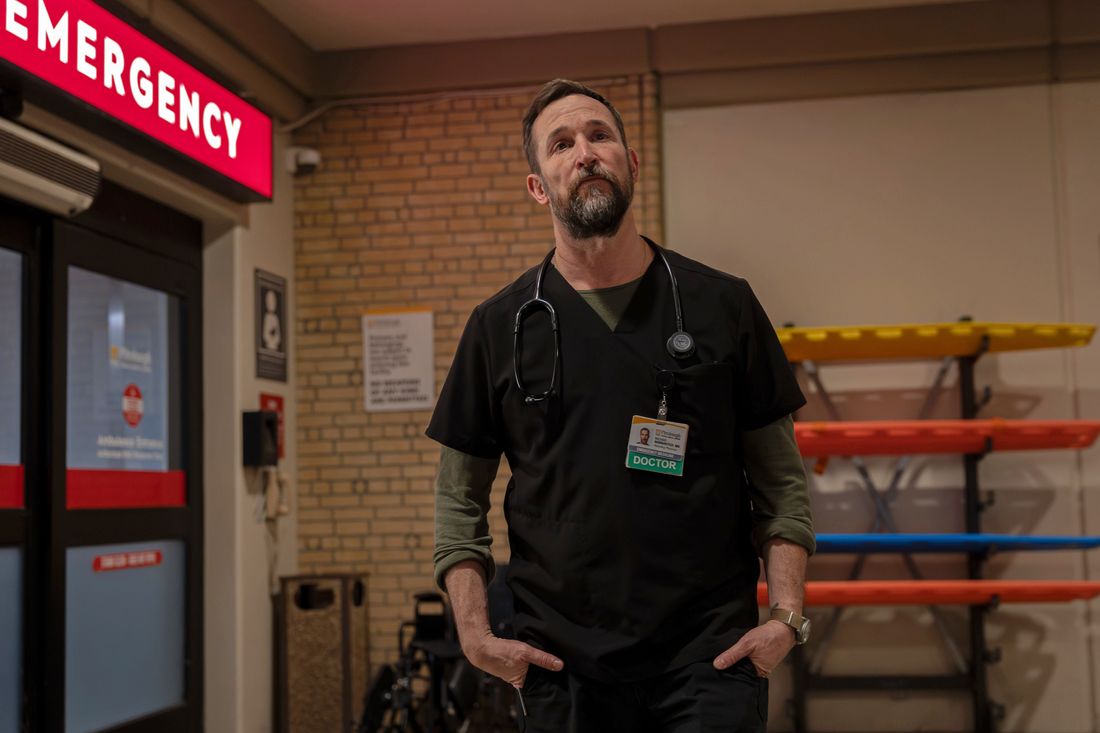
Spoilers follow for the second season of The Pitt through finale “9:00 P.M.”
The day after winning a Golden Globe, the team behind the show The Pitt was preparing for a particularly intense scene: an emergency C-section. They were filming the season finale and needed everything to look incredibly realistic. The scene involved a woman experiencing a life-threatening complication called eclampsia, and who hadn’t received any prenatal care. The props team was busy filling a detailed prosthetic uterus with white vinegar. Nearby, they arranged the other props – the uterus, umbilical cord, and a silicone baby – for the scene. The baby, laid in a disposable aluminum pan, was being prepped with a mixture of whipped cream cheese and a special red gel to simulate birth. The makeup artists then carefully inserted the baby feet-first into the prosthetic uterus, essentially performing a birth in reverse for the cameras.
Noah Wyle, an executive producer on the show and recent Golden Globe winner, noticed my amazed reaction as a remarkably lifelike baby doll was placed inside a plastic womb and filled with a fluid mimicking amniotic fluid. He asked if I was a mother, and I told him I had two daughters. I was relieved their births hadn’t been as dramatic as this scene. Wyle then shared a funny story about an anesthesiologist at his child’s birth being starstruck by the doctor who played Dr. Carter on ER, which briefly worried him about the epidural. Later, he showed me a side-by-side comparison: on one side, him in a tuxedo with his Golden Globe, and on the other, him in scrubs, covered in fake blood, holding the silicone baby – photos taken just twelve hours apart.
The first season of The Pitt was a huge hit, bringing back the popular medical drama format that hadn’t captivated audiences and critics in over ten years. It successfully updated a familiar TV style for streaming viewers. Anthony Wyle, known for his 13 seasons as John Carter on ER, now plays Dr. Michael “Robby” Robinavitch, a tough but just attending physician leading a team through a busy emergency shift. The show carefully introduced its many new characters, like Dr. Mel (Taylor Dearden) who cares for her sister, and the ambitious Dr. Santos (Isa Briones). A dedicated online fanbase quickly developed, focusing on details like Dr. Robby’s glasses and relationships between the show’s large cast. The season received numerous awards, including an Emmy for Best Drama and a SAG Award for Best Ensemble.
The biggest challenge for the show The Pitt in its second season was maintaining momentum without repeating the intense, high-stakes drama of the first season. After a shooting at a music festival left the emergency room overwhelmed and a staff member struggling with a panic attack, showrunner R. Scott Gemmill wanted to avoid simply escalating the drama each year. He believed a good show should be compelling on its own merits, not just through shocking events. So, instead of another large-scale disaster, season two focused on a more realistic Fourth of July weekend, featuring challenges like a tech failure, an accident at a water park, and a difficult, though short-lived, situation involving ICE officers interfering with emergency room procedures.
The season primarily focuses on Robby’s unraveling. As he prepares for a three-month leave – which seems like a way to avoid facing his struggles – he lashes out at his colleagues on his last day. While people like Nurse Dana and Dr. Abbott try to address his behavior, his junior colleagues, Drs. Mohan and Javadi, bear the brunt of his criticism. The season’s central questions all revolve around Robby: How will he react to his replacement, Dr. Al-Hashimi, who has revealed a concerning medical issue? Will he repair his relationships with those he’s pushed away? Will he even leave on the motorcycle trip? And if he does, will he return safely – or does he even want to?
HBO announced that Ganesh wouldn’t be back for a third season just before the finale, marking the second significant character departure from The Pitt in two seasons and causing a strong negative reaction from fans who felt the show was again sidelining a woman of color (following Dr. Heather Collins’ exit after season one). However, according to creator Gemmill, the show’s more focused approach in season two is a deliberate choice, staying true to the original concept: a series about doctors rotating through an emergency room led by Dr. Robby. Gemmill describes Robby as the central figure and emotional core of the show, explaining, “I see the show mostly through Robby’s eyes.” He sees Robby’s unwavering skill as constantly challenged by his deeply rooted personal traumas.
After the massive chaos of season one’s finale, season two of The Pitt ends with a much more focused, but no less intense, medical crisis: a crash C-section involving just two patients. It was fascinating to watch how much went into making this scene feel real – tons of prosthetics, a really complex surgical sequence, and the SFX and acting teams constantly improvising to sell the idea of a doctor performing an emergency surgery on a pregnant belly. But honestly, this wasn’t the first traumatic birth the team had tackled, and they clearly learned a lot from the first time around, knowing exactly how to build on what worked and make it even more impactful.
Nicole Wolf, who plays the mother, is fitted with a realistic prosthetic pregnant belly attached to a custom-built bed designed specifically for her body. She gets into position by sliding under the bed until the prosthetic aligns perfectly with her upper chest. Dr. Fred Einesman, one of the medical consultants for The Pitt, then leads the actors through detailed rehearsals to prepare them for a harrowing scene. The scene involves making two incisions to reach the uterus, after which amniotic fluid will fill the abdomen. The medical team will have very little time to deliver the baby before the mother’s heart fails, which would also kill the baby.
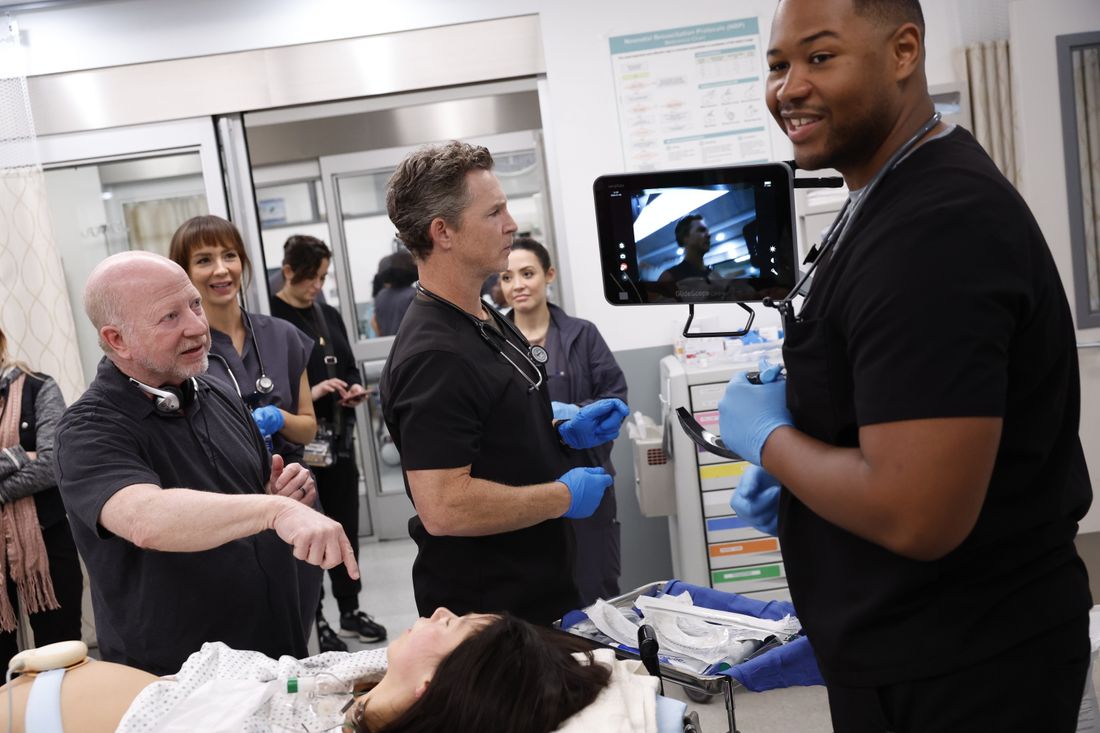
The fake belly used in the scene already has a slit in it, closed with magnets so it opens realistically when actors make a cut with their safe, blunted scalpels. Before each take, a fake uterus and baby are placed inside. The uterus is filled with a special fluid—vinegar instead of water, which would wash away the fake blood and fluids on the silicone baby—but the magnets aren’t strong enough to keep everything in place. The actors have to actually cut into the fake uterus during each take to make the fluid spill out convincingly, which unfortunately means the prop can’t be used again. The special effects team has prepared four extra uteruses, neatly stacked in a pale pink pile next to the baby’s roasting pan.
A problem arose during rehearsal with the single practice uterus they had. When actor John Hatosy, playing Abbott, attempted to make the initial incision with a prop knife, he couldn’t puncture the sac. The finale’s director, John Wells, spoke with the medical advisor, Dr. Einesman, and they decided the props team should create a small hole in the sac beforehand. This would allow Hatosy to convincingly mimic the cut, and then actor Noah Wyle could continue with the scene using scissors. Everyone felt this solution would work, but it couldn’t be tested further as they had no more practice uteruses available.
The first usable take ran into a problem. While the scissors worked perfectly, the props team accidentally punctured the fake uterus during the incision, causing the amniotic fluid to leak and soak into the prosthetic body Wolf was wearing. This created a vinegar smell on set, prompting one crew member to joke about Easter eggs. The intimacy coordinator pointed out that Wolf shouldn’t have to sit in the leaking fluid for hours. Additionally, the director wasn’t satisfied with the amount of fluid – they wanted a rush, not just a small puddle. Could they increase the pressure? The makeup team switched to water, and the special effects team connected a new uterus to a small compressor. To fix the issue, the director decided that when the actors deliver the baby, someone will call for a pause. Everyone will freeze, the makeup and SFX teams will quickly add more fluid to the baby to make it look messier while the actor holds it up, and then they’ll resume filming. The editors can remove the fluid application from the final cut.
Wells gives the signal to start, and the actors begin the carefully planned delivery sequence. Robby assists with the first cuts. Abbott calls for a team to help with the baby. When Robby cuts into the fake uterus, a rush of red liquid fills the prosthetic belly. Wells, watching on a monitor from a small room nearby, smiles and gives the director a thumbs-up. As Wyle gently removes the baby, the assistant director’s voice booms over the loudspeaker: “Wait for the cream cheese!” Everyone stops. The special effects team quickly adds a small amount of whipped cream cheese and a special goo to simulate the baby’s coating – it looks incredibly realistic.
The final scene flows together perfectly: the initial injury, the quick switch to a surgical delivery, the rush of fluid, the newborn covered in birth fluids, and the coordinated movements of the medical team working to save both mother and baby. A lot of what makes The Pitt so captivating is its ability to visually represent that intense energy – the series doesn’t shy away from showing how everything is done. However, even with all the chaos, the camera stays focused on Robby’s expression. We’re not just watching this dramatic emergency unfold; we’re watching Robby process it, seeing his hesitation, acceptance, and weariness. He’s clearly reluctant, but feels he’s the only one who can handle the situation.
Much of Robby’s character development this season came from actor Jason Wyle’s vision. He believed the traumatic events at PittFest would significantly impact Robby’s mental health, adding to the unresolved issues from his past and the lingering effects of the COVID pandemic. Wyle saw these experiences triggering deeper, unaddressed childhood traumas, culminating in a downward spiral throughout the season. He actually began laying the groundwork for this in season one, requesting that a copy of Zen and the Art of Motorcycle Maintenance be placed in Robby’s backpack, marked on page 17. Wyle envisioned Robby initially questioning if he needed help but avoiding actually seeking it. After PittFest, he imagined Robby revisiting the book for guidance, essentially trying to self-treat. According to Wyle, Robby would avoid acknowledging his true needs and instead focus on practical, mechanical solutions. Between seasons, Wyle pictured Robby buying a motorcycle and forming a connection with Duke, a seasoned mechanic who acts as a mentor, and then planning a break without fully recognizing his underlying despair.
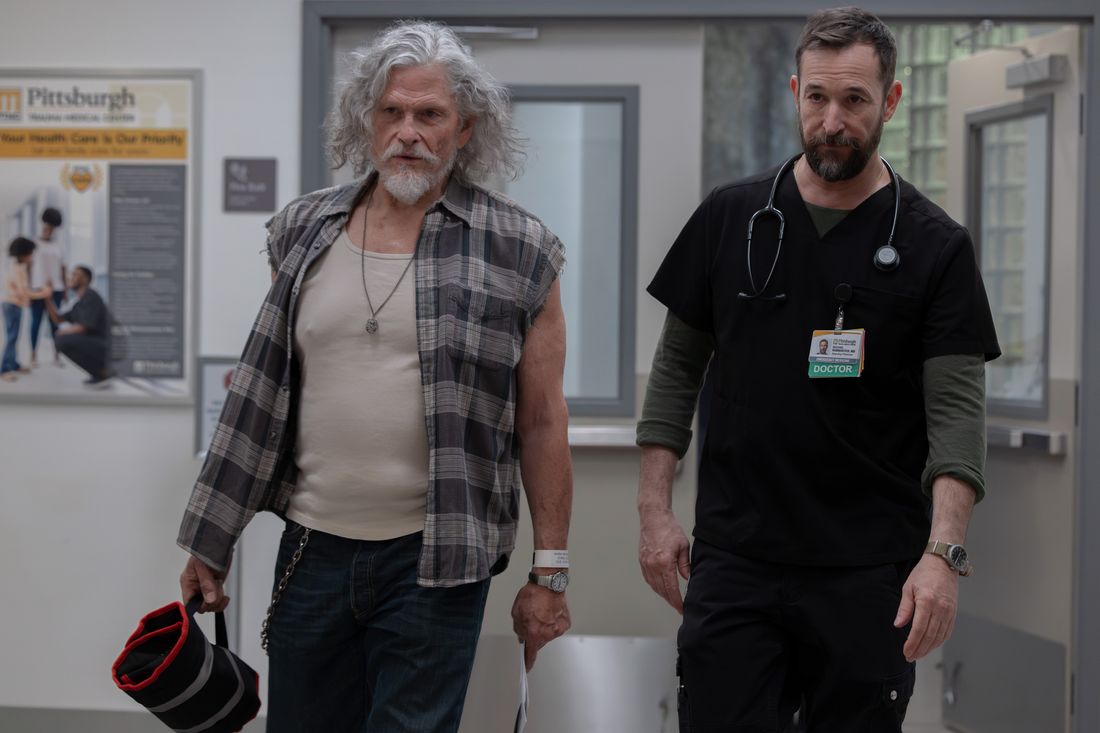
The season’s ending is meant to force Robby to confront his true desires. The difficult childbirth scene, according to the writer, was created to ensure Robby would be needed even after his work hours, and to push him to realize he can’t keep hiding his emotional pain. The writer initially envisioned the season focusing on Robby’s healing process, but realized it would take more than one episode to fully explore. Robby hasn‘t truly committed to addressing his own issues – he’s only talked about it and briefly tried therapy, but hasn’t followed through. He’s good at helping others, but struggles to accept help himself.
The day after filming the difficult trauma scene, I observed a scene where several characters said goodbye to Robby, each hoping to help him before he makes a bad decision. Actor Rob Wyle is incredibly skilled at portraying subtle emotions – he often tilts his head slightly and smiles even when his character is clearly suffering. In this scene, Duke, who was visiting the ER for a sore throat, unexpectedly receives serious news and uses the moment to urge Robby to take care of himself. After carefully rehearsing the movements of all the actors, the director decided to film close-ups of Wyle’s face. Wyle had already delivered a moving performance, but he took it to another level. His face, already showing sadness, seemed to deepen with new lines and creases, making his eyes even more mournful and his smile heartbreakingly painful.
As a huge fan of this show, I’m finding this season a little frustrating. It’s always been very internal, focusing on what Robby is thinking and feeling, and this year it feels even more confined, almost suffocating, since everything takes place in one location over a single day. They tried to introduce a new character, Dr. Al-Hashimi, but her arc felt rushed. We go from her being an antagonist to incredibly vulnerable way too quickly – it just doesn’t feel believable within the span of a day. We quickly learn she’s worried about AI and has a strange memory issue, but it’s all a bit glossed over. We always know exactly what Robby thinks of her – suspicious at first, then grudgingly trusting, and ultimately hurt when he finds out about her condition – but we never really get to understand her motivations. In the finale, she bravely shares her struggles with seizures, hoping for some understanding, and he just tears into her for keeping it a secret. It’s clear he feels needed in the ER, and that both validates and traps him. But honestly, after he spent the whole shift dismissing her, why on earth would she confide in him with something so personal?
Actress Rana Moafi, who plays Al-Hashimi, believes her character is genuinely trying to reach out to Robby. Moafi explains that Al-Hashimi has attempted to connect with him through logic and practical solutions, and now she’s finally being completely open and vulnerable. The resulting conversation reveals differing viewpoints: Robby maintains Al-Hashimi shouldn’t be working in the emergency room, while she believes she’s safe with a second doctor present. According to Harry Wyle, Robby’s concerns are justified, even if harsh. However, Moafi points out that Al-Hashimi’s neurologist has cleared her to work, and having two doctors cover each other is typical in an ER setting. Moafi feels Robby is being unfair by questioning Al-Hashimi’s character and accusing her of being irresponsible. Executive producer David Gemmill agrees there’s merit to both sides, acknowledging Robby’s valid concerns while also noting that most ER cases aren’t major traumas. Ultimately, the situation is more complex than Robby seems willing to consider.
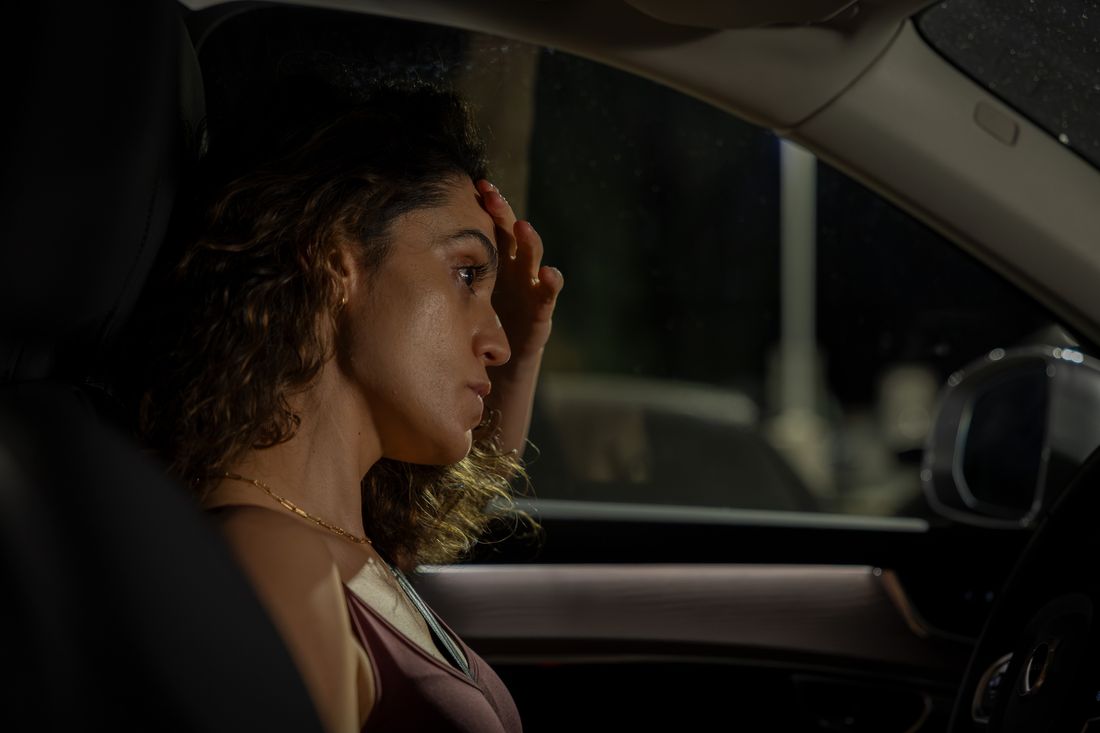
The scene ends with Al-Hashimi driving away from the hospital, then breaking down in tears out of frustration. The director, Gemmill, explains they originally filmed a conversation with her ex-husband, but felt the scene was stronger without it. The intention is to show her realizing she shouldn’t be driving, which leads to her emotional breakdown. It marks the start of a new, difficult path as she confronts her issues. Actress Moafi acknowledges that Al-Hashimi driving while knowing it’s unsafe might seem unusual, but it makes sense given the traumatic day she’s had – a betrayal of trust. Al-Hashimi is both heartbroken and angry because she spent the entire shift dealing with what Moafi describes as subtle prejudice from Dr. Robby, which he doesn’t seem to recognize. Moafi points out that the issues of inequality and sexism are not being addressed.
As a critic, I’ve been following the online chatter about The Pitt, and a lot of fans are disappointed with the direction season two has taken. The biggest complaint? Less focus on the show’s women of color and a noticeable shift in Robby’s character. He’s become less the warm, guiding figure we loved in season one, and some viewers are struggling with that. But Jason Wyle, who plays Robby, pushes back on the idea that his character needs to be perfect. He jokes that fans are wondering why ‘Daddy’ is acting differently, but firmly points out that Robby was never meant to be a father figure in the first place. It’s an interesting defense, suggesting this season is actually more in line with the character’s original intent.
According to Wyle, the strong reactions from fans about Robby aren’t about changes in the show itself, but rather a desire to see him consistently portrayed as a purely good character. Fans have projected heroic qualities onto Robby, seemingly ignoring any less admirable behaviors. However, the show itself appears conflicted about how to present him – is he a supportive mentor and father figure, or a more romantic and potentially problematic character? Robby often delivers moral lectures, and is usually right, creating a contradiction: the show wants us to see him as flawed, but consistently portrays him as a perfect doctor. While the show allows for understanding and forgiveness of Robby’s mistakes, he rarely shows the same compassion to others.
The set of The Pitt is always bustling with activity. The emergency room is designed so you can see all the way down the hallways, meaning every room and corridor needs to be filled with extras for most scenes. This, combined with the complex medical procedures and technical language, creates a very fast-paced and sometimes overwhelming environment. While preparing for a particularly intense trauma scene, I heard Luke Tennie, who recently joined the cast, admit he was still getting used to the speed of things. He kept repeating, “Slow is smooth and smooth is fast,” as he worked on mastering the timing.
Even though season two focuses more on Robby, The Pitt remains a show with a large cast sharing the spotlight. Following her Emmy win, actress LaNasa had a strong storyline as Nurse Dana, including extended scenes where she guided a new nurse in caring for a sexual assault survivor and handling a deceased patient. However, characters McKay (Fiona Dourif) and Santos have smaller roles this season, largely dealing with administrative tasks. Meanwhile, Ganesh’s character, Mohan, who Robby previously admired for her compassionate patient care, is limited to a single scene involving a panic attack before deciding the emergency room isn’t the right fit for her.
Gemmill explains he didn’t plan for Mohan’s departure at the beginning of the season; it developed naturally as he wrote the story. He believes it’s important for the show to consistently introduce and say goodbye to characters. This avoids creating a false sense of security for viewers, who shouldn’t assume their favorite characters will always return. Specifically regarding Mohan, the writers wanted to portray the uncertainty many young doctors face when they don’t have a clear path forward. Gemmill notes that the fact that both major departures have been women of color is simply a result of the show’s diverse cast and is largely coincidental. Ultimately, Gemmill is establishing a storyline where all characters are potentially vulnerable, with Robby being the exception.
According to Gemmill, the third season will continue to explore Robby’s struggles with mental health, focusing on his journey to seek help and how that impacts him and those around him. Wyle reveals that Robby’s tattoos offer clues to his character. He has “memento mori” (remember you will die) on one arm and “amor fati” (love of one’s fate) on the other, which he physically covers when he crosses his arms. A new tattoo in season two, the name “Phaedrus,” references a character from Zen and the Art of Motorcycle Maintenance—a man haunted by a ghost he believes is his own better self. Wyle explains that these details are intentional, aiming to create a sense of realism and depth for all the characters, making their lives feel fully realized.
The season ultimately culminates in a scene that showrunner Gemmill had planned from the beginning: Robby cradling Baby Jane Doe, the infant discovered abandoned early in his shift. Gemmill explains they always intended for Robby to end the season with the baby in his arms. In that moment, Robby comforts the infant, revealing he too was abandoned as a child. Actor Harry Wyle describes this as a perfect opportunity for Robby to share his deepest secrets with someone who can’t respond. Wyle anticipates some fans will speculate about Robby adopting the baby, but clarifies that’s not going to happen. Instead, Robby will leave feeling regretful, wishing he were in a position to offer the child a home, with the hope that maybe someday he will be.
The scene with Robby and the baby was initially meant to feel hopeful, but it comes across as deeply sad. Near the very end of writing the season, Gemmill added a final scene: Santos and Mel singing “You Oughta Know” at a karaoke bar. He only told Dearden and Briones about it beforehand. This scene is meant to be a release, filled with joy and excitement—a contrast to the more somber moments like Robby’s emotional breakdown and the fireworks. Gemmill hopes the scene leaves viewers feeling optimistic about Santos and Mel’s future, believing they will be alright.
Read More
- Off Campus Season 1 Soundtrack Guide
- X-Men ’97 Finally Gave Gambit the Hero Moment He Deserved
- Chainsaw Man Volume 24’s Cover Art Reveals a Brand-New Denji
- 46 Years Later, The Mandalorian & Grogu Answers A Major Empire Strikes Back Question
- 10 Worst End-Game Couples In Sitcom History
- HoI4 fans harsh reactions to the announcement of another DLC pack
- Gold Rate Forecast
- DoorDash responds after customer uses AI to make food look bad and get a refund
- Emily Henry Says to ‘Trust the Vision’ For Beach Read Adaptation
- Katanire’s Yae Miko Cosplay: Genshin Impact Masterpiece
2026-04-17 05:09