Polymarket, that paragon of financial acumen, saw its single-day notional trading volume hit $478 million, with the politics category alone accounting for $220 million, nearly half of total daily activity. One might say the world’s problems are now priced like stock options-only cheaper.
Elsewhere, rival prediction market Kalshi, that beacon of ethical market practices, found itself in hot water after a contentious contract involving the Khamenei market. It’s a wonder the platform didn’t collapse under the weight of its own moral ambiguity.
Polymarket Sets Historic Record as Geopolitical Tensions Drive Crypto Betting
Prediction markets surged to historic highs as the United States and Israel launched coordinated strikes on Iran. One might say the world’s financial wizards were busier than a squirrel in a nut factory.
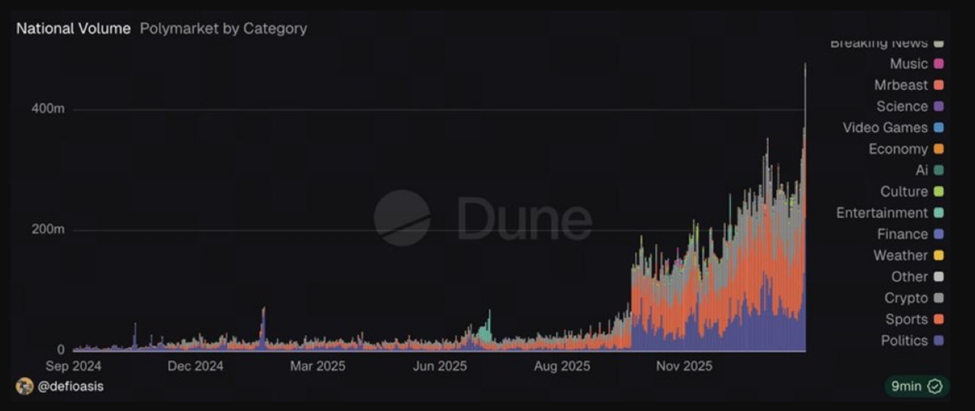
Polymarket reached an all-time high across the platform and its political markets. According to data aggregated by Defioasis, Polymarket’s spike coincided directly with the strikes, which is about as coincidental as a rainstorm in a desert.
On the day the U.S. and Israel bombed Iran, Polymarket’s daily trading volume hit $478 million. The politics category alone, $220 million. A new high, and not just for the markets.
– defioasis.eth (@defioasis) March 1, 2026
This signals the platform’s capacity to price geopolitical events faster than TradFi markets or polling models. One might say it’s the future, if the future were run by people who care more about profits than people.
Certain strike-timing contracts set their own records, with individual trades clearing up to $90 million. A testament to the liquidity flowing into the platform-though one wonders if the money is coming from investors or the wallets of those who knew the strikes were coming.
However, the traction was also marred by allegations of insider trading, with Bubblemaps identifying at least six addresses that profited approximately $1.2 million from bets tied to the Iran conflict. One might call it a coincidence, but the odds are as slim as a politician’s promise.
JUST IN: 🇮🇷 🇺🇸 Six suspected insiders made $1.2M betting on a U.S. strike on Iran. Most of these wallets: • were funded in the last 24h • specifically bet for February 28 • bought “yes” hours before the strike
– Bubblemaps (@bubblemaps) February 28, 2026
The surge in activity shows how prediction markets are increasingly blurring the line between financial speculation and geopolitical forecasting. One might say it’s a new era, if the era were run by people who think the word “ethics” is a typo.
The timely pricing of real-world events demonstrates the efficiency of blockchain-based markets. However, it also raises concerns about transparency and fairness, particularly when wallets appear to perfectly anticipate outcomes. One might say it’s a marvel, if marvels were less about money and more about morality.
Kalshi Faces Backlash Over Khamenei Market, CEO Defends Settlement and Ethics
Meanwhile, Kalshi, that paragon of ethical trading, faced its own controversy with the contract titled “Ali Khamenei out as Supreme Leader?” It’s a wonder the platform didn’t collapse under the weight of its own moral ambiguity.
The market, which had accumulated over $50 million in total volume, saw roughly $20 million traded on strike day alone. One might say the market was as popular as a politician’s speech.
Following Khamenei’s reported death during the strikes, critics argued the platform had effectively created a proxy death market, despite its stated rules against profiting from death outcomes. One might say it’s a new low, if lows were measured in dollars and not dignity.
You settled Jimmy Carter to “No” on attending Trump’s inauguration after he died. You knew people were betting the 99-year-old would die before the event. You settle on death, just not when it makes you money. This has nothing to do with death, this has everything to do with your…
– jellyman (@jellymanguy) March 1, 2026
Kalshi CEO Tarek Mansour addressed the backlash on X (Twitter), emphasizing that all positions would be settled at pre-death last-traded prices. Meanwhile, post-death positions would be fully reimbursed, including all trading fees. One might say it’s a noble gesture-if noble gestures were less about avoiding lawsuits.
Mansour defended the market’s design as consistent with U.S. regulations. He noted that leadership changes in Iran carry significant geopolitical, economic, and national security implications. This, he said, makes such markets relevant without directly incentivizing death. One might say it’s a stretch, if stretches were measured in logic and not loopholes.
“A market on Ali Khamenei’s out as Supreme Leader was important because leadership changes in Iran have a major impact on the world order,” Mansour wrote, outlining that traders could still profit or lose based on legitimate political outcomes rather than mortality. One might say it’s a clever way to dodge the question, if questions were about ethics.
The settlement process, he explained, adhered strictly to the CFTC-filed contract terms, which referenced the last-traded price prior to Khamenei’s death, even amid ambiguities in reporting timelines. One might say it’s a legal technicality, if technicalities were about fairness.
Reposting because my other message was unclear:
We settled the market to last traded price before time of death (per our rules). All positions, no matter when they were opened, got paid out on the last-traded price before his death.
On top of that, if you bought a position…
– Tarek Mansour (@mansourtarek_) March 1, 2026
On the one hand, Polymarket is setting new benchmarks for trading volume amid geopolitical tension. Meanwhile, Kalshi is facing ethical scrutiny. One might say it’s a tale of two markets, if tales were about money and not morals.
Both events highlight the potential and the risks of prediction markets. These platforms offer unprecedented speed and transparency in pricing world events. However, as February 28 demonstrated, they also amplify ethical dilemmas and regulatory attention during crypto-driven speculation. One might say it’s a new frontier, if frontiers were less about greed and more about grace.
Read More
- United Airlines can now kick passengers off flights and ban them for not using headphones
- Solo Leveling’s New Manhwa Chapter Revives a Forgotten LGBTQ Story After 2 Years
- The Boys Season 5 Spoilers: Every Major Character Death If the Show Follows the Comics
- Grok’s ‘Ask’ feature no longer free as X moves it behind paywall
- Mewgenics vinyl limited editions now available to pre-order
- Assassin’s Creed Shadows will get upgraded PSSR support on PS5 Pro with Title Update 1.1.9 launching April 7
- Gold Rate Forecast
- How to Get to the Undercoast in Esoteric Ebb
- Nintendo Officially Rewrites Princess Peach After 41 Years
- ‘Timur’ Trailer Sees Martial Arts Action Collide With a Real-Life War Rescue
2026-03-01 23:06