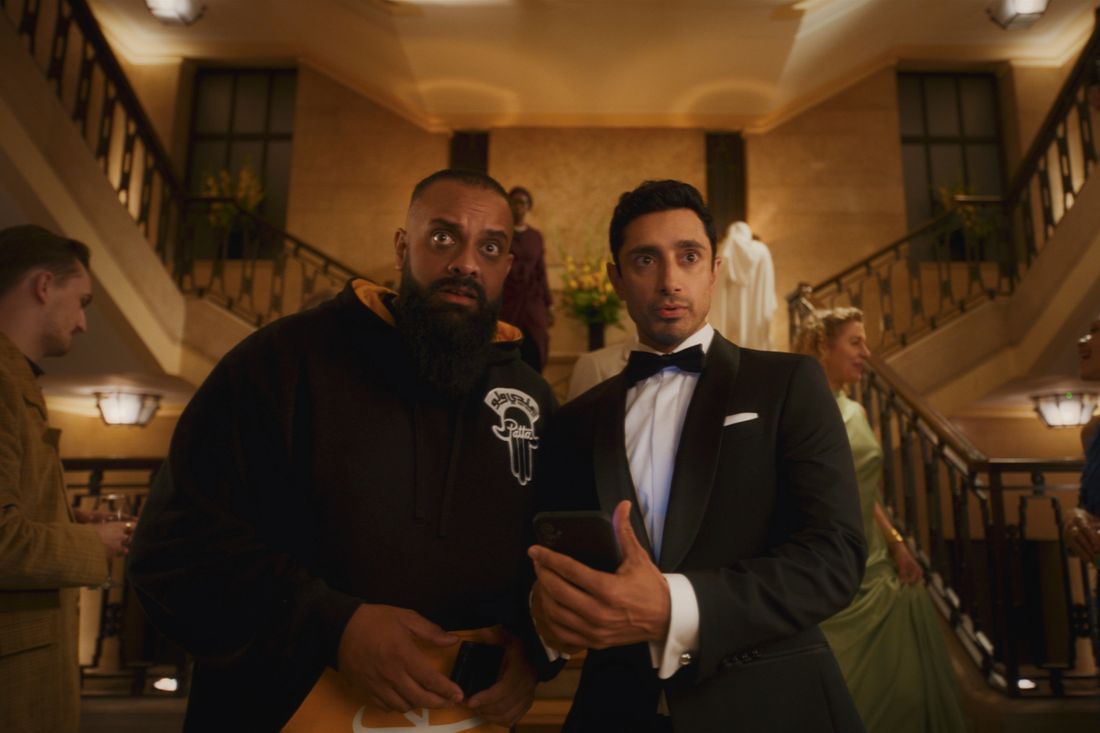
Riz Ahmed consistently delivers strong performances, and with each project comes the inevitable question of what his role signifies. This question has become so central to how audiences view his work that it’s almost expected.
Let me tell you about Bait, the new Prime Video miniseries from Riz Ahmed. He not only stars, but created and wrote the whole thing, and it’s…a lot. It’s a wild ride that shifts genres with each of its six episodes – one minute it’s a comedy, the next a thriller, then a family drama, and even a romantic walk-and-talk. Honestly, it feels like Ahmed is simultaneously analyzing himself and poking fun at the very idea of self-analysis. There are moments where it feels like the entire show is an extended audition for him to play James Bond – it really leans into that debate. And at other times, the conversations about Muslim life are so specific and insider-y, you have to appreciate the boldness of potentially alienating some viewers. There’s a particularly sharp commentary on Hollywood hypocrisy in one episode that I wish had been explored further, instead of…well, Patrick Stewart voicing a pig’s head, which is a thing that happens. But despite all the quirks and detours, Bait feels truly unique. It’s a bold experiment constantly circling two questions that have clearly been on Ahmed’s mind throughout his career: how far has representation really gotten us, and what’s the cost of always looking to those in power to provide it?
Riz Ahmed has played a wide range of characters – from individuals associated with extremism and facing prejudice, to those pursuing ambition or fighting for justice. This raises important questions: Does his presence in a project make it more realistic, provocative, or diverse? When does an actor become defined by their ethnicity, religion, or background, and when does that become a burden? Through his acting, producing, music, and activism, Ahmed has consistently explored these issues, and his new film, Bait, continues this thoughtful examination.
It’s easy to see a pattern in Riz Ahmed’s work, but that repetition seems intentional. He appears to constantly revisit how real progress can be made, acknowledging how slow and gradual change truly is. Back in 2017, his speech to the British Parliament about the need for more diverse stories led to the creation of the Riz Test, which evaluates how Muslims are depicted in media. However, a 2022 study showed that Muslims are still largely unseen in film and television. While South Asian, Middle Eastern, North African, and Muslim actors are making gains, these improvements haven’t fundamentally changed the industry. Ahmed himself has achieved significant recognition – an Oscar nomination for Sound of Metal, an Oscar win for the short film The Long Goodbye, and a role in Rogue One: A Star Wars Story – but these instances remain exceptions rather than the rule. His film Bait explores what it would take for a person of color to become James Bond, precisely because a non-white actor has never held the role. The Bond character, like many leading roles in major franchises, historically represents a system that excludes people of color from positions of power. Idris Elba was a popular choice for Bond for years, but he received a knighthood before the opportunity ever materialized. These issues within the entertainment industry are persistent and clear.
Riz Ahmed stars in Bait as Shah Latif, an actor down on his luck. Once a promising rapper and award-winning filmmaker – a role that mirrors Ahmed’s own experiences – Shah is now struggling to make ends meet, even resorting to keeping the tags on his clothes. He sees a potential breakthrough when he auditions for a James Bond role. The film opens during his audition, where he initially appears confident and composed, until a co-star asks him a disarming question: “Do you even know who you are?” This question throws him off, as he grapples with his own identity – feeling unsure if he’s perceived as authentically brown, British, or Muslim. Unable to answer under pressure, Shah realizes that even a perceived rejection can be turned into publicity. He deliberately exits the audition through a less-used door, gives a mysterious smile to the waiting paparazzi, and intentionally creates a viral moment, hoping to generate buzz within and beyond the entertainment industry.
Shah’s cousin, Zulfi (played by the hilarious Guz Khan), has been his close friend since they both experienced a racist attack as children. Zulfi playfully teases Shah in his distinctive accent, joking about Shah’s height and whether he’ll get special shoes for the role. Shah’s mother, Tahira (Sheeba Chaddha), is thrilled he might become the next James Bond and eager to share the news with her friends, wanting to solidify her status within their social circle. However, Shah’s casting isn’t certain. The film frequently points out how people often mistake him for Dev Patel, and another talented British actor of Indian descent, Himesh Patel, is also in contention. Furthermore, some British Pakistanis criticize the idea of a non-white Bond, dismissing it as a superficial issue that avoids addressing more important political concerns.
Shah’s ex-girlfriend, Yasmin (Ritu Arya), is at the center of the challenges he faces, and the show Bait feels reminiscent of Scott Pilgrim vs. the World with its constant stream of obstacles. As Shah prepares for his next audition, he’s confronted by one difficult person after another. For example, a museum curator dismisses concerns about Britain’s history of taking artifacts from other cultures, preventing Shah from delivering a speech with religious themes. A popular activist criticizes Shah for becoming “too Westernized” with his growing fame and demands an apology for a past incident. Even a family friend working in finance – a profession Shah’s family approves of more than his acting – draws attention away from him. Each new character and situation takes Bait in a different direction, shifting between action, suspense, romance, Bollywood-style musical numbers, and even a James Bond-esque vibe.
The show’s frequent side stories, told in short, digestible episodes, always circle back to the central theme: the many costs – cultural, financial, personal, familial, romantic, and professional – of being a minority in a society dominated by another group. Bait is most compelling when it avoids simple answers, showing the Pakistani community as flawed with its own prejudices based on class, race, and gender. It suggests that conflict within minority groups can sometimes stem from a desire to align with dominant cultures, and sometimes from other factors. The show also doesn’t shy away from criticizing other countries and nationalities. (Dubai isn’t spared criticism, and neither are British individuals who participated in the invasions of Afghanistan and Iraq and then expressed admiration for the countries they damaged.) The goal isn’t to offend the community Shah and his team represent, but to immerse viewers in the complex realities and contradictions within it.
The most daring element of the show Bait is the voice of the pig’s head, brilliantly performed by Stewart. It’s so unexpectedly creative and yet absurd that it risks overwhelming everything else. Initially used to frighten the Latif family, the pig’s head quickly becomes Shah’s unlikely confidant, coach, and tormentor. Stewart delivers his lines with a dramatic, precise style, mirroring and intensifying Shah’s own self-doubt. The fact that this forbidden object knows Shah’s deepest, most critical thoughts about himself and his family adds another layer of complexity to the show’s themes. It requires viewers to accept the outlandish premise that Shah is confiding in a dead pig – and eventually, this gamble pays off. All of these strange elements – the pig’s head, Shah’s confessions, the chaotic events, and his desperate attempts to prove himself – are designed to make us question the purpose of representation in modern society. Can real change come from within established systems? If not, what actions should be taken? The answers are personal and evolving, much like the actor Ahmed’s own views on these issues. However, his passionate and thoughtful exploration of these questions is captivating and makes you eager to see where his inquiries lead.
Read More
- United Airlines can now kick passengers off flights and ban them for not using headphones
- Gold Rate Forecast
- How to Complete Bloom of Tranquility Challenge in Infinity Nikki
- How to Solve the Glenbright Manor Puzzle in Crimson Desert
- 8 Actors Who Could Play Blackbeard In One Piece Live-Action Season 3
- A Dark Scream Theory Rewrites the Only Movie to Break the 2-Killer Rule
- All Golden Ball Locations in Yakuza Kiwami 3 & Dark Ties
- Watch Out For This Amazing Indian Movie That Made BAFTAs History
- All MLB The Show 26 Quirks & What They Do
- VTuber who plays games with her feet grows a ‘new’ muscle because of it
2026-03-25 23:55