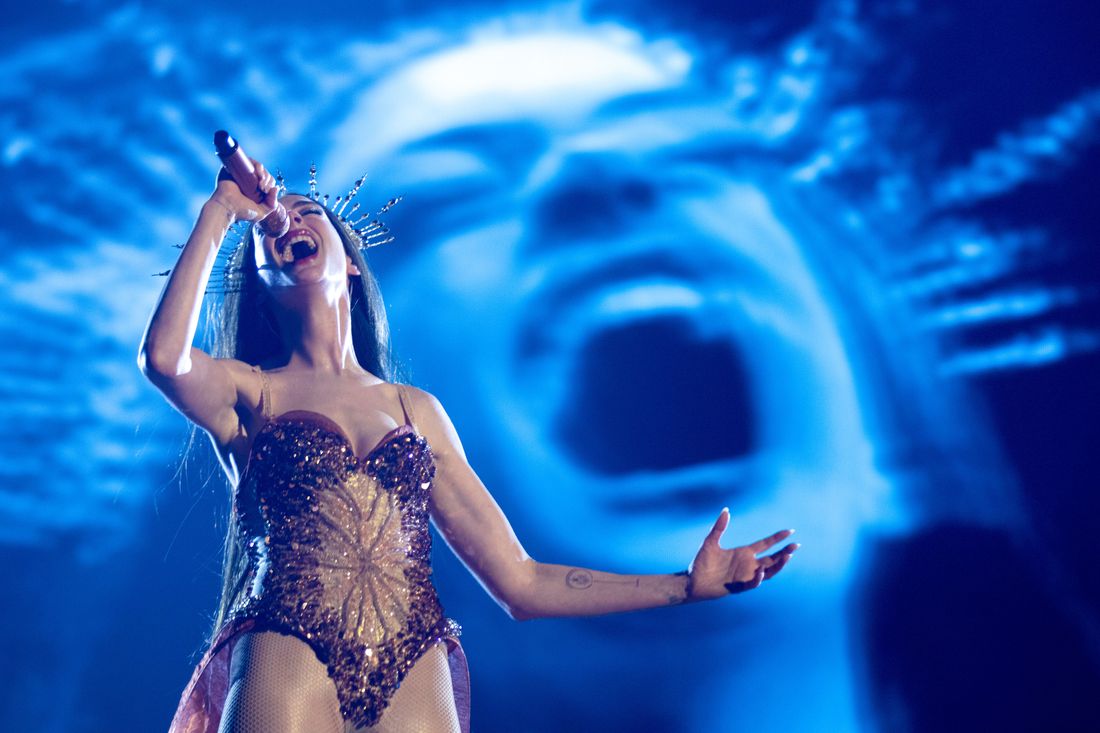
David Lowery, the writer and director of the new film Mother Mary, has said he drew a lot of inspiration from Taylor Swift. He’s explained that Anne Hathaway’s character, a pop star, is envisioned as what Swift might be like in 10 to 15 years, as he told Empire magazine. Lowery also used Swift’s Reputation concert film as a guide for filming stadium scenes, and he and Hathaway both attended the Eras Tour. While I believe Lowery is genuine, it’s also smart to appeal to Swift’s fans – even if the movie ultimately disappoints them. However, the comparison to Swift doesn’t quite feel accurate.
The music created for the character, composed by Jack Antonoff, Charli XCX, and FKA Twigs (who is also in the cast) and sung by the actress herself, feels dreamy and distant, not bold or easily memorable. Crucially, while Taylor Swift always aims to connect with fans by seeming relatable, this character is intended to be admired from a distance. As her former collaborator, designer Sam Anselm, explains, she wants people to simply care about her. Her sad and thoughtful vibe is reminiscent of Lana Del Rey, and her past use of lace masks and unusual red-carpet looks evokes Lady Gaga. However, the name is deliberate. Above all, with her signature halo headpieces, the character feels like a medieval religious icon – a divine diva appearing on stage to be worshipped by adoring crowds.
David Lowery’s film, Mother Mary, isn’t really about fame or music, despite appearances. It’s fundamentally a story about a fractured friendship, though that description doesn’t quite capture how unusual and unsettling the movie is. Most of the film unfolds in a converted barn on Sam’s property outside London, where she lives and works. This is where Sam and Mary end up after Mary unexpectedly shows up at her door. Years ago, the two women created the stage persona ‘Mother Mary’ together. While Sam went on to a successful career, she’s never gotten over Mary abruptly leaving her behind. Mary claims she flew from L.A. needing a dress only Sam can make, but what she really needs is validation from someone who truly knew her, and, surprisingly, an exorcism.
Mary believes she’s haunted by a spirit that Sam also experienced in Mary’s bedroom after a concert. This presence, which appears as a flowing red sheet, might be connected to the on-stage accident that left Mary scarred and questioning her future. Interestingly, this spirit also seems to reflect the long-held resentment Sam eventually overcame. Whether the ghost is real or symbolic isn’t the main point. Mary and Sam often feel like two sides of the same artistic mind – Mary as the public performer, presenting a calm exterior while pushing herself to the limit, and Sam as the private, secluded artist working tirelessly alone. The story struggles most when it tries to portray them as relatable people, failing to capture the carefree joy they once shared as children, dreaming of achieving something extraordinary together, as shown in an old photograph.
Mary and Sam are presented as almost otherworldly figures – they don’t seem to have ordinary needs or desires, like eating or having relationships. Even their early, more playful work, which fans still request at concerts, and the practical concerns of their employees, are glossed over. (Hunter Schafer, playing Sam’s assistant, mostly appears to deliver a dramatic, theatrical speech at the end.) In contrast to this film, Michaela Coel’s other recent artistic collaboration, Steven Soderbergh’s The Christophers, keenly focuses on the financial struggles of artists, depicting them as vividly as the art itself. Mother Mary, however, keeps both the characters’ professional and personal lives vague and symbolic. While Anne Hathaway is captivating onstage, she’s consistently shown as sad and vulnerable offstage, and Coel portrays Sam with a mysterious, almost prophetic quality. This distance feels intentional, as if the film is preventing viewers from realizing the core of their relationship is actually a rather simple story about forgiveness.
Despite a recent detour with a Disney-streamed Peter Pan remake, director David Lowery—known for films like A Ghost Story and The Green Knight—still delivers a compelling and heartfelt film. It’s hard to simply dismiss, and features strikingly memorable imagery, such as a dreamlike ballet sequence where a weary Mary moves across multiple stages in a single, continuous shot. The film creates a fascinating, enclosed world—one filled only with women, not in a romantic way, but with intense, close-knit relationships. Men aren’t excluded from these spaces, they’re simply absent. The connection between Mary and Sam wasn’t a typical romance; it was a deeper, spiritual bond that ultimately left both of them feeling incomplete after their separation.
Remembering seeing Mary perform after they broke up is incredibly painful for Sam. Watching her from the audience, so near yet feeling impossibly distant, highlights the raw ache of the situation. It wasn’t about the music itself, or who deserved recognition, but something deeper – the feeling of being excluded from Mary’s world, reduced to simply an observer instead of someone special.
Read More
- Off Campus Season 1 Soundtrack Guide
- X-Men ’97 Finally Gave Gambit the Hero Moment He Deserved
- Chainsaw Man Volume 24’s Cover Art Reveals a Brand-New Denji
- 46 Years Later, The Mandalorian & Grogu Answers A Major Empire Strikes Back Question
- 10 Worst End-Game Couples In Sitcom History
- HoI4 fans harsh reactions to the announcement of another DLC pack
- Gold Rate Forecast
- DoorDash responds after customer uses AI to make food look bad and get a refund
- Emily Henry Says to ‘Trust the Vision’ For Beach Read Adaptation
- Dragon Quest II HD-2D Remake: Where to get the Magic Key
2026-04-14 16:54