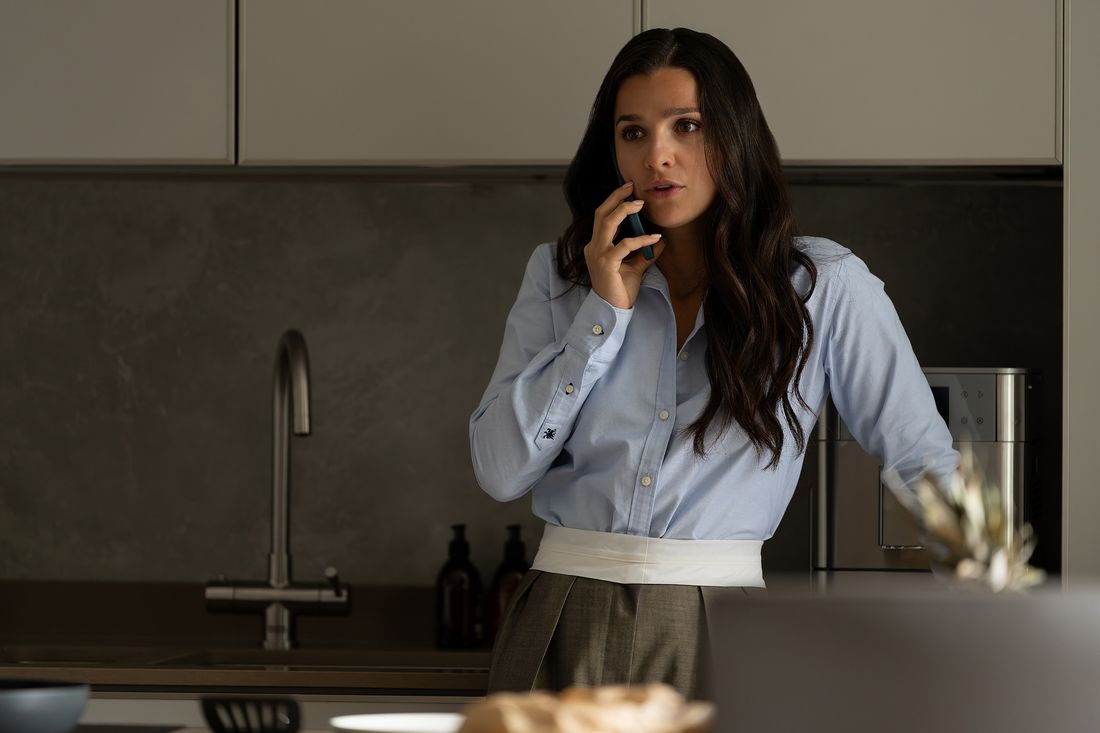
This article discusses events from the seventh episode of Industry season four, titled “Points of Emphasis,” which aired on HBO on February 22nd. Be aware that it contains spoilers.
Yasmin Muck, now an investigative journalist, isn’t driven by altruism. Throughout the fourth season of Industry, Marisa Abela’s character has been navigating a difficult marriage with her husband, Henry (Kit Harington), who struggles with addiction, all while trying to establish themselves at the fintech firm, Tender. Yasmin fiercely defends Tender’s problematic CEO, Whitney Halberstram (Max Minghella), and increasingly compromises her own morals to achieve her goals – even orchestrating a threesome with Henry and Whitney’s assistant, Hayley (Kiernan Shipka), and leveraging a connection to a neo-Nazi to gain support for Tender. She’s determined to make both her marriage and career succeed, but everything unravels in the episode “Dear Henry.” When evidence surfaces suggesting Tender is a fraudulent company, Whitney gives Henry a letter confessing the truth – effectively making him a scapegoat. In the latest episode, Yasmin goes on the offensive, using her connections to smear Tender, frame Henry, and protect herself. Having often been abandoned, she’s now taking control and abandoning him first.
Marsha Abela, who won a BAFTA for her role in Industry, brilliantly portrayed Yasmin’s complex struggles. The character grappled with the trauma of a difficult childhood – specifically, abuse by her father – alongside her own self-doubt and anxieties about fitting in. As Yasmin climbed the social ladder and entered aristocratic circles, she tried to project confidence. Her marriage to Henry initially seemed like a dream come true, but as it falls apart, Yasmin transforms into a fiercely independent and self-protective woman, as described by one of the show’s editors.
According to Abela, Yasmin’s decision to ask Alexander to investigate Henry’s involvement in Tender’s failure is about protecting herself. Abela describes Yasmin as decisive – once she’s made up her mind, she doesn’t look back. It’s not that she doesn’t have feelings for Henry, but she needs to focus on moving forward.
How did you first feel about Yasmin’s storyline in season four, where she’s searching for meaning both for Henry and herself? I was thrilled to delve into the idea of Yasmin prioritizing someone else’s needs. We see this especially in episodes two and three, as she tries to support Henry and help him through a difficult time. This is the most mature we’ve seen her, because she finally has someone she cares for as much as herself. Throughout the first season, Yasmin’s biggest goal was to feel valuable and needed, and she believes this new role as a wife will allow her to do that. She sees herself succeeding and flourishing, not just as Henry’s wife, but as someone truly important in his life – as a supportive and powerful partner.
By the end of season three, she appears eager to fit into the upper class. However, at the start of season four, she and Henry clash over something seemingly small – whether a servant or Yasmin should open the curtains. This highlights a fundamental difference: she lacks the ingrained understanding that comes with being raised among the aristocracy. Yasmin is clearly making an effort to adapt, changing her appearance and even the way she speaks to seem more refined. She’s trying to blend in, but she still doesn’t quite view the servants as simply part of the background, as Henry does. Unlike the others in the house who act freely around the staff, she feels self-conscious and doesn’t feel completely alone with her husband when servants are present.
Yasmin and Henry’s relationship is so rocky because they’re both trying to understand what their marriage actually is. What was it like working with your co-star? We had fantastic chemistry, having been married on screen much longer than Yasmin and Henry. It’s funny, we developed a very comfortable, almost sibling-like dynamic, which was helpful when exploring the idea of a marriage without intimacy. We really embraced that comfort and pushed each other to get the best performance possible in those scenes – it wasn’t necessarily competitive, but we definitely challenged each other.
In episode seven, I kept thinking about a warning Yasmin’s aunt Cordelia gives her during Henry’s birthday party: that unconditional love in a marriage can be dangerous, as it can be exploited and used against you. Cordelia quickly becomes a sort of prophetic figure for Yasmin throughout the season. From the moment Henry suggests having a child in episode two, Yasmin seems to realize Cordelia was right – she feels powerless and vulnerable. Cordelia’s words throw Yasmin off balance, and she spends the rest of the season trying, but failing, to regain control. By episode seven, Yasmin finally decides she needs to take action. Really, by the end of episode six, she’s reached her limit and realizes she needs to prioritize her own well-being, as no one else will.
Yasmin begins her plan by confiding in Henry’s uncle, Alexander, revealing Henry’s drug use and infidelity. However, this risky move could backfire on her. The scene highlights Yasmin subtly influencing others to question Henry’s stability and trustworthiness. She’s being very cautious, and she’s also using her close relationship with Lord Norton as a way to gauge how far she can go – almost seeking his approval to start building a new life for herself. She’s acting like someone tentatively testing boundaries, seeing what she can get away with. Lord Norton understands what she’s doing, and his silence in that moment essentially gives her permission to move forward and explore this new path.
Alexander seems to be the only person in the industry who doesn’t portray Yasmin in a sexual way. I was curious about how we could depict their relationship without any sexual undertones or a traditional male perspective. I believe showing that kind of dynamic would allow the audience to see Yasmin as a more complex character.
Throughout the season, Yasmin consistently framed other women’s experiences as abuse, even suggesting her sister, Cordelia, was abused by their father, and claiming Whitney’s assistant, Hayley, didn’t consent to a hookup. This pattern reveals Yasmin’s growing obsession with power – something that has deeply impacted her own life. She seems to be learning that controlling others through accusations of abuse is a way to gain power, particularly over other women. She initially explores this idea with Cordelia, and even more noticeably with Hayley. It’s as if she’s mimicking the behavior of powerful figures from her past – her father, and her bosses – essentially ‘playing a role’ in those interactions. By positioning herself as someone who understands and empathizes, she creates a false sense of security, but ultimately uses it to establish a power dynamic she can control and make others vulnerable.
Yasmin discovers Whitney has been employing women, including young ones, through an escort service, and is using them to blackmail influential people. I saw Whitney this season as similar to Jeffrey Epstein, and Yasmin as a figure like Ghislaine Maxwell. I’m curious about how you interpreted that comparison, and whether the show’s creators, Mickey Down and Konrad Kay, discussed it with you.
The parallels extend to Yasmin’s background – her father was a wealthy publisher who died on a yacht named Lady Yasmin. All of this contributes to a portrait of a woman who’s always lacked a sense of security, control, or belonging. Suddenly, she’s thrust into a world of immense power. The story explores what that does to her – whether it corrupts her, or if she becomes complicit. That’s the central comparison we were making.
Were you concerned about the connection between the character Yasmin and the Ghislaine Maxwell case? I intentionally kept them separate. The story felt loosely based on something already heavily covered in the news. While we were filming, details of the case were still developing, and now, looking back, the whole situation is truly horrifying and disturbing, so I’m relieved I didn’t make a direct connection.
The conversation between Harper and Yasmin right before they go out reveals a lot about how they see each other. Two lines from Yasmin really stood out: “I guess I kind of grew up at someone’s mercy” and “God, I wish I was still 17. It was so easy to get people to do things for you.” These small moments offer a glimpse into her character.
We explored many different ways to edit that scene. Some versions were very emotional and intense, while others were more subdued. Ultimately, it’s a scene about a woman feeling deeply disappointed in herself after another setback. That line about wishing she was 17 highlights a deeper truth about Yasmin – the weight of responsibility as a woman, the pain of a failed marriage, and the struggle to find success in love, career, or simply happiness.
Yasmin is turning 30 and feels she hasn’t achieved what society expects of women her age. Harper is the only person she feels comfortable confiding in, and the only family she has left. Filming this scene was deeply emotional, and each take explored a different kind of vulnerability. Sometimes, saying these difficult truths felt strangely detached, as if she already knew them on a deeper level. Other times, the weight of them felt overwhelming. The director and editor, Mickey and Konrad, were given the freedom to choose the version that best captured the scene’s nuance.
That scene meant a lot to both Myha’la and me. It was a really special and fulfilling moment to film, especially after four seasons of their complicated, on-again, off-again relationship.
You mentioned Harper and Yasmin show each other their most vulnerable sides because of their history. What specific innocence does Yasmin still recognize in Harper, and what innocence might Harper still see in Yasmin?
One of the key songs on the album Industry, called “Birth of a World Killer,” is about Harper. Yasmin understands that Harper feels a powerful need to be dominant and successful – she believes this is how she’ll gain approval and feel secure. But Yasmin also sees the vulnerable young girl underneath, the one who simply wants to be accepted, taken seriously, and loved. Conversely, Harper sees Yasmin as deeply traumatized and frightened, someone who’s desperately trying to maintain control in a life that feels chaotic and overwhelming.
Harper’s comment about being traumatized by her own trauma also seems true for Yasmin, though Yasmin herself might not see it that way. It just feels like Yasmin isn’t as insightful as Harper.
Read More
- United Airlines can now kick passengers off flights and ban them for not using headphones
- Crimson Desert: Disconnected Truth Puzzle Guide
- All 9 Coalition Heroes In Invincible Season 4 & Their Powers
- Grey’s Anatomy Season 23 Confirmed for 2026-2027 Broadcast Season
- Mewgenics vinyl limited editions now available to pre-order
- Viral Letterboxd keychain lets cinephiles show off their favorite movies on the go
- Assassin’s Creed Shadows will get upgraded PSSR support on PS5 Pro with Title Update 1.1.9 launching April 7
- All Golden Ball Locations in Yakuza Kiwami 3 & Dark Ties
- Does Mark survive Invincible vs Conquest 2? Comics reveal fate after S4E5
- The Boys Season 5 Spoilers: Every Major Character Death If the Show Follows the Comics
2026-02-23 07:10