In a 1982 interview, artist Toni Cade Bambara was asked about the purpose of art. While often quoted as saying the artist’s role is to “make revolution irresistible,” her complete answer offers more insight. She explained that an artist’s work is shaped by the community they come from and serve. If an artist is connected to a wealthy, powerful class, their art will reflect that. But as someone dedicated to serving an oppressed community, Bambara believed her job was to make the idea of revolution appealing and achievable. This idea resonated while watching Boots Riley’s film, I Love Boosters, and seems to be a guiding principle for Riley himself – to present revolutionary ideas in a way that inspires those who need it most.
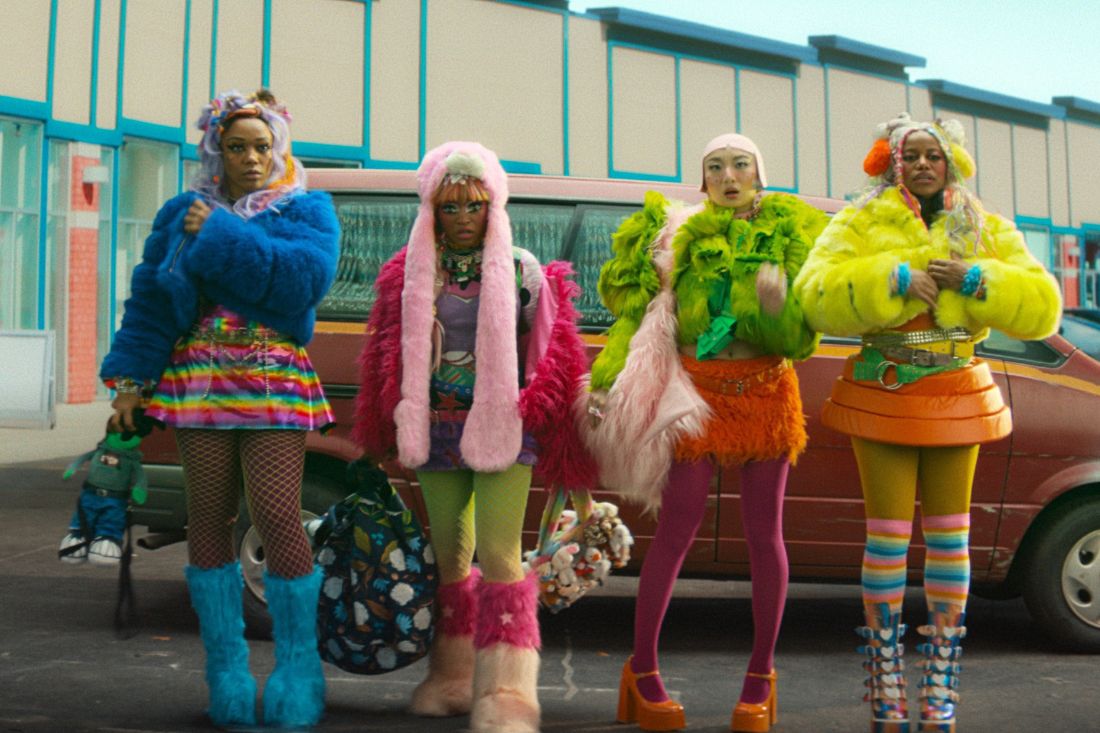
On paper, I Love Boosters sounds perfect for me: a fast-paced, visually striking film relying on practical effects. It follows the Velvet Gang, a group of resourceful young Black women who steal from designer Christie Smith (Demi Moore) to survive, selling the goods at lower prices. The story eventually blends into science fiction, highlighting the power of workers uniting against a harsh capitalist system. However, the film doesn’t quite live up to its potential. Despite its vibrant visuals, strong production design, and costumes, the script and dialogue feel heavy and awkward. It’s disappointing, because while the story is somewhat thin – lacking in character development and delivering familiar political messages – the film is undeniably exciting and visually stunning.
Riley’s films prioritize delivering a strong political message – supporting workers, unions, and community – over artistic storytelling, which actually weakens his impact. While he clearly wants a broad audience for his ideas, his characters feel underdeveloped. This might seem surprising given the incredible visual detail in I Love Boosters – from its impressive stop-motion animation and miniatures to its stunning special effects, costumes, and set design. Shirley Kurata’s vibrant costumes and Christopher Glass’s imaginative sets, like the rolling ball of stressors only one character can see, are particularly noteworthy, as is Natasha Braier’s creative cinematography. However, despite all this visual brilliance, the script feels lacking in heart and doesn’t offer the same level of care and detail as the film’s technical aspects. It’s a beautiful film, but it ultimately feels devoid of genuine human connection.
Taylor Palmer is usually a vibrant and funny performer, known for her natural delivery and playful humor. Her new film, I Love Boosters, includes some cartoonish, over-the-top gags, reminiscent of classic Looney Tunes cartoons. However, despite Palmer’s talent, the script feels heavy and prevents her from shining. The jokes don’t land as they should, and many feel forced or incomplete. The movie hints at Corvette’s loneliness and past troubles, but it doesn’t fully develop her character or explain what drives her to live in an abandoned fast-food restaurant. This lack of character development makes it difficult to connect with her emotionally. Consequently, a pivotal conflict between Corvette and her friend Sade feels flat, as we haven’t been given enough insight into who these women are or what their relationship means to them. The film struggles to create genuinely impactful moments because the characters feel like tools to deliver political messages rather than fully realized people.
Riley’s film boasts a strong cast, but the characters themselves feel underdeveloped. Taylour Paige delivers a quirky performance, with a bizarre ability to transform into another character played by Robin Thede during the heist scenes. Julianne Moore plays an irritating character embodying the self-importance of the creative class, while LaKeith Stanfield offers a delightfully strange, though somewhat random, side character. Eiza González is stuck with a lot of explanatory dialogue about a fantastical device and complex ideas. It’s a curious choice to give your least experienced actor the most challenging lines. Ultimately, Riley prioritizes plot and message over fully fleshed-out characters, which explains why the humor doesn’t always hit. Poppy Liu, as a Chinese factory worker, brings a welcome energy, but her storyline, while promising a look at cross-cultural solidarity, feels incomplete. The film’s ideas about community and struggle are admirable, but they lack the necessary detail and realism to truly resonate. More consistent humor would have helped tie everything together and forgiven many of the film’s flaws.
It’s interesting when a movie like I Love Boosters has positive political messages but still feels artistically unfulfilling. (By ‘good politics,’ I mean ideas that promote a hopeful future for the planet and prioritize compassion over domination.) It raises the question of whether it’s possible to create art that critiques capitalism within a system so heavily reliant on it. Can a film be well-intentioned but ultimately fall short in its execution? Can its political goals be worthwhile even if the story itself isn’t compelling? Personally, I believe a film needs to be emotionally and visually engaging first and foremost, and those elements should enhance the narrative. It’s not an unreasonable expectation – many leftist films succeed on both artistic and political levels. For example, Lina Wertmüller, a Marxist feminist filmmaker, created films in the 1970s, like A Night Full of Rain and Seven Beauties, that explored complex issues of gender, communism, and feminism. What made her films so powerful was her ability to bring those political ideas to life through compelling characters and stories. She showed how these ideas impacted everyday life and relationships, often with the help of actors like Giancarlo Giannini. I Love Boosters aims for a more playful and surreal style, but it doesn’t consistently succeed. While visually striking, it lacks the storytelling skills needed to truly connect with the audience.
In a 1982 interview, Toni Bambara explained that an artist’s purpose should be defined by the community they connect with. However, she pointed out that American society doesn’t typically see things that way. Instead, work that supports the existing economic system is considered true art, while anything challenging it is labeled as political, preachy, or even strange and unpleasant. I could easily make similar criticisms of Riley’s work, but that’s precisely what she intends: to create direct, unapologetic work that feels like propaganda, yet is also engaging. She wants to connect with people on a visceral level, acknowledging the struggles they’ve always known. Revolutions aren’t built on abstract ideas – they’re driven by real people with hopes, fears, and flaws. It’s people, not concepts, who feel deeply and strive for change, and that’s what makes a revolution feel both authentic and achievable.
Read More
- Netflix’s Little House On The Prairie Reboot: Release Date, Cast & Everything We Know
- Off Campus Season 1 Soundtrack Guide
- YouTuber arrested after viral AI bodycam videos spark real police complaints
- Silver Rate Forecast
- Prime Video’s New R-Rated Spy Thriller Is Officially No.1 On Streaming Despite Poor Reviews
- Gold Rate Forecast
- Brent Oil Forecast
- Peaky Blinders: The Immortal Man’s Tommy Shelby Is a Better Father Than Michael Corleone
- EUR ZAR PREDICTION
- Bulgakov’s Take: Koreans Bet the Farm on Chips, Crypto, and Chaos
2026-05-23 15:55