
It’s frustrating when you buy a new game you’ve been excited about, only to find out it’s not fun to play. With so many mixed reviews and sponsored content online, it’s hard to know what’s truly good. The key is to learn how to quickly understand what players are saying. By summarizing lots of opinions, you can get an honest view of a game’s pros and cons. This guide will teach you how to do just that – both by thinking critically and using helpful AI tools – so you can make smarter choices about the games you buy.
Key Takeaways
- Cut Through the Noise with Summaries: Use text summarization to quickly grasp the essential points from lengthy game reviews, patch notes, and community debates, helping you make better decisions without hours of reading.
- Know When to Use AI vs. Manual Methods: Let AI tools process massive amounts of player feedback for a quick community pulse check. Use your own manual approach to understand the specific nuances of a single professional review or a complex strategy guide.
- Focus on the Core Gaming Pillars: A truly useful summary provides a complete picture by covering the key elements of the player experience: gameplay mechanics, story, presentation, and overall performance.
What is Text Summarization and Why Should Gamers Care?
Let’s face it, most people don’t have the time to read lengthy reviews or watch long videos to decide if a new game is any good. You just want the key details – what’s fun, what’s not, and if the game tries to squeeze extra money out of you. That’s where summarizing text comes in handy. Essentially, it’s about taking a long piece of writing and turning it into a short, easy-to-understand version that still includes all the important information.
Gamers, this is a game-changer. It lets you quickly understand long and complicated things like update details, forum discussions, or lots of online reviews. Instead of spending ages figuring out what everyone thinks about a new update, a good summary gives you the key information in just a few minutes. This helps you make quicker and smarter choices about what to play and buy. And it’s not just useful for players – game developers also use summaries to sort through tons of feedback to see what needs improvement and what players are enjoying.
Manual vs. AI-Powered Summaries
Recommending a game to a friend – telling them whether it’s worth buying or skipping, and explaining why – is a form of summarizing. This personal approach is valuable because you can understand nuance, like humor or shared references, and describe how a game feels – something a computer struggles with. However, it’s time-consuming, and your own preferences can influence your opinion. For example, if you love role-playing games, you might unfairly criticize a shooter for not having a strong story. While your perspective is helpful, AI summarization offers speed and objectivity. It can quickly analyze tons of reviews and give you a clear, unbiased picture of what most people think.
When Summaries Are a Gamer’s Best Friend
Summaries are incredibly helpful in a few situations. If you’re unsure about buying a new game, a summary of reviews can quickly highlight the good and bad points, saving you time. For games that are constantly updated, like Warzone, summaries can cut through lengthy patch notes and tell you exactly what changed – which weapons were adjusted and what the new popular strategies are. This lets you quickly adapt and create a new setup. Finally, summaries are great for understanding what people are saying online. When a new update comes out and discussions explode on platforms like Reddit, a summary can give you the main points without having to read through tons of comments.
Summarizing Game Reviews by Hand: A Quick Guide
Sometimes, you just want to roll up your sleeves and figure things out yourself. While AI can spit out a summary in seconds, doing it manually gives you a ton of control and helps you really understand what people are saying. It’s a skill, and like any good gaming skill—whether it’s mastering a combo or learning a map—you can get better with practice. The key is to have a solid process so you’re not just staring at a wall of text and feeling overwhelmed. Think of it like breaking down a boss fight: you identify the patterns, focus on the weak points, and execute your strategy.
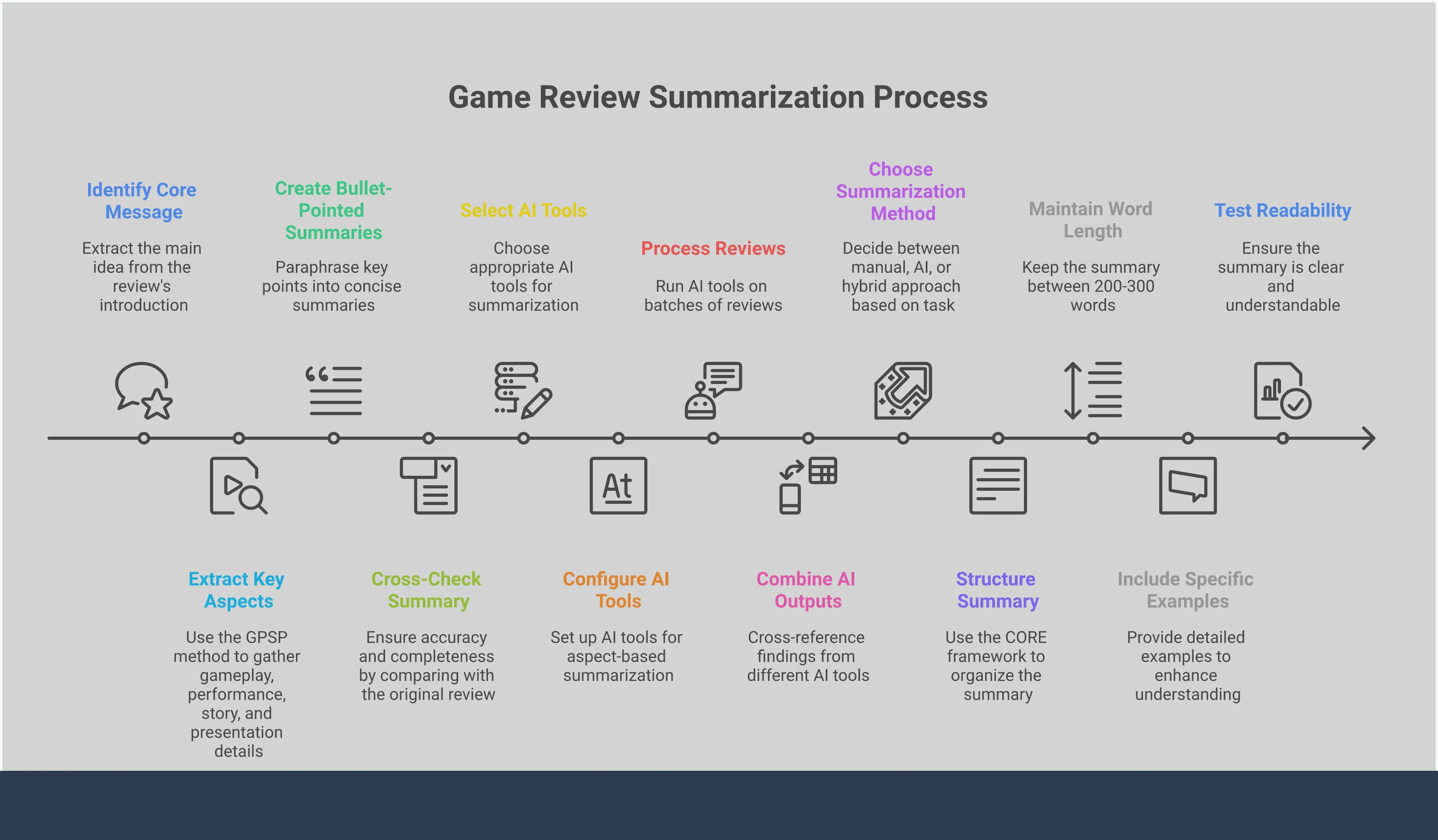
Writing your own summaries helps you truly understand what you’re reading. Instead of just quickly glancing over the text, you’re actively thinking about it, figuring out what it means, and deciding what’s most important. This lets you notice subtle details – like if someone is being sarcastic or really excited about something specific – that a computer might miss. It’s not just about getting the main idea; it’s about forming your own well-informed opinion. Here’s a simple guide to help you summarize reviews effectively, so you can easily understand what makes a game great.
Find the Core Message
Before diving into specifics, first figure out the overall impression. Is the reviewer happy, unhappy, or neutral? A strong summary begins by understanding the main point. Studies show it’s helpful to first identify what the reviews are discussing – the key topics or features. Think of it like finding the central argument or main goal of the review. For example, is the review highly positive about the story but critical of technical issues? Identifying this core theme will be your guide throughout the summary and help you accurately represent the reviewer’s meaning.
Zero in on Key Gaming Aspects
Now that you’ve identified the main point of the review, focus on the details. Most game reviews cover similar areas: how the game plays, its graphics, story, sound, and how well it runs. Your task is to find exactly what the reviewer said about these things. Finding these specific details is crucial for creating a good summary, and you don’t need complex tools to do it. Just read the review and note the author’s thoughts on things like fighting, the game’s world, characters, or music. This will make your summary truly helpful for other players.
Use Bullet Points to Keep it Clean
Nobody wants to read a dense block of text, especially when they’re trying to get information quickly. This is where bullet points become your best friend. They break up the information, making it scannable and easy to digest. In fact, many automated systems approach summarization through a process of sentence ranking followed by sentence selection. You can do the same thing manually. After you’ve identified the key aspects, organize them into a clean, bulleted list. This format is perfect for highlighting the pros and cons, letting readers see the game’s strengths and weaknesses at a glance without getting lost in the prose.
Master the Art of Paraphrasing
Don’t just copy and paste from the original review! A great summary means rewriting the reviewer’s ideas in your own words. This proves you understand the information and makes your summary read much better. Simply picking out what seem like the best sentences isn’t as effective – studies show it doesn’t always create the best result. For instance, instead of directly quoting something like, “The inventory management system is a convoluted mess,” you could say, “Players might find the inventory system difficult to use.” It conveys the same meaning but is more concise and fits seamlessly into your summary.
The Best AI Summarizers for Gamers
If you prefer playing games to reading about them, AI summarizers can be a lifesaver. They quickly condense long articles – like lengthy game reviews – into just the key information. It’s like getting a quick summary without having to search for one. This is a great way to quickly compare reviews or understand a game’s strengths and weaknesses before you buy it.
With so many choices available, a handful really shine due to how simple they are to use and how reliable their results are. They help you quickly find the important information you need as a gamer, filtering out everything else.
Grammarly’s Summarization Features
As a gamer, I already love using Grammarly, but I was blown away by how much more it does than just catch typos! It has these AI features that are seriously helpful, like a summarizer. I can take a long game review and get the key points in just a few seconds – no more sifting through tons of details! Seriously, instead of spending ages reading about a game’s backstory, I can get the gist in a couple of minutes and decide if it’s something I’m interested in. It’s a huge time-saver and helps me quickly figure out what games are worth checking out.
QuillBot’s Text Condensing Capabilities
If you need to quickly understand the main points of a text, QuillBot is a great option. It’s famous for paraphrasing, but its summarization tool is especially useful for things like articles and reviews. This helps you quickly find the most important information in game reviews, so you can decide if a game is worth playing. It’s also perfect for comparing opinions from different sources – you can quickly summarize each review with QuillBot and get a complete picture without spending hours reading.
Sourcely for Research Summaries
If you like to thoroughly research games before you buy them, Sourcely can help. It creates quick summaries of information gathered from game reviews, online forums, and Reddit, so you can easily understand what people are saying. Sourcely saves you time by highlighting the most important details, especially when it comes to things like the game’s ending or whether it includes in-game purchases. It helps you get a complete picture of how a game is being received before you decide to play.
A Look Under the Hood: How AI Summarizers Work
Have you ever wondered how AI can quickly summarize long game reviews? It’s not magic, but a fascinating technology. These tools essentially read and understand text, then condense it into a shorter version – much like a person would, but incredibly fast. Knowing how they work can help you use them even more effectively.
These tools work by separating essential information from unnecessary details – it’s like helping a computer focus on the most important task. They do this by analyzing language, pinpointing the main ideas, and then summarizing everything concisely. Let’s take a look at how these powerful tools actually work.
The Basics of Natural Language Processing
AI summarizers work thanks to a technology called Natural Language Processing, or NLP. Essentially, NLP helps computers understand human language, including things like slang and sarcasm. When you ask a summarizer to condense a game review, it uses NLP to break down the sentences, pinpoint important words (like “gameplay” or “story”), and figure out the overall feeling. It’s a difficult task, especially because gaming has its own specific language. Creating these AI systems requires a lot of training data, and it can be hard to find enough good-quality game reviews to teach them, making effective summarizers even more remarkable.
Extractive vs. Abstractive Summaries
AI summarizers typically work in one of two ways: by extracting information or by creating an abstract. An extractive summary is made by identifying the most important sentences in a text – think of it like highlighting the key parts. The AI scores each sentence, picks the highest-rated ones, and combines them to form a summary. It essentially pulls out important sentences directly from the original text.
An abstractive summary is a more sophisticated technique. Instead of simply pulling sentences directly from the review, it uses artificial intelligence to create entirely new sentences that convey the main points. Think of it like having a friend explain what’s good and bad about something in their own words. This usually leads to summaries that sound more natural and flow better, because the AI isn’t restricted to the original wording.
Aspect-Based Summarization for Gaming
Typical game reviews often give a general overview, which isn’t always the most helpful. Aspect-based summarization offers a better solution. It breaks down reviews into specific features of the game, like graphics, gameplay, story, and sound. Instead of reading one long summary, you get focused information about the things that matter most to you. This detailed approach helps you quickly understand a game’s strengths and weaknesses, so you can decide if it’s worth playing.
Why Summarizing Game Reviews Can Be Tricky
Summarizing a movie review is fairly straightforward, but game reviews are much more difficult. Games are interactive, detailed, and players feel very passionately about them. Whether you’re summarizing manually or with AI, you’ll face unique challenges. It’s not enough to just list what’s good and bad; you need to capture the feeling of a game that can take hundreds of hours to complete. A game’s quality depends on many things – how it plays, its technical performance, the story, the art, and even the player community. Reviews often focus on just one or two of these aspects, making it hard to create a well-rounded summary. You need to balance technical details with personal opinions and find the core truth. Recognizing these challenges is the first step to writing useful summaries for other gamers. The sheer number of opinions and the specific language gamers use make summarizing game reviews particularly tough.
Drowning in Information
Even though there are tons of game reviews online from places like Steam, Metacritic, and YouTube, it’s surprisingly hard to get a clear overall picture. AI struggles because most reviews aren’t neatly organized – good, useful data is actually hard to find. For people, the problem is wading through a huge number of short, unhelpful reviews to find the ones that really offer valuable opinions. It’s like searching for a rare item amidst a pile of common junk.
Balancing Deep Mechanics with Simple Explanations
Video games rely on complicated systems, but it’s hard to describe what it feels like to play them. Think about the precise timing of blocking in Sekiro, or creating the perfect weapon setup in Warzone. A good explanation needs to cover these complex details without using confusing technical terms. It’s a difficult balance to strike. Surprisingly, research suggests that even the most sophisticated AI doesn’t always do a better job of pinpointing what’s important than simpler approaches. Ultimately, the aim is to take technical elements—like character progression, item creation, and how combat works—and explain how they impact the player’s overall experience. This requires a genuine understanding of the game itself.
Staying Objective with Different Perspectives
Gamers feel strongly about the games they play, and their opinions are often very personal. Someone who enjoys relaxing farming games will likely have a different opinion than a player who prefers fast-paced, competitive shooters. This makes it hard to get a truly unbiased view. When summarizing player reactions, it’s important to show the full range of opinions, not just the loudest or most extreme ones. For example, when the trailer for the Diablo 4 expansion was released, fans had wildly different reactions. A good summary wouldn’t simply state that people were excited; it would show the combination of enthusiasm, doubt, and hopeful anticipation. The key is to find shared feelings within all those individual opinions.
Reading the Room: Sentiment Analysis
Gaming communities have a unique way of communicating, using memes, sarcasm, and references that others might not understand. This poses a challenge for AI trying to figure out if a review is positive or negative. For example, a sarcastic comment like, “I really enjoyed fighting a boss for three hours only to have it glitch at the very end,” could be mistakenly seen as positive. Experts have found that people often disagree on what makes a review good or bad, and current AI tools struggle with these subtle differences. To truly understand a review, you need to understand the culture – like recognizing the humor in a game like Palworld or knowing what popular slang terms like “poggers” mean.
How AI Can Level Up Your Review Game
Finding time to read tons of Steam reviews or watch long videos to pick a new game can be tough. That’s where AI can really help. It won’t replace your own judgment, but it can quickly give you the key information you need. Imagine having a research assistant that can scan thousands of opinions in seconds and give you the main points – that’s what AI can do.
As a gamer, I’m always checking reviews before I buy or after an update drops, but sifting through tons of comments takes forever. That’s where AI summaries have been a game-changer for me. Seriously, it cuts right to what people are actually saying – whether a game’s getting unfairly hammered with bad reviews or if that new patch finally fixed the lag. It means I spend way less time researching and a lot more time, you know, playing the game. It’s all about working smarter, not harder, and getting straight to the point.
Gain Speed and Efficiency
AI’s biggest benefit is how much time it saves. Instead of spending hours reading through player feedback on forums and reviews, AI-powered tools can summarize everything in seconds. They’re especially good at grouping similar comments together, so you can quickly see what people are praising and complaining about most – no more endless scrolling! This is incredibly useful when a new game launches or a major update comes out, allowing you to instantly understand how the community is reacting. It helps you spot trends and get a clear picture of what players generally think.
Analyze Community Feedback with Sentiment Analysis
AI can go beyond simply identifying what players are discussing and reveal how they feel. This process, called sentiment analysis, provides a strong way to grasp the overall mood of a game’s community. AI can analyze player reviews to determine whether the feedback is generally positive, negative, or neutral. It can even pinpoint specific emotions, like annoyance with glitches, enthusiasm for new content, or dissatisfaction with the plot. This provides a much more detailed understanding than a basic rating, allowing you to see the emotional reasons behind the feedback.
Spot Trends in User Opinions
Have you ever wanted to know exactly what players love or dislike about a game? Artificial intelligence can help with that! It’s really good at pinpointing specific features people are talking about – things like graphics, combat, the storyline, or multiplayer mode. AI can gather all the comments related to each of these areas and summarize what players think. This is great for finding patterns. For instance, you might learn that players dislike the main story but really enjoy a particular side quest – something you might not have noticed on your own.
Make Smarter Game Purchases
All of this information helps you decide how to spend your money and time more wisely. When AI summarizes game reviews, it highlights what players liked and disliked, letting you quickly see if a game is a good fit for you. For example, if you value a strong story, you can focus on that aspect in the summary. Getting a clear and brief overview of a game’s good and bad points means you can make smart choices and avoid regretting your purchase.
Manual vs. AI: When to Use Each Method
When it comes to summarizing reviews, the choice between doing it yourself and using AI isn’t about which is better, but which is most suitable. Both have advantages, and using the right one can save you time and give you a clearer understanding. It’s like choosing the right tool for a job – you wouldn’t use the wrong one! AI excels at quickly analyzing large volumes of text and identifying overall trends, making it ideal for understanding general public opinion. It can process thousands of comments in minutes, something a person simply couldn’t do.
However, reading and summarizing information yourself is best when you need to fully understand complicated plans or the specific feeling conveyed in a professional review. Humans are still better at understanding context and what something really means. Often, the best way to work is to use AI to quickly go through the information first, and then use your own judgment to analyze it thoroughly. Let’s look at some common gaming examples to see which method works best in different situations.
For Complex Gameplay and Strategies
If you want to really understand a new game strategy or a complicated character setup, a summary written by a person is usually best. While AI can quickly identify main ideas, it often misses the important details – like how specific equipment, skills, and playing styles work together. A human reader can figure out why a strategy is effective, not just that it exists. For complex things like the ideal setup in a game like Warzone, you need someone who can provide context and think critically to fully understand everything and improve your gameplay.
For Community Chats and Forum Posts
Want to know what players are saying about a new game update? AI can help! Instead of spending hours reading through Reddit and Discord, AI tools can quickly sort through all the comments and show you the most common praises and complaints. This gives you a clear overview of how players are reacting and helps you spot important trends – like a sudden increase in reports about a bug or a popular new meme – without getting overwhelmed by the sheer volume of discussion. It’s a fast way to understand what the community thinks.
For Professional Game Journalism
Professional game reviews are unique because of the writer’s style, how they’re organized, and their personal opinions. While AI can pick out important details, it usually misses the reviewer’s individual voice and how they felt about the game. That’s why reading these reviews requires a human touch. It lets you understand the reviewer’s reasoning, consider the good and bad points as they intended, and ultimately decide if the game is worth playing – something an AI can’t quite capture.
The Anatomy of a Great Gaming Summary
What makes a good game summary truly useful? It’s not just about keeping it brief, but being insightful. A great summary quickly guides you to the essential information, like a clear signpost, without wasting your time on unimportant details. It values your time and helps you decide if the game is worth playing – and dedicating your weekend to.
Creating a great summary is like building the ideal setup for a game. You need the right pieces working together to achieve the best result. A strong summary is well-rounded, covering all the important details without being too lengthy. It should clearly explain how the game plays, the overall feel of the story, and what players are talking about. When you get those elements right, your summary will be both helpful and insightful.
Finding the Right Length
There’s no perfect length for summarizing a game review. You need to find a balance – enough detail to be helpful, but short enough to read quickly. Aim for a couple of focused paragraphs that hit the key points. It should be more than just a quick opinion, but definitely not a long, detailed essay.
The goal is to describe what makes the game special without getting bogged down in details. A good summary should cover how the game is played, its story and visual style, and give you an idea of its overall quality – is it smooth and refined, or full of problems? If you can answer those questions clearly in around 200-300 words, you’ve likely written a solid summary.
Must-Have Elements for Any Game Summary
Every solid game summary should touch on a few key pillars. Think of these as the essential stats for any game. First up is gameplay: What do you actually do in the game? Cover the core loop, combat, and any unique mechanics. Next, hit the presentation—this includes graphics, art style, and sound design. Sometimes, a game’s underrated soundtrack can be a major selling point.
Remember to include the game’s story and general atmosphere. Is it a serious, intense role-playing game, or a cheerful, relaxing farming simulator? Also, consider how players feel while playing – are they excited, annoyed, or let down? A truly effective summary combines these details to give readers a clear sense of what it’s like to actually play the game.
Common Mistakes That Kill Readability
A summary quickly falls apart when it doesn’t make sense. This often happens if you simply grab sentences from a longer piece and put them together without considering how they connect. The result is a summary that feels jumpy and is difficult to understand. A strong summary should read smoothly, connecting ideas and essentially telling a brief story about the game.
A frequent error is using vague language or overused phrases. Statements like “fun for hours” or “a must-play for fans” aren’t very informative. Be specific instead! For example, instead of saying “fun combat,” describe it as “fast-paced combat that rewards precise timing.” Adding personal insights and focusing on clear, detailed descriptions will make your summary much more helpful and easier to understand.
How to Get Better at Summarizing Game Content
Becoming a skilled summarizer takes effort, just like learning anything new. It involves teaching yourself to identify the most crucial details and express them briefly. Whether you’re recommending a game to friends or writing reviews, improving this skill will help you make your ideas clearer and more persuasive. The best way to get better is to practice regularly and focus on developing a few key habits, which will quickly improve how you analyze and share information about games.
Practice Daily with Different Genres
Becoming a skilled summarizer requires practice with different kinds of games. What’s important in a review of a large role-playing game like Diablo 4 isn’t the same as what matters in a fast-action shooter. Each game genre has its own unique features and what players expect to see. By summarizing various game types – for example, a relaxing farming game one day and a competitive battle royale guide the next – you’ll get better at quickly recognizing the most important aspects, like how varied the gameplay is, how well the game’s levels are designed, or how engaging the story is. This variety helps you focus on what truly defines each gaming experience.
Check Your Own Work for Accuracy
A summary is only useful if it’s accurate. After you write one, take a minute to compare it against the original review. Did you capture the author’s overall sentiment correctly, or did you accidentally misrepresent their opinion? Accuracy is crucial because it ensures you’re conveying the key feelings and features of the game properly. This self-review process is your best defense against missing a critical detail, like a major bug or a standout feature. It’s easy to get the gist of an article, but a great summary also reflects the nuance, capturing the excitement or disappointment that fans might be feeling. Always ask yourself: If someone only read my summary, would they get a true sense of the original review?
Related Articles
- Deus Ex LFG: Connect with Other Augs in LFG Feature on Z League App
Frequently Asked Questions
Should you summarize game reviews yourself, or use an AI tool? There’s no simple answer – it depends on your goal. If you need a fast overview of many opinions, like hundreds of comments on Reddit after an update, an AI tool is perfect. It can quickly handle large amounts of text. However, if you’re trying to deeply understand a detailed guide or a thoughtful review from a source you trust, summarizing it yourself is better. Your brain excels at recognizing subtle cues like tone, sarcasm, and the specific details that make a strategy effective.
It’s natural to wonder if AI can truly understand the unique language gamers use, including slang and inside jokes. While AI is becoming very intelligent, it still struggles with these nuances. Things like sarcasm are particularly difficult for AI to detect – a comment complaining about server issues might be mistakenly seen as positive. Because of this, it’s best to use AI summaries as a general overview of what people are saying, rather than as completely accurate information.
When writing a game summary, focus on the most important aspects. First, describe the gameplay – what does the player do and how enjoyable is it? Next, cover how the game looks and sounds, including the graphics, art style, and sound design. Briefly explain the story or main idea, as this shapes the game’s atmosphere. Finally, capture the reviewer’s overall feeling – were they excited, annoyed, or indifferent? Covering these points will give readers a clear and helpful overview of the game.
You might be wondering why you should summarize reviews yourself when AI can do it for you. The reason is that summarizing helps you develop a more thoughtful and well-informed opinion. When you do it yourself, you really dig into the review, noticing the reviewer’s perspective and any hidden meanings. This process helps you decide what’s truly important to you in a game, ultimately helping you choose wisely and spend your time and money on games you’ll actually enjoy. It’s not just about creating a summary; it’s about improving your critical thinking skills.
Worried an AI will just give you a dull, basic summary of a game? While some simple AI tools can be a little boring, the better ones are much more advanced. Many now use a technique called aspect-based summarization, which is great for gamers. Instead of a long, single paragraph, these tools break down the summary into sections like “Gameplay,” “Graphics,” and “Story.” This allows you to quickly find the information you want and get a clear, organized understanding of what a game does well and where it falls short.
Read More
- United Airlines can now kick passengers off flights and ban them for not using headphones
- All Golden Ball Locations in Yakuza Kiwami 3 & Dark Ties
- 15 Lost Disney Movies That Will Never Be Released
- Best Zombie Movies (October 2025)
- Every Major Assassin’s Creed DLC, Ranked
- Adolescence’s Co-Creator Is Making A Lord Of The Flies Show. Everything We Know About The Book-To-Screen Adaptation
- These are the 25 best PlayStation 5 games
- How To Find The Uxantis Buried Treasure In GreedFall: The Dying World
- How to Get to the Undercoast in Esoteric Ebb
- What are the Minecraft Far Lands & how to get there
2025-12-26 15:07