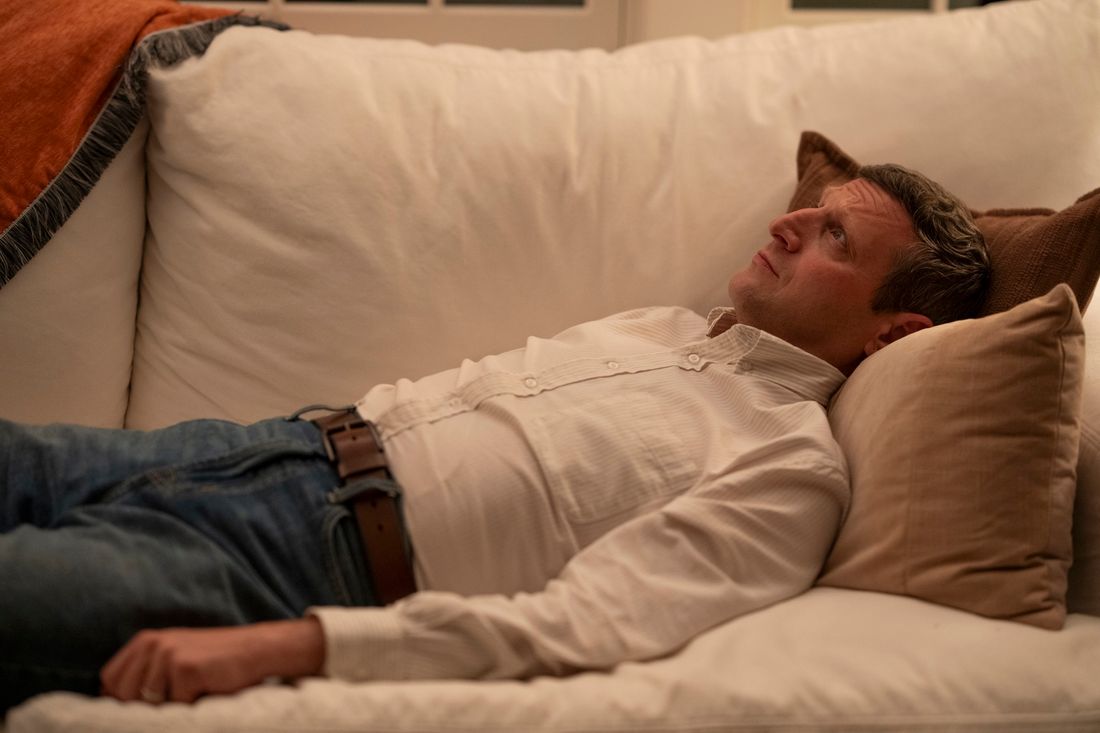
The season finale of The Chair Company left viewers hanging, but perhaps that was inevitable given HBO’s early decision to renew the show. The series proved to be a surprising hit, becoming HBO Max’s most popular new comedy with an average of 3.3 million American viewers per episode. It’s a remarkable success for such an unusual show, centered around Tim Robinson’s character, Ron Trosper, an eccentric office worker whose fixation on a broken chair and a small embarrassment leads him on a bizarre journey. This odyssey involves run-down buildings, a shadowy company called Red Ball Market Global, a creepy figure named Mike Santini, and even the politics of small-town Ohio.
I really enjoy The Chair Company, but I honestly didn’t expect it to become so popular – I thought it would appeal to a much smaller audience. Its longer, ongoing format naturally limits how quickly it could spread, especially compared to the instantly shareable sketches of I Think You Should Leave. Is the show’s success simply due to Robinson’s popularity? Or do Robinson, Kanin, and the team have a knack for creating content that really sticks with you – those phrases (“Wake-y, wake-y, first day with the moooneyyy…”) and characters (Mike Santini, the late Ruben Rabasa from the “Focus Group” sketch) that burrow into your mind? It’s hard to say exactly why the show resonated so well, but however it happened, its renewal brings up a key question: how will the show maintain this momentum in a second season? Will the conspiracy expand internationally? Will Ron get a new case to solve?
These questions apply to a standard TV show, and if anything about The Chair Company seems predictable, I’m curious what you’re seeing. The season finale, “Minnie Mouse Coming Back Wasn’t on My Bingo Card,” doesn’t solve the central mystery, but sends Ron off on a new path that might or might not be connected to what he’s been investigating. The previous episode, “I Said to My Dog, ‘How Do You Like My Hippie Shirt?,’” revealed a conspiracy surrounding the Tecca office chairs and identified Alice Quintana, a purchasing director, as the importer – she’s also a major investor in Ron’s wife Barb’s new business. The finale begins with Ron briefly trying to give up his investigation. He’s worried about Barb’s happiness and whether pursuing the truth is worth it, so he attempts to return to a normal life, though he’s been effectively demoted at Fisher Robay after a small fight with his boss, Jeff. He focuses on supporting his family and starts thinking about what would truly make him happy.
The brief respite Ron finds doesn’t last long. He’s relentlessly driven by the conspiracy he’s uncovered. Things get even more complicated when he learns his new dog, Baby, isn’t actually his – she ran away from her previous owner. He returns Baby, only to find out through social media that the owner is abusive, and possibly even a vampire with a bizarre new form. Later, thanks to Jeff’s awkward attempt to impress Ron with karaoke, he discovers the conspiracy also involves Fisher Robay. However, the episode doesn’t end there. It concludes at Ron’s high school, where a strange man reveals that Ron’s embarrassing chair collapse wasn’t an accident. It was deliberately caused by Amanda, a coworker and former classmate who still holds a grudge over a silly incident – Ron accidentally launched a gummy bear into her chest years ago. The man, Amanda’s boyfriend, claims she used her mind to dismantle the chair.
Even if you’ve watched the finale and the entire season, does anything actually make sense? Does it give you any idea where the show is going? While the episode hints at what season two might be like, it doesn’t really clarify much. Ron’s story isn’t over, as the conspiracy turns out to be much larger than a simple local fraud, and it seems to be connected to Jeff and a mysterious organization called Red Ball Market Global. Plus, Amanda’s boyfriend revealing her possible telekinetic powers could give Ron a new path to follow. We also learn Mike isn’t who he seemed to be. However, none of these reveals truly resolve anything from earlier in the season. So even if Jeff is involved in Red Ball Market Global, what does it all mean? Throughout the season, the show has been so strange and unclear that a straightforward explanation would feel disappointing or go against the show’s core nature. The point isn’t really to solve the mystery of the faulty office chair or the local corruption.
Basically, you can expect season two to continue in the same vein as the first – the central mystery, even if it doesn’t fully add up, will keep driving the story forward. Without it, the show would feel more like a series of disconnected comedic bits. The creators are clearly far more interested in exploring Ron’s character, his fixation, the quirky world they’ve built, and creating funny moments from the show’s intense and unsettling atmosphere than they are in actually solving the puzzle.
I’m usually hesitant to call creators like Robinson “new philosopher kings” or compare current shows to Twin Peaks… but in this case, the comparison is unavoidable. Twin Peaks initially grabbed viewers with the mystery of who killed Laura Palmer, but it was the atmosphere – the redwood forests, the diner, the unsettling feeling that something was always lurking – that truly captivated audiences. While the show eventually solved the central mystery (Laura’s father was the killer), it then introduced illogical and supernatural explanations, transforming a simple whodunit into something far more complex. This ambiguity sparked years of analysis and interpretation, which David Lynch and Mark Frost continued to build upon in Twin Peaks: The Return. Ultimately, all those layers felt like an attempt to impose order on Lynch’s raw, intuitive vision, subtly shaped by Frost, and presented on screen.
Similarly, The Chair Company feels less like a tightly plotted story and more like a series of funny scenes connected by an overarching narrative. Like Twin Peaks, the show doesn’t aim to neatly solve its central mystery; it thrives on illogical and surreal events. When you add moments like Amanda seemingly breaking a chair with her mind and Ron’s possible encounter with a ghostly figure, the show deliberately blurs the line between what’s real and what isn’t.
Without a clear way to understand it, we naturally start to wonder what The Chair Company is truly about. Over the years, people have interpreted Robinson’s work in many different ways – as a commentary on living in a society with unclear rules, the anxieties surrounding social norms, and even masculinity. While all of those themes are present, the show explores much more. It’s deeply rooted in a midwestern sensibility, exemplified by the father in episode eight – a proud, humble business owner who also craves more recognition. I believe Ron’s frustrations with modern life – his complaints about poor quality and the inability to voice concerns – are central to the show’s meaning. He repeatedly expresses this feeling, highlighting a sense of helplessness and dissatisfaction.
The beauty of these different interpretations is that they all work, because The Chair Company is deliberately open to multiple meanings. I don’t even think the creators fully realized the show’s recurring themes. But exploring all the possibilities is much more rewarding than trying to solve a simple mystery, like figuring out who owns Red Ball Market Global. Perhaps that’s why The Chair Company stays with you – it allows your mind to wander and embrace complexity, freeing you from the need for concrete answers, and giving you the sense that you’re experiencing something truly special.
Read More
- United Airlines can now kick passengers off flights and ban them for not using headphones
- Crimson Desert: Disconnected Truth Puzzle Guide
- All 9 Coalition Heroes In Invincible Season 4 & Their Powers
- Mewgenics vinyl limited editions now available to pre-order
- Grey’s Anatomy Season 23 Confirmed for 2026-2027 Broadcast Season
- Assassin’s Creed Shadows will get upgraded PSSR support on PS5 Pro with Title Update 1.1.9 launching April 7
- Viral Letterboxd keychain lets cinephiles show off their favorite movies on the go
- The Original Resident Evil is Finally Available on Steam
- Crimson Desert Guide – How to Pay Fines, Bounties & Debt
- Does Mark survive Invincible vs Conquest 2? Comics reveal fate after S4E5
2025-12-02 20:55