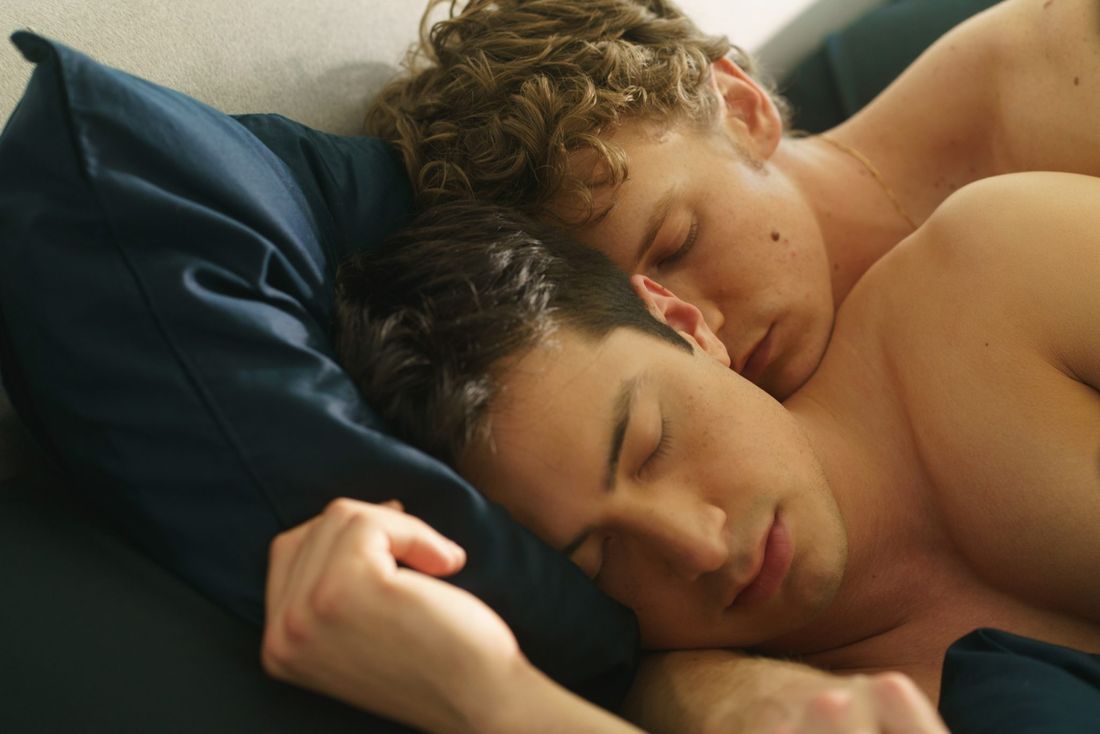
A wave of excited screams filled the Clapham Grand in South London at the first of what would become a weekly club night called Heated Rivalry. Even before the party officially began, as people in hockey jerseys started arriving on the dance floor, a familiar song started playing. It wasn’t a popular dance track like t.A.T.u.’s “All the Things She Said” or Wet Leg’s “mangetout,” but rather “Rivalry,” the intense opening theme from the electronic score composed by Peter Jones (who uses the stage name Peter Peter) for the series.
Jones created a soundscape for the show using atmospheric synths and strong drumbeats, reflecting the competitive spirit while also capturing its emotional core with delicate melodies. The Canadian synth-pop musician, who composed the music for the sports romance, says he intentionally aimed for a subtle approach. “I wanted the music to support the story without being overly noticeable,” he explains.
Before working on Heated Rivalry, Jones had released five albums but hadn’t received any credit as a composer. However, the show’s creator, Jacob Tierney, was a big fan of Jones’s music, especially the 2024 album Éther, and actually wrote the scripts while listening to it. Tierney first asked Jones to create both an original score and to include some of his existing songs from the album. However, the plans didn’t quite work out due to scheduling issues. As talks stalled, the idea of using pre-recorded songs was dropped, and Jones ended up composing a lot of original music – dozens of cues – for the show’s six episodes.
As a fan, I was so excited for Heated Rivalry, but I had no idea how quickly everything came together! The composer, Jones, told me the release date got moved up, and suddenly he was under immense pressure. He basically had just ten days to finish the first episode, which meant around seven to ten days per episode for the whole series – about seven weeks total! Luckily, the director, Tierney, gave him creative freedom while staying really involved. Jones would upload rough drafts directly to a shared folder for quick feedback. He even joked that he wasn’t sure if that’s how things are usually done in TV, but they just didn’t have time for anything else. Honestly, as a first project, Heated Rivalry was an incredible challenge for him, and he wouldn’t trade the experience for anything – he called it a ‘hell of a first gig’!
First Drafts
Jones initially wrote the music based only on the screenplay, but he realized his approach was off once he saw the filmed scenes. He explains that he anticipated being asked to create music with a strong sexual vibe, but the actual intimate moments were much more emotionally driven. He quickly understood that a simple, driving techno beat wouldn’t fit. His first attempt felt too aggressive and even crude, so he switched to gentler melodies and softer synth arrangements to create a more delicate atmosphere.
I remember when he first looked at the project, he thought he’d be writing a lot of music! He told me about how the script called for scoring the entire nightclub scene with t.A.T.u.’s ‘All the Things She Said,’ but ultimately, they didn’t need him for that part. Luckily, the spotting sessions – where he’d watch the footage with the director and figure out what needed original music – helped him understand exactly how much scoring was actually required. It was good to get that clarified!
Jones used a wide range of instruments to create the music, each with a specific purpose. He described his Access Virus synthesizer as incredibly versatile, using it to create rich, atmospheric chords. For melodies and bass lines, he preferred the classic sound of analog synthesizers like the Korg Mono/Poly and Juno-60. He programmed drum beats on an Elektron Analog Rytm drum machine, and used a Hapax sequencer to build the overall arrangements. To record the music, Jones synchronized Logic Pro software with the video footage, allowing him to improvise in real time while watching the scenes. This setup let him focus on playing the instruments rather than the recording process, capturing spontaneous performances.
Shane and Ilya’s First Time: “It’s You”
A song called “Lisbonne” didn’t make it into the final version of the Éther soundtrack, but it was originally intended to play during a key intimate scene between characters Shane and Ilya. Instead, the creator wrote a new song, “It’s You,” with lyrical suggestions from another collaborator. He surprisingly wrote and produced the entire track in just one night, starting with a synth arpeggio and building from there. The song’s soft vocals capture the unspoken feelings between Shane and Ilya, hinting that their connection has become something more than just a casual fling, with lyrics like “Stay right here / Don’t ever leave.”
When Jones was creating new music, he felt the pressure to match the emotional impact of his song “Lisbonne,” but he didn’t have the same amount of time to refine it. He jokingly says it felt like he needed to outdo his own work. Some of his earlier, unused musical ideas still appear in unexpected places. For example, a track called “Ciel,” from his album Éther, was originally written for an All-Star Game in Tampa, but now it’s the name of the nightclub where characters Shane and Ilya share a meaningful look in the fourth episode.
The Vegas Bathroom: “Let’s Make a Deal”
While the score often features energetic electronic sounds, the piano provides a softer touch for the show’s more personal scenes. Composer Jones drew inspiration from a surprising source: the soap opera The Young and the Restless. He noticed the show’s piano music was very emotional and felt it would add a romantic quality to the series. “I wanted to include something sensitive – not just electronic dance music,” Jones explains. He even titled a theme for the characters Scott and Kip “Young and Restless,” which plays after a tense moment between them in episode three, “Hunter.”
During the bathroom scene with Shane and Ilya at the Vegas awards show, the music simplifies to gentle piano chords that sound like they’re reverberating off the tiles. Composer Jones achieved this “warped piano” effect by processing the notes through a sound-altering device. As Ilya makes his offer to Shane, the music uses a sustained, unresolved chord to build tension. According to Jones, this musical choice mirrored Ilya’s manipulative hold over Shane, deliberately avoiding a resolution to reflect the power dynamic.
The Vegas Hotel Room: “Inferno”
Following Shane’s loss to Ilya, they head back to Ilya’s penthouse for sex, which isn’t as gentle as their first time together. During the encounter, the song “Inferno”—a high-energy track reminiscent of the movie Challengers—plays, and it’s likely to become a popular anthem at Heated Rivalry club events.
Even though Jones initially leaned towards fast-paced electronic dance music, he ultimately chose a slower approach. “It’s more slow techno,” he explains. He originally considered a tempo of 130 beats per minute, but settled on 90 or 100 for the track, ‘Inferno,’ because it better suited the show’s atmosphere. The four-minute piece gradually builds with layers of sound—starting with a low bass and a single drumbeat, then adding a distinctive synth riff he calls “hacker synth”—mirroring the rising intensity of the scene. Each strong beat heightens the tension until it’s almost unbearable. “I wanted to create both excitement and a sense of uncertainty, reflecting the complex relationship between the characters,” Jones says.
Couch Sex: “Heartbeat”
While many of the initial musical ideas Jones created were cut, the “Heartbeat” theme remained a consistent element from the beginning. This romantic series of four musical cues reappears throughout the series to highlight intimate moments. The chords themselves stay the same each time, but the instrumentation and arrangement change. “Heartbeat I” features a lively synth melody when Shane and Ilya reconnect after a long separation in the first episode. Later, the fast, descending notes of “Heartbeat II” play when Ilya sends Shane a flirty text before a game. “Heartbeat III,” famously used during the tuna-melt scene, changes speed and builds to a peak. Jones considers it a key musical element in Shane and Ilya’s relationship, explaining, “It just sounds like love, and I wanted the chords to reflect how their love changed – like their hearts beating in sync.”
Scott and Kip: “La Nuit Est Longue”
When I first got my hands on the scripts, Scott and Kip’s story – you know, the hockey player and the barista – it wasn’t meant to be its own episode. It was woven into two existing ones. But as the show’s structure evolved, I realized Scott and Kip needed their own unique sound. I wanted to really set them apart from Shane and Ilya, so I brought in the guitar. It’s funny, I actually used the theme from ‘The Young and Restless’ as a starting point! The original was a piano piece, but I adapted it for electric guitar and layered some synths over it to create something special for them.
The track “La Nuit Est Longue” is another key piece of music, offering a hopeful sound with its consistent electronic drums, cymbals, and pads. It plays during Scott and Kip’s first night together. While musically different from the sounds associated with Shane and Ilya, composer Jones intentionally connected it to earlier music. “It uses the same chords as ‘Heartbeat,’” he says, “but with a different rhythm and arrangement. I wanted a subtle connection, something not immediately obvious, so I intentionally made it a bit ambiguous.”
The Cottage: “Two Souls” Become “One Soul”
The argument between Shane and Ilya on a Las Vegas rooftop at the end of their first year is underscored by the song “Two Souls,” which uses melancholic horns and a building, repeating beat to convey their sadness and regret. This musical theme reappears later in the season as a gentler version, “One Soul.” This acoustic rendition, featuring a romantic piano melody composed by Jones, is first hinted at when Ilya tells Shane he loves him over the phone in Russian. The full version of “One Soul” plays at Shane’s cabin the morning after they both confess their feelings.
Jones originally wrote a different piece of music for the cottage scene, but Tierney loved the instrumental track “Two Souls” and suggested using it instead. This track is actually a musical version of a song Jones had previously written with lyrics and guitar, though he hasn’t released it yet, but may revisit it later. While deciding on track titles, Jones realized the connection: the rooftop scene represented a couple in love but kept apart, while the cottage scene brought Shane and Ilya together. He explains, “They truly become one at the end.”
Coming Out: “Utopie”
As the season ends, the music becomes deliberately minimal. Jones notes that the tempo slows down significantly, and that these moments of silence are crucial. Just like sound, silence contributes to the atmosphere of a scene. In the final episode, “The Cottage,” this quietness builds suspense, making the audience wonder when the isolation of Shane and Ilya will be broken.
The moment is interrupted when Shane’s father walks in on him kissing Ilya. Back at his parents’ house, Shane nervously comes out to them with Ilya at his side. Later, he steps outside where his mother apologizes for not creating an environment where he felt comfortable being himself. The scene uses the song “Utopie,” a calming and gentle piece that feels like something you’d hear at a spa. Interestingly, this same music played earlier in the episode, “Rose,” when Shane and Ilya were shown waking up and cuddling.
Jones highlighted two scenes – the warm acceptance from Shane’s parents and a brief, happy afternoon at home – as a taste of the life Shane could have had. He described these as fleeting but perfect moments. “It felt like they were on the verge of having the perfect life,” Jones explained. “For a little while, they weren’t worried about what anyone thought of them, and they felt truly free.”
Read More
- United Airlines can now kick passengers off flights and ban them for not using headphones
- All Itzaland Animal Locations in Infinity Nikki
- Katanire’s Yae Miko Cosplay: Genshin Impact Masterpiece
- Crimson Desert: Disconnected Truth Puzzle Guide
- How to Get to the Undercoast in Esoteric Ebb
- All Golden Ball Locations in Yakuza Kiwami 3 & Dark Ties
- BloxStrike codes (March 2026)
- How to Complete Bloom of Tranquility Challenge in Infinity Nikki
- 6 Ways Invincible Season 4’s Hell Episode Rewrites The Comics
- Superman/Spider-Man #1 Review: Bigger DC-Marvel Crossovers Teased
2026-02-18 17:58