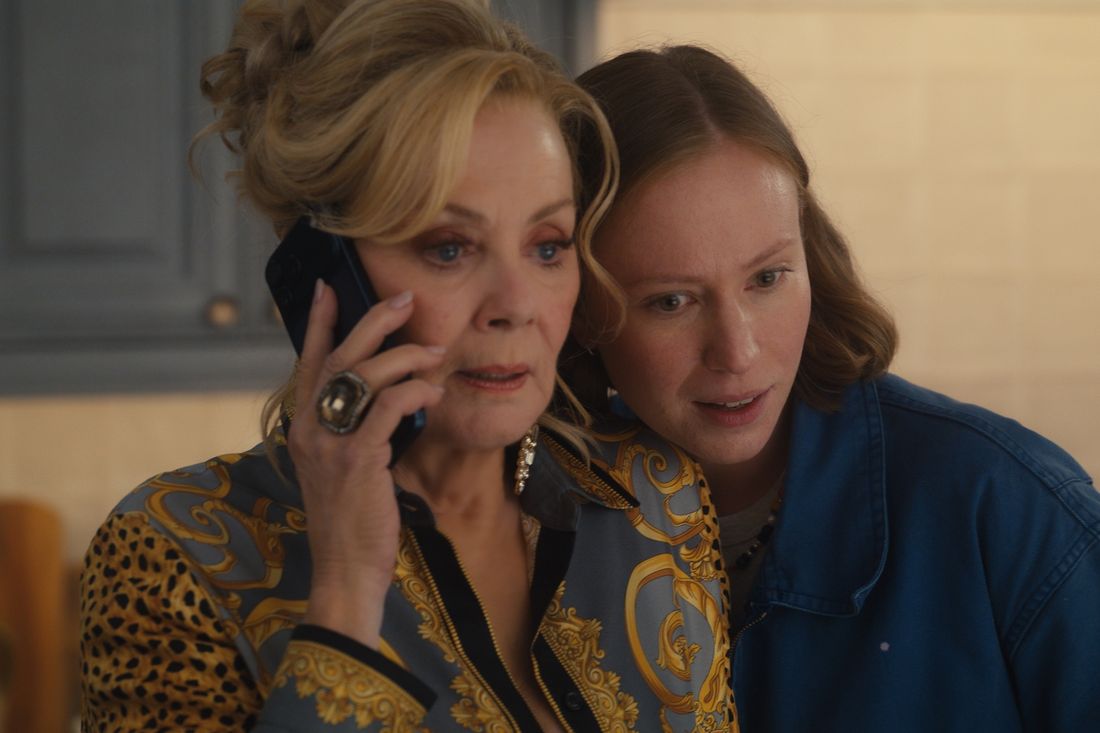
During its five seasons, Hacks has received numerous awards, including Emmys and a Peabody, and earned praise from both critics and viewers. It’s boosted the careers of Jean Smart, Hannah Einbinder, and Megan Stalter, and, like The Studio, it’s the type of show that the entertainment industry enjoys because it offers praise alongside gentle criticism. As the show has evolved, it’s become more heartfelt. The final season retains the original themes of female friendship, feminist ideals, and features more genuine emotion and self-appreciation than before. The show celebrates storytelling as an important art, portrays the relationship between managers and their clients as almost sacred, and depicts fans as simply grateful to be connected to someone famous. Deb and Ava continue to challenge male dominance, and now, the larger systems of power. These are the familiar themes Hacks consistently explores, and this season—even while addressing free speech and media consolidation—feels like a catchy but familiar tune, a fresh take on a well-known refrain.
I’ve been following Hacks since the beginning, and it’s fascinating to see how much the show has evolved. It started as this wonderfully barbed battle between Deborah Vance, a comedy legend past her prime, and Ava, a struggling writer. Then it settled into a comfortable groove of these two women working together. But Season Four really shook things up, showing us the emptiness that can come with achieving ‘success’ – especially when Deborah landed a late-night gig and then bravely walked away from a controlling, and frankly awful, billionaire boss. What I’ve noticed over the seasons is that the show’s initial, sharp satire of the Hollywood scene has softened. It feels like the creators are less willing to truly critique the people they now work alongside. Season Five doubles down on this shift, turning its attention away from comedians and actors and instead focusing its fire on the executives – the Bobs of the world – and the systemic issues of mismanagement and unchecked power that plague the industry. It makes you wonder if talent even matters anymore, or if it’s all just about who’s at the top.
For years, the show Hacks has explored what ‘fairness’ even means in the often superficial and illogical world of entertainment, specifically questioning if a comedian like Deborah – a talented woman whose work was wrongly credited to men for years – could truly become a mainstream success. Now, with the character of Bob acting as a villain embodying the worst traits of powerful media figures, Hacks positions Deborah’s strength not just as admirable, but as a matter of principle. She represents free expression, female empowerment, and independence, refusing to be limited by men, corporations, or age. In its final season, the show argues that comedy is a vital tool against oppression. It’s a bit ironic to think of someone with so much privilege – designer gowns and a massive estate – as a rebel against the system, but the show seems to suggest that’s exactly what Deborah is, and even Jimmy Kimmel might agree.
At the close of season four, Deb left her late-night show to shield Ava after Ava revealed that Bob had made Deb remove a joke about an actor’s past misconduct. The network, wanting to protect a movie career of Ethan Sommers, initially limited what Deb could ask, then forced her to cut the moment from the interview. Ava complained to a former colleague, a journalist who had previously broken a big story, and Bob then demanded Deb fire Ava. When Deb refused, Bob reminded her of a strict clause in her contract: she wouldn’t be allowed to perform live comedy for 18 months. As season five begins, Deb is determined to take control of the story. Bob has spent months damaging her reputation through his media outlets, so Deb plans a comeback show at Madison Square Garden, where she’ll expose how he silenced her.
Deb is juggling writing new stand-up routines with Ava and overseeing a hotel renovation in Las Vegas alongside her trusted advisor, Marcus. Meanwhile, back in California, Jimmy and Kayla are working to grow their agency and facing tough competition from Kayla’s father, Michael, who, like Bob, belittles anyone who challenges him. This season is a classic underdog story, but Deb, Ava, and Kayla are anything but traditional. Deb’s rocking a huge hairstyle, Ava keeps mentioning “the working class,” and Kayla has a very unique (and colorful) way of describing how to handle her enemies.
The show Hacks often balances outlandish humor with a sense of moral superiority, playfully mocking its characters’ ridiculous behavior before quickly justifying their actions. In the season five premiere, a character named Randi essentially lays out the show’s core idea: Hollywood is a uniquely American blend of culture, business, art, and history. This season, Hacks defends free speech not by directly confronting those who try to limit it, but by championing comedy itself. The show downplays direct conflict; a character attempting to exploit Deb and Ava’s work with AI appears briefly, and a decision to remove Deb’s content from streaming services is only briefly discussed. Hacks focuses more on demonstrating how to overcome injustice than dwelling on its frustrations. This season also differs from previous ones by starting with Deb and Ava already working together, avoiding the familiar pattern of separation and eventual reconciliation, allowing each episode to explore different paths toward progress.
In the latest episode of Hacks, the show continues its trend of both playfully criticizing and genuinely appreciating the entertainment industry. We see this dynamic play out when Tony Kushner, a renowned playwright, humorously dismisses Deb’s request for him to quickly write her memoir, but later helps her and Ava recognize the significant impact of her early television work on Who’s Making Dinner?. Meanwhile, Deb’s over-the-top idea for a massive sculpture of herself outside her new hotel sparks some funny conversation. The hotel renovation also leads to the creation of a new comedy club aimed at supporting up-and-coming comedians. Hacks is increasingly focused on the people who keep working within the industry, like Ava, who’s tasked with writing scripts that meet increasingly specific (and sometimes contradictory) demands, and Jimmy, who tirelessly searches for new talent. The show suggests that, in this world, any effort – even a comedy routine – can be a meaningful act, and the results are always worth the struggle.
Whether you’ll enjoy this new direction depends on how you feel about the show’s mix of playful jabs and genuine support, and if you’ll get tired of how perfectly nice everyone is becoming. (It’s surprisingly jarring to learn Deb once made a mildly insensitive joke about a lesbian comedian, given how much her rough edges have been smoothed over.) The series really focuses on how Deb’s energy inspires those around her, and uses their changes as a way to convince the audience. Most of the season’s excellent guest stars, especially Cherry Jones and Leslie Bibb, rally around Deb’s goals and give her even more confidence, which feels a bit like the show is unfairly influencing our opinion. While Deb’s jokes about being a woman at the top of a “hierarchy of suffering,” above historical figures like Joan of Arc and Malala Yousafzai, aren’t always hilarious, the show argues she should still be allowed to try them. It suggests we all have the right to speak our minds, even if our attempts aren’t always successful, and that if it encourages others to do the same, that’s a win.
The show still relies too much on jokes we’ve seen before, like Deb’s short-lived attempt at a publicity stunt with a much younger partner, Jimmy and Kayla’s ridiculously bright outfits, and Ava pretending to care about voting just for show. It’s also somewhat predictable to see Deb trying to rebuild her image and stay relevant – it’s a pattern the series often falls back on before unexpectedly pushing Deb and Ava to success. However, it’s hard to mind these familiar themes when the cast still delivers hilariously absurd moments, like Kayla seriously telling a client that Las Vegas’s dive bars and strip clubs are a dream come true, or Deb doing a goofy dance in full clown makeup over and over to cheer up a family member. (Plus, fans have been waiting a long time for a certain romantic moment between two characters, and it definitely delivers.)
It’s difficult to criticize the new way Hacks avoids trending on social media, especially considering the real dangers of a few powerful companies controlling the media, people losing their jobs for expressing their opinions, and the general fear of facing consequences for disagreeing with prevailing viewpoints. At least Hacks is willing to address these issues, even if it ultimately seems self-congratulatory. Given its premise – that talent overcomes negativity – and its success, it’s likely the show will always be a celebration of itself, and in a way, it’s already achieved what it set out to do.
Read More
- United Airlines can now kick passengers off flights and ban them for not using headphones
- Crimson Desert: Disconnected Truth Puzzle Guide
- All 9 Coalition Heroes In Invincible Season 4 & Their Powers
- Mewgenics vinyl limited editions now available to pre-order
- Invincible Season 4 Episode 6 Release Date, Time, Where to Watch
- The Boys Season 5 Spoilers: Every Major Character Death If the Show Follows the Comics
- Grok’s ‘Ask’ feature no longer free as X moves it behind paywall
- Assassin’s Creed Shadows will get upgraded PSSR support on PS5 Pro with Title Update 1.1.9 launching April 7
- ‘Timur’ Trailer Sees Martial Arts Action Collide With a Real-Life War Rescue
- Nintendo Officially Rewrites Princess Peach After 41 Years
2026-04-09 17:56