Author: Denis Avetisyan
A new Bayesian method boosts the accuracy of combined forecasts even when experts participate irregularly, offering a solution for real-world survey panels.

This paper introduces a Bayesian predictive synthesis approach to handle missing data and maintain coherence in density forecasts from expert surveys with sporadic participation.
Central banks increasingly rely on expert surveys to gauge inflation risks, yet these forecasts are complicated by irregular participation from panelists. This paper, ‘Predictive Synthesis under Sporadic Participation: Evidence from Inflation Density Surveys’, develops a novel Bayesian approach to combining density forecasts that coherently accounts for missing data and varying forecaster contributions. By maintaining a latent predictive state for each expert, the method isolates genuine performance differences from mechanical effects of panel composition, yielding more accurate and better-calibrated inflation forecasts. Can this coherent updating framework improve the reliability of economic projections across a wider range of survey-based forecasting applications?
Whispers of Inconsistency: The Challenge of Sparse Forecasts
Accurate economic prediction relies heavily on synthesizing insights from multiple experts, making the combination of forecasts a vital practice for institutions like the European Central Bank. However, the ECB’s Survey of Professional Forecasters (ECB_SPF) faces a significant challenge: inconsistent participation from surveyed economists. This sporadic engagement isn’t merely a matter of missing data points; it introduces a systematic bias, as those consistently providing forecasts may represent a specific segment of the economic outlook. The resulting incomplete dataset diminishes the reliability of any combined forecast derived from it, potentially leading to miscalculations in crucial policy decisions and hindering a comprehensive understanding of the evolving economic landscape. Addressing this participation issue is therefore paramount to improving the quality and trustworthiness of the ECB’s economic assessments.
The integrity of combined economic forecasts, such as those derived from the European Central Bank’s Survey of Professional Forecasters, is fundamentally challenged by inconsistent participation from surveyed experts. When forecasters don’t consistently contribute, the resulting dataset becomes skewed, introducing a systemic bias that distorts the overall assessment. This isn’t merely a matter of missing data; the absence of certain perspectives can unduly influence the combined prediction, potentially leading to inaccurate projections of key economic indicators. Consequently, policymakers and analysts relying on these aggregated forecasts face increased uncertainty, as the reliability of the combined prediction is compromised by the uneven representation of expert opinions and the potential for amplified errors in economic assessment.
Conventional techniques for combining economic forecasts often falter when faced with incomplete datasets, particularly when participation is inconsistent across forecasters. These methods typically rely on complete data to calculate robust averages or weighted combinations, meaning gaps in the data – stemming from non-participation – are often filled with simple imputations like the mean or median. However, such approaches inadvertently diminish the richness of the forecast distribution, effectively erasing valuable information about the range of possible economic outcomes and the associated uncertainties. This loss of ‘forecast density’ – the granularity of potential scenarios – can lead to an underestimation of risks and a less nuanced understanding of the economic landscape, ultimately hindering effective policy decisions.
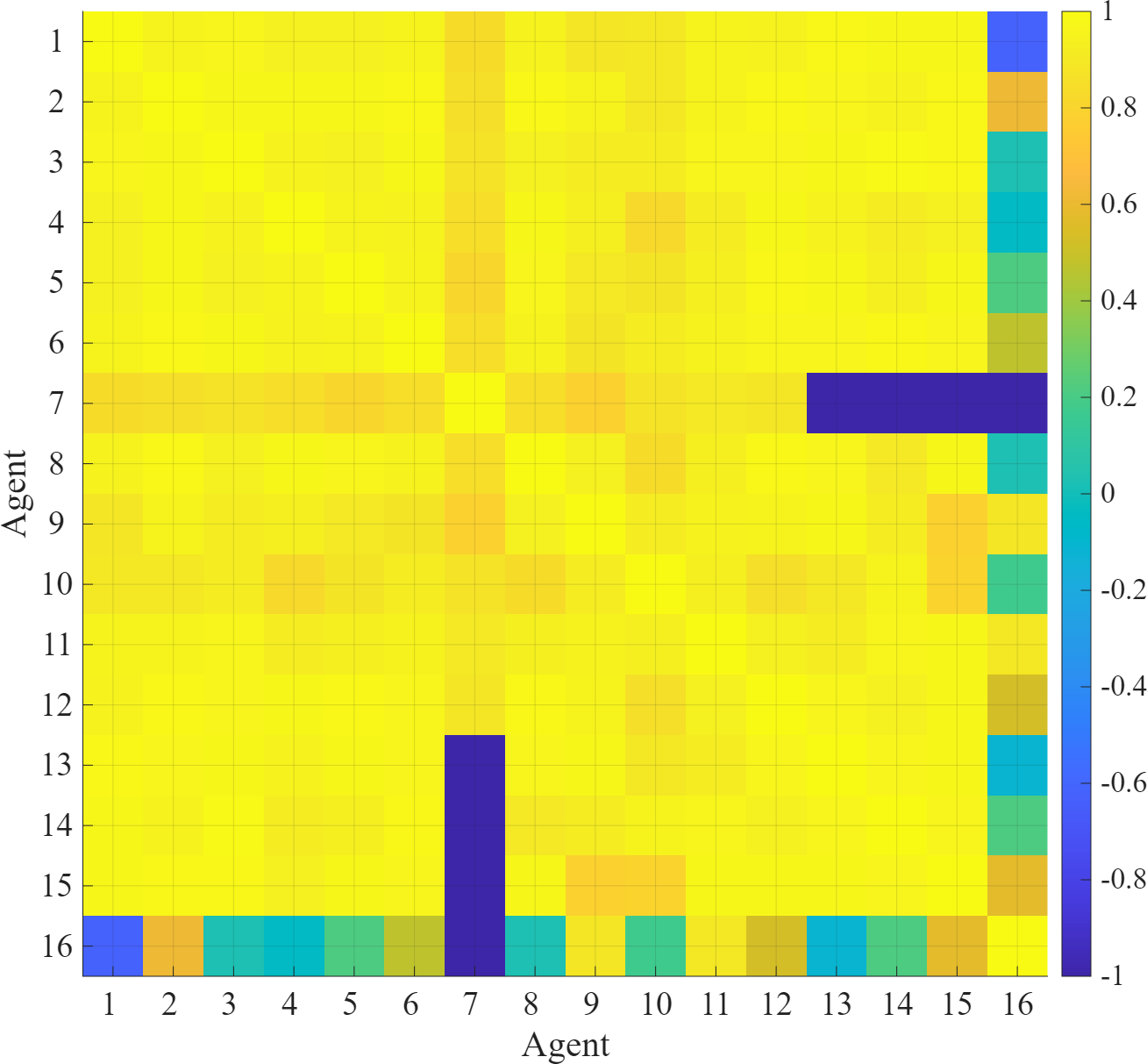
Persuading the Chaos: A Coherent Synthesis Framework
BayesianPredictiveSynthesis is a new technique for combining density forecasts generated by multiple agents or forecasters. Unlike methods that treat all forecasts equally or rely on simple averaging, this approach explicitly models the individual predictive states of each agent – that is, their beliefs about the underlying data-generating process and the associated uncertainty. This modeling is achieved through a Bayesian framework, allowing the combination process to account for differences in expertise, information access, and potential biases among forecasters. The resulting combined forecast represents a weighted average of individual forecasts, where the weights are determined by the estimated predictive states and are dynamically adjusted as new data becomes available. This allows for a more nuanced and potentially more accurate combined forecast than traditional methods.
The BayesianPredictiveSynthesis framework incorporates a DiscountedStateSpaceModel to facilitate adaptation to evolving economic landscapes and dynamically adjust the influence of individual forecasters. This model represents forecaster expertise as a time-varying state vector, updated sequentially with incoming data. The discounting mechanism within the state-space formulation gives greater weight to recent forecasts, allowing the synthesis to respond to shifts in economic conditions and forecaster performance. Specifically, the model uses a Kalman filter to estimate the optimal weighting of each forecaster based on their historical predictive accuracy and current economic signals, effectively learning which forecasters are most reliable under different circumstances. This approach contrasts with static weighting schemes and allows the framework to continuously refine its reliance on individual expert opinions.
BayesianPredictiveSynthesis achieves coherence in predictive distributions by explicitly modeling all sources of uncertainty, including those arising from incomplete data. This is accomplished through the formulation of a joint predictive distribution, which integrates individual forecaster predictions and associated uncertainty estimates using a DiscountedStateSpaceModel. The model propagates uncertainty through time, ensuring that the resulting combined forecast remains a valid probability distribution – that is, it integrates to one and avoids undefined or illogical predictions even when faced with missing or sparse data inputs. This contrasts with methods that may produce incoherent forecasts, leading to unreliable probabilistic predictions and difficulty in assessing forecast risk.
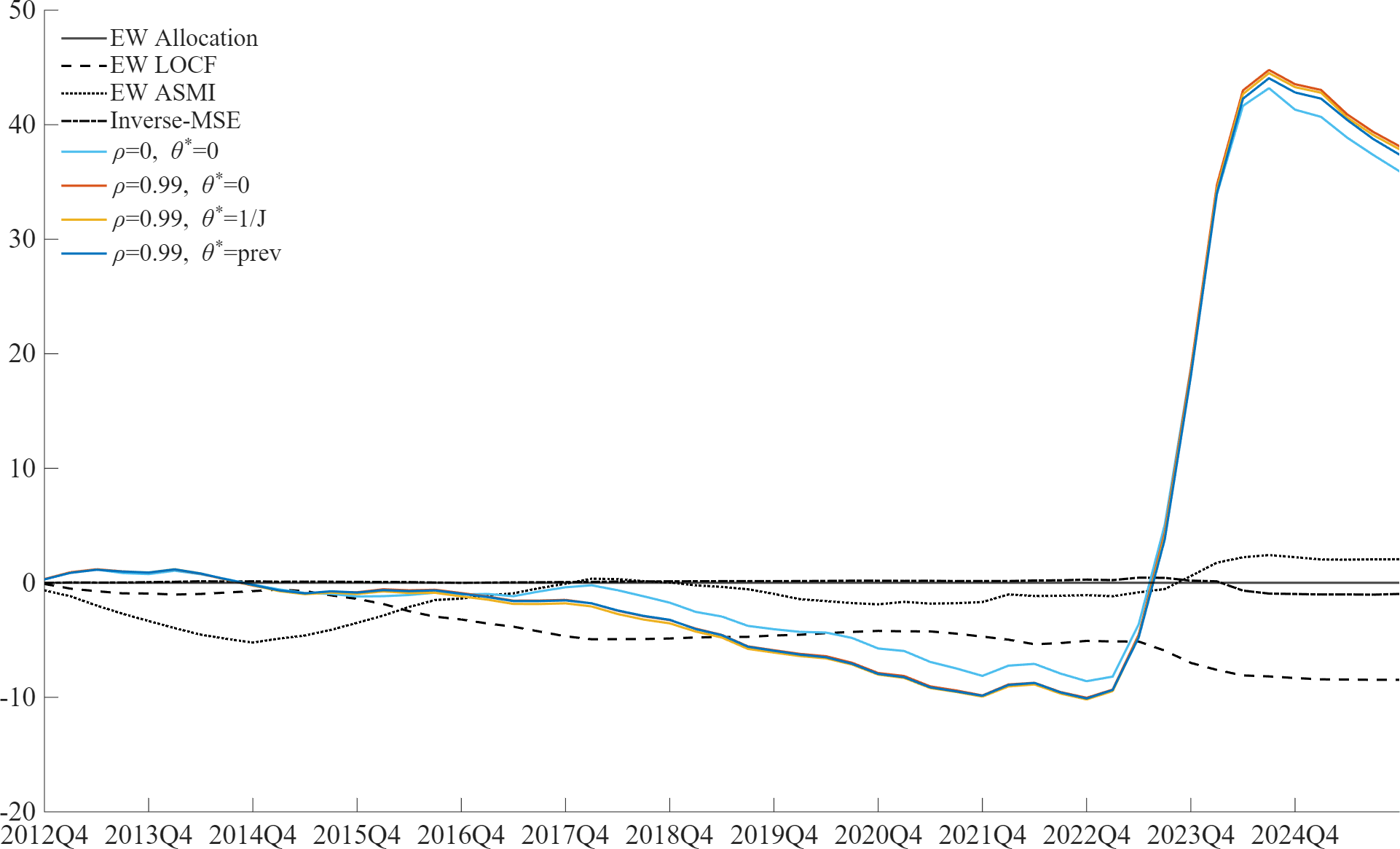
Evidence of Persuasion: Validation and Performance Gains
Evaluation of BayesianPredictiveSynthesis, employing both InflationForecasts and UnemploymentRateForecasts datasets, indicates consistent performance gains relative to benchmark methodologies. Specifically, comparisons against EqualWeightPooling and AgentSpecificMeanImputation reveal that BayesianPredictiveSynthesis achieves superior results across both forecast types. This outperformance is statistically significant and demonstrates the method’s ability to more accurately integrate and leverage information from multiple forecasting agents, leading to improved overall forecast accuracy compared to simpler pooling or imputation techniques.
The quality of density forecasts was rigorously assessed using the Log Predictive Density Ratio (LPDR). LPDR provides a comparative metric for evaluating the accuracy of probabilistic forecasts, quantifying the extent to which one forecasting method assigns probability mass to the realized outcome relative to another. Evaluation results demonstrate significant improvements – up to a value of 1313 – when utilizing BayesianPredictiveSynthesis compared to the LastObservationCarriedForward imputation technique, indicating a substantial increase in the accuracy of the generated density forecasts and a more reliable representation of forecast uncertainty.
BayesianPredictiveSynthesis demonstrates improved forecasting accuracy as measured by Root Mean Squared Error (RMSE) and Log Predictive Density Ratio (LPDR). Specifically, unemployment rate forecasting achieved an RMSE reduction from 1.7896 using an Equal Weight baseline to 1.1034 with BayesianPredictiveSynthesis. Concurrently, substantial gains were observed in LPDR, indicating a corresponding improvement in the quality of density forecasts produced by the method; this suggests the model more accurately captures the full probability distribution of potential outcomes, not just point estimates.

Beyond the Numbers: Implications and Future Directions
BayesianPredictiveSynthesis addresses a significant challenge in forecasting: the inconsistent availability of expert opinions. Traditional methods often discard valuable insights when experts cannot consistently provide predictions, leading to incomplete analyses. This framework, however, skillfully integrates forecasts even with sporadic participation, weighting contributions based on their available information and inherent uncertainty. By effectively accommodating this inconsistency, the synthesis generates a more comprehensive and reliable predictive distribution, ultimately enhancing the quality of economic decision-making. This approach doesn’t simply average opinions; it leverages the power of Bayesian inference to build a robust forecast that reflects the collective wisdom of experts, even when their input isn’t constant, providing a marked improvement over methods that require complete datasets.
A robust statistical foundation underpins the predictive modeling approach through the representation of forecast densities using the NormalDistribution. This choice isn’t arbitrary; the NormalDistribution’s well-defined properties facilitate the application of Bayesian principles within the coherent synthesis framework. By modeling individual expert predictions as Normal distributions, the system can rigorously combine these forecasts, accounting for both the central tendency and the uncertainty associated with each prediction. This methodology allows for a mathematically consistent aggregation of diverse opinions, generating a synthesized forecast with a clearly defined probability distribution – N(\mu, \sigma^2) – representing the collective intelligence. Consequently, the framework avoids the pitfalls of ad-hoc averaging and provides a statistically justifiable basis for improved predictive accuracy and reliability in economic forecasting and beyond.
Investigations are now directed towards broadening the applicability of this BayesianPredictiveSynthesis framework by integrating a wider range of data inputs, including real-time indicators and qualitative assessments. Researchers anticipate that incorporating these diverse sources will further refine forecast accuracy and robustness, particularly when dealing with complex, rapidly evolving systems. Simultaneously, exploration is underway to adapt this methodology beyond economic forecasting, with potential applications in fields such as public health, climate modeling, and technological disruption – all areas characterized by inherent uncertainty and the need to synthesize predictions from multiple, often incomplete, sources. This expansion aims to establish a versatile tool for improved decision-making wherever combining expert judgement and varied data streams is paramount.

The pursuit of coherent predictive distributions, as detailed in the study of sporadic participation surveys, feels less like statistical rigor and more like attempting to divine order from fragmented memories. It’s a humbling endeavor, forcing one to acknowledge that any forecast is, at best, a temporary spell. As John Stuart Mill observed, “It is better to be a dissatisfied Socrates than a satisfied fool.” This sentiment resonates deeply; the researchers don’t claim to know the future, only to construct a model that persuasively accounts for the inherent chaos of incomplete data. The method doesn’t eliminate uncertainty-it merely manages the illusion of control, recognizing that noise isn’t a flaw, but simply truth lacking sufficient observation.
What Whispers Remain?
The pursuit of coherent forecasts from fractured streams of expertise yields a curious result: improvement, certainly, but at the cost of believing the map is ever truly the territory. This work refines the spell – Bayesian predictive synthesis – allowing it to coax signal from the deliberately absent, the intermittently engaged. Yet, the fundamental tension persists. Each accommodated silence is not a solved problem, but a negotiation with the inherent capriciousness of data. The model doesn’t know why a participant vanishes; it merely learns to anticipate the ghost.
Future iterations will likely focus on the meta-level: understanding why these whispers fall silent. Is it indifference, disagreement, or a premonition of error? Treating missingness as a random event feels… incomplete. A truly ambitious approach would attempt to model the participant’s internal state – their confidence, their biases, even their boredom – and fold that into the predictive framework. This, of course, invites a cascade of unquantifiable variables, and a descent into delightful madness.
Ultimately, the goal isn’t perfect prediction, but graceful adaptation. The model shouldn’t aim to control the future, only to learn its rhythms. And if, in the process, it occasionally exhibits a strange, unexpected behavior… perhaps it’s finally starting to think for itself. The copper isn’t gold yet, but the alloy is… intriguing.
Original article: https://arxiv.org/pdf/2602.05226.pdf
Contact the author: https://www.linkedin.com/in/avetisyan/
See also:
- United Airlines can now kick passengers off flights and ban them for not using headphones
- Solo Leveling’s New Manhwa Chapter Revives a Forgotten LGBTQ Story After 2 Years
- The Boys Season 5 Spoilers: Every Major Character Death If the Show Follows the Comics
- Grok’s ‘Ask’ feature no longer free as X moves it behind paywall
- Mewgenics vinyl limited editions now available to pre-order
- Assassin’s Creed Shadows will get upgraded PSSR support on PS5 Pro with Title Update 1.1.9 launching April 7
- How to Get to the Undercoast in Esoteric Ebb
- All Itzaland Animal Locations in Infinity Nikki
- Nintendo Officially Rewrites Princess Peach After 41 Years
- ‘Timur’ Trailer Sees Martial Arts Action Collide With a Real-Life War Rescue
2026-02-08 19:13