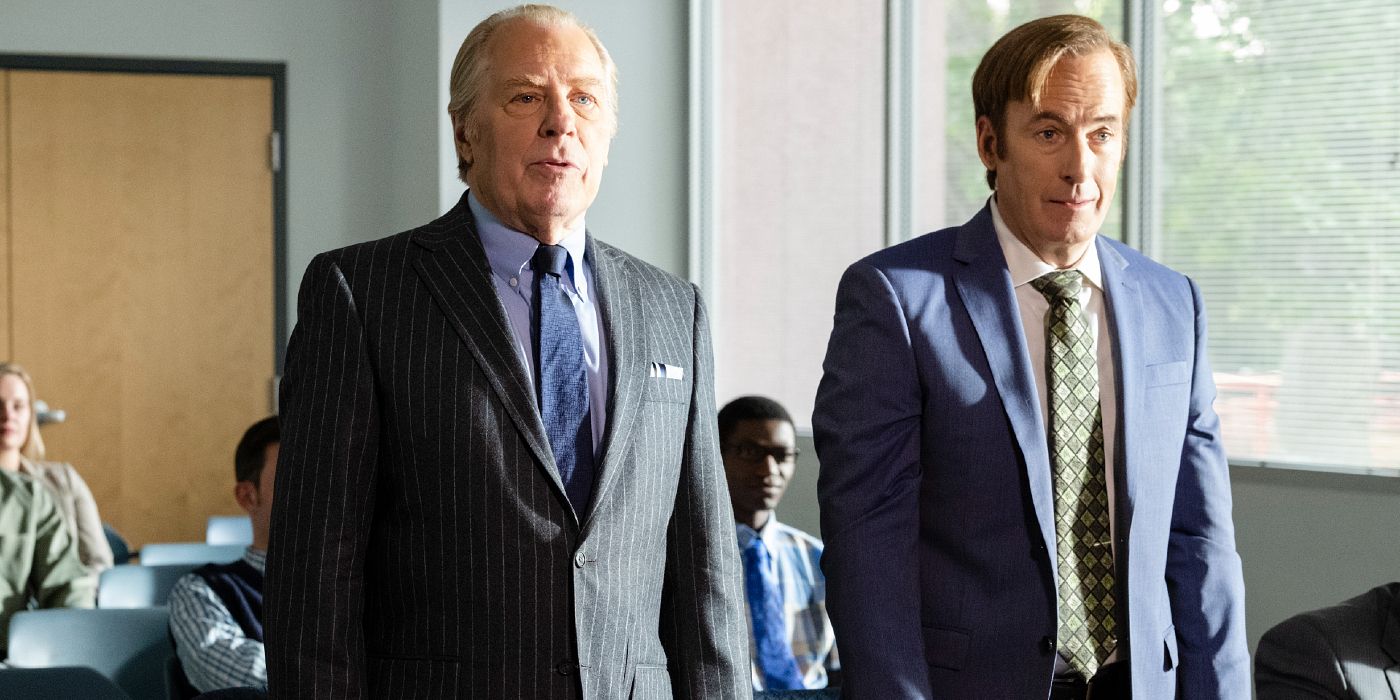
A truly unforgettable moment in television is Chuck McGill’s emotional breakdown at his bar association hearing. Even viewers who haven’t seen the show that introduced Saul Goodman, or even Breaking Bad, recognize this powerful scene. Chuck’s extended, impassioned speech has become a popular meme and remains one of the show’s most iconic moments.
Even dedicated fans of Better Call Saul have noticed one strange part of Chuck’s speech. Towards the end, he claims his brother Jimmy McGill – who later becomes Saul Goodman – was “stealing” from their parents when they were kids. This wording might seem like a slip of the tongue, but it’s actually a deliberate choice. It’s a clever way the show reveals more about Chuck’s character.
Chuck McGill Accurately Described Jimmy McGill During His Rant in “Chicanery”
The phrase “robbing them blind” is commonly used to describe someone who steals from others so skillfully that the victims don’t even realize they’ve been robbed. However, in the Better Call Saul episode “Chicanery” (Season 3, Episode 5), Chuck mistakenly says “stealing them blind” while attempting to warn people that Jimmy was deceitful and shouldn’t be trusted.
Chuck McGill is furious, claiming Jimmy is capable of far worse than what people currently see. He points to a staged accident involving a billboard as proof of Jimmy’s manipulation. Chuck recounts a past incident where Jimmy deliberately caused trouble, and Chuck foolishly covered for him by bringing him into his law firm. He believes Jimmy’s dishonest tendencies started in childhood – always stealing, even as a young boy. Chuck feels it’s a cruel joke that Jimmy became a lawyer and regrets not stopping him earlier. He urges whoever is listening to prevent Jimmy from continuing down this path.
Most people wouldn’t notice a difference between saying someone “robbed” versus “stole” something, as both mean taking property illegally. While it might just seem like a slight difference in how it sounds, legally these words have distinct meanings and apply to different situations.
In legal terms, robbery involves taking property from someone using force or threats. Stealing, or theft, simply means taking someone’s property without their consent or without them knowing. Because robbery involves violence, it usually carries a harsher penalty than stealing, which often results in a lighter sentence.
Despite being harsh and dismissive towards his brother, Chuck was correct to say Jimmy was “stealing from their parents” instead of “robbing them.” Legally speaking, Jimmy never committed robbery. Throughout his various identities – as the con artist Slipping Jimmy, Saul Goodman, and finally as Gene Takavic, the Cinnabon manager – Jimmy never resorted to violence.
He either couldn’t handle seeing blood, or he was smart enough to avoid participating in anything unlawful. It seemed Jimmy required an accomplice.
Jimmy exploited weaknesses in the legal system and skillfully manipulated people to get what he wanted, whether it was money or favors. He considered this a perfect combination of his past as a con artist and his knowledge of the law. This allowed him to build a large fortune and avoid consequences for years, but ultimately, his actions earned him the hatred of everyone around him.
There’s a moment in “Hit and Run” – Season 6, Episode 4 – that really stuck with me. Bill Oakley, delivering the line with that trademark coldness, lays into Jimmy. He gets defending your client, he admits, but what Jimmy did – scamming the court just to free a dangerous cartel leader – that’s where Oakley draws the line. It’s a simple speech, but it perfectly captures the moral bankruptcy of the situation, and it’s delivered with such a biting, justified anger. It’s just… wrong, and Oakley makes sure we feel that weight.
Chuck McGill’s Words Highlight That He’s a Great Lawyer and a Terrible Person
Words, both spoken and written, are essential in nearly every situation. This is especially true for lawyers, who must be extremely careful and precise with their language. A single inaccurate or unclear word can easily ruin a strong legal case.
Chuck, a highly respected lawyer in Albuquerque, New Mexico, truly believed in upholding the law – he considered himself a guardian of justice. He was particularly proud of his legal accomplishments.
As a critic, I found a fascinating detail in Chuck’s character – his unwavering precision with language, even when completely losing his cool. It really highlighted how deeply he valued the technicalities of the law; he wouldn’t just call something ‘stealing’ when it was actually ‘robbery’. It felt absolutely true to who he was that he’d be internally devastated by such a slip-up, even during a highly charged outburst. It wasn’t just about being right; it was about maintaining that absolute, legalistic integrity, even under immense pressure.
However, more significantly, the precise language Chuck used and his delivery perfectly captured his character – a character almost entirely devoid of human feeling.
Chuck was an exceptionally skilled lawyer, but it came at a cost. He tended to see people not as individuals, but solely for how they could be used in his cases – as witnesses, potential suspects, or people he could control and instruct. He consistently flaunted his legal expertise and acted superior. A prime example of this behavior was evident during his disciplinary hearing, known as the “Chicanery” case. He also held a rigid belief that people were either law-abiding or lawbreakers, with no room for gray areas.
As a film buff, I always saw Chuck as someone who really believed he was better than everyone else, and he was obsessed with rules – not with what the law intended, but with the exact wording. That’s why he couldn’t bring himself to feel sorry for anyone who broke them, no matter how minor the infraction. It completely explained his relentless pursuit of Jimmy and why he was so determined to destroy him legally, sticking to the letter of the law with cold precision.
Chuck McGill Is Right About Jimmy McGill, But Only Because He Made It Happen
Chuck believed Jimmy was inherently a criminal and a con artist, a view he couldn’t explain. He famously compared Jimmy becoming a lawyer to giving a dangerous weapon to an animal. Chuck’s negative opinion of his brother was especially strong because Jimmy repeatedly turned to crime, even after Chuck had helped him avoid prison years earlier. Given that Jimmy was the main character, many viewers expected Chuck’s beliefs to be challenged or disproven eventually.
Chuck was ultimately proven right about Jimmy, but unintentionally so. His unwavering belief that Jimmy would never change actually caused Jimmy to continue down the wrong path. Because Chuck always saw Jimmy as a reckless and irresponsible younger brother, he never gave him a chance to prove otherwise.
Chuck felt it was his personal responsibility to protect the law, and that meant keeping his brother Jimmy away from it. Even during his last court appearance, before he took his own life, Chuck attempted to discredit Jimmy using precise legal arguments instead of simply resorting to anger or name-calling. He also actively worked to undermine Jimmy’s career and relationships, turning people against him.
You know, thinking about it, Chuck was actually the more skilled manipulator and deceiver, really. That doesn’t excuse anything Jimmy did, of course – his dishonesty and crimes were still wrong. But understanding what Chuck was capable of… it definitely makes you see Jimmy’s actions in a different light, doesn’t it? It adds a whole new layer to everything.
It’s difficult to view Jimmy’s illegal actions as anything other than a response to the mistreatment he suffered at the hands of Chuck, fueled by Chuck’s hypocrisy and, ultimately, his passing. Saul Goodman’s entire identity can be interpreted as a final, defiant act against Chuck – a deliberate parody of the very people who were supposed to represent and enforce the law with fairness.
If Chuck had been less arrogant and given Jimmy a fair opportunity, the terrible events that followed could have been avoided. Jimmy repeatedly tried to earn Chuck’s respect, but was consistently belittled and dismissed. Ultimately, the “McGill” name became associated with a disreputable lawyer known for helping criminals, rather than with the honorable legal figure Chuck always believed he was.
Found an error? Send it so it can be corrected.
Read More
- Off Campus Season 1 Soundtrack Guide
- X-Men ’97 Finally Gave Gambit the Hero Moment He Deserved
- Chainsaw Man Volume 24’s Cover Art Reveals a Brand-New Denji
- 46 Years Later, The Mandalorian & Grogu Answers A Major Empire Strikes Back Question
- 10 Worst End-Game Couples In Sitcom History
- HoI4 fans harsh reactions to the announcement of another DLC pack
- DoorDash responds after customer uses AI to make food look bad and get a refund
- Gold Rate Forecast
- Emily Henry Says to ‘Trust the Vision’ For Beach Read Adaptation
- Katanire’s Yae Miko Cosplay: Genshin Impact Masterpiece
2026-04-15 03:41