Darling, Bitcoin mining and artificial intelligence are performing a most stylishly dreadful two-step-one wants to prance about decentralised and carefree, while the other conducts a tightening, corseted centralisation behind the velvet curtain. The divergence widens faster than a chorus line, and it’s hardly good for the stability of anyone’s model or mood.
According to analysis from Galaxy Research and Grand View Research, Bitcoin’s hashrate has consolidated dramatically from its early distributed architecture, while AI infrastructure is trending toward decentralization through edge computing deployments that distribute processing across nodes rather than concentrating it in centralized data centers.
The governing concept here is what we would call the Centralization Asymmetry: two of the most capital-intensive technology sectors are evolving in opposing directions at the same time, and the implications for network security, regulatory exposure, and investor risk models have not been adequately priced. Bitcoin was designed to be decentralized. AI was not – yet AI is now moving that direction faster than Bitcoin is holding its ground, darling.
DISCOVER: Best crypto to buy right now – CoinSpeaker’s updated guide
Bitcoin Mining Transmission Chain from ASIC Dominance to Pool Concentration
The transmission chain operates as follows: hardware manufacturing concentration feeds pool consolidation, which feeds hashrate dominance, which feeds protocol-level systemic risk. ASIC production is currently dominated by three firms – Bitmain, MicroBT, and Canaan – meaning that supply chain disruptions or regulatory interventions at the hardware level cascade directly into mining capacity. U.S. Customs has seized Bitmain equipment over compliance concerns in recent years, demonstrating that this is not a theoretical vulnerability.
Pool-level concentration has worsened materially over the past two years. From 2019 through 2022, the top two pools held approximately 35% of global hashrate, with the top six accounting for roughly 75%.
By December 2023, those figures had climbed to 55% and 90% respectively, according to data tracked by b10c’s Mining Centralization Index – and conditions have deteriorated further into 2025. As of this year, the top four pools control an estimated 75% of hashrate, with the top six collectively mining 95% to 99% of all blocks.
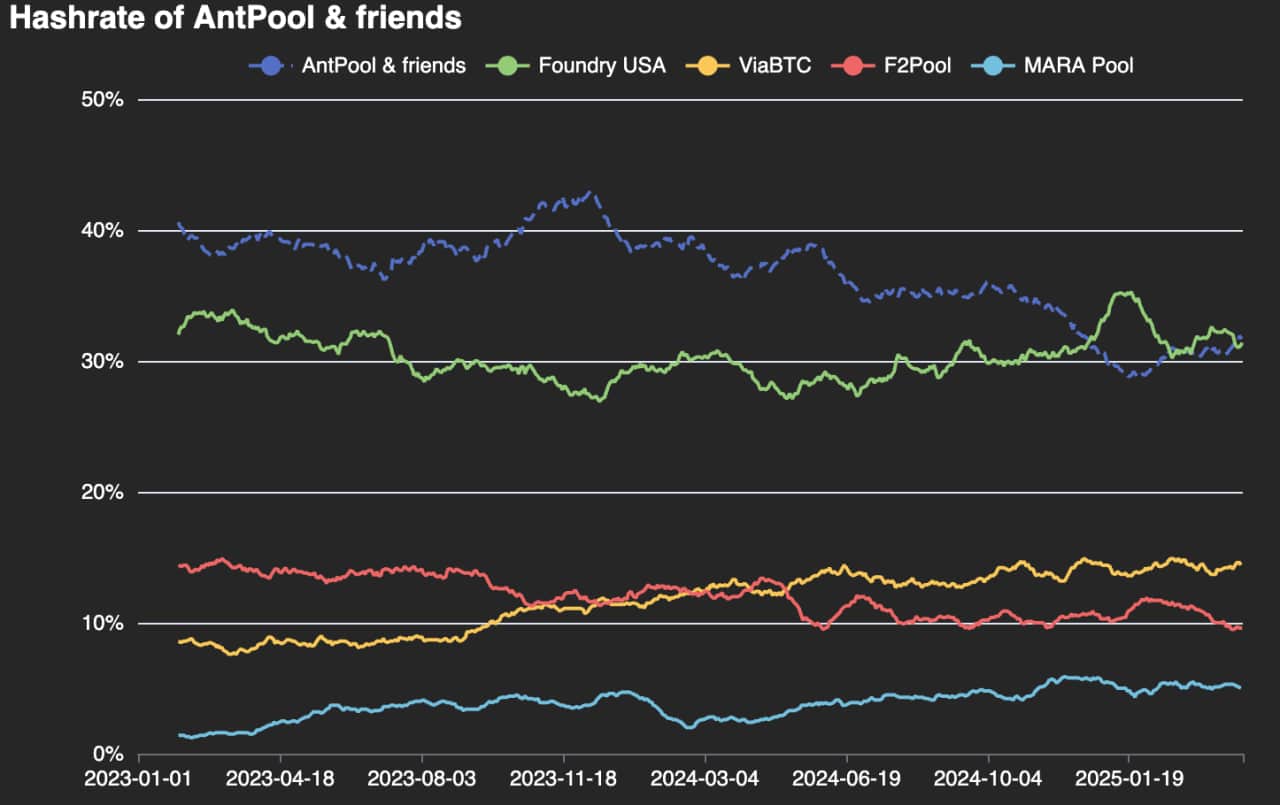
Source: B10C
In March 2025, Foundry USA mined seven consecutive blocks, in the process orphaning two valid blocks from AntPool and ViaBTC. No transactions were lost, but the episode illustrated precisely the kind of protocol stress that emerges under sustained hashrate concentration – a single pool’s dominance producing real interference in block propagation without triggering formal threshold alarms.
The parallel to the post-2021 China mining ban is instructive but imperfect: that episode temporarily redistributed hashrate across jurisdictions; the current consolidation is structural rather than geopolitical, and harder to reverse. Geopolitical disruptions can accelerate the problem too, as illustrated by the 77% collapse in Iran’s hashrate when regional conflict knocked an estimated 427,000 machines offline – removing a meaningful distributed participant and pushing effective concentration higher among surviving pools.
The AI Counter-Trend: Edge Computing and What the Divergence Actually Signals
The more consequential signal is not the centralization of Bitcoin mining in isolation – it is the simultaneous decentralization of AI infrastructure, which reframes the Centralization Asymmetry as something broader than a Bitcoin-specific governance debate.
Edge computing distributes inference and training workloads across geographically dispersed nodes, reducing dependence on hyperscaler data centers in a way that structurally mirrors Bitcoin’s original design intent.
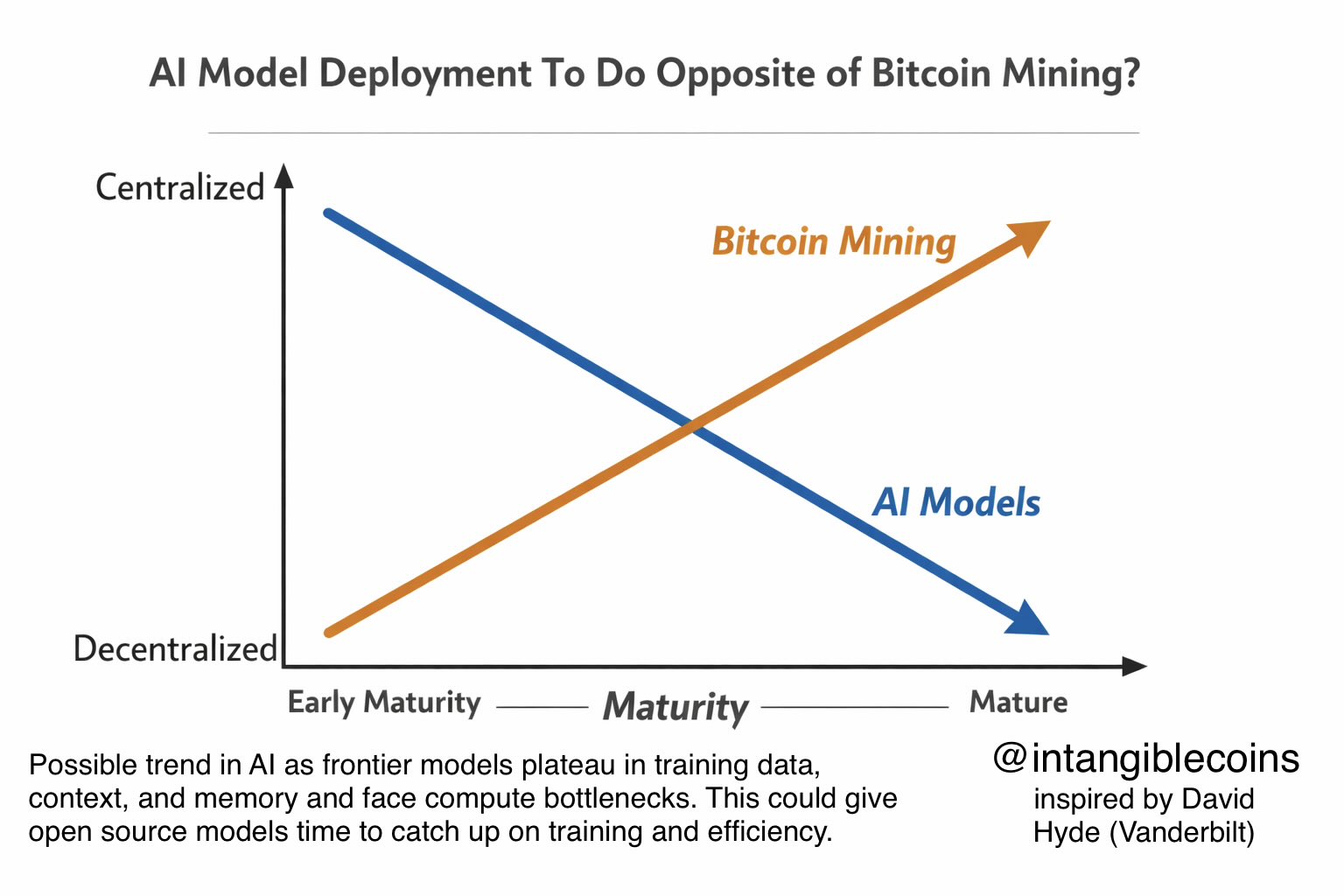
Source: Galaxy Research
The irony is difficult to miss: the technology sector Bitcoin mining was supposed to outcompete on decentralization grounds, is now executing the decentralization playbook more credibly.
We suspect this divergence is partly driven by economic factors that mining companies themselves have accelerated. Public miners pivoting facilities toward AI data center buildouts – reducing their Bitcoin hashrate commitments in favor of higher-margin compute leasing – are simultaneously amplifying pool dominance among the operators who remain and validating the AI infrastructure model they are migrating toward.
Bitfarms’ infrastructure pivot toward AI, executed under the Keel Infrastructure rebrand, is one of the more visible examples of this dynamic: a major mining operator reducing its hashrate footprint while allocating capital to the decentralizing infrastructure trend on the other side of the ledger.
What has not been adequately priced is the feedback loop. Each miner that exits Bitcoin for AI compute reduces the pool of independent hashrate contributors, which increases the relative weight of the remaining large pools, which worsens the Mining Centralization Index, which raises the probability of a protocol-level stress event that triggers regulatory scrutiny across all jurisdictions where mining operates at scale. The Centralization Asymmetry is not static – it compounds.
EXPLORE: Best meme coins to watch – CoinSpeaker’s updated rankings
Read More
- United Airlines can now kick passengers off flights and ban them for not using headphones
- Solo Leveling’s New Manhwa Chapter Revives a Forgotten LGBTQ Story After 2 Years
- The Boys Season 5 Spoilers: Every Major Character Death If the Show Follows the Comics
- Grok’s ‘Ask’ feature no longer free as X moves it behind paywall
- ‘Timur’ Trailer Sees Martial Arts Action Collide With a Real-Life War Rescue
- How to Get to the Undercoast in Esoteric Ebb
- TikToker’s viral search for soulmate “Mike” takes brutal turn after his wife responds
- Invincible Season 4 Episode 6 Release Date, Time, Where to Watch
- All Itzaland Animal Locations in Infinity Nikki
- Nintendo Officially Rewrites Princess Peach After 41 Years
2026-04-13 15:10