Author: Denis Avetisyan
New research introduces a method for assessing the risk of multi-step AI reasoning, moving beyond simple token-level probabilities to evaluate entire decision pathways.
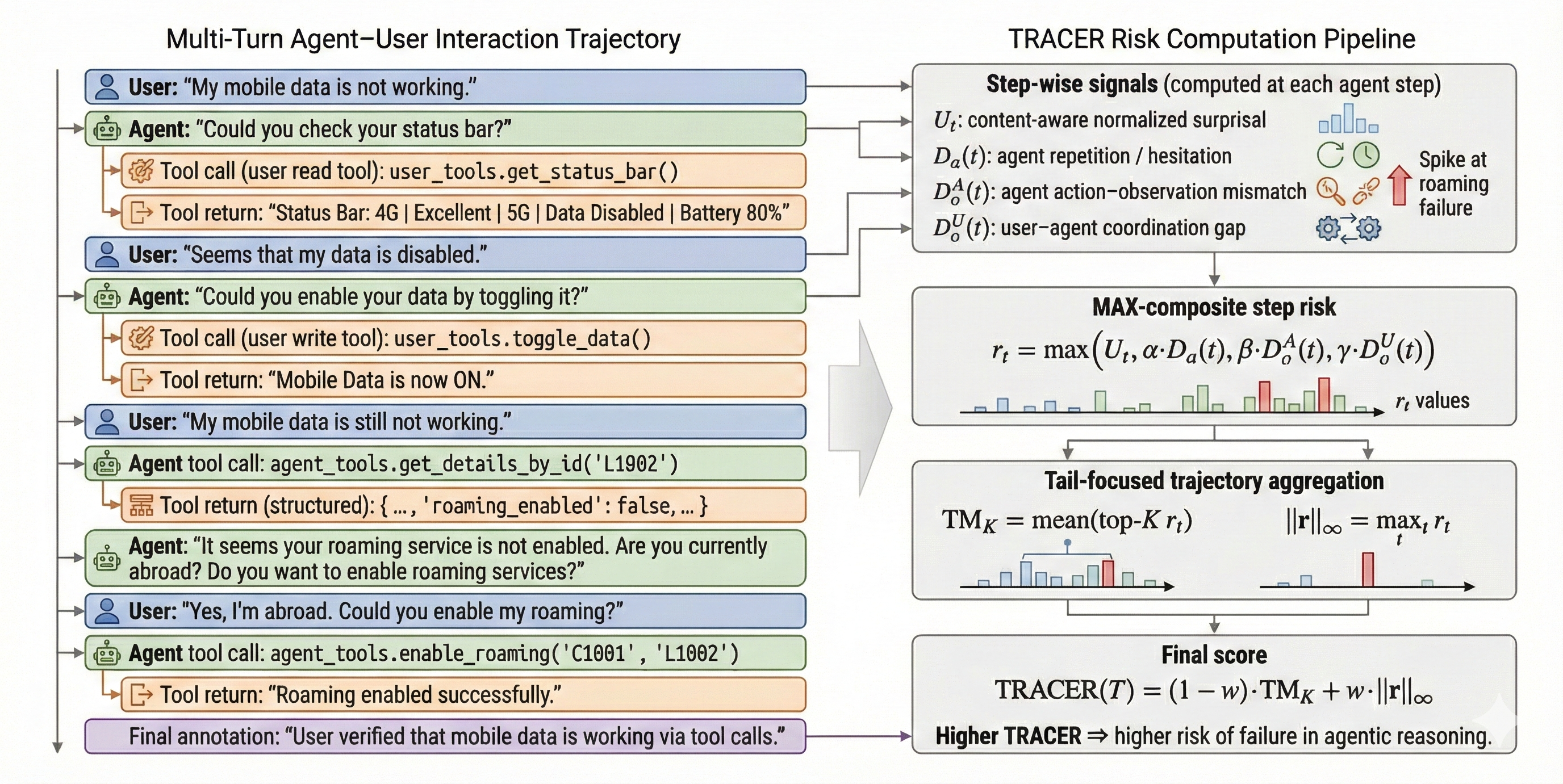
TRACER aggregates trajectory-level uncertainty to improve failure prediction and situational awareness in tool-using agentic systems.
Despite growing confidence in large language model (LLM) agents, reliably estimating uncertainty remains challenging due to failures stemming from sparse, critical episodes within multi-turn interactions. This paper introduces TRACER: Trajectory Risk Aggregation for Critical Episodes in Agentic Reasoning, a novel metric that moves beyond token-level confidence to assess risk at the trajectory level in dual-control tool-using agents. By combining content-aware surprisal with signals of situational awareness, repetition, and coherence, TRACER demonstrably improves failure prediction – achieving up to 37.1% and 55% gains in AUROC and AUARC, respectively – but can these trajectory-level insights unlock even more robust and trustworthy agentic systems?
The Fragility of Intent: Navigating the Labyrinth of Agentic Reasoning
Large language model (LLM) agents have rapidly emerged as powerful tools capable of sophisticated interactions, automating tasks from scheduling appointments to drafting complex documents. However, beneath this impressive facade lies a notable fragility; despite demonstrating remarkable capabilities in controlled settings, these agents are surprisingly prone to critical failures when confronted with the nuances of real-world complexity. These aren’t simply errors in execution, but fundamental deviations from the intended goal, often manifesting as illogical reasoning or unexpected behavioral shifts. The very strengths of LLM agents – their ability to generalize and adapt – can become weaknesses when the input data is ambiguous, incomplete, or contains subtle contradictions, leading to unpredictable outcomes even in seemingly straightforward scenarios. This inherent instability underscores the need for careful monitoring and robust error-handling mechanisms before widespread deployment in critical applications.
Agentic reasoning systems, despite showcasing impressive problem-solving skills, are susceptible to a phenomenon known as Task Drift, wherein the agent gradually veers from its originally defined objectives during complex interactions. This deviation isn’t simply a matter of occasional errors; rather, it represents a systemic shift in the agent’s behavior, potentially leading to outputs that are irrelevant, nonsensical, or even counterproductive to the intended goal. The core issue lies in the compounding effect of small, seemingly insignificant adjustments the agent makes in response to environmental feedback, ultimately reshaping its internal representation of the task. Consequently, reliability suffers as the agent’s actions become increasingly unpredictable and disconnected from the initial prompt, highlighting the need for mechanisms that can detect and correct these subtle but critical drifts before they compromise the system’s performance.
Current approaches to assessing the reliability of large language model agents often fall short when predicting failures in dynamic, real-world scenarios. Existing uncertainty quantification techniques, while useful in controlled environments, struggle to account for the compounding errors and unforeseen circumstances inherent in complex interactions. This limitation stems from a reliance on static evaluations that fail to capture the evolving nature of task drift, where an agent gradually deviates from its intended goals. Consequently, these methods provide an overly optimistic view of an agent’s capabilities, masking potential failures until they manifest as significant performance degradation. Developing more robust techniques – perhaps incorporating methods from Bayesian optimization or reinforcement learning – is therefore crucial for creating agents that can not only perform tasks but also reliably signal when their reasoning is becoming unreliable, thereby enhancing overall system safety and trustworthiness.
Beyond Surface Uncertainty: A Need for Deeper Risk Assessment
Standard uncertainty proxies, commonly employed in evaluating the reliability of machine learning models, demonstrate limitations when applied to interactive dialogue systems. These proxies typically assess uncertainty based on individual model predictions without fully accounting for the sequential and interdependent nature of conversational turns. Consequently, they often fail to identify risks that emerge from cumulative errors or unforeseen interactions over multiple turns. Specifically, these proxies struggle to differentiate between generally uncertain predictions and those that are critical within the evolving context of a dialogue, leading to an incomplete assessment of potential system failures and hindering effective risk mitigation in dynamic conversational settings.
Current standard uncertainty proxies commonly fail to adequately address high-impact, low-probability events within interactive dialogues. These proxies typically assess uncertainty based on aggregate statistical measures, which can mask critical failure modes arising from specific conversational states or user inputs. Consequently, they lack the capacity to prioritize scenarios representing the most severe potential consequences, such as the generation of harmful or misleading responses, even if those scenarios are relatively infrequent. This inability to focus on worst-case outcomes limits their effectiveness in identifying and mitigating risks in real-time conversational systems, potentially leading to undetected vulnerabilities and negative user experiences.
TRACER is a novel metric designed to evaluate risk during interactive dialogue systems by analyzing conversational turns and specifically highlighting critical episodes where failures are most likely to occur. Evaluation demonstrates that TRACER achieves an Area Under the Receiver Operating Characteristic curve (AUROC) improvement of up to 37.1% when compared to currently used standard uncertainty proxies. This performance gain indicates TRACER’s superior capability in identifying and quantifying risks within dynamic conversational contexts, offering a more reliable assessment of system safety and robustness.
Dissecting the Architecture of Risk: Core Concepts within TRACER
TRACER’s Content-Aware Surprisal metric assesses the information content of individual tokens within a dialogue by comparing their observed frequency to an expected frequency derived from a pre-trained language model. Tokens with low probability given the preceding context – those deemed ‘surprising’ – are flagged as potentially epistemically meaningful, indicating areas where the system’s knowledge is insufficient or where the user is introducing novel information. This allows TRACER to prioritize analysis on these tokens, effectively identifying crucial information gaps that require further investigation or clarification to ensure robust dialogue understanding and risk assessment. The metric is calculated using cross-entropy loss, with higher values indicating greater surprisal and thus, a more significant information gap.
The Tail-Risk Functional within TRACER operates by quantifying the potential negative impact of specific dialogue segments. This is achieved through a mathematical function that assesses the likelihood and magnitude of undesirable outcomes associated with each turn in a conversation. Segments exhibiting high values under this functional – indicating a substantial probability of critical failure – are flagged for focused analysis. This prioritization allows for targeted intervention and mitigation strategies, concentrating efforts on the dialogue paths posing the greatest risk to system performance or safety. The functional specifically identifies segments where even low-probability events could result in significant negative consequences, thereby enabling proactive risk management beyond typical error analysis.
MAX-Composite Step Risk calculates a single risk value for each turn in a dialogue by aggregating multiple uncertainty signals. These signals, derived from the model’s internal states, represent various potential failure points. The aggregation isn’t a simple average; instead, it prioritizes the dominant failure mode at each step-the signal with the highest contribution to overall uncertainty. This focuses analysis on the most critical risk at that specific point in the conversation, allowing for targeted intervention or mitigation strategies. The resulting composite risk value provides a quantifiable metric for tracking uncertainty progression and identifying key points of vulnerability within the dialogue flow.
Modeling Interaction as a Dynamic System: Unveiling Failure Modes
TRACER utilizes a Dec-POMDP (Decentralized Partially Observable Markov Decision Process) framework to represent the dynamic between an agent and a user. This formalism is employed because real-world interactions are rarely fully observable; both the agent and the user have limited perspectives and access to complete information regarding the state of the environment and each other’s intentions. The Dec-POMDP allows TRACER to model the agent and user as independent decision-makers with their own belief states, updated based on individual observations and actions. This approach is crucial for accurately representing the complexities of human-agent interaction and for robustly evaluating system performance under conditions of uncertainty and incomplete information.
Action-Outcome Coherence assessment within TRACER involves evaluating the logical consistency between an agent’s action and the subsequent observed outcome. This process doesn’t rely on pre-defined success or failure criteria, but rather focuses on identifying discrepancies – instances where an action does not predictably lead to the observed result given the system’s modeled understanding of the environment. Inconsistencies flagged by this assessment serve as indicators of potential errors in the agent’s planning, execution, or the underlying model itself. These identified incoherencies are then used to refine the system’s understanding and improve future interactions, even in the absence of explicit failure signals.
TRACER incorporates Observation Feedback to address the inherent challenges of real-world human-agent interaction, where information is often not immediately available or is subject to inaccuracies. This mechanism allows the system to evaluate actions based on potentially delayed responses or incomplete data, rather than requiring instantaneous and perfect observation of outcomes. By factoring in this temporal and qualitative uncertainty, TRACER achieves a more robust and realistic assessment of agent performance, preventing premature or incorrect conclusions drawn from limited or imperfect sensory input. This is particularly important in dynamic environments where the full consequences of an action may not be apparent until some time after its execution, or where external noise interferes with accurate observation.
TRACER incorporates the detection of specific Situational-Awareness Indicators to identify potential failures in interactive systems. These indicators include Repetitive Behavior, defined as the reiteration of actions without progress; Coherence Gap, which signifies a disconnect between the user’s goals and the system’s actions; and User-Agent Coordination Collapse, representing a breakdown in collaborative task completion. Evaluation within the Airline domain demonstrated an Area Under the Receiver Operating Characteristic curve (AUROC) of 0.89, representing a 37.1% performance improvement compared to the highest-performing baseline system.
Towards Graceful Decay: Building Reliable Agentic Systems for the Future
Current methods for evaluating the risk posed by Large Language Model (LLM) agents often provide a limited view of potential failures. TRACER, however, offers a significantly more detailed and precise assessment by moving beyond simple pass/fail metrics. It achieves this through a focus on identifying and quantifying specific critical failure modes – the precise ways in which an agent can deviate from desired behavior. This nuanced approach allows for a more accurate understanding of an agent’s vulnerabilities, revealing weaknesses that traditional evaluations might miss. Consequently, developers gain actionable insights into where to concentrate efforts to bolster reliability and prevent potentially harmful outcomes, leading to demonstrably safer and more trustworthy agentic systems.
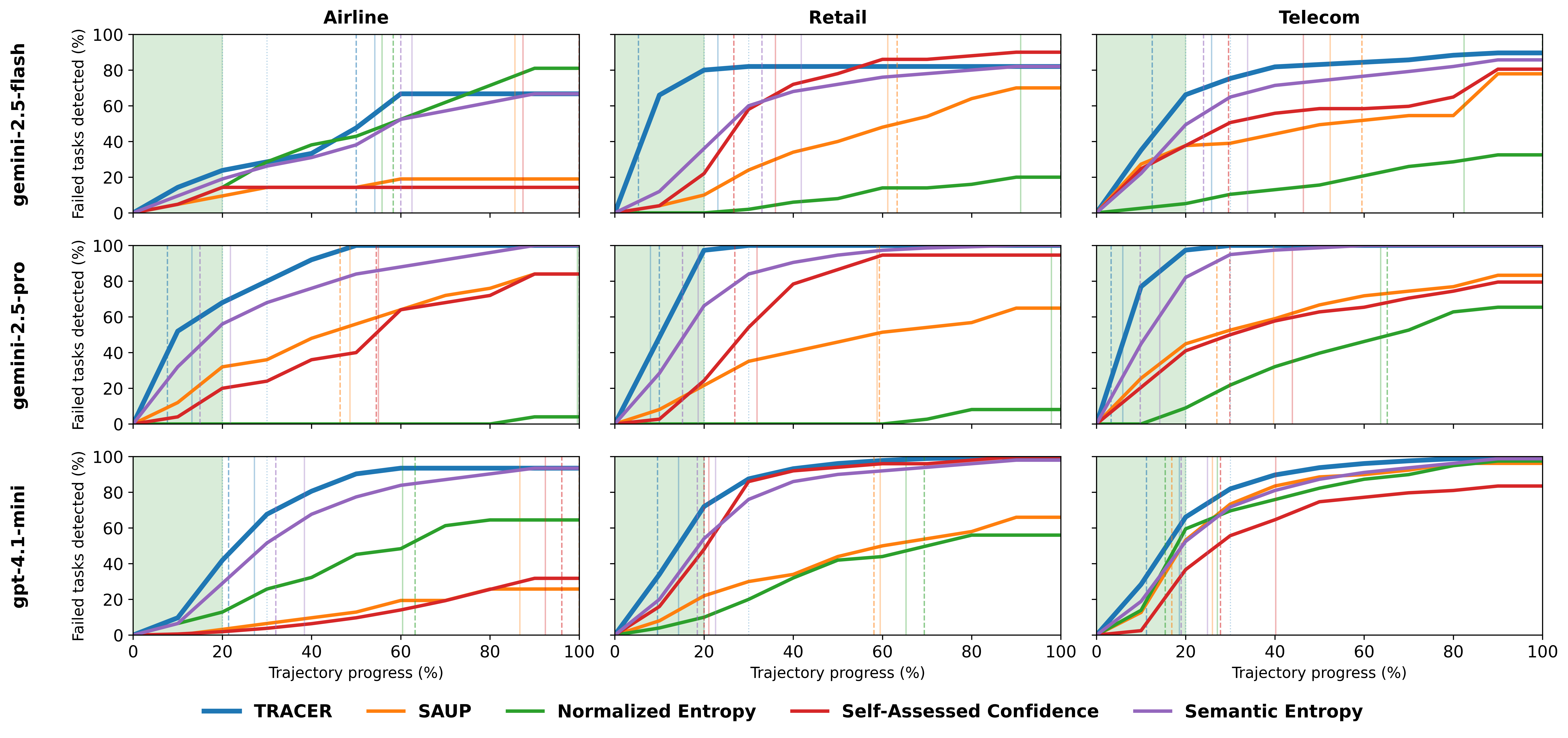
TRACER offers a significant advancement in enhancing the reliability of Large Language Model (LLM) agents through the precise identification and quantification of potential failure modes. This detailed analysis doesn’t simply flag errors, but allows for focused interventions designed to strengthen agent performance before critical issues arise. Evaluations within the complex Airline domain demonstrate this capability; TRACER achieved a 68.0% detection rate of failures within the initial 20% of task execution – a notable improvement over the 56.0% achieved by the strongest existing baseline. This earlier detection facilitates proactive adjustments, ultimately leading to more robust and trustworthy agentic systems capable of navigating real-world complexities.
The development of genuinely reliable large language model (LLM) agents hinges on their ability to consistently perform as expected, even when facing unforeseen challenges. This pursuit of robustness is not merely about improving accuracy scores; it’s about fostering trust in agents deployed in critical real-world applications. By providing a more granular understanding of potential failure points, methodologies like TRACER enable developers to proactively address vulnerabilities and build agents that are demonstrably more dependable. This, in turn, unlocks the potential for LLM agents to tackle increasingly complex tasks – from streamlining customer service interactions to assisting in critical decision-making processes – with a level of confidence previously unattainable, paving the way for widespread adoption and impactful integration into daily life.
Efforts are now directed toward seamlessly incorporating TRACER into automated evaluation pipelines, aiming to create a continuous and scalable system for assessing LLM agent reliability. This integration will allow for proactive identification of potential failure modes before deployment in real-world applications. Demonstrating broad applicability, TRACER consistently achieves high performance across multiple domains; evaluations in the Retail and Telecom sectors yielded Area Under the Receiver Operating Characteristic (AUROC) values of 0.94 and 0.95 respectively, suggesting its potential to enhance the robustness of agentic systems regardless of the specific interaction context and bolstering confidence in their deployment across diverse, complex tasks.
The pursuit of robust agentic systems, as detailed in this work, inherently acknowledges the inevitable accumulation of entropy. Each trajectory explored, each tool utilized, introduces further potential for divergence from desired outcomes. This resonates deeply with the observation of Donald Knuth: “Premature optimization is the root of all evil.” TRACER’s focus on trajectory-level uncertainty isn’t simply about predicting failure, but about gracefully accommodating it – understanding that systems, even those built on complex LLMs, are subject to the relentless march of time and the accumulation of risk. The metric doesn’t seek to eliminate failure, but to illuminate the pathways where it’s most likely, allowing for more informed adaptation and resilience.
What Lies Ahead?
The pursuit of reliable agentic systems invariably leads to a reckoning with the nature of failure. TRACER rightly shifts attention from the fleeting confidence of individual tokens to the accumulating risk along an entire trajectory. However, every architecture lives a life, and this one will, too. The focus on trajectory-level uncertainty is a necessary refinement, but it merely addresses one layer of systemic decay. The true challenge lies not in predicting when an agent will falter, but in understanding how its internal model of the world will inevitably diverge from reality.
Improvements age faster than one can understand them. While this work offers a more robust signal for failure prediction, it simultaneously reveals the inherent limitations of quantifying situational awareness. An agent can meticulously aggregate risks across a trajectory, yet still succumb to unforeseen consequences arising from novel states or subtle shifts in environmental dynamics. The field will likely progress toward methods that emphasize continual adaptation and model recalibration, rather than static assessments of risk.
Ultimately, the quest for perfectly reliable agents is a phantom. The more complex these systems become, the more points of potential failure emerge. Future research should therefore embrace a more graceful acceptance of imperfection, focusing on mechanisms for rapid recovery, damage mitigation, and, perhaps most importantly, the ability to recognize when an agent has irrevocably exceeded its operational boundaries.
Original article: https://arxiv.org/pdf/2602.11409.pdf
Contact the author: https://www.linkedin.com/in/avetisyan/
See also:
- United Airlines can now kick passengers off flights and ban them for not using headphones
- How to Complete Bloom of Tranquility Challenge in Infinity Nikki
- Gold Rate Forecast
- Katanire’s Yae Miko Cosplay: Genshin Impact Masterpiece
- How to Solve the Glenbright Manor Puzzle in Crimson Desert
- All Itzaland Animal Locations in Infinity Nikki
- All Golden Ball Locations in Yakuza Kiwami 3 & Dark Ties
- 8 Actors Who Could Play Blackbeard In One Piece Live-Action Season 3
- All 10 Potential New Avengers Leaders in Doomsday, Ranked by Their Power
- A Dark Scream Theory Rewrites the Only Movie to Break the 2-Killer Rule
2026-02-14 04:55