Artificial intelligence agents have moved from test use to live payments, according to a new Keyrock report written by Ben Harvey in collaboration with Coinbase, Tempo, and Virtuals.
This is the digital equivalent of a toddler learning to tie shoelaces, but with more blockchain.)
The report said agents settled more than $73 million across 176 million transactions over 12 months. (Which is like saying a toddler walked 176 million steps-impressive, but also a bit concerning.)
Keyrock said machine-to-machine payments are no longer only a concept. The report said four payment models have now emerged, backed by Coinbase, Stripe, Google, Visa, and American Express. (Because who needs privacy when you can have a consortium of giants?)
In one year, machine payments have evolved from concept to live ecosystem, with agents settling 176M transactions.
Our research with @CoinbaseDev, @tempo, and featuring @virtuals_io analyses the payment stack’s evolution, how the economics work, and what stands in the way.
– Keyrock 🔑🪨 (@keyrock) May 21, 2026
Harvey said “machine-to-machine payments were a concept” a year ago, but the market now has active payment rails. The report also said large financial and technology firms spent more than $8 billion through acquisitions to build their position in the new payment stack. (Because nothing says “innovation” like buying up competitors for $8 billion.)
Stablecoins solve the small-payment problem
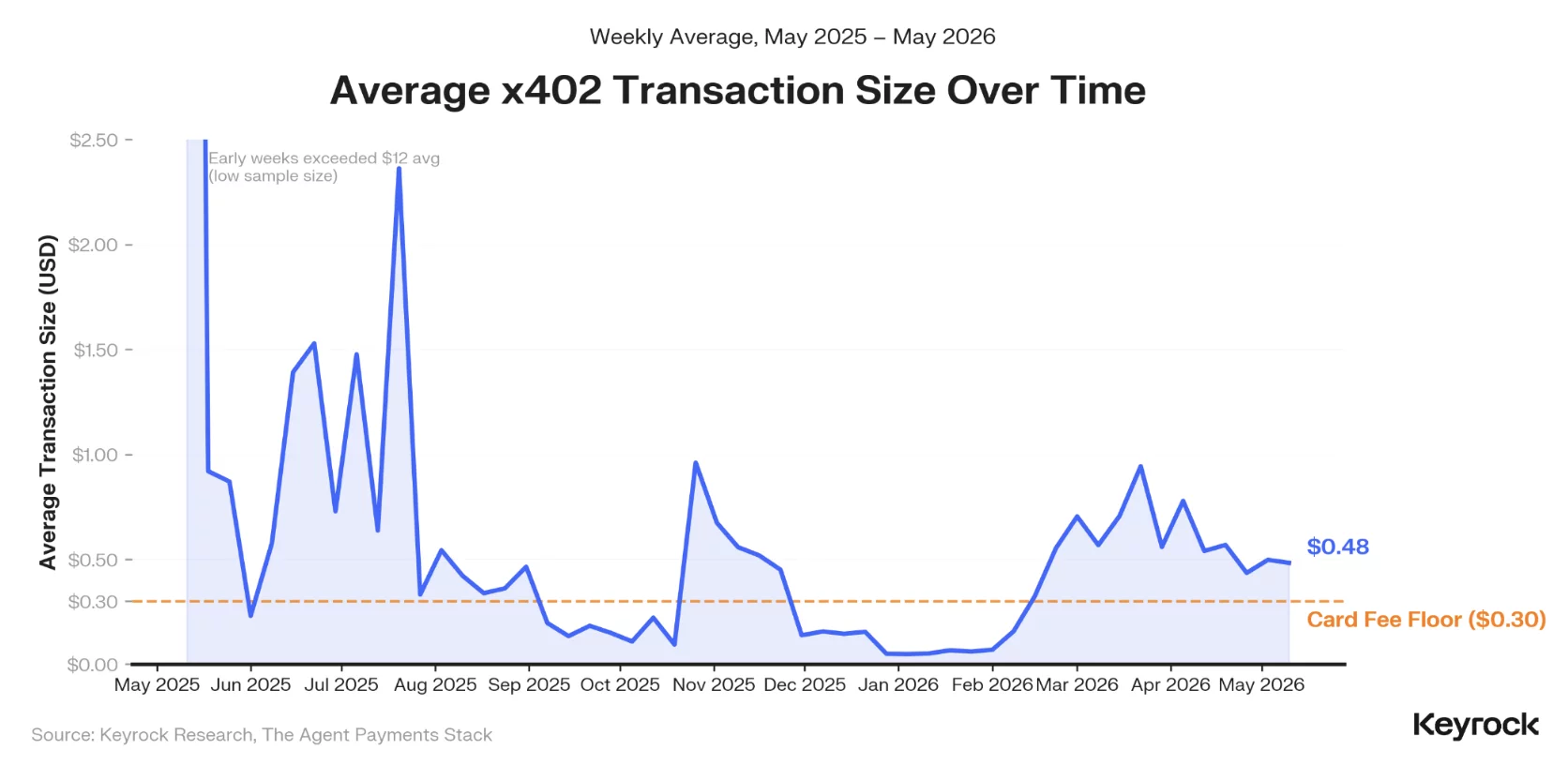
Keyrock said the average AI agent payment sits far below normal card-payment economics. Across 176 million x402 payments, the median transaction was between $0.01 and $0.10, while 76% of activity fell below the $0.30 card-fee floor. (Imagine paying 30 cents to buy a candy bar. Now imagine paying 0.01 cents to buy a digital squirrel. The future is here.)
That fee gap explains why stablecoins are becoming useful for machine commerce. Keyrock said Layer 2 stablecoin settlement costs about $0.0001, making blockchain rails more workable for small payments such as API calls, data access, and automated digital services. (Because nothing says “practical” like paying a fraction of a cent for a service you might not even need.)
USDC dominates AI agent settlement
USDC handled 98.6% of the 176 million payments tracked in the Keyrock report. The report said stablecoins became the settlement layer for machine commerce because they could process sub-dollar payments without breaking the business model. (Because nothing says “reliable” like a stablecoin backed by a single company’s reserves.)
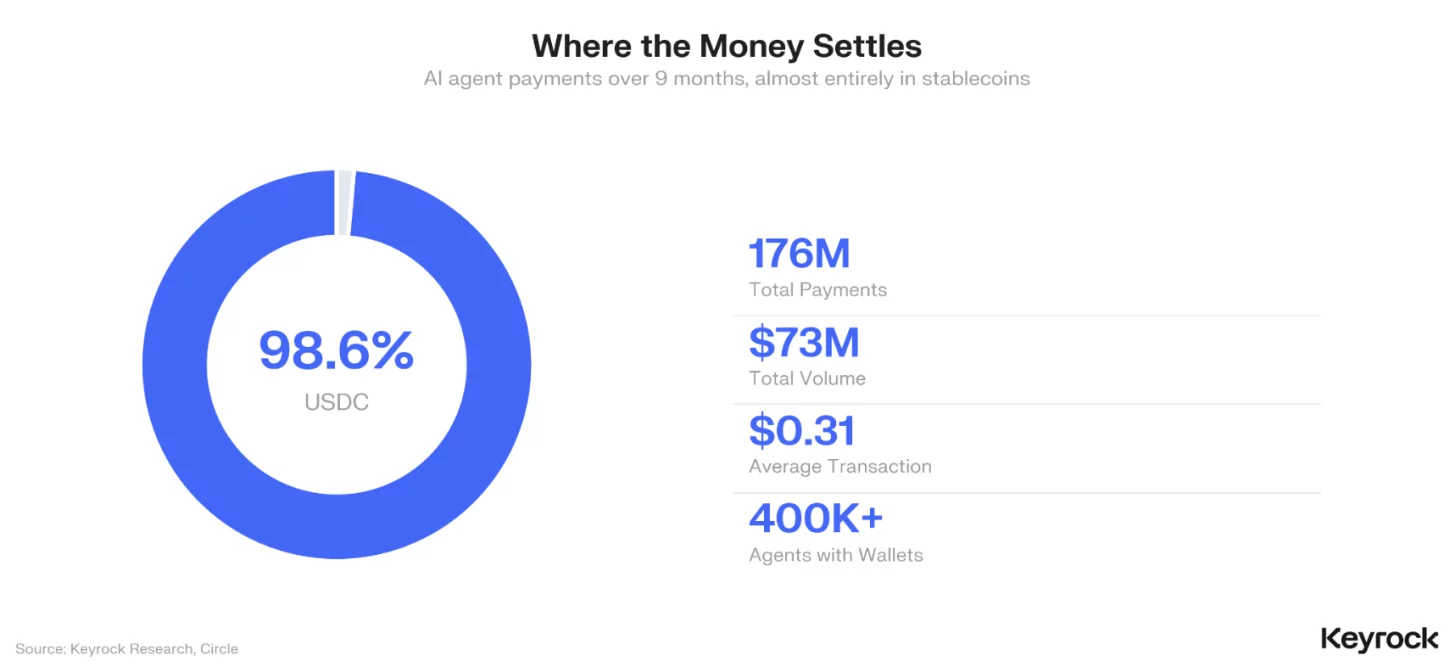
Keyrock also flagged concentration risk. It said the agent-payment market depends heavily on Circle’s reserve management, regulatory position, and technical infrastructure. The report described this as both a validation of USDC and a weakness for the wider sector. (Because nothing says “robust” like relying on one company’s ability to keep its promises.)
Coinbase and Google expand agent payment tools
Related reports show that Coinbase has been building AI agent payments through x402 and Agentic.market. Crypto.news reported that Agentic.market lets autonomous agents find and buy services using USDC, while x402 had already settled about 165 million transactions across more than 480,000 agents at launch. (Because nothing says “scalable” like 480,000 agents all paying with the same currency.)
Market updates also show the race is wider than Coinbase. Crypto.news reported that Google and Solana launched Pay.sh for stablecoin-based API payments, while Anchorage Digital introduced AI banking tools for autonomous payments. These moves show that AI agent payments are becoming a live infrastructure market, not only a crypto experiment. (Because who wouldn’t want to trust their financial future to a combination of algorithms and corporate interests?)
Read More
- Off Campus Season 1 Soundtrack Guide
- Chainsaw Man Volume 24’s Cover Art Reveals a Brand-New Denji
- DoorDash responds after customer uses AI to make food look bad and get a refund
- HSR Banner Schedule (Honkai Star Rail)
- Hideo Kojima says Metal Gear Solid 2 became the future he hoped would not happen
- Ethereum Eyes Break Above $2,420 as Rally Hangs in the Balance
- How to Get to the Undercoast in Esoteric Ebb
- Silver Rate Forecast
- Euphoria Season 3’s New R-Rated Sydney Sweeney Scene Proves The Show Is Trolling Us
- 8 Funniest Billy Butcher Quotes From The Boys
2026-05-25 11:00