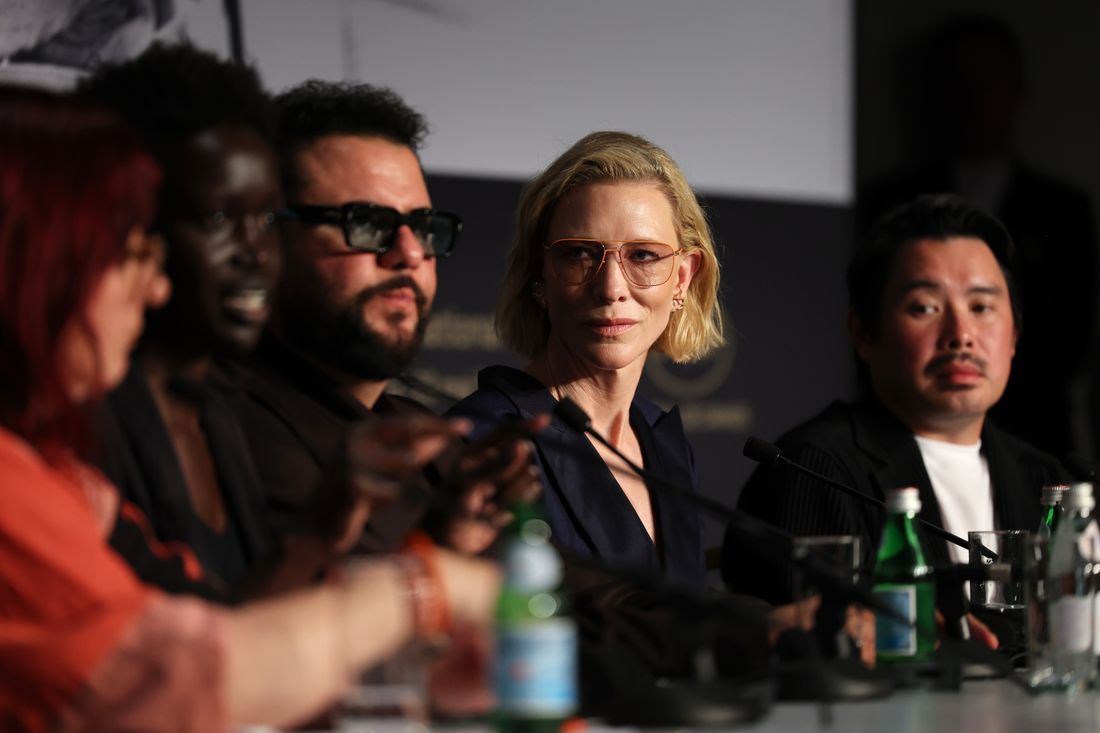
As I approached the room at the top of the Palais to interview Cate Blanchett, a festival employee stopped me. I explained my purpose, and she gave me a look – a classic French combination of sympathy and disapproval that I’d become familiar with. “It’s not possible,” she stated, shaking her head. When I clarified that the interview was with Cate Blanchett, she immediately waved me through.
Cate Blanchett’s reputation is so strong it can even influence events at the Cannes Film Festival. Recognizing this influence, Blanchett co-founded the Displacement Film Fund with the International Film Festival Rotterdam. The fund supports filmmakers who have been displaced themselves, or who create powerful, truthful stories about the experiences of displaced people. This week, Blanchett announced the latest grant winners: Mohammed “Mo” Amer, Annemarie Jacir, Akuol de Mabior, Bao Nguyen, and Rithy Panh.
The day after a wonderful conversation at a festival—where she discussed films like Carol and Tár, and a funny story Guillermo del Toro once told her—I met with Blanchett, who was wearing all off-white, including platform shoes, to talk about her fund and revisit some of those topics. Joining us was Vietnamese American filmmaker Nguyen, whose film How to Ride a Bike is about a father who secretly learns to ride a bike after struggling to teach his son, and Amer, the Palestinian American comedian and creator of Netflix’s Mo. Amer is working on a new project, Return to Sender, which follows a Palestinian comedian and refugee facing increasingly frustrating immigration issues while touring the world.
“I love those shoes!” Cate Blanchett responded, “Oh, thank you. I’m actually surprised they’re still so white – that’s quite an accomplishment! I believe they’re Sanderson shoes, and they’re very comfortable. I was wearing heels earlier, but I had to take them off. I just couldn’t take it anymore.”
We started this fund after a conversation at the Global Refugee Forum. I was with Ke Huy Quan, Echo Quan, Ayman Tamer, Koji Yanai, and Isaac Kwaku Fokuo. Everyone at our table was asked to make a commitment. Koji had recently produced the film Perfect Days, and we were hearing a powerful story from an Afghan educator and activist who was once a refugee. I realized these kinds of stories weren’t getting enough attention in film, so we decided to pledge that our table would support and fund filmmakers who have been displaced. Just because someone is displaced doesn’t mean they stop being a creative artist.
That’s how the idea started, and we began looking for support. I’ve known Clare Stewart at Rotterdam for a long time, so I reached out to them and they were very enthusiastic – it aligned perfectly with their goals. It felt like a great fit, bringing together major public institutions, private individuals, corporate sponsors, and filmmakers. We envisioned it as a smaller-scale version of the MacArthur Genius Grants – not open to everyone, but focused on supporting experienced filmmakers who were looking to reach a wider audience and avoid being overlooked. Luckily, Film Forum has generously offered to host the first group of filmmakers, including a qualifying round and a week of screenings in New York this fall.
We chose these filmmakers through a two-step process involving a nominations committee and a selection committee. This year, Agnieszka Holland, Barbara Broccoli, Ke Huy Quan, and Jonas Rasmussen (director of Flee) were on the selection committee. We created a long list of potential candidates, then narrowed it down, hoping our top five choices would be available to participate.
Mohammed Amer: I said “no.” I was like, “Just stop calling.”
C.B.: Lots of fruit baskets.
I immediately said yes when Cate called. I’m a huge admirer of her work, and this project felt incredibly important – easily one of the highlights of my year. It’s a privilege to contribute to something that I hope will inspire other emerging artists. As soon as she asked, I was excited to join the team.
Bao Nguyen and Ke Huy Quan, a mutual friend and incredibly talented artist who is also a Vietnamese refugee, have been wanting to collaborate on a project for a while. After Ke Huy Quan’s Oscar win for Everything Everywhere All at Once, he became very busy. They both felt there was a need for a more complex portrayal of the Vietnamese American experience, moving beyond typical narratives focused solely on being refugees or the Vietnam War. When Bao learned Ke Huy Quan was discussing a new initiative with Cate, he realized he had many stories he wanted to tell. He was then asked if he was available to direct, and he planned a tight schedule: finish filming by August, hand the footage to the editor, get married, and allow time for a rough cut to be assembled while he was away.
M.A.: He’ll use the funds for his honeymoon.
Look, I actually promised my fiancé I’d be taking it easy, but honestly, opportunities like this don’t come around often. It’s rare to get to tell a story that’s so personal and meaningful, with complete creative freedom. Plus, having Cate Blanchett’s support and belief in the project means the world to me. I’m always balancing work and life, trying to make a real impact with what I do. Honestly? I might even have to reschedule the wedding if I need to, because this project is just too important.
C.B.: Just change the pitch to a wedding film.
During your presentation yesterday, you discussed RSL Media, a tool you co-founded to help artists control how their work is used by AI. I’m curious to know your own views on consenting to the use of your work in AI systems.
C.B.: Yes, that’s RSL Media. I’m not against AI at all – I see its potential as a tool, but we need to be careful with it. AI is becoming increasingly common, and many filmmakers might want to use it. However, we haven’t solved the problems of consent and transparency. RSL Media offers a way for artists to clearly give or deny permission for their work to be used. It allows for a direct question: “We’re about to use your image, is that okay?” Artists can say ‘yes’ with conditions, like requiring contact with a representative or lawyer to discuss terms. I believe in fair exchange, but simply taking someone’s work without permission isn’t a negotiation.
You mentioned a funny, but also relatable, experience – waking up at 3 a.m., overwhelmed by the thought of work and contemplating just staying in your wardrobe. When did you last feel that way, and what do you do to cope? C.B. responded with a long pause, then said she relies on Xanax gummies and often asks her husband the night before what her plan is to get through it, to which he simply replies, ‘You’ll be fine.’
M.A.: Did somebody say gummies?
These are unsettling times, and many people are feeling anxious. But when you find an idea that resonates with others, it can be incredibly energizing. I recently heard someone say that hope isn’t enough – we need to be actively working towards a better future. It’s about recognizing the urgency and taking action, but doing so with genuine hope, not naive optimism. There’s a lot of work to be done, so let’s get started. When we work together, we find strength, and that can even help us sleep better at night.
It’s reassuring to know I’m not the only one who feels lost.
C.B.: Yeah, definitely. I’m completely overwhelmed right now.
Watching Mo come to life with season two felt like an incredibly intense, transformative experience for me. It was almost like going through multiple deaths and rebirths! I think that’s true of any really meaningful work, and honestly, just life itself – you’re constantly balancing so many different things at once.
When there’s a lot on the line and things are stressful, that’s when work feels truly meaningful. We’re drawn to high-stakes situations because that’s when we’re actually putting something on the line. Without that risk, everything feels bland and unfulfilling.
I really enjoyed the story you shared yesterday – the one about that difficult person. C.B. then admitted they were likely under the influence of psychedelic mushrooms at the time. They also emphasized how much they value working with diverse people and appreciate different perspectives, even if it leads to disagreement. When asked about handling conflicting opinions from colleagues, C.B. said they welcome it and believe it’s a good thing to discuss.
The interviewer asked how personally involved the filmmaker was with her films. M.A. responded by saying she’s actually writing the entire script, though the subject of the interview isn’t aware of that yet.
The condition was that the story needed to include a role for an older white actress [chuckles]. We’ve discussed creative freedom quite a bit, and these filmmakers usually bring their own producers. We’re available to assist them whenever they require support.
It’s unusual to have that much creative freedom, and I really appreciate it. I like being challenged to develop a story with the simple premise – ‘You come from a community that’s been forced to leave home,’ without needing to make that the central focus. It’s exciting to consider what fresh stories can emerge from that starting point.
There’s been a lot of talk about the noticeable absence of major Hollywood and studio films at Cannes this year. What are your thoughts on that?
C.B.: After being part of the festival as a jury member and attending many times with films, you start to notice certain themes appearing, though it doesn’t seem planned. The festival organizers see a huge number of films and understand that Cannes is a very critical platform. They want the films to succeed here and connect with each other. Each year’s festival has its own unique feel. I don’t think the current lineup was intentionally chosen; it just happened this way. This year, there’s a strong presence of Japanese and Spanish cinema. I recently saw James Gray’s film, as well as those by Hirokazu Kore-eda, and I found Paper Tiger particularly beautiful – America should be proud of it.
Seeing a vibrant place like Cannes reminds me that cinema is still thriving. Whenever people ask me how the film industry is doing, I tell them to come here, experience a movie, and feel the energy – like when the audience gives a six-minute standing ovation! That kind of enthusiasm is enough to keep me going for the rest of the year.
Thierry Frémaux noted that Hollywood seems quiet lately. Does that ring true? Are there fewer roles or quality scripts available?
C.B.: It feels like people are playing it safe. However, there’s a lot of filming happening in the U.K. and Central Europe. I think some are hesitant to start projects in certain U.S. states due to political conflicts with the federal government. But there’s also a surge in lower-budget films. Our industry is incredibly adaptable and resourceful. We often grapple with complex issues – like the impact of AI – publicly, which can give the impression we’re facing a lot of problems. And we are, of course. The creative process is always full of challenges.
You’ve got at least two exciting projects coming up: the Brady Corbet film and a biopic about Martha Stewart. Have you had a chance to speak with Martha yet?
C.B.: Not yet! We haven’t met, but I’m a huge fan. I’m fascinated by her life, her influence, and how she sees the world. We have a strong script, and we’re developing it now, but it’s still in the early stages.
Brady Corbet made The Brutalist for $9 million, and he strongly prefers maintaining complete creative control over his films. He believes larger budgets often come with unwanted restrictions and interference.
Absolutely. I often felt similar pressures while making my series. Working with companies like A24 or Netflix means collaborating with a lot of different people, and everyone has their own ideas. What’s special about this project is that I had the freedom to be completely creative, do exactly what I wanted, and hopefully make something meaningful. When you’re working with a limited budget, you have to be resourceful and rely on the generosity of others. I once spoke with a director who said that people will recognize your passion for a project, and sometimes that can be taken advantage of – and he was right. Storytelling is just part of who I am. It’s not about the money; it’s about creating something special, which then leads to recognition, popularity, and ultimately, success.
C.B.: So you can buy a pair of glasses like the ones you’re wearing now.
M.A.: [Laughs.]Yes, of course. I want to look good.
People might be surprised by how funny Cate is. She’s really witty over text, and it’s something I didn’t anticipate. It’s funny because when you get the call, someone will say, imitating a British accent, ‘Cate would like your number.’
C.B.: Why were they speaking in that voice?
M.A.: When I read your texts, that’s how I read them.
Read More
- Off Campus Season 1 Soundtrack Guide
- Euphoria Season 3’s New R-Rated Sydney Sweeney Scene Proves The Show Is Trolling Us
- Gold Rate Forecast
- All Golden Ball Locations in Yakuza Kiwami 3 & Dark Ties
- DoorDash responds after customer uses AI to make food look bad and get a refund
- Jon Bernthal Explains Why Marvel Let Him Make The Darkest Punisher Story Ever
- Dutton Ranch Review: Paramount+’s New Western Takes All The Best Parts Of Yellowstone & Makes Them Better
- The 2026 Cannes Film Festival Standing-O-Meter
- Uncovering Financial Fraud with the Power of Networks
- ETH Holders Cash In: Is the Party Over, or Just Getting Started?
2026-05-19 21:57