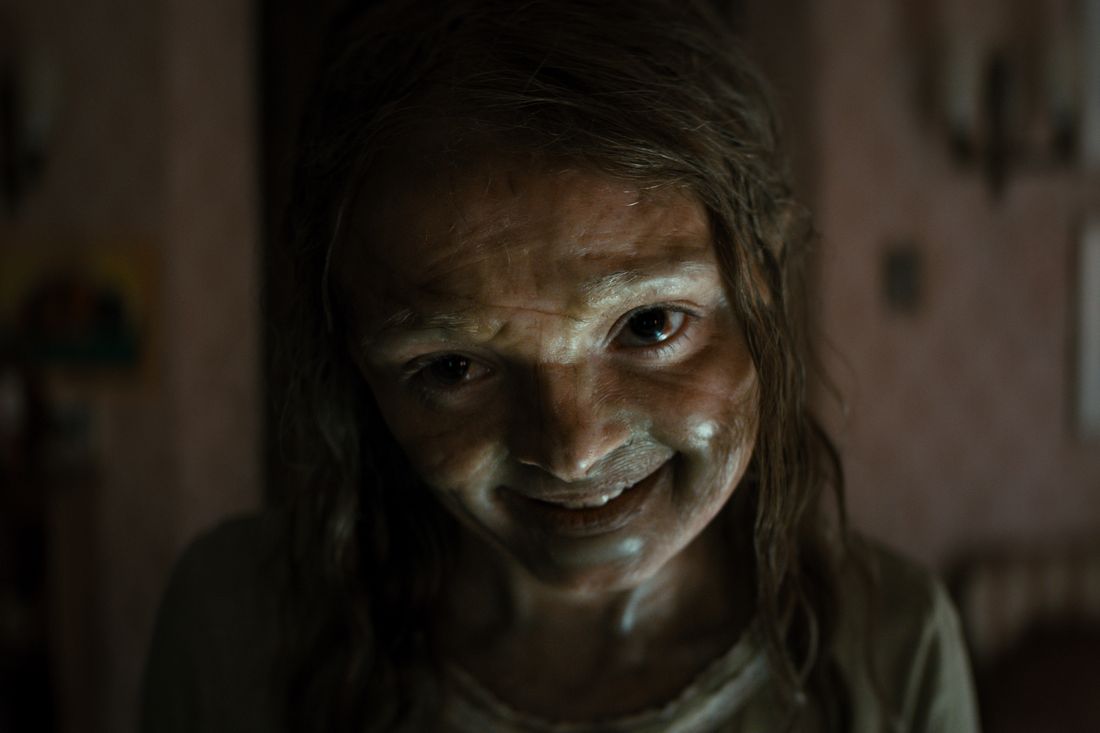
The idea of a parent’s love being limitless is tested in this story. When Charlie and Larissa Cannon are reunited with their daughter, Katie, after she’s been missing for eight years, it’s unsettling. Katie disappears while the family lives in Cairo for five months – Charlie is working as a journalist. She’s played by Emily Mitchell initially, but when she returns, found inside an ancient sarcophagus at a plane crash site, she’s portrayed by Natalie Grace with disturbing makeup and prosthetics. Though alive, she appears like a decaying corpse – her skin is gray and dried out, her hands and feet are claw-like, and she breathes with difficulty. Doctors say she’s traumatized and catatonic, requiring heavy sedation to prevent self-harm. Despite this, her parents are determined to care for her at home. As they tentatively touch her damaged hair, you brace yourself for a violent reaction.
It does eventually happen, but it takes a very long time. This Mummy movie is a ridiculously over-the-top, gross-out film that oddly tries to be a slow, thoughtful experience. (I hesitate to even use its full title, Lee Cronin’s The Mummy, which seems unnecessary considering the other Mummy films starring Tom Cruise and Brendan Fraser. It makes it sound like director Lee Cronin, known for Evil Dead Rise, is a major celebrity.) But the film doesn’t offer enough substance to justify its slow pace, as it moves from Egypt to the desert of the American Southwest, where the Cannon family – including teenager Sebastián and young Maud – are trying to rebuild their lives. It’s not nearly as unsettling or emotionally resonant as Hereditary, either in its portrayal of something deeply wrong within the family’s New Mexico home, or in its exploration of parental guilt and grief. By the time the movie finally embraces its wild side with peeling skin, reanimated corpses, and a scorpion attack, it’s already lost most of the audience’s patience.
Despite being released by Warner Bros., The Mummy shares a producer with the recent updates to classic monster movies like The Invisible Man and Wolf Man, but it doesn’t quite fit into that same series. The only connection to the original The Mummy is the concept of being wrapped in bandages and buried alive – which is exactly what happened to Katie, who is discovered alive inside an ancient stone coffin that archaeologists expected to find empty. The idea of being sealed in darkness is genuinely frightening, but the movie doesn’t fully explore that horror. Once Katie becomes possessed, she exhibits typical traits – vomiting, levitating, contorting her body, and speaking in a sickly-sweet voice that quickly turns demonic. Perhaps the mummy isn’t very compelling once unwrapped, or maybe The Mummy simply lacks originality.
The movie struggles to avoid relying on stereotypical depictions of Egypt, though it does feature Dalia Zaki (May Calamawy), a Cairo-based detective, which grounds part of the story in Egypt. Dalia is persistent, but we don’t learn much else about her as she investigates Katie’s disappearance while other characters focus on their emotions. The mystery centers around a strict Egyptian woman (Hayat Kamille) who practices magic with her family on their farm. It’s unclear whether she’s using magic out of necessity or to benefit her family. The fact that they’re about to lose their land to flooding suggests she’s acting out of desperation, as their rituals don’t seem to be helping them. However, the ending unfairly blames the woman, portraying her as a threatening, foreign figure targeting a young American girl – a classic fairytale witch. Ultimately, the film focuses on who she chose as her target rather than why she used magic.
Read More
- Solo Leveling’s New Manhwa Chapter Revives a Forgotten LGBTQ Story After 2 Years
- All Itzaland Animal Locations in Infinity Nikki
- The Boys Season 5 Spoilers: Every Major Character Death If the Show Follows the Comics
- Gold Rate Forecast
- How to Get to the Undercoast in Esoteric Ebb
- Cthulhu: The Cosmic Abyss Chapter 3 Ritual Puzzle Guide
- Woman fined $2k over viral googly eyes graffiti on $100k statue
- Smarter, Faster Networks: Optimizing Early-Exit Architectures for Edge AI
- Zerowake GATES : BL RPG Tier List (November 2025)
- CBR’s Official Spring 2026 Anime Series Power Ranking (Week 1)
2026-04-17 15:54