In the dusty plains of the financial frontier, a new gold rush has emerged, though this time the prospectors are armed with algorithms and the stakes are measured in billions. A BitMEX research report, published on a Thursday as unremarkable as any other, revealed that the traditional finance (TradFi) perpetual swap volume had ballooned from a mere $525.8 million to a staggering $30.7 billion weekly in Q1 2026. It seems the old guard has finally caught wind of the crypto mechanism, now a decade in the making, and is riding it like a bucking bronco.
Key Takeaways:
- BitMEX’s report shows TradFi perpetual swap weekly volume soared from $525.8 million to $30.7 billion in Q1 2026, a leap that would make even the most seasoned cowboy blush.
- Commodity perpetuals grew by a jaw-dropping +65,463% after Binance, the new sheriff in town, launched gold and silver contracts in January 2026. By March, oil had added $6.9 billion weekly, proving that even black gold can shine in the right hands.
- BitMEX, the original inventor of the perpetual swap, saw a +1,322.6% volume growth and plans to add forex pairs and new commodity listings in 2026, because why stop at oil when you can trade the whole darn planet?
According to the BitMEX analysis, this product category started in 2026 with market penetration so low it made a tumbleweed look busy. By late February, weekly volume peaked at $54.5 billion. The shift was as structural as a barn built by a master carpenter. Exchanges adapted the same mechanism that BitMEX co-founders Arthur Hayes, Ben Delo, and Samuel Reed introduced on May 13, 2016, with the XBTUSD contract, to cover gold, silver, crude oil, and U.S. equities. It’s like teaching an old dog new tricks, but this time the dog is Wall Street and the tricks involve billions.
BitMEX data shows Binance posted the sharpest gain, growing volume by +74,536.6% after launching gold and silver perpetuals in January 2026. The exchange now holds 62.7% of the total TradFi perp market share, leaving competitors in the dust like a donkey in a horse race. Hyperliquid grew +953.4% and currently holds 29.7%. BitMEX itself posted +1,322.6% volume growth, the second-best rate among all tracked platforms, ahead of both Hyperliquid and Aster. It’s a race to the top, and everyone’s got their spurs on.
The BitMEX report identified two distinct phases in Q1 growth. Precious metals drove January and February volume, like prospectors flocking to a new claim. Crude oil entered in March, just in time to ride the wave of Iran-related geopolitical tensions. By then, crude oil perpetual volume had shot from zero to $6.9 billion weekly, according to BitMEX. The Wall Street Journal covered the development, focusing on the availability of 24/7 oil trading through crypto derivatives platforms. That coverage drew in traders who had no prior exposure to the product category, like a saloon attracting thirsty travelers.
BitMEX data shows commodity perpetuals overall grew +65,463%, reaching $25.0 billion in weekly volume. By the week of March 15, XAG (silver) held 34.8% of the commodity market share, crude oil held 27.7%, and XAU (gold) held 27.5%. Smaller allocations went to copper, platinum, and palladium, the researchers noted. It’s a regular smorgasbord of commodities, and everyone’s got a plate.
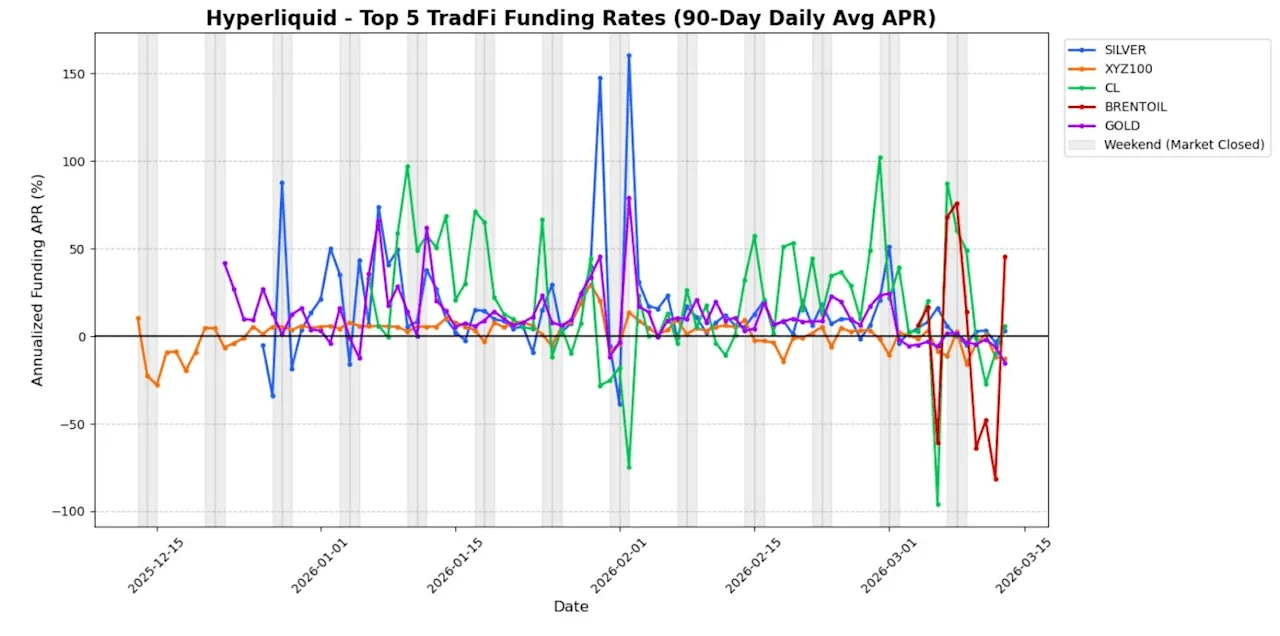
Equity perpetuals grew +908%, reaching $4.9 billion weekly with a peak of $5.7 billion during the week of March 8, per BitMEX. The top contract by volume was Hyperliquid’s XYZ100 NASDAQ 100 index product at 42.2% of equity volume. Nvidia, Strategy, Tesla, and Circle followed. Even Robinhood stock ranked among the top ten most traded equity perpetuals, proving that everyone wants a piece of the pie, no matter how small.
In the report, BitMEX researchers explain the mechanism underneath these products as a funding rate system. When a perpetual contract trades above its spot index, long position holders pay short holders at regular intervals, typically every eight hours. When it trades below, shorts pay longs. The rate self-corrects without an expiration date, eliminating quarterly rollover friction. It’s like a well-oiled machine, except the oil in question is worth billions.
Applying that mechanism to traditional assets introduces a complication that BitMEX details at length in the report. Commodity and equity markets close on weekends, because even Wall Street needs a day off. Exchanges handle the offline period differently. Binance freezes its price index at Friday’s close and applies a smoothed exponential weighted moving average with a plus or minus 3% deviation constraint. Hyperliquid uses a similar approach, with crude oil capped at plus or minus 5%. BitMEX, however, allows its internal order book to move freely within a rolling 2% hourly limit, letting price discovery continue through the full weekend without a hard ceiling. It’s like leaving the saloon doors open while everyone else locks up tight.
That difference generated arbitrage opportunities during the March oil events, according to the BitMEX report. When crude oil gapped higher on geopolitical news over a weekend, Hyperliquid’s WTIOIL contract hit its 5% ceiling and stopped reflecting the move. BitMEX’s WTIUSDT continued trading, and the spread between the two contracts became as actionable as a cowboy with a grudge. By Monday’s open, Hyperliquid had to catch up to spot, leaving arbitrageurs grinning like a cat with a canary.
A separate opportunity emerged from funding rate differentials, BitMEX noted. The exchange’s SPY contract ran at a negative 119.22% annualized funding rate on weekdays, meaning long holders received payment. The Coinbase stock contract ran at a negative 105.23% on BitMEX versus a positive 1.04% on Hyperliquid. BitMEX calculates that a long-short position across the two venues produced a net annualized spread of roughly 106% with limited directional exposure. The MicroStrategy spread offered 52.92%, and Apple offered 37.33%, according to BitMEX’s 30-day average funding rate analysis. It’s like finding gold in them thar hills, except the hills are made of data.
Bitget enabled weekend trading for TradFi pairs in February 2026, after previously halting all activity on Saturdays and Sundays. Lighter, which held 30.7% of TradFi perp volume in late 2025, lost that share and posted a 30.4% volume contraction through Q1. Its December 2025 token generation event did not reverse the decline, per BitMEX data. It’s a reminder that in this game, yesterday’s hero can become today’s has-been faster than you can say “sell.”
Looking ahead, BitMEX said it plans to add Brent crude, natural gas, copper, and platinum perpetuals to its platform. Forex pairs including EURUSD, GBPUSD, AUDUSD, and USDJPY are also in development. The report flags that Hyperliquid’s index partnership with S&P Global is drawing regulatory scrutiny from the U.S. Commodity Futures Trading Commission (CFTC), which requires platforms offering leveraged derivatives to U.S. users to register as a designated contract market or swap execution facility. It’s like the sheriff finally showing up to a town that’s been running wild.
BitMEX places total weekly TradFi perp volume at $30.7 billion as of the report’s publication and identifies bonds, agricultural commodities, and interest rate products as the next potential additions to the perpetual swap ecosystem. The gold rush is far from over, and the prospectors are just getting started.
Read More
- Netflix’s Little House On The Prairie Reboot: Release Date, Cast & Everything We Know
- Off Campus Season 1 Soundtrack Guide
- Silver Rate Forecast
- Prime Video’s New R-Rated Spy Thriller Is Officially No.1 On Streaming Despite Poor Reviews
- Gold Rate Forecast
- Brent Oil Forecast
- EUR ZAR PREDICTION
- EUR USD PREDICTION
- 币安人生 PREDICTION. 币安人生 cryptocurrency
- Amazon Primes new GenAI cartoon looks like K-Pop Demon Hunters with aliens
2026-04-09 18:30