It might sound like something from a science fiction game, but recent research indicates that hackers using quantum computing could potentially compromise Bitcoin’s security and steal funds during transactions much faster than previously thought.
Is Doomsday Near For Bitcoin?
Google’s Quantum AI team released a new report and blog post on Tuesday stating that the cryptography behind Bitcoin and Ethereum could be cracked with fewer resources than previously thought. They estimate it would take less than 500,000 physical qubits and around 1,200 logical qubits, significantly lower than earlier estimates that suggested millions would be needed.
Most blockchains and cryptocurrencies use a powerful type of math, called 256-bit elliptic curve cryptography, to keep wallets and transactions secure. This system relies on a problem called the discrete logarithm problem (ECDLP-256). Recent research suggests it may now require significantly fewer resources to solve this problem, potentially weakening the security of these systems. The following blog post details this finding:
As a researcher, I’ve found that these quantum circuits could realistically be run on today’s superconducting qubit processors – specifically, a CRQC with under 500,000 physical qubits – in just a few minutes. This estimate is based on reasonable expectations for the performance of hardware like Google’s advanced quantum processors. Importantly, this represents about a 20x decrease in the qubit resources needed to tackle the ECDLP-256 problem, and it builds on a consistent trend of improving how we translate quantum algorithms into practical, fault-tolerant circuits.
The report states that powerful quantum computers could break the security of current online encryption methods. Unlike simply hacking digital wallets, the research simulates a real-time attack where a quantum computer could steal Bitcoin during a transaction in roughly 9 minutes. This is possible by rapidly using the briefly exposed public key to figure out the private key, giving it a 41% chance of succeeding before a new Bitcoin block is added (which takes about 10 minutes). Ethereum may be safer than Bitcoin in this regard because its transactions are confirmed more quickly.
The Culprit: Taproot
These findings offer a new way to look at Taproot, Bitcoin’s 2021 upgrade. While Taproot improved privacy and made transactions more efficient, it also began to publicly display public keys on the Bitcoin blockchain. This removed a layer of protection previously offered by older address types. As a result, roughly 6.9 million BTC – including those from the earliest days of Bitcoin and addresses used frequently – are now potentially vulnerable to attacks from future quantum computers.
Quantum computers are a new type of machine that harnesses the principles of quantum physics to handle information. Unlike regular computers which use bits representing either 0 or 1, quantum computers use qubits. Qubits can represent 0, 1, or a combination of both simultaneously, allowing the computer to investigate many potential solutions at the same time. Traditional computers check each possibility one after another. This difference means that a quantum computer, for specific complex calculations – like breaking down very large numbers used in security – could find answers in minutes that would take even the most powerful conventional supercomputer longer than the universe has existed.
Although a quantum-resistant computer doesn’t exist yet, Google recently set an internal goal of 2029 to update its systems for quantum security, which is pushing up the estimated timeframe for when this transition needs to happen. Experts caution that this update will take several years, even before the necessary technology is fully developed.
Some people on X (formerly Twitter) are starting to worry about the potential threat quantum computers pose to cryptocurrency. Nic Carter, co-founder of Coin Metrics and a Bitcoin supporter, recently shared a new study from researchers at Oratomic, Caltech, and UC Berkeley. This study suggests that a quantum computer with just 10,000 advanced qubits could potentially crack the encryption that secures cryptocurrencies.
Surprisingly, the Google Quantum AI research isn’t necessarily the most worrying quantum computing paper that came out today.
— nic carter (@nic_carter) March 31, 2026
About one-third of all Bitcoins could become vulnerable to attacks from future quantum computers if no changes are made. This could affect how traders price older coins and impact practices like Taproot usage and address reuse. It’s important for traders to monitor the adoption of Taproot, the progress of Bitcoin upgrades (like those proposed in BIP-360), and whether developers start planning a shift to protect against these future threats, especially as the potential risks become more pressing around 2029.
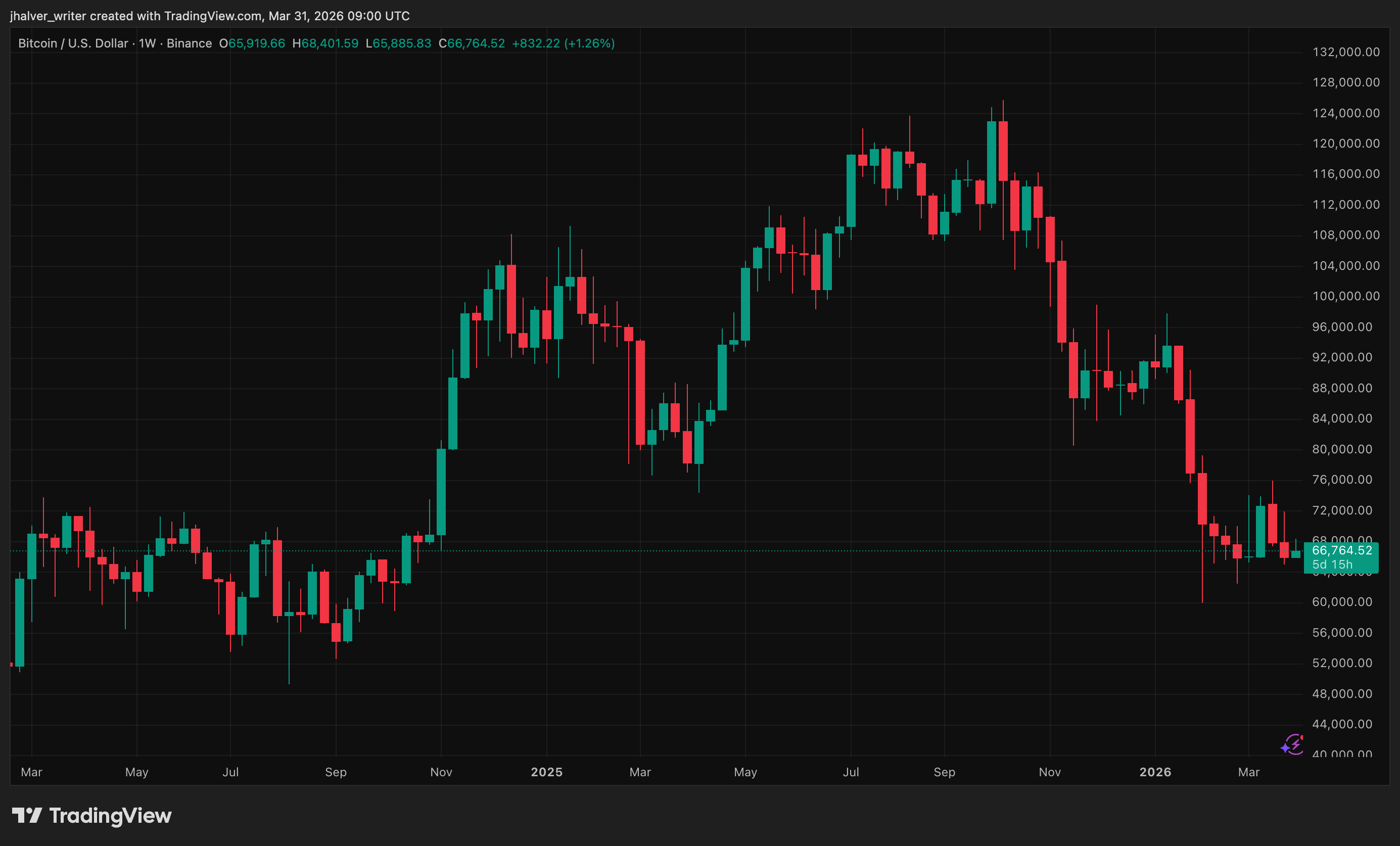
Cover image from Perplexity, BTCUSD chart from Tradingview
Read More
- Off Campus Season 1 Soundtrack Guide
- X-Men ’97 Finally Gave Gambit the Hero Moment He Deserved
- 46 Years Later, The Mandalorian & Grogu Answers A Major Empire Strikes Back Question
- 10 Worst End-Game Couples In Sitcom History
- HoI4 fans harsh reactions to the announcement of another DLC pack
- Chainsaw Man Volume 24’s Cover Art Reveals a Brand-New Denji
- Emily Henry Says to ‘Trust the Vision’ For Beach Read Adaptation
- Hatsune Miku cosplayer goes viral selling $15 cups of “foot juice” to thirsty anime fans
- Gold Rate Forecast
- DoorDash responds after customer uses AI to make food look bad and get a refund
2026-03-31 12:59