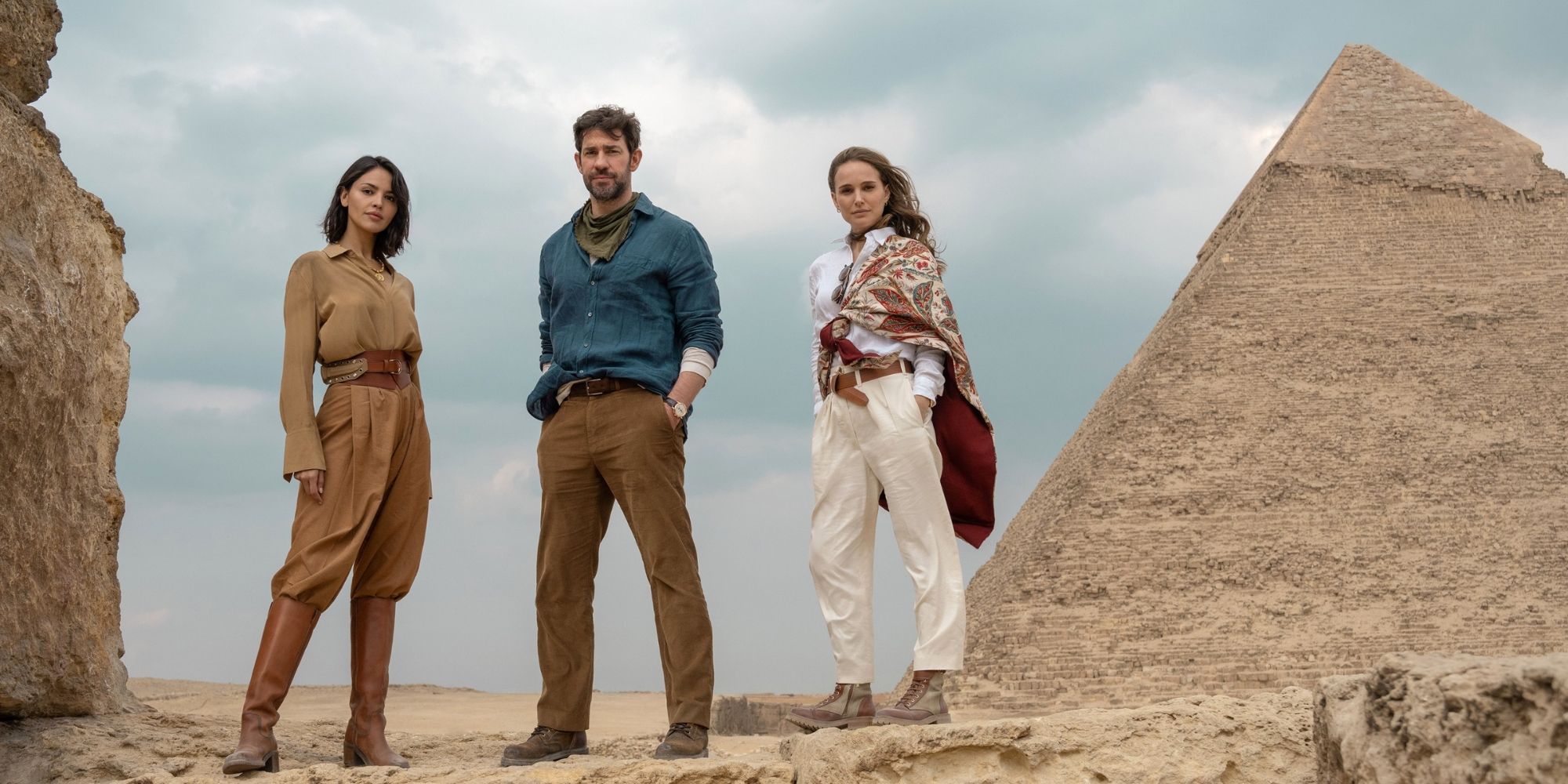
Guy Ritchie’s adventure film is becoming popular on streaming services once again. It follows two separated siblings, played by John Krasinski and Natalie Portman, as they search for the mythical fountain of youth. Their quest leads them on a journey across the globe, from Thailand and London to Austria, and ultimately to Egypt’s Great Pyramids.
In Fountain of Youth, the treasure hunters uncover a huge cavern under the Great Pyramid of Khufu. While the Khufu pyramid is Egypt’s most famous landmark, the film falls into a common Hollywood trap of focusing on just one Egyptian site, ignoring the country’s vast history. This feels out of character for director Guy Ritchie, whose films usually explore lesser-known locations. The Red Pyramid at Dashur would have been a more unique and fitting setting for the story.
Fountain of Youth Proves a Secret Cavern in the Great Pyramid of Giza Has Become a Tired Trope
Luke Purdue, a former archeologist now making a living as a treasure hunter, is hired by the wealthy and terminally ill Owen Carver. Carver believes the legendary Fountain of Youth can save him. When Luke gets stuck while following clues left by the Protectors of the Path – a secret group that hides and guards the fountain – he turns to his sister, Charlotte, for assistance.
Natalie Portman plays Charlotte, who cautiously teams up with Luke and his colleagues to find a crucial missing clue. Throughout the search, Luke is followed by a captivating and enigmatic woman named Esme, played by Eiza González. Esme is a Protector determined to prevent Luke from finding the fountain, believing it’s necessary to safeguard humanity.
The story begins with a hidden passage discovered beneath the Great Pyramid of Khufu, opening into a vast cavern. The Pyramids of Giza, Egypt’s most famous landmark and one of the last remaining ancient wonders, are a common setting for adventure films. Because they’re so frequently used, audiences often anticipate the location as soon as a film like Fountain of Youth heads to North Africa.
Both Transformers: Revenge of the Fallen and X-Men: Apocalypse used the Great Pyramid of Giza as a key location, but in ways that many found unrealistic. Transformers depicted a hidden Decepticon device inside the pyramid, raising questions about how it remained undetected through scans and archaeological digs. X-Men: Apocalypse created a secret chamber within the pyramid to house technology used by the villain En Sabah Nur. Disney+ also featured the pyramid as a meeting place for the Ennead.
The Great Pyramids of Giza have been explored – and damaged – for centuries. Even before modern archaeology, ancient Egyptians raided the pyramids for treasures, leading later pharaohs to build secret tombs, like those carved into the Valley of the Kings. Over time, the Greeks, French, and British also plundered the area.
Archaeology started in the late 1800s as more of a treasure hunt than a science. Early archaeologists often used destructive methods like explosives and tunnels. For over two centuries, the Great Pyramids have been studied repeatedly with each new technological advancement. The recent Hollywood portrayal of a hidden chamber within the most excavated site in history is uninspired, improbable, and oversimplifies the complex history of the pyramids.
Fountain of Youth Utilized the Great Pyramid’s ‘Big Void’ in the Worst Way
In 2017, the ScanPyramids project discovered a large empty space, called the “Big Void,” above the Grand Gallery inside the Great Pyramid. Using a technique called muon radiography, they found this space measured about 30 meters long, and also detected a smaller void near the pyramid’s base. While gaps like these are often found in ancient structures, the Big Void was notable for its unusually large size.
Some archaeologists want to do further scans of the area, and even send a camera through the stones to explore the space inside. However, others aren’t convinced anything is actually there. Well-known Egyptologist Zahi Hawass thinks the empty space likely serves a structural purpose, helping to support the Grand Gallery and chambers below, or that it was a ramp used during construction that was sealed off once finished.
The filmmakers probably got the idea for a hidden passage from recent scans of Khufu’s pyramid, which revealed new spaces. In the movie, this passage leads to a big room with a musical puzzle. Solving the puzzle unlocks a larger cave where the legendary fountain is hidden.
It’s actually quite ironic that the chamber shown in the film would likely have caused the Great Pyramid to collapse. Weighing an estimated 5.75 million tons, the pyramid wouldn’t have been able to support such a large underground water space, and would almost certainly have fallen over time. We’ve seen this happen with other ancient structures – the Black Pyramid of Dashur, for example, has been crumbling since it was built because groundwater eroded its base.
The Red Pyramid of Dashur Should’ve Been the Focus of Fountain of Youth
In Fountain of Youth, Luke and his team had to figure out a puzzle to reach the massive cavern hidden under Khufu’s pyramid. The solution came from a musical code discovered by Thomas, Charlotte’s musically talented son. By playing specific notes on an old machine, he used the room’s unique sound qualities to open the path forward.
The Red Pyramid at Dashur is known for its amazing acoustics, and it would have been a much better fit for the story’s puzzle than the Great Pyramid of Giza. Locals call it the “Bat Pyramid” because of all the bats living inside. Its tall ceilings create strong echoes in the chambers, and some scientists think these echoes were intentionally used to amplify sound. This would have made it ideal for a puzzle involving music or sound.
Beyond its interesting sound qualities, the Red Pyramid remains more enigmatic than the Great Pyramid of Giza. It hasn’t been explored as thoroughly, and you don’t see it featured as often in documentaries or news reports. The Red Pyramid also has a peculiar draft of air, and no one knows where it comes from. While some scientists think it’s just a natural wind current, others suspect there’s a hidden ventilation system that keeps the pyramid cooler and fresher than other pyramids.
Some believe the pyramid wasn’t just a tomb, but an ancient factory that used water from the ground for making things. This idea suggests the ammonia smell wasn’t just from bat droppings, but a byproduct of these chemical processes. The pyramid’s location near the Nile River, a vital source of life in Ancient Egypt, could also support the idea that it was connected to a legendary water source.
The Red Pyramid at Dashur was a perfect setting for the story and ideas in Fountain of Youth, and it offered a more realistic explanation for the legendary fountain of immortality. It felt believable that a hidden passage could exist under this lesser-known pyramid, and its characteristics aligned with the film’s focus on lost history and unsolved mysteries. This approach suits director Ritchie, who prefers to highlight the hidden beauty and unique character of his locations instead of choosing the most obvious ones.
Found an error? Send it so it can be corrected.
Read More
- Off Campus Season 1 Soundtrack Guide
- Chainsaw Man Volume 24’s Cover Art Reveals a Brand-New Denji
- X-Men ’97 Finally Gave Gambit the Hero Moment He Deserved
- 46 Years Later, The Mandalorian & Grogu Answers A Major Empire Strikes Back Question
- HoI4 fans harsh reactions to the announcement of another DLC pack
- 10 Worst End-Game Couples In Sitcom History
- Gold Rate Forecast
- DoorDash responds after customer uses AI to make food look bad and get a refund
- Emily Henry Says to ‘Trust the Vision’ For Beach Read Adaptation
- Hatsune Miku cosplayer goes viral selling $15 cups of “foot juice” to thirsty anime fans
2026-03-29 02:40