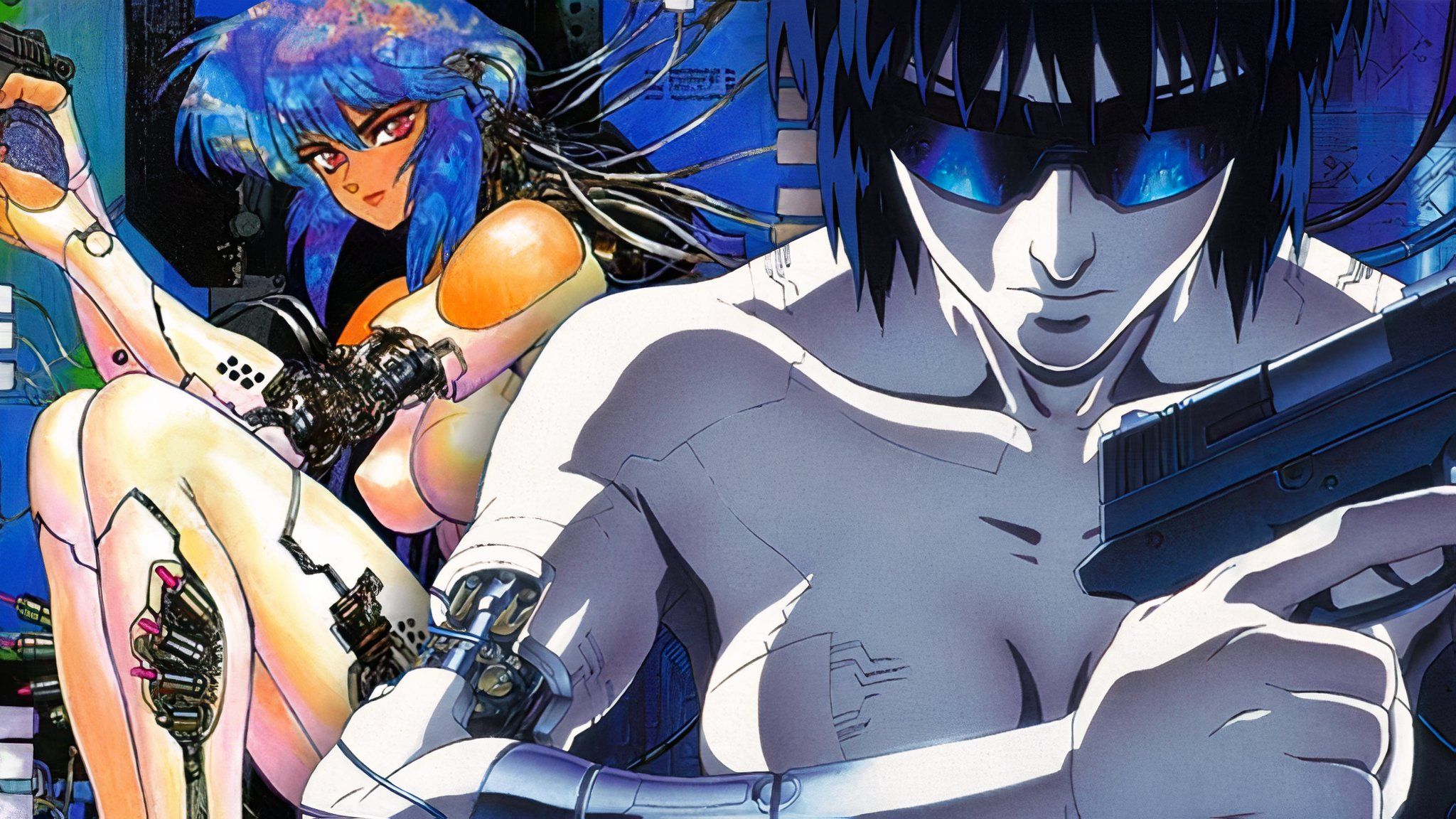
Artificial intelligence is becoming increasingly prevalent, and with recent technological leaps, many people are drawn to cyberpunk manga. This is because the fictional worlds depicted in these comics are starting to resemble our own reality. Visionary authors like Masamune Shirow, Katsuhiro Otomo, and Tsutomu Nihei essentially predicted the digital age through their manga, doing so before the technology even existed.
These manga explore potential problems facing our future if society continues on its current path. They highlight issues like the rise of dictatorships, the dangers of unchecked artificial intelligence, threats to privacy from brain-computer interfaces, the blurring lines between humans and machines, and the ethical dilemmas that come with our increasing reliance on technology.
Ghost in the Shell Turned Government-Backed Hacking Into a Moral Crisis
The main villain in Ghost in the Shell is the Puppet Master, an artificial intelligence created by the Japanese government for spying, influencing the stock market, and manipulating politics. The series depicts Section 6 building defenses and analyzing behavioral patterns to stop the Puppet Master, a tactic similar to how we detect and prevent malware today.
Unlike many other stories, Ghost in the Shell doesn’t just present Kusanagi’s cyborg body as a source of strength. It also explores the dangers of relying on technology we can’t fully trust. In fact, the creator of Ghost in the Shell, Masamune Shirow, warned in 2025 that without safeguards, technology meant to help us could actually end up controlling us.
Akira Encoded Japan’s Atomic Trauma Into a Cyberpunk Story When No Other Genre Would Touch It
The film Akira can be seen as a reflection of Japan’s recovery after the devastation of Hiroshima and Nagasaki. According to scholar Jenny Kwok Wah Lau, it’s a natural result of the experiences surrounding the war and its aftermath. The film’s powerful, psychic entity symbolizes the destructive force of atomic power, while Tetsuo’s wild and unpredictable abilities represent a broader loss of control – both over technology in the modern world and over Japan’s own rebuilding process after the war.
Katsuhiro Otomo began his manga series in December 1982, a time when Japan was experiencing strong economic growth. The story powerfully illustrates the problems that arise when a society rebuilds quickly without dealing with the emotional scars and deeper issues its people face. The series concludes with Kaneda establishing Neo-Tokyo as an independent nation, driving out the UN and creating a new leadership structure, ultimately confirming Akira’s point that power structures never truly disappear.
Serial Experiments Lain Mapped the Collapse of Identity in Networked Spaces Before Social Media
The anime Serial Experiments Lain debuted in 1998, created by Chiaki J. Konaka. A short manga side-story, Serial Experiments Lain: The Nightmare of Fabrication, also exists. In it, Yoshitoshi Abe uses the character Lain Iwakura to illustrate that online identities don’t simply add to who we are, but can replace parts of ourselves.
The anime Serial Experiments Lain surprisingly foreshadowed the impact of smartphones. It features ‘Navi’ devices – portable communicators that become central to all social connections and grant access to ‘the Wired,’ a network much like the internet. As the story unfolds, the main character, Lain, struggles to determine which version of herself is ‘real.’ This allows the creator to suggest that the true threat of online spaces isn’t being watched, but the way we construct online identities that can ultimately overshadow who we are in private.
Blame! Built the Most Precise Pre-Internet Model of What AI Researchers Now Call Misalignment
AI safety experts describe “misalignment” as a situation where an AI system keeps working towards its initial goal even when the reasons that goal was helpful no longer exist. Although this is now a standard term in the field, it wasn’t when the manga Blame! was first published. Remarkably, the author, Tsutomu Nihei, captured this idea more clearly in 1997 than many technical explanations do today.
Nihei’s manga depicts robotic builders endlessly expanding a massive structure, initially reasonable in size but growing to the diameter of Jupiter. This expansion occurred because a virus eliminated humanity’s ability to control the builders. Furthermore, Killy’s almost complete silence is a key element of Blame!. Nihei uses this silence to show that traditional human stories no longer matter in a world run by automated systems operating independently of people.
Battle Angel Alita Identified Cybernetic Commodification as the Central Moral Failure of Post-Human Civilization
In Battle Angel Alita, Kishiro portrays Alita’s incredible fighting skills, honed through Panzer Kunst, not as a source of strength, but as a desperate means of staying alive. The Scrapyard, where the story takes place, exists only to supply resources to Zalem, a city floating above it. Every cyborg body there, including Alita’s, is simply a disposable tool owned by the Factory system. The Motorball league serves as a way to distract and exploit those living in the Scrapyard, pushing them to their physical limits with no hope of freedom.
What sets Battle Angel Alita apart is its perspective: the story doesn’t portray cybernetic enhancements as a terrifying future, but as a normal part of life for those living in the Scrapyard. Critics agree that this is a key element, stemming from the creator’s idea that such technology isn’t a problem to be solved, but simply how life is for its inhabitants.
Appleseed Dismantled the Utopia Argument Before Cyberpunk Had Even Built One
Shirow initially released the first volume of Appleseed as a paperback in February 1985. The story features bioroids – genetically engineered humans designed to eliminate aggression – as a key political element. Shirow portrays the stability achieved by Olympus not as a positive outcome, but as an incredibly advanced and disturbing form of control, where the need for governance is removed by biologically suppressing the very impulses that would cause conflict.
I’ve always been fascinated by how ahead of its time Ghost in the Shell was. The Central Management Bureau’s core idea – that peace at any cost is justified – really predicted a lot of the arguments we started having in the ’90s. And Shirow’s story didn’t just hint at things like using drugs or genetics to control behavior, but really dove into the ethical questions around consent and modification, all before most of us even thought these were real possibilities! It was like he saw the future of these issues unfolding.
Biomega Transformed Nihei’s Megastructure Anxiety Into a Corporate Bioweapon
Unlike Blame!, Nihei’s Biomega shows a virus being spread on purpose. In this story, the organization in charge doesn’t lose control of the N5S virus – they actually use it as a way to control the population. This is a shift from the accidental disasters seen in Blame! to a deliberate, large-scale change planned by a corporation.
I’m completely captivated by Nihei’s Biomega! The story centers around Zouichi Kanoe, this incredible cyborg, and his AI-powered motorcycle, Fuyu. What really gets me is how they seem to be the only ones left with a strong moral compass in this world. It’s a really thought-provoking look at how much humanity we might lose as AI gets more advanced and research pushes boundaries.
Bubblegum Crisis Established That Corporate Power Makes Legal Institutions Decorative
Adam Warren created a comic book adaptation of Bubblegum Crisis called Bubblegum Crisis: Grand Mal. The series highlights the weaknesses within the AD Police force. However, the issue isn’t just with the police themselves; GENOM’s immense political and financial influence essentially renders the AD Police powerless. When the police prove unable to stop the Boomers, Sylia Stingray creates the Knight Sabres, a group that fights GENOM outside the legal system.
The anime Bubblegum Crisis was clearly inspired by films like Blade Runner, The Terminator, and Streets of Fire. However, it took the themes of those movies a step further by portraying the power of the GENOM corporation as stemming from its sheer size and bureaucratic control, rather than from secret plots or conspiracies. GENOM doesn’t need to actively scheme to win – its dominance comes simply from being so large and established.
No Guns Life Proved Post-War Bodily Ownership Is Cyberpunk’s Most Unresolved Argument
In 2014, Karasuma began No Guns Life, presenting a very well-defined take on a common theme in cyberpunk stories, something Ghost in the Shell had explored before. After the war, Berühren Corporation doesn’t just hire Juzo Inui; they control everything about him – the mechanical body he uses, his medication, and even his physical functions through a remote control system called Harmony implanted in Tetsuro Arahabaki.
One of the cleverest things Karasuma does is make Juzo’s gun-head both his greatest strength and his biggest weakness – he needs others to fire it for him. Ultimately, No Guns Life reveals that those who’ve been augmented are all veterans exploited by corporations who refuse to let go of control.
Cyber City Oedo 808’s Advanced Technology Gives the State More Elegant Instruments for the Same Old Violence
The anime Cyber City Oedo 808, based on three novels never released in English, uses explosive collars as a key element of its story. While seemingly futuristic, Police Chief Hasegawa’s remote control over the collars worn by Sengoku, Gogol, and Benten isn’t about advanced technology—it’s a modern take on the age-old power of the state to control its people.
While Bubblegum Crisis suggested that corporations undermine the legal system, Cyber City Oedo 808 presents the opposite view. Even in 2808, the government still holds all the power; massive cities don’t share it, they simply find new ways to exert control. This gives Cyber City Oedo 808 a clear and consistent style, setting it apart from other cyberpunk works of the 1990s.
Found an error? Send it so it can be corrected.
Read More
- Off Campus Season 1 Soundtrack Guide
- DoorDash responds after customer uses AI to make food look bad and get a refund
- Euphoria Season 3’s New R-Rated Sydney Sweeney Scene Proves The Show Is Trolling Us
- Gold Rate Forecast
- All Golden Ball Locations in Yakuza Kiwami 3 & Dark Ties
- Jon Bernthal Explains Why Marvel Let Him Make The Darkest Punisher Story Ever
- YouTuber arrested after viral AI bodycam videos spark real police complaints
- Disney’s Near-Perfect 4-Part Sci-Fi Saga Is So Good, You’ll Finish It In One Weekend
- Law & Order Season 26: Release Date, Story, & Everything We Know
- Amazon MGM Studios confirms casting for next James Bond actor is underway
2026-03-20 06:14