Author: Denis Avetisyan
A new data-driven model, AIFL, delivers competitive streamflow predictions by leveraging the power of pre-trained machine learning and readily available weather data.
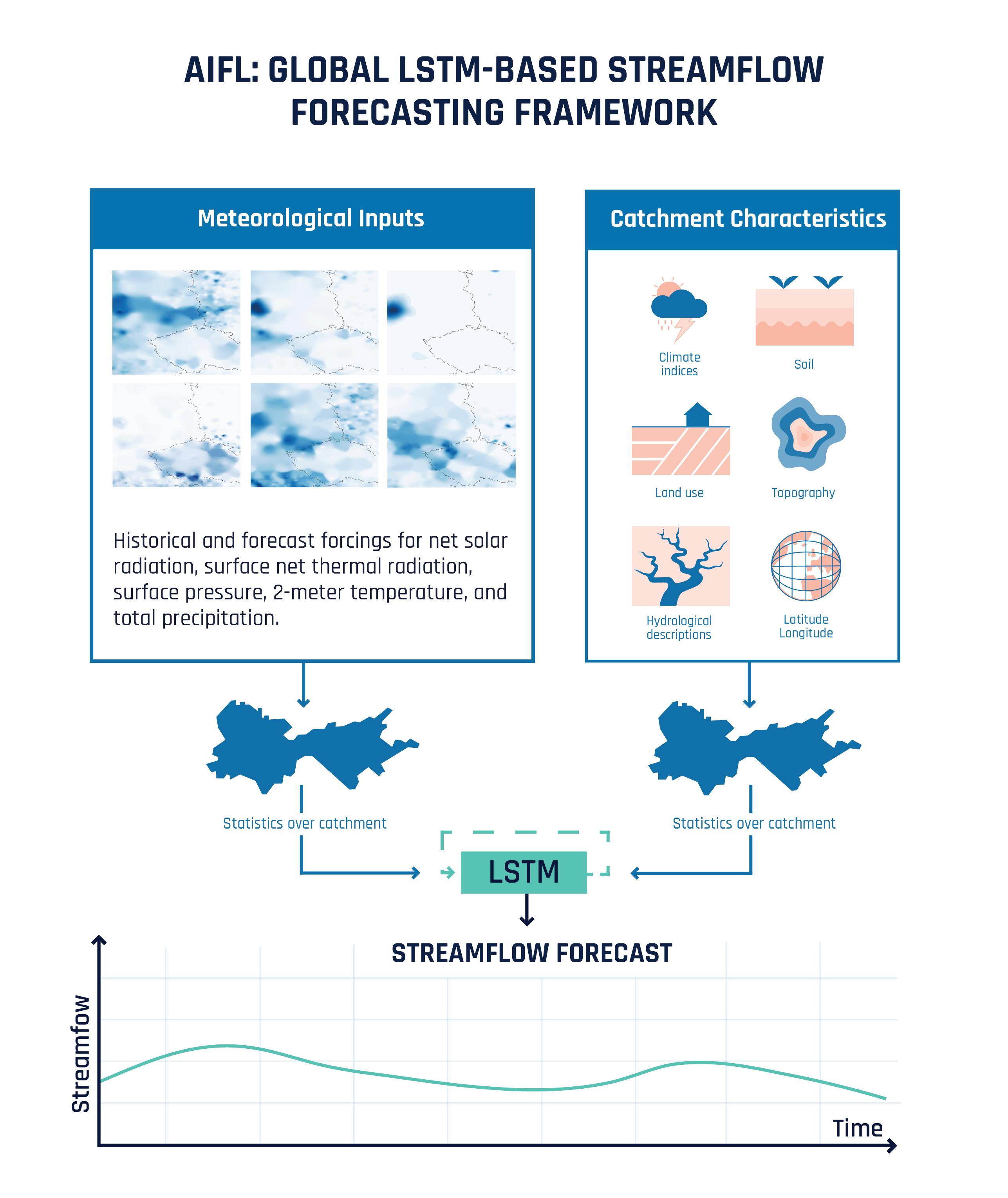
AIFL is a global daily streamflow forecasting model utilizing a deterministic LSTM network pre-trained on ERA5-Land reanalysis and fine-tuned on IFS forecasts.
Despite advances in hydrological forecasting, a persistent gap remains between the performance of data-driven models using historical data and their accuracy with operational forecast products. This paper introduces AIFL (Artificial Intelligence for Floods), a global daily streamflow forecasting model leveraging a deterministic LSTM network pre-trained on ERA5-Land reanalysis and fine-tuned on operational Integrated Forecasting System (IFS) forecasts. AIFL achieves competitive skill-with a median modified Kling-Gupta Efficiency of 0.66-by bridging this reanalysis-to-forecast domain shift, offering a transparent and reproducible baseline for the global hydrological community. Will this two-stage training strategy unlock further improvements in global flood prediction and water resource management?
The Illusion of Prediction: Why Flood Forecasting Remains a Struggle
Effective global flood forecasting stands as a cornerstone of modern disaster preparedness, yet current systems consistently grapple with limitations in predictive accuracy. While invaluable for anticipating potential crises, these systems often struggle to capture the intricate interplay of meteorological and hydrological factors that govern flood events. The complex nature of rainfall, terrain, and river dynamics, combined with data scarcity in many vulnerable regions, introduces significant uncertainty into forecasts. This can lead to both false alarms – eroding public trust – and, more critically, underpredictions that leave communities exposed to devastating consequences. Consequently, a pressing need exists to refine existing methodologies and explore innovative approaches capable of delivering more reliable and timely flood warnings, ultimately mitigating the escalating risks associated with these increasingly frequent and intense events.
Current flood forecasting largely depends on integrating atmospheric predictions from Numerical Weather Prediction models with detailed Process-Based Hydrological Models that simulate how water moves across landscapes and through river systems. However, this coupling presents significant challenges; the computational demands are substantial, requiring considerable processing power and time, particularly when modeling large areas or anticipating extreme events. Moreover, these hydrological models often struggle to accurately represent the intricate interplay of factors influencing flood risk, such as land use changes, vegetation dynamics, or the effects of urbanization on runoff. These complex interactions, coupled with uncertainties in both weather forecasts and model parameters, can limit the accuracy and timeliness of flood predictions, highlighting the need for innovative approaches to enhance forecasting capabilities.
Recognizing the constraints of current flood prediction methodologies compels a shift toward innovative approaches. Existing systems, while valuable, often struggle with the intricate interplay of meteorological and hydrological factors, leading to inaccuracies, particularly in rapidly evolving flood scenarios. Consequently, researchers are actively investigating alternative methods – including machine learning, data assimilation techniques, and real-time sensor networks – to enhance both the precision and speed of flood forecasts. These efforts aim to move beyond computationally intensive simulations and leverage the increasing availability of data to provide more timely and reliable warnings, ultimately bolstering disaster preparedness and mitigating the devastating impacts of flooding events.
Trading Simulations for Statistics: A Data-Driven Approach
Artificial Intelligence for Floods (AIFL) represents a departure from traditional physics-based hydrological models by utilizing a Long Short-Term Memory (LSTM) neural network for global flood forecasting. This LSTM architecture is trained on a substantial dataset of hydrological data, encompassing parameters such as streamflow, precipitation, and elevation data, to learn complex relationships influencing flood events. Unlike methods relying on complex simulations of physical processes, AIFL employs a data-driven approach, enabling it to identify patterns and predict flood occurrences directly from observed data. The standardization of the LSTM architecture allows for consistent application across diverse geographical regions and facilitates scalability for near-real-time flood prediction systems.
The CARAVAN Dataset is a crucial component of the Artificial Intelligence for Floods (AIFL) system, providing the necessary data for both model training and performance evaluation. This dataset contains streamflow observations-records of water discharge over time-collected from over 900 river basins globally. Beyond streamflow, CARAVAN incorporates critical landscape attributes including drainage area, slope, and elevation, as well as climate data derived from multiple sources. The dataset’s extensive geographical coverage and inclusion of both hydrological and geomorphological variables enables AIFL to learn complex relationships between landscape characteristics, climate forcing, and resulting streamflow, leading to improved flood forecasting capabilities.
The Reanalysis-to-Forecast Domain Shift represents a significant error source in hydrological forecasting, arising from discrepancies between the historical reanalysis data used for training and the real-time forecast data used for prediction. AIFL directly addresses this issue through a specialized training methodology. This methodology incorporates techniques designed to minimize the statistical difference between the training and forecasting distributions, thereby improving the model’s ability to generalize from historical observations to future predictions. Specifically, AIFL utilizes domain adaptation strategies to align the feature spaces of reanalysis and forecast data, reducing prediction uncertainty and enhancing forecast accuracy when transitioning from retrospective analysis to real-time prediction scenarios.
Bridging the Gap: Mitigating the Reanalysis-to-Forecast Problem
The Artificial Intelligence for Flood Learning (AIFL) model utilizes a two-stage training strategy initiated by pretraining on the ERA5-Land dataset. ERA5-Land is a comprehensive reanalysis dataset produced by the European Centre for Medium-Range Weather Forecasts (ECMWF) that provides hourly estimates of land surface variables – including temperature, soil moisture, and snow cover – from 1979 to near-real time. This pretraining phase establishes a robust foundational understanding of land surface conditions and atmospheric interactions, allowing the model to learn generalizable patterns before exposure to specific forecasting scenarios. The dataset’s extensive historical coverage and comprehensive variable set are critical for building a strong baseline capable of mitigating the effects of domain shift when subsequently finetuned on operational forecast data.
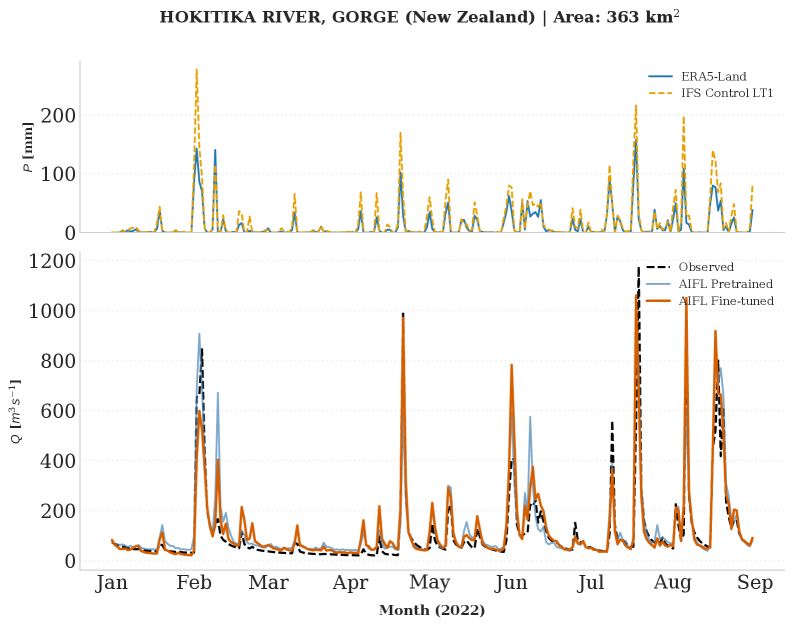
Following pretraining on the ERA5-Land reanalysis dataset, the AIFL model undergoes finetuning using data from the Integrated Forecasting System (IFS). The IFS provides operational weather forecasts, representing current, real-time atmospheric conditions. This finetuning process adapts the pretrained model to the specific characteristics of operational forecast data, thereby improving the model’s ability to generate accurate predictions within the context of live forecasting scenarios. The utilization of IFS forecasts directly addresses the discrepancy between the static reanalysis data and the dynamic nature of real-time predictions, leading to enhanced predictive accuracy and reliability.
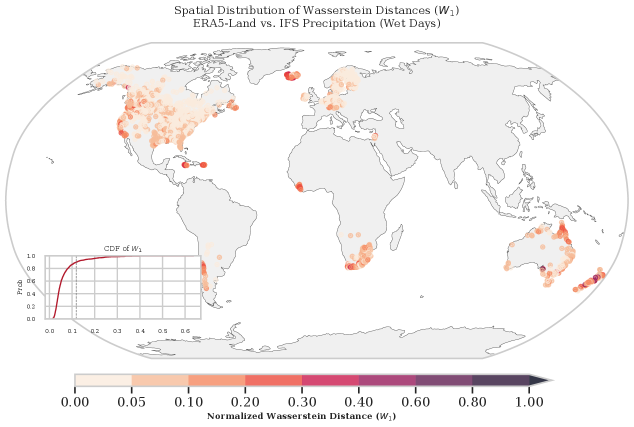
The discrepancy between reanalysis datasets, like ERA5-Land, and real-time Integrated Forecasting System (IFS) forecasts-referred to as the Reanalysis-to-Forecast Domain Shift-introduces inaccuracies in flood prediction models. This shift arises from differences in data assimilation methods, model physics, and the representation of observational errors between the two data sources. A Two-Stage Training Strategy mitigates this impact by initially establishing a strong baseline using the comprehensive ERA5-Land dataset, followed by adaptation to the statistical characteristics of current IFS forecasts. Evaluations demonstrate this approach significantly reduces prediction errors attributable to domain shift, resulting in demonstrably more reliable and accurate flood forecasting.
The Limits of Accuracy: A Realistic Assessment of Performance
To accurately assess its capabilities, the Artificial Intelligence for Flood Learning (AIFL) system underwent a comprehensive benchmarking process, directly comparing its performance against the Google Global Flood Model – a widely utilized and highly respected operational forecasting system. This rigorous evaluation wasn’t merely about achieving a score; it involved subjecting AIFL to the same real-world conditions and data inputs as a currently deployed, leading model. By establishing this direct comparison, researchers could quantify AIFL’s strengths and weaknesses, and pinpoint areas for improvement, ultimately determining its potential to contribute to global flood forecasting efforts and provide a valuable independent verification of existing methodologies.
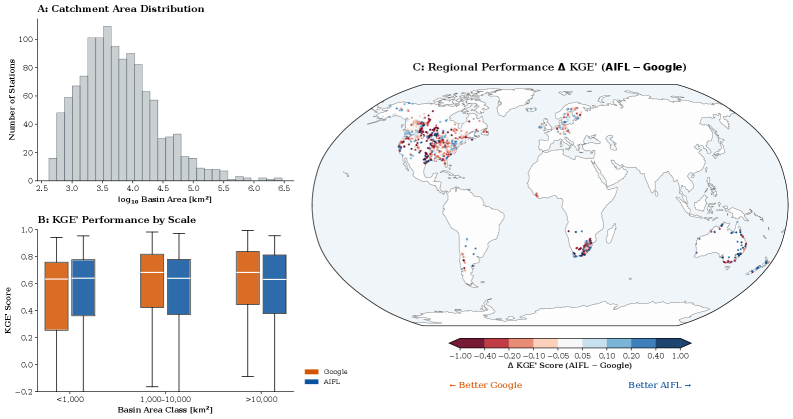
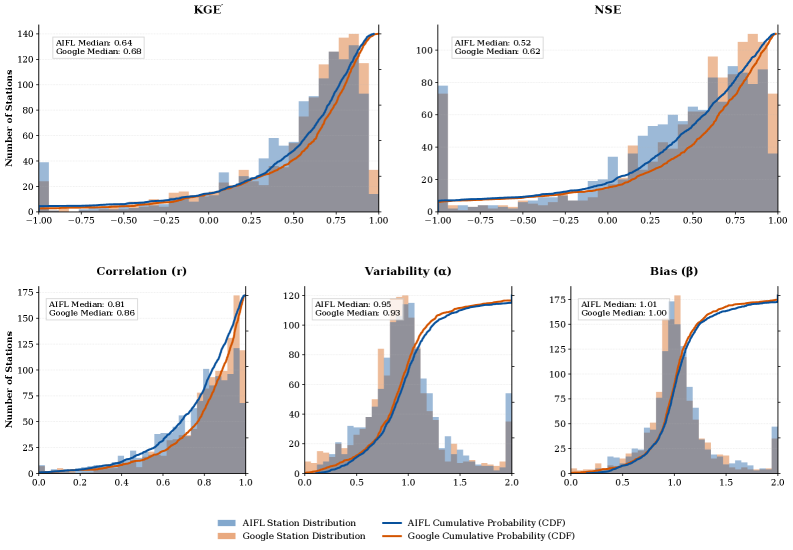
Assessment of the Artificial Intelligence for Flood forecasting (AIFL) system reveals a strong capacity for global streamflow prediction, achieving a median Kling-Gupta Efficiency (KGE) score of 0.66. This figure positions AIFL as a highly competitive alternative to established operational models, notably the Google Global Flood Model, which attains a KGE of 0.678. The Kling-Gupta Efficiency, a hydrological evaluation metric, considers multiple aspects of the predicted hydrograph – mean, variance, and correlation – providing a comprehensive measure of forecast accuracy. A score approaching 1.0 indicates a perfect match between predicted and observed streamflow, and the proximity of AIFL’s result to the Google model suggests its potential for reliable and accurate flood forecasting on a global scale.
Analysis reveals that the Artificial Intelligence for Flood forecasting (AIFL) system demonstrates superior performance to the established Google Global Flood Model at over 42 percent of monitored stations worldwide. This localized outperformance isn’t simply a matter of marginally better scores; it indicates a capacity for more accurate streamflow prediction in a substantial portion of river networks. While the overall median Kling-Gupta Efficiency (KGE) scores remain comparable between the two systems, this station-by-station advantage suggests AIFL’s potential to refine forecasts in regions where the Google model currently faces limitations, offering a valuable tool for localized flood risk assessment and mitigation strategies.
A significant outcome of the AIFL system is its capacity for highly reliable flood event detection, achieving perfect precision globally – meaning it eliminates false alarms. This represents a crucial advancement in flood forecasting, minimizing unnecessary disruption and resource allocation. However, this pinpoint accuracy currently comes at the cost of comprehensive event capture; the system’s recall, or ability to identify all actual flood events, is limited to approximately 54% for events with a return period of 1.5 to 2 years. While AIFL consistently avoids incorrectly predicting floods, a substantial portion of smaller to moderate events currently go undetected, highlighting a trade-off between minimizing false positives and maximizing the identification of all flood occurrences.
The Artificial Intelligence for Flood Learning (AIFL) system doesn’t represent a completely novel approach, but rather a significant evolution of established techniques in hydrological forecasting. Built upon the foundations of Long Short-Term Memory (LSTM) networks – a type of recurrent neural network adept at processing sequential data – AIFL incorporates architectural advancements such as Hydra-LSTM and Monte Carlo LSTM (MC-LSTM). These extensions allow the model to better capture the complex, non-linear dynamics of river systems and quantify forecast uncertainty, respectively. This deliberate building upon existing frameworks not only facilitates integration with current hydrological practices, but also establishes a robust platform for continued innovation; researchers can leverage the proven capabilities of LSTM while exploring new layers of complexity and refining the model’s predictive power for even more accurate and reliable flood forecasting.
The pursuit of a ‘global’ streamflow forecasting model, as presented in this work, feels predictably ambitious. The AIFL model, pre-trained and fine-tuned, represents another layer of abstraction built upon existing data – ERA5-Land and IFS. It’s a testament to ingenuity, certainly, but one destined to encounter the inevitable complexities of real-world application. G. H. Hardy observed, ‘The essence of mathematics is its freedom from empirical determination.’ This model, however, is entirely defined by empirical data, and as such, will ultimately be judged not by its elegant LSTM networks, but by the accuracy of its predictions when production data inevitably introduces unforeseen variables. Every architecture, no matter how sophisticated, becomes a punchline over time.
What’s Next?
This AIFL model, predictably, establishes a new baseline. A remarkably transient achievement, given the history of hydrological modeling. The authors present a globally applicable streamflow forecast, built on the now-ubiquitous LSTM architecture. One anticipates a flurry of papers claiming incremental improvements – different loss functions, slightly tweaked hyperparameters, perhaps a novel attention mechanism. Production, naturally, will discover edge cases this elegant framework fails to address. It always does.
The reliance on both reanalysis and operational forecasts is… interesting. Acknowledging that even the best physics-based models aren’t perfect is a start. The true test will be scaling this beyond the demonstration period, and dealing with the inevitable data assimilation challenges as real-time observations become available. Expect significant drift, requiring constant recalibration. The pursuit of ‘global’ models often obscures the fact that hydrology is fundamentally local.
Ultimately, this work is a step towards automating the inevitable. The field will circle back, as it always does, to incorporating more physics. Because everything new is old again, just renamed and still broken. Perhaps the next iteration will simply be a more efficient way to run a hydrological model that looks remarkably like the ones built thirty years ago. One can only hope it’s well-documented this time.
Original article: https://arxiv.org/pdf/2602.16579.pdf
Contact the author: https://www.linkedin.com/in/avetisyan/
See also:
- All Itzaland Animal Locations in Infinity Nikki
- Paramount CinemaCon 2026 Live Blog – Movie Announcements Panel for Sonic 4, Street Fighter & More (In Progress)
- Cthulhu: The Cosmic Abyss Chapter 3 Ritual Puzzle Guide
- Persona PSP soundtrack will be available on streaming services from April 18
- Raptors vs. Cavaliers Game 2 Results According to NBA 2K26
- The Boys Season 5 Spoilers: Every Major Character Death If the Show Follows the Comics
- Rockets vs. Lakers Game 1 Results According to NBA 2K26
- Dungeons & Dragons Gets First Official Actual Play Series
- Spider-Man: Brand New Day LEGO Sets Officially Revealed
- Focker-In-Law Trailer Revives Meet the Parents Series After 16 Years
2026-02-19 11:23