
Your article’s one-sentence summary should quickly explain what the article is about and why someone should read it—think of it like a video game quest description. Just as a confusing quest makes a game frustrating, a weak summary won’t encourage readers to dive into your content. Whether you’re sharing important advice or something lighthearted, your summary needs to grab attention and make people want to learn more. This guide will show you how to write a summary that clearly explains the value of your work and makes your readers feel it’s worth their time.
Key Takeaways
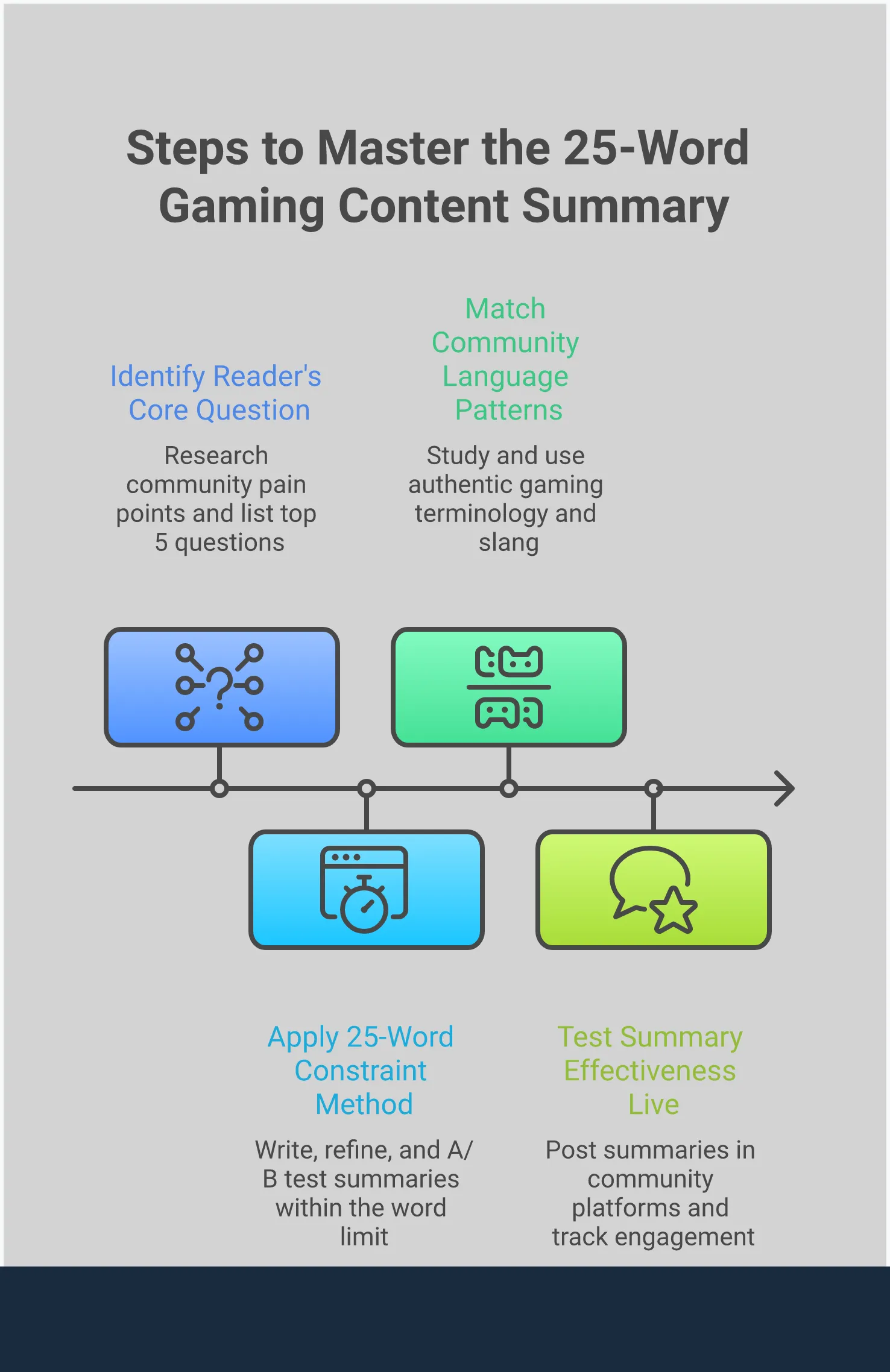
- Answer Their Core Question First: Figure out the single most important thing your audience wants to know. Your summary should directly address that need, promising a clear answer or solution right from the start.
- Stick to the 25-Word Rule: Keep your summary concise to make it easy to read and remember. This forces you to cut the fluff and deliver a clear, powerful message that respects your reader’s time.
- Match the Community’s Vibe: Use the language and tone your audience already uses. A summary that sounds like it came from a fellow gamer builds instant trust and shows you’re part of the community.
What is a One-Sentence Summary?
A one-sentence summary is like a quick pitch for your content – it’s the core idea of your article, guide, or opinion, condensed into a single, attention-grabbing sentence. Think of it as the line under a headline that makes people want to click and learn more. It’s what convinces someone your content, like a guide to game strategies or a review of a new trailer, is worth reading.
A good article summary does more than just explain the content – it tells readers what they’ll gain and why it’s relevant to them right now. In today’s crowded online world, especially in gaming, grabbing someone’s attention immediately is crucial. Your summary is your first chance to connect with a reader and convince them to keep reading.
The Power of 25 Words
Effective summaries are brief – around 25 words is ideal. Shorter summaries are easier to understand quickly, helping readers decide if they want to learn more. A concise summary is also more memorable and shareable. Think about how viral stories spread – they’re easily retold in just a sentence or two. Your summary should be that same, easily digestible core idea – a quick, shareable message that sticks in people’s minds.
Why Clarity is Your Superpower
Want to get straight to the point? Clarity is your most powerful tool. No one wants to wade through confusing or unclear writing – if readers have to struggle to understand your message, they’ll simply move on. Being clear means you have a specific goal for your audience: do you want them to take action, feel a certain way, or simply be entertained? Your writing should be designed to achieve that goal. Just like a good story, clear communication starts with a clear message. Prioritizing clarity respects your reader’s time and builds trust by delivering on your promise.
Find Your Audience’s Core Question
To write a truly effective summary, first understand what your audience is looking for. It’s similar to a goal in a game – you can’t succeed if you don’t know what you’re trying to achieve. Every article, news story, or opinion piece answers a question someone has. Your task is to figure out that central question, even if your reader hasn’t explicitly searched for it.
It’s not just about the words people search for—it’s about why they’re searching. Are they looking for a fast solution to a challenge, or do they want to dive into the game’s story? Are they hoping for a funny moment, or a detailed explanation of updates? When you figure out what someone truly wants to know, you can create a summary that immediately shows them you have the answer. This is what makes someone click on your content instead of just scrolling past it.
What Do Your Readers Really Want?
As a gamer, I don’t just want to hear about a game, I want to feel like I’m part of it. I want to feel like my experience matters, and that’s what I look for in any content I read. I’m looking for something that connects with me – maybe a character I can relate to, a funny moment that reminds me of my own struggles in the game, or just that excited feeling you get with a new release. Basically, I want to see my journey reflected in what I’m reading. So, when I see a summary, it needs to promise something emotionally satisfying – a big reveal, a clever solution, or anything that makes me feel more in control of the game. It’s about making me feel invested!
Common Questions Gamers Ask
What do people typically ask about games? These questions generally fall into a few categories. Some are straightforward and practical, like asking about the best weapons or how to beat a level. Others seek confirmation or connection – people might want to know if others share their frustrations or enjoy the same jokes. Many questions also come from a desire to learn more about the game’s story and characters. Understanding what kind of question someone is asking is the first step to providing a helpful answer.
Nail Your Answer: The Heart of the Summary
After understanding what your audience wants to know, your summary should give them a clear and direct answer. It’s essentially the main point of your article – not just a preview, but the key information your headline promised. A strong summary doesn’t just suggest value; it immediately provides something useful. This is where you show readers you have the solution they need, the answer to their question, or the insight they’ve been searching for.
Okay, so when I’m summarizing something – like after reading a long strategy guide for a game – I’ve learned it really boils down to two things. First, I need to really understand the core idea, the one big thing the guide is trying to teach me. It’s not about listing everything, it’s about figuring out the most important takeaway – what will actually make me better at the game? Then, I have to explain it in plain English, ditching all the complicated terms and fluff. If I can’t explain it simply, I don’t really understand it myself! A good summary should hit you right away, and that only happens when it’s clear and to the point.
Find Your Main Message
Before you start summarizing, figure out your main point. What’s the single most important thing you want your audience to remember? Are you explaining a strategy, sharing news, or describing how you feel about an update? Your content needs a clear purpose. For example, if you’re writing a guide, your key message might be that a certain character build easily defeats the final boss. If it’s a news article, it could be that a recent update weakens a popular weapon, requiring players to change their gear. Identifying this central idea will give your summary a clear focus and direction.
Avoid Jargon and Keep it Simple
When explaining something, especially to a broad audience like gamers, avoid complicated jargon. Effective explanations are clear and easy to repeat – think about how you’d describe it to a friend while waiting for a game to start. Instead of using technical terms like “AoE DPS” and “crit multipliers,” focus on the result: “This setup lets you quickly defeat large groups of enemies.” Using simple, direct language helps everyone – both new and experienced players – understand what you’re saying and why it matters.
What Makes a Summary Engaging for Gamers?
To really capture a gamer’s interest with a summary, don’t just state the facts – connect with them! Gamers are smart and enthusiastic, and they can easily spot uninspired content. A great summary speaks directly to them, sparks their curiosity, and offers something worthwhile, like a helpful strategy, a funny moment, or a fresh take on a game they enjoy.
A good summary should grab your reader’s attention like the first line of a compelling conversation. To do that, consider what interests them. Focus on sparking their curiosity, immediately capturing their attention, and using language they understand. If you nail these points, you’ll have them wanting to learn more before they even reach the core information.
Address Reader Curiosity Head-On
Gamers constantly seek information – they want to know the best strategies, how difficult challenges are, and the reasoning behind game design choices. Your writing should quickly guide them to the answers they need. By telling a compelling story, you can create a strong connection that keeps them engaged and coming back for more.
Don’t just announce what you’re talking about—present it as an answer or a surprising discovery. Instead of simply saying “Here’s a review of the new update,” try something like “Is the new update a game-changer or a complete failure?” This immediately connects with what your audience is wondering and promises a definite conclusion, making your content much more interesting.
Create Hooks that Grab Attention
Online, you have just a few seconds to grab someone’s attention. A great “hook” – a short, compelling statement – is your best bet. It should spark curiosity and make people want to see more. The most effective hooks are simple, easy to remember, and focus on a single, clear idea. This is particularly important for content that’s likely to be shared widely, as people tend to spread things that are easy to understand and retell.
Instead of a vague statement like, “Something funny happened in Palworld,” try something more engaging, such as, “Palworld’s death mechanic is hilarious, and it’s not my fault!” The latter example is more detailed, shows personality, and makes people curious to learn more. A good opening line shouldn’t reveal everything—it should just entice readers to find out what happens next.
Use Gaming Language They Understand
If you want to connect with gamers, it’s important to use the terms they use. Knowing gaming slang like “meta,” “nerfed,” “cheese,” and “RNG” shows you understand their world and are part of the community. Adapting your communication style to match your audience makes your message feel more genuine and easier to connect with.
It’s not about using trendy slang; it’s about choosing the clearest and most effective language for your audience. For example, a Call of Duty player would immediately understand “the best long-range meta Warzone loadout” better than “the most effective weapon configuration for combat at a distance.” Using the right terminology builds credibility and shows your audience you understand their world.
How Do You Choose the Right Tone?
Using the right tone isn’t just about being friendly; it’s about connecting with your audience and showing them you understand their world. Tone is essentially the personality you bring to your writing, and when it comes to gaming, it can be the deciding factor between someone clicking on your content and scrolling right past it. Are you offering expert analysis, sharing a funny moment, or reacting to exciting news? Each situation calls for a different style of communication.
Consider your audience and the type of content you’re creating. A direct and assertive style is best for competitive guides, while a humorous and lighthearted approach suits content about online communities and memes. The important thing is to be deliberate with your voice. You want to connect with your audience by speaking their language. Think of your opening sentence as setting the tone – it should feel natural to the conversation they’re already having. Getting this right isn’t just about delivering information, it’s about building a relationship.
Match Your Audience’s Vibe
Each gaming community has its own style and vibe. You’ll need to communicate differently with serious players deeply invested in a game like Diablo 4 than you would with those just looking for fun Palworld videos. The best way to start is by observing – spend time on forums, watch streams, and read comments to get a feel for how people talk about the game. Your writing should feel natural and fit right in with their existing conversations.
When summarizing content, adjust your writing style to fit the topic. For instance, a detailed look at a game’s music, like an analysis of the Diablo 4 soundtrack, deserves a thoughtful and positive tone. But a guide explaining the best gear should be straightforward and assertive. Matching the overall feel of the content will quickly build trust with your audience.
Balance Humor with Helpful Info
As a gamer myself, I really appreciate when content creators can make me laugh – especially when it’s something we’ve all been through in a game! It’s awesome when someone gets that shared experience and can poke fun at it. But it’s not just about being funny, you know? A funny summary is great, but it also needs to tell me why I should read the article. A clever way to do that is to hint at a frustrating or hilarious game moment that the article actually solves or explains – something that instantly makes me think, ‘Oh yeah, that happened to me!’ and makes me want to click.
Using this method lets your audience share in the humor while also demonstrating your insightful perspective. For example, when discussing the harsh gameplay of Palworld, you can embrace its dark comedy, similar to how this article highlights the game’s amusing death sequences. It’s about more than just getting a laugh – you’re building a story that resonates with your readers and feels relatable.
Adapt to Community Culture
It’s not enough to just get a general feel for a community. You also need to understand what’s happening right now. What are people currently joking about? What are the big debates? If your content connects with these current topics, it will feel fresh and important. Make sure your writing style matches how the community is feeling – whether they’re enthusiastic, annoyed, or really excited.
Big announcements always get people talking, and it’s important to reflect that excitement and variety of opinions in your writing. For example, if you’re writing about the Vessel of Hatred trailer, your article should capture the range of reactions. Showing you understand the community’s culture demonstrates you’re a part of it, not just someone looking for views.
The 25-Word Rule: Why Less Is More
Ever struggled to explain something complicated, like a game strategy, and lost your friend in the details? It happens! We often end up with long, rambling sentences. A helpful trick is the ’25-word rule’ – try to keep your sentences concise, aiming for under 25 words. It’s not a hard rule, just a good guideline for clear communication.
This approach works so effectively because it pushes you to communicate clearly and directly. In today’s fast-paced world, where people quickly scan content, getting to the point is crucial. Lengthy, complex sentences require too much effort from readers, who can easily lose focus and move on. By using concise language, you make your content easy to scan, simple to grasp, and more likely to keep readers engaged. It’s about valuing your audience’s time and delivering information efficiently, without unnecessary details. This focus on brevity builds trust by showing respect for their time and a commitment to clear communication.
Break Down Complex Ideas
Video games often have complicated rules and systems. Explaining things like crafting in Diablo 4 or building a character in Honkai: Star Rail can be tricky. Trying to cover everything in one long sentence just leads to confusion. That’s where the ’25-word rule’ comes in handy – it helps you break down complex ideas into smaller, easier-to-understand pieces. Each short sentence lets your reader pause and process the information before moving on, creating a clear and logical explanation. It’s similar to progressing through a game one level at a time, instead of immediately facing the toughest challenge.
Test Your Word Count
Try treating writing like a game! After you write a sentence, check its word count. If it’s over 25 words, see if you can make it more concise without changing the meaning. Reading your writing aloud is a great way to check for long, rambling sentences – if you run out of breath, it’s probably too long! Think of it like improving equipment in a game: you’re refining your sentences to be as clear and impactful as possible. This small habit can significantly improve how people respond to your work.
Make Every Word Count
When space is limited, choose your words carefully – every one should contribute to your message. Think of it like packing for a trip: you can’t afford to bring unnecessary items. This encourages you to remove fluff and use strong, direct language. For example, instead of saying “It’s really important that you try to get this specific item,” simply say, “You need this specific item.” This approach – treating each short sentence as a focused piece of writing – helps you be more deliberate and impactful. It guarantees your message is concise, clear, and effective.
Common Mistakes That Kill a Summary
Writing a concise, one-sentence summary seems straightforward, but it’s often harder than it looks. When you’re caught up in a complicated story – like a gamer facing a ban – it’s easy to want to share every detail. However, a summary isn’t about providing a full account; it’s about grabbing someone’s attention and making them want to learn more.
We often stumble when we forget what we’re trying to achieve. We either share too much detail, use language that’s too complex, or rely on overused, attention-grabbing phrases. A poor summary doesn’t just fail to attract readers—it can actually turn them off by making the topic seem unclear or dull. It’s like the first level of a video game—if it’s not engaging, people might stop playing before they even get to the best parts. Getting your summary right is essential because it’s often the only chance you have to show someone your story is worth reading. Let’s look at common mistakes so you can avoid them and get straight to the point.
Trying to Say Too Much
It’s natural to want to share everything when you’re enthusiastic about something, but a summary filled with too much detail can be overwhelming. It loses impact and leaves your audience unsure of the main point. A compelling story isn’t about including every fact – it’s about identifying the single, most important idea. Instead of recounting everything that happened, like with the Lantern Rite incident, focus on the most surprising or crucial part. What’s the one key piece of information that makes the story worth sharing? Pinpoint that, and build your message around it.
Forgetting Who You’re Talking To
Think about explaining a video game setup to someone who’s never played before. You wouldn’t use complicated gaming terms, would you? The same idea applies when you’re summarizing information. You need to adjust how you talk depending on your audience. If you’re talking to other gamers, feel free to use common slang and references. But when explaining something to people unfamiliar with the topic, avoid technical jargon. Always consider: Who are you talking to, and what background knowledge do they have? This will help you communicate clearly and make sure your message is understood.
Using Generic Buzzwords
Overused words like “epic,” “insane,” and “game-changing” have become meaningless. Using these common buzzwords makes your writing sound generic and doesn’t convey what makes your story unique. You need a strong, clear reason for telling your story. Instead of simply calling something “crazy,” explain why it was. Was it due to a surprising problem, a severe consequence, or something else? Being specific builds interest and demonstrates to your reader that you have a genuine story, not just empty exaggeration.
How to Test Your One-Sentence Summary
You’ve written a summary and feel good about it, but how can you be sure others will understand it? Before sharing it, it’s important to test it out. This isn’t about getting permission, but about confirming your message is clear and effective. It’s like doing a final check of your equipment before a big challenge – you want to make sure everything functions flawlessly when it matters most.
Okay, so when I’m writing something – a guide, a review, anything really – I always try to make it super clear and grab people’s attention right away. The best way to know if I’ve actually done that is to get another pair of eyes on it. I can read it over myself a few times, but honestly, the real test is showing it to other gamers – the people I want to read it! That feedback can be the difference between my post getting lost in the shuffle and actually starting a big discussion. It’s that important.
Quick Ways to See if it Works
Before sharing your summary, quickly check it yourself. These simple tests only take a moment and can help you find and fix any clear mistakes.
To improve your writing, start by reading it aloud. If it doesn’t sound smooth and natural, your readers might struggle with it too. Then, ask yourself, “So what?” – does your writing immediately explain why it matters? Finally, quickly show it to a friend – if they can’t grasp the main idea in just a few seconds, you need to make your message clearer.
Get Feedback from Other Gamers
As a gamer, I always find the best way to see if my game summaries are actually good is to share them with other players! I like to post them in Discord servers dedicated to the game, or on relevant subreddits. But just asking “Is this good?” doesn’t really help. Instead, I try to steer the conversation a bit, asking specific questions to get truly useful feedback. It’s all about finding out if it actually resonates with the people who play the game!
To see how well your summary is landing with people, ask direct questions about their emotional response. For example, you could ask if it sparks their curiosity or if the main topic is clear. This feedback is incredibly valuable – use it to refine your language and make your message more impactful. Remember, improving your writing is a process, so don’t hesitate to revise and experiment with different versions until you create something that really resonates.
Why Your Summary Decides Your Success
This is the make-or-break moment. Before a reader commits to your full article, they scan your one-sentence summary. It’s your digital handshake, your opening cinematic, and your elevator pitch all rolled into one. In a sea of content, your summary is the beacon that signals to the right audience, “Hey, this is for you.” It’s not just about describing your article; it’s about selling the experience. A weak summary means even the most epic guide or hilarious take gets scrolled past. A strong one, however, grabs a reader by the collar and pulls them in, promising value, entertainment, or a new perspective they won’t find anywhere else. This is where you win or lose their attention. It’s the single most important factor in getting someone to actually read your work, because if the summary doesn’t land, nothing else you’ve written matters. It has to be compelling enough to stop the scroll and convince them that your content is worth their time. Think about your own browsing habits. How many articles do you click on based solely on a headline and a short description? That’s the power you’re wielding. A well-crafted summary respects the reader’s time and intelligence, showing them immediately that you understand what they’re looking for and that you have the answer, the laugh, or the insight they crave. It’s the foundation upon which the rest of your article’s success is built.
Nail That First Impression
Memorable stories are usually easy to sum up in just one sentence, and your summary should be just as impactful. It’s your first chance to grab someone’s attention! Great summaries share something people will want to talk about, evoke an emotional reaction, and offer genuine usefulness. Whether you’re explaining the response to a new trailer or sharing a funny meme, your summary should capture the main point and make it stick. Think of it as the reason someone will choose to read more.
Set the Right Expectations
A good summary is like a preview for your reader, telling them exactly why they should be interested. It should immediately explain the main point of your content. Are you providing a helpful tutorial, like how to build the best gear in Warzone, or are you sharing your thoughts on a game’s music? Be direct and specific. This isn’t about tricking people into clicking; it’s about earning their trust. When you clearly state what your content is about, you attract the right audience and deliver what they expect. This builds a connection with your readers because they feel you understand their needs, and they’ll be more likely to stay engaged.
Related Articles
- Deus Ex LFG: Connect with Other Augs in LFG Feature on Z League App
Frequently Asked Questions
Don’t think of the 25-word limit as something you always have to follow. It’s really just a way to practice being clear and concise. If a sentence is a little longer – say, 28 words – but it’s well-written and easy to understand, that’s perfectly fine. The point is to avoid overly long, complicated sentences and make your writing easy to scan and digest.
While both are short and impactful, a headline aims to quickly grab someone’s attention, like a teaser. A one-sentence summary follows up on that initial hook, giving readers a bit more detail about what the article is about and why they should read it. Think of the headline as stopping someone from scrolling past, and the summary as convincing them to actually click and learn more.
It’s understandable to feel overwhelmed when trying to summarize a complex topic in just one sentence. You shouldn’t aim to explain everything – instead, focus on the single most important point or solution your work offers. Think about what you want readers to remember most, and crafting that core message into a concise sentence will become much easier.
Want to make sure you fit in with a gaming community? The best approach is to become a part of it. Don’t just observe – actively join the conversations. Pay attention to comments on platforms like Reddit, watch popular streamers, and learn the community’s unique slang and humor. Your communication should feel natural and like it belongs in their ongoing discussions. When you demonstrate that you understand their culture, players will be much more likely to listen to and trust you.
Yes, you can definitely use a question as your one-sentence summary! It’s a great way to grab readers’ attention, especially if you ask something they’re already wondering. For example, a question like “Will this new update really fix the problem?” immediately makes them want to read your article to find out the answer.
Read More
- All Itzaland Animal Locations in Infinity Nikki
- Paramount CinemaCon 2026 Live Blog – Movie Announcements Panel for Sonic 4, Street Fighter & More (In Progress)
- Cthulhu: The Cosmic Abyss Chapter 3 Ritual Puzzle Guide
- Persona PSP soundtrack will be available on streaming services from April 18
- Spider-Man: Brand New Day LEGO Sets Officially Revealed
- Focker-In-Law Trailer Revives Meet the Parents Series After 16 Years
- Raptors vs. Cavaliers Game 2 Results According to NBA 2K26
- The Boys Season 5 Spoilers: Every Major Character Death If the Show Follows the Comics
- Dungeons & Dragons Gets First Official Actual Play Series
- Rockets vs. Lakers Game 1 Results According to NBA 2K26
2026-02-16 15:26