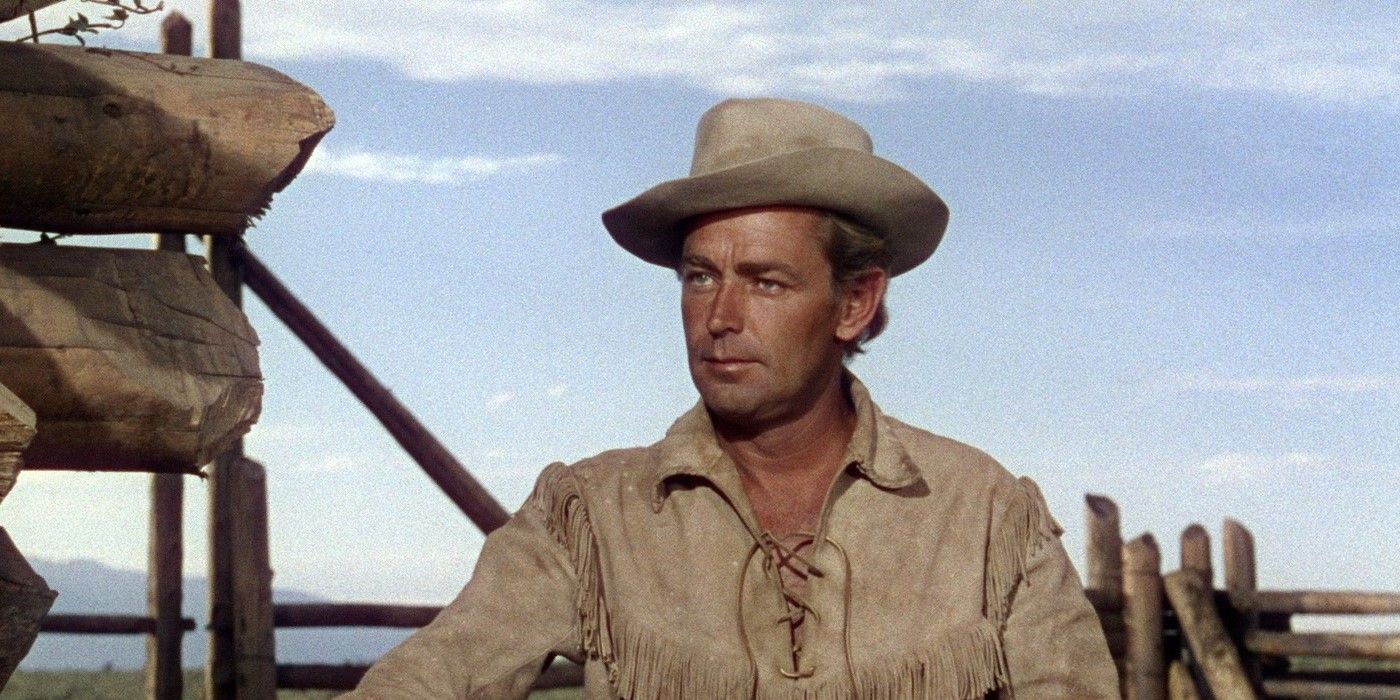
Western films have been a central part of cinema since the early days of Hollywood. Movies like Rio Bravo (1959), The Searchers (1956), The Magnificent Seven (1960), and Shane (1953) perfectly capture the spirit of the genre during that time. Though known for exciting gunfights, tales of revenge, and rugged frontier landscapes, these films often have a surprising amount of emotional depth and compelling characters, both heroic and flawed.
Directed by George Stevens and featuring Alan Ladd, Shane is a beloved Western that blends traditional storytelling with a fresh, modern approach. It’s considered one of the most emotionally resonant films ever made, and the scene where Shane says goodbye to Joey is particularly iconic, capturing the very heart of the Western genre.
Shane Changed the Traditional Western Gunslinger Story
What sets Shane apart, even compared to other Westerns of its time, is its quiet sadness. Unlike earlier films that focused on grand displays and heroic posturing, Stevens’s movie feels peaceful and gentle, with violence shown as a part of the natural landscape and everyday life. The story doesn’t feel like a series of exciting gunfights, but rather like a mournful reflection on the type of person the Wild West created—and a type of person who would soon become obsolete. This change in tone, though understated, is intentional and positions the film as a turning point, connecting the traditional, larger-than-life Western with the more thoughtful and realistic films that came after.
Shane is the story of a quiet, retired gunslinger who arrives in a Wyoming valley where the residents are terrorized by a cruel landowner named Rufus Ryker. He finds work helping the Starrett family, who are struggling to hold onto their farm. The Starretts’ young son, Joey, quickly becomes fond of Shane, especially after discovering Shane’s skills with a gun when he protects them from Ryker’s hired thugs. As Ryker learns about Shane’s abilities, the conflict intensifies, leading to a final showdown.
Shane is different from many heroes in Westerns because his struggle isn’t about deciding what’s right or wrong—it’s about understanding the difference and being troubled by the consequences of his actions. He’s not a typical hero of later films, nor is he a perfectly righteous lawman from older stories. He’s a man who realizes that while violence can offer quick solutions, it ultimately creates lasting problems. This inner conflict—between doing what he feels is right and the toll it takes on his soul—not only defines Shane’s character but also sets the stage for the conflicted heroes that Hollywood would create in the years to come.
Throughout the story, the audience quickly understands that Shane is a man shaped by a violent past, demonstrated by his quickness with a gun. He tries to avoid killing whenever possible, but won’t hesitate if he feels cornered. Unlike some modern heroes, Shane doesn’t need to prove himself – from the beginning, it’s clear he’s a skilled and capable killer.
The film visually highlights this theme through careful staging and framing. Shane is often shown against vast landscapes – open skies and mountains – which, while representing freedom, actually emphasize how alone he is. Whenever he’s in a scene with the Starretts, he appears awkward and doesn’t quite fit in, suggesting the family’s home life rejects him. These subtle visual details reinforce the film’s tragic core: Shane’s strength is what makes him so helpful, but it also means he can never truly belong.
What makes his story compelling isn’t his talent with a gun, but his strong sense of right and wrong and how he defied the typical Western hero. He wasn’t a sheriff or someone who sought out gunfights – he was a new kind of character for that era. When the film came out, it dramatically altered the Western genre. Before that, Western heroes were usually portrayed as soldiers, lawmen, or respectable members of the community, largely due to the restrictions of the Hays Code.
Shane was a complex character – a wanderer with a troubled past, yet still capable of kindness. He was one of the first movie heroes who lived by his own principles, not necessarily the rules of society. This complexity became a model for characters that followed, like those seen in Open Range. These figures, including Shane, all share a central contradiction: they are good people forced to rely on skills that aren’t.
Shane’s Speech Is a Defining Part of Western History
With Ryker defeated, a wounded Shane prepares to ride out of the valley, leaving Joey heartbroken. Seeing how upset the boy is, Shane gives a powerful speech – one that’s become famous in movies. He tells Joey, “A person can’t change who they are, Joey. Trying to be someone else just doesn’t work. You can’t escape the consequences of taking a life. Once you’ve killed, you can’t go back to being innocent. Good and evil leave a lasting mark, and you can’t erase them.”
After delivering his final lines, Shane rides away into the sunset, leaving his future uncertain after being wounded by a gunshot. It was a touching conclusion to a movie that nearly didn’t get made.
That speech is the Western genre’s equivalent of Hamlet’s famous “To be or not to be.” It perfectly embodies the deep weariness felt by the most iconic Western heroes. It’s more than just about feeling sorry for past actions—it explores questions of who these men are, and how violence becomes a core part of their identity. When Shane says that good and bad are like a “brand,” he’s admitting that in the Wild West, morality leaves a lasting mark, just like a brand on cattle. Once someone has taken a life, even if they felt justified, it changes how the world sees them forever.
The speech is a powerful moment of realization, and the speaker wouldn’t want Joey to go through the same thing. Like many people from that time, he’s witnessed enough violence and has no desire to experience it again.
At the beginning of the movie, he enters the valley seeking a new life. But after stopping Ryker’s gang, he understands he doesn’t fit into the world the Starretts are creating. Knowing he’s about to die, he focuses on giving Joey a positive influence, hoping to inspire him to choose a better path – the peaceful life he himself always wanted.
What makes that scene so powerful is what it doesn’t do. There’s no dramatic music until after Shane leaves, and the emotions aren’t exaggerated. We just hear Joey’s quiet sobs as the camera watches Shane ride off and become a legend. It’s a remarkably subtle farewell – and one that stays with you long after the credits roll.
Shane was a man hoping for a quiet life, wanting to escape the mistakes he’d made. In his last message, he deeply regretted his past and warned Joey against a life of violence, explaining how it can take over a person. He didn’t want Joey to repeat his errors and urged him to find strength in family, not in fighting and bloodshed.
As a huge movie fan, I’ve always been struck by how Shane subverts expectations. It’s a Western often seen as celebrating gunfights, but for me, the film actually argues against violence. Sure, we might root for Shane when he takes down the villains, but the real power of his story is a warning – a plea to find better paths. It’s so different from a lot of action flicks; Shane doesn’t treat killing lightly. It really shows the weight of taking a life, and how it changes a person forever. It’s a powerful message that stays with you long after the credits roll.
Shane Continues to Influence Modern Westerns
Released in 1953, Shane quickly became a landmark film in Hollywood, essentially creating a blueprint for how heroes are portrayed. Before Shane, movie heroes were typically straightforward and virtuous, like a classic John Wayne character – always doing the right thing and with no flaws. But George Stevens’ film introduced a more complex character, a man with a troubled past who simply wants to start over and live a peaceful life.
As a Western fan, that final shot of Shane riding away always gets me. It feels like he’s saying goodbye to a whole way of life – the kind of rugged individualism that just doesn’t fit into the new America that’s being built. He’s made sure the Starretts and the other farmers are safe, and guys like Ryker can’t hurt anyone anymore. But more than that, his little speech feels like he’s finally come to terms with who he is, and accepted his role in things, even if that means riding off into the sunset.
What happens to him next is up to the audience. Some might see him continuing his journey, traveling from town to town and bringing his own brand of justice. Others find his story more powerful if it ends with his death, representing the final chapter of a bygone time after he’s said goodbye to Joey.
Shane’s story offered a hopeful perspective, especially when compared to darker Westerns like The Great Silence, Django, and The Wild Bunch. The film feels like a farewell to the traditional Western, using music, visuals, and characters to remind audiences of a classic era in Hollywood.
Many classic stories about a solitary hero owe a debt to the film Shane, which has had a lasting influence on cinema. It essentially perfected the formula for the hero’s journey, so it’s no surprise that later films, intentionally or not, have borrowed elements from it.
Found an error? Send it so it can be corrected.
Read More
- Netflix’s Little House On The Prairie Reboot: Release Date, Cast & Everything We Know
- Off Campus Season 1 Soundtrack Guide
- Silver Rate Forecast
- Prime Video’s New R-Rated Spy Thriller Is Officially No.1 On Streaming Despite Poor Reviews
- Gold Rate Forecast
- Brent Oil Forecast
- EUR ZAR PREDICTION
- 币安人生 PREDICTION. 币安人生 cryptocurrency
- EUR USD PREDICTION
- KPop Demon Hunters Meets Avatar: The Last Airbender In Netflix’s 3-Part Fantasy Series
2026-02-07 03:16