Author: Denis Avetisyan
Researchers have developed a novel method to detect the faint neutrino signals emitted before a star collapses, potentially providing hours of advance notice for supernova observations.
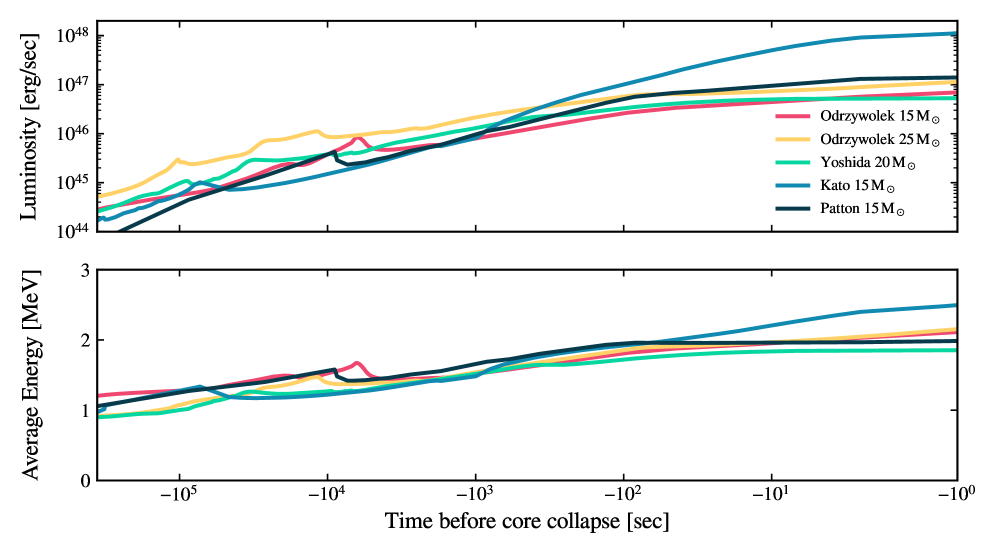
A ‘rate+time’ analysis of pre-supernova neutrinos from detectors like KamLAND and Super-Kamiokande demonstrates improved early warning capabilities compared to traditional rate-only methods.
Despite decades of theoretical modeling, the precise mechanisms preceding core-collapse supernovae remain poorly understood, hindering efforts to forecast these cataclysmic events. This paper, ‘Development of an early warning method incorporating pre-supernova neutrino light curves’, introduces a novel alarm methodology leveraging the temporal evolution of pre-supernova neutrino event rates to improve supernova early warning systems. By incorporating a “rate+time” analysis-using a log likelihood ratio test referencing multiple stellar models-we demonstrate the potential for significantly earlier warnings compared to conventional rate-only methods, while maintaining a consistent false alarm rate. Could this approach, tested on data from KamLAND and Super-Kamiokande, pave the way for real-time supernova forecasting and a deeper understanding of stellar collapse?
The Whispers Before the Bang: Detecting the Stellar Premonition
The dramatic finale of a massive star’s life – a core-collapse supernova – is one of the most energetic events in the universe. However, preceding this spectacular explosion is a subtle harbinger: a burst of neutrinos. These nearly massless particles, emitted from the star’s core in the hours before collapse, offer a crucial, albeit fleeting, early warning system. Unlike photons which are easily scattered, neutrinos can escape the collapsing star virtually unimpeded, carrying information about the stellar core’s final moments. Detecting this pre-supernova neutrino signal, though exceedingly difficult, would provide invaluable insights into the mechanics of stellar death and potentially allow for unprecedented multi-messenger astronomy, linking the neutrino burst to the subsequent detection of photons and other particles from the supernova itself.
The detection of pre-supernova neutrinos presents an extraordinary scientific hurdle, largely due to the incredibly faint signal expected amidst a constant barrage of background noise. These neutrinos, emitted from the stellar core prior to collapse, interact weakly with matter, meaning detectors must be massive and exquisitely sensitive to capture even a handful of events. Furthermore, the predicted rate of these pre-supernova neutrinos is exceptionally low – perhaps only a few per second for the entire galaxy – making it difficult to distinguish a genuine signal from random statistical fluctuations. Sophisticated algorithms and advanced noise reduction techniques are therefore crucial, but even these face limitations in reliably identifying the subtle signature of an impending stellar catastrophe. The challenge lies not only in detecting the neutrinos, but in confidently asserting that a detected event isn’t merely a chance occurrence within the detector’s inherent background.
The reliable detection of pre-supernova neutrinos remains a considerable challenge due to the subtle nature of the signal and the overwhelming presence of background noise. Current neutrino detectors, while incredibly sensitive, frequently register random fluctuations that mimic the expected pre-supernova burst, creating false positives. This difficulty in distinguishing a genuine signal from statistical noise significantly hinders the ability to issue timely alerts before a star collapses. Sophisticated algorithms and increased detector sensitivity are crucial, but even with advancements, the low event rate – the infrequency of these pre-supernova emissions – complicates efforts to confidently identify a true precursor event and distinguish it from chance occurrences, ultimately limiting the window for potential observational follow-up and astrophysical insights.
The Messenger’s Signature: Decoding the Neutrino Interaction
The primary method for detecting pre-supernova neutrinos centers on the inverse beta decay interaction. This process occurs when an electron antineutrino ( \bar{\nu}_e ) interacts with a proton, producing a positron and a neutron. The positron quickly annihilates with an electron, releasing two gamma rays detectable by liquid scintillator or water Cherenkov detectors. Crucially, the delayed coincidence between the prompt gamma rays from positron annihilation and the later gamma rays resulting from neutron capture on hydrogen – typically occurring within several microseconds – provides a strong signature for identifying this specific interaction and distinguishing it from background noise. Because this interaction specifically targets electron antineutrinos, its observation confirms the neutrino’s flavor and indicates a potential progenitor source undergoing gravitational collapse.
Liquid scintillator detectors, such as KamLAND, utilize a large volume of organic liquid that emits photons when interacting with neutrinos. These photons are then detected by photomultiplier tubes, allowing for the reconstruction of the neutrino’s energy and direction. Water Cherenkov detectors, like Super-Kamiokande, operate on the principle that charged particles traveling faster than the speed of light in water emit Cherenkov radiation – a cone of light detectable by the detector’s photomultiplier tubes. Both detector types are essential for capturing the rare interactions of neutrinos due to their large target masses – on the order of kilotons – and their ability to discriminate signal events from background noise. KamLAND is particularly sensitive to \overline{\nu}_e from reactor antineutrinos, while Super-Kamiokande detects all flavors of neutrinos and antineutrinos, offering complementary data for astrophysical studies and supernova monitoring.
The sensitivity of a pre-supernova neutrino detection system is directly proportional to both detector efficiency and the accuracy of event reconstruction. Detector efficiency, encompassing factors like target mass, scintillator purity, and photomultiplier tube coverage, determines the probability of observing a neutrino interaction. Event reconstruction accuracy, which involves precisely determining the energy and direction of the detected neutrino, is crucial for distinguishing genuine pre-supernova signals from background noise. Lower reconstruction accuracy increases the false positive rate, while lower detector efficiency reduces the number of detected events, both diminishing the system’s ability to provide a reliable and timely alert. Therefore, improvements in these areas are essential for maximizing the signal-to-noise ratio and increasing the effective range at which a pre-supernova neutrino burst can be confidently identified.
From Whispers to Warnings: Refining the Alarm Strategy
Early alarm systems relied on Rate-Only Analysis, which determined alarm significance by quantifying excess events above a predicted background rate. This method calculated a p-value based solely on event counts, flagging an alarm when the observed rate deviated sufficiently from expectations. However, Rate-Only Analysis demonstrated a propensity for false positives due to its sensitivity to statistical fluctuations and inability to account for temporal event patterns. These false alarms stemmed from random variations in the event rate, leading to incorrect signals despite no actual anomalous event occurring, and ultimately limiting the reliability of the initial alarm systems.
Rate+Time Analysis represents an advancement over simple rate-only methods by incorporating the temporal evolution of event detection. Instead of solely assessing the statistical significance of an excess event count, this approach analyzes how the rate changes over time. This is achieved through the application of a Likelihood Ratio Test, which compares the likelihood of the observed data given a signal hypothesis to the likelihood given a background-only hypothesis. The resulting test statistic provides a more robust measure of confidence, reducing the incidence of false positive alarms by explicitly considering the time-dependent behavior of the neutrino signal and differentiating it from random fluctuations in the background noise.
A Combined Alarm System utilizing data from both the KamLAND and Super-Kamiokande detectors demonstrably improves supernova early warning capabilities. This approach leverages the complementary data streams to enhance the signal-to-noise ratio and reduce statistical uncertainty in event detection. Specifically, the combined Rate+Time analysis achieved an average alarm lead time of 14.7 hours prior to predicted core collapse. This represents a 2.4-hour improvement over a combined system relying solely on rate-only analysis, which yielded an alarm lead time of 12.3 hours.
Modeling the Stellar Demise: Predicting the Neutrino Symphony
Pre-supernova neutrino light curves, essential for interpreting observational data, are computationally derived using stellar models such as the Patton Model, the Yoshida Model, and the Odrzywolek Model. These models simulate the final stages of stellar evolution, focusing on the processes immediately preceding core collapse. Each model employs differing numerical techniques and approximations of the underlying physics, but all aim to predict the time-dependent neutrino flux – specifically, the number of neutrinos emitted across various energy levels – as a function of time relative to core collapse. The resulting light curves represent the expected detection rates for neutrino observatories, allowing researchers to compare theoretical predictions with observed neutrino signals and constrain the parameters of stellar evolution and supernova mechanisms.
Stellar models simulating pre-supernova neutrino emission rely on detailed calculations of several key physical processes. Thermal pair production, occurring at the extreme densities and temperatures within a collapsing star, generates electron-positron pairs which then interact via weak interactions. These weak interactions, specifically electron capture on protons and neutrons, as well as inverse beta decay, are the primary mechanisms for producing the observed neutrinos. The rate of these interactions is highly sensitive to the energy distribution of the electrons and positrons, as well as the local density and composition of the stellar material. Accurate modeling requires solving the Boltzmann transport equation for neutrinos, accounting for energy losses due to neutrino scattering and absorption, and implementing appropriate nuclear physics input for the weak interaction rates.
Accurate predictions of neutrino emission from core-collapse supernovae require accounting for the Mikheyev-Smirnov-Wolfenstein (MSW) effect, a phenomenon wherein neutrino flavor oscillations are influenced by matter density. This effect significantly alters the predicted neutrino flux detected at Earth, as electron neutrinos can convert to other flavors during their passage through the star and interstellar medium. Crucially, the magnitude of the MSW effect is dependent on the neutrino mass ordering; calculations must therefore proceed using both the Normal Mass Ordering (where m_1 < m_2 < m_3 ) and the Inverted Mass Ordering ( m_3 < m_1 < m_2 ) to bracket the possible observational outcomes and reduce model uncertainty. Failure to incorporate these factors leads to discrepancies between predicted and observed neutrino events.
A Cosmic Early Warning System: The Future of Stellar Forensics
A fully realized SuperNova Early Warning System hinges on the coordinated operation of neutrino observatories worldwide. These facilities, designed to detect the fleeting interactions of neutrinos – nearly massless particles produced in the heart of collapsing stars – form the crucial first line of defense in anticipating supernova events. Unlike light, neutrinos readily escape from the stellar core, arriving hours – and potentially days – before the visible explosion. By establishing a global network, scientists aim to capture these early neutrino signals, providing invaluable advance notice to the astronomical community. This lead time allows telescopes to swing into action, capturing the supernova’s initial burst of light and other electromagnetic radiation, and enabling a comprehensive, multi-messenger observation of a stellar death – a feat previously beyond reach. The system’s effectiveness isn’t simply about detecting a supernova, but about maximizing the window for detailed study, and ultimately, unlocking the secrets of these cataclysmic events.
A future SuperNova Early Warning System promises a paradigm shift in how astronomers study cataclysmic stellar events. Beyond simply providing up to 14.7 hours of advance notification for core-collapse supernovae, the network is designed to facilitate multi-messenger astronomy – a holistic approach combining the detection of elusive neutrinos, ripples in spacetime known as gravitational waves, and traditional electromagnetic radiation. This convergence of data streams offers an unprecedented opportunity to observe supernovae across the entire spectrum, allowing scientists to probe the inner workings of stellar collapse with far greater detail than ever before. By correlating signals from these diverse sources, researchers can reconstruct a complete picture of the explosion, unraveling the complex physics at play and ultimately refining models of stellar evolution and the creation of heavy elements in the universe.
A coordinated, global alert system for supernovae promises a paradigm shift in astrophysical understanding. The ability to observe these stellar explosions with advanced warning, and across multiple wavelengths – neutrinos, gravitational waves, and electromagnetic radiation – allows for an unprecedented level of detail in studying the final stages of stellar evolution. This multi-messenger approach moves beyond traditional observational limitations, enabling scientists to probe the inner workings of supernovae with greater precision and test existing models of stellar collapse. Consequently, this will refine current understandings of element formation, the dynamics of cosmic rays, and the overall energetic processes that shape the cosmos, ultimately opening entirely new avenues for scientific discovery and furthering insights into the universe’s most powerful events.
The development of an early warning system for core-collapse supernovae, as detailed in this research, necessitates a rigorous examination of the limits of predictability. This pursuit echoes the inherent boundaries of knowledge, mirroring the way black holes challenge the applicability of physical law and human intuition. As Stephen Hawking once stated, “Intellectual humility is proportional to the complexity of nonlinear Einstein equations.” The ‘rate+time’ analysis presented here, while offering potential for earlier detection through pre-supernova neutrinos, acknowledges the complex interplay of factors governing stellar collapse. Any predictive model, much like a theory approaching a black hole’s event horizon, faces fundamental limitations, demanding continuous refinement and an acceptance of inherent uncertainty.
Beyond the Horizon
The development of pre-supernova neutrino detection methodologies, as presented in this work, represents a transient reprieve from the inevitable. While the “rate+time” analysis demonstrates a marginal improvement in early warning potential, it is crucial to acknowledge the fundamental limitations inherent in attempting to predict gravitational collapse forms event horizons with well-defined curvature metrics. The signal, even with refined temporal analysis, remains fragile – susceptible to background noise, detector inefficiencies, and the stochastic nature of core processes. A statistically significant alarm is, after all, merely a probabilistic statement, not a deterministic decree.
Future research must confront the reality that the universe does not offer guarantees. Greater emphasis should be placed on multi-messenger astronomy, integrating neutrino data with gravitational wave observations and electromagnetic signals. However, even complete concordance of these signals cannot eliminate the possibility of unforeseen physics at play within the stellar core. Singularity is not a physical object in the conventional sense; it marks the limit of classical theory applicability – a point beyond which prediction itself becomes meaningless.
The pursuit of early warning systems is, perhaps, an exercise in self-deception. It provides the illusion of control over events that are fundamentally beyond human influence. Yet, the drive to understand, to anticipate, remains. The true value of this research may not lie in its predictive power, but in its capacity to illuminate the boundaries of knowledge, and to remind humanity of its precarious position within the cosmos.
Original article: https://arxiv.org/pdf/2601.15691.pdf
Contact the author: https://www.linkedin.com/in/avetisyan/
See also:
- Off Campus Season 1 Soundtrack Guide
- 46 Years Later, The Mandalorian & Grogu Answers A Major Empire Strikes Back Question
- X-Men ’97 Finally Gave Gambit the Hero Moment He Deserved
- HoI4 fans harsh reactions to the announcement of another DLC pack
- Chainsaw Man Volume 24’s Cover Art Reveals a Brand-New Denji
- 10 Worst End-Game Couples In Sitcom History
- DoorDash responds after customer uses AI to make food look bad and get a refund
- Emily Henry Says to ‘Trust the Vision’ For Beach Read Adaptation
- Hatsune Miku cosplayer goes viral selling $15 cups of “foot juice” to thirsty anime fans
- Katanire’s Yae Miko Cosplay: Genshin Impact Masterpiece
2026-01-24 17:25