When Stanley Kubrick’s Eyes Wide Shut came out in the summer of 1999, it didn’t make much of an impact. Critics were confused by it, seeing it less as a finished film by a renowned director and more like an early, unfinished version. This was understandable, as Kubrick had passed away in March, shortly after submitting a rough cut to Warner Bros., and the studio, along with his estate, finished the film. The marketing had led audiences to expect a highly explicit and provocative erotic thriller, potentially with an NC-17 rating, centered around a large orgy. Instead, they got a slow, atmospheric drama about a Manhattan doctor (Tom Cruise) who is disturbed by his wife’s (Nicole Kidman) admission of a sexual fantasy. He then wanders through a series of encounters that don’t go beyond attraction, culminating in a masked sex party hosted by a secretive, wealthy group on Long Island. The film felt dreamlike and strange, with Cruise and Kidman giving unusually odd performances, and the party itself—the masks, the secret password, and the carefully planned movements—struck many viewers as more comical than sensual or threatening.
Kubrick’s films often gain new layers of meaning over time, and Eyes Wide Shut is no exception. While the film is known for its explicit scenes, more unsettling moments—like one where a shop owner seemingly offers his young daughter to Tom Cruise’s character—suggest a world where sex, power, and exploitation are intertwined. Looking back, these subtle hints now seem to foreshadow disturbing events that would later come to light. In the 2010s, conspiracy theories like Pizzagate and QAnon brought rumors of elite sex-trafficking into public view. Then, with the arrest and death of Jeffrey Epstein, Kubrick’s film, once overlooked by many, began to feel eerily prophetic.
Over time, people started to wonder if Stanley Kubrick’s Eyes Wide Shut had strangely predicted future events. Kubrick was famous for being a perfectionist, spending years on his films and demanding countless takes of each scene. This led some to believe that every detail – costumes, props, even the actors’ delivery – was intentional, filled with hidden meaning for those willing to look closely. This thinking even extended to the conspiracy theory that he helped NASA fake the moon landing and subtly confessed by dressing the character Danny Torrance in an Apollo 11 sweater in The Shining. Rodney Ascher’s 2012 documentary, Room 237, presented these and other wild theories without judgment, potentially fueling them further. Kubrick himself didn’t discourage the speculation. He became increasingly reclusive in his later years, rarely giving interviews and letting his films speak for themselves – open to any interpretation. So, when Eyes Wide Shut appeared to foreshadow a scandal that wouldn’t surface for decades, it prompted a question: Did Kubrick somehow know what was coming?
It didn’t take long for a wild conspiracy theory to pop up online, naturally. People started claiming that Stanley Kubrick’s Eyes Wide Shut wasn’t just a movie, but a warning. They believed it actually showed a real pedophile ring operating among the powerful and wealthy. That masked orgy scene? Not just symbolic of upper-class hypocrisy or complicated relationships – they said it was a straight-up recreation of actual events happening behind closed doors. The story goes that once those involved realized what Kubrick had done, they had him killed and then heavily edited the film, supposedly cutting around 24 minutes of the most damning footage. But some fans believe Kubrick was too clever, and he left enough clues hidden in the final cut for us to figure out the truth, even after the studio tried to cover things up.
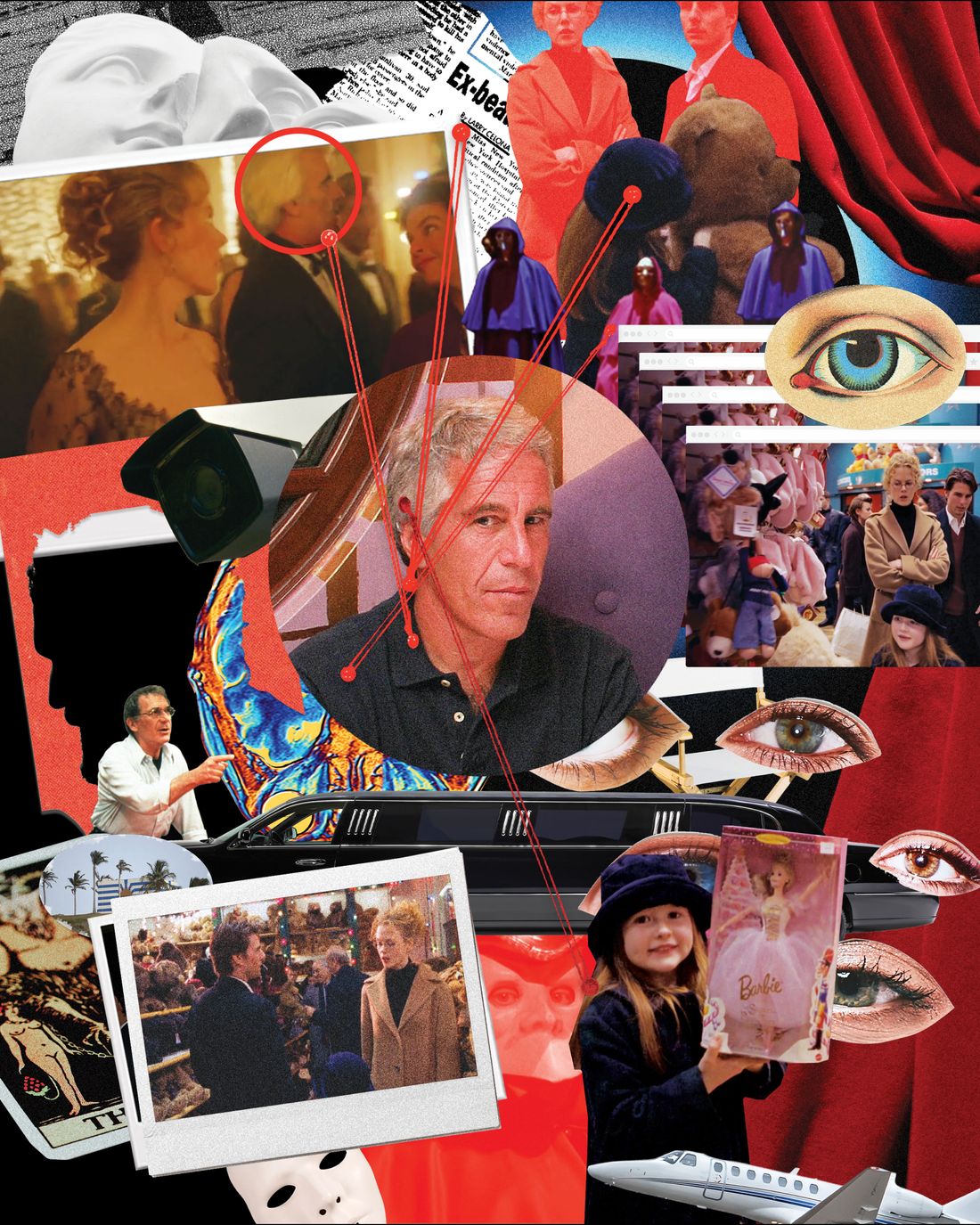
Different interpretations of this theory exist, each suggesting a specific group that Kubrick was trying to reveal. Some focus on well-known groups like the Illuminati or Satanists. Others highlight the Rothschild family, pointing out their past ownership of the building used for some of the film’s party scenes. More extreme claims suggest that Eyes Wide Shut wasn’t just foreshadowing Epstein’s crimes, but was actually about him. The evidence cited includes a brief appearance of a couple in a party scene who some believe resemble Epstein and Ghislaine Maxwell – specifically, the man’s gray hair.
Many interpretations of the film hinge on a single moment. In the final scene, Bill and Alice Harford walk through a toy store with their daughter, Helena. Right before the credits, Helena briefly stands near two men who some believe were also at the film’s opening party, and then follows them down another aisle. This quick shot, analyzed in detail through slow-motion videos and online posts, is seen by some as a shocking reveal: the Harfords have given their daughter to the cult.
This idea has gained a lot of traction online. You can find different versions of it all over platforms like Reddit, YouTube, and TikTok, where Stanley Kubrick is now often seen less as a director and more as someone who exposed a dark secret about wealthy and powerful people, ultimately paying the price for it. While it used to be confined to the more obscure corners of the internet, it gained wider attention last December when Roger Avary, a co-writer of Pulp Fiction and director of The Rules of Attraction, shared his take on the conspiracy theory during an appearance on The Joe Rogan Experience.
During a podcast conversation with Joe Rogan, screenwriter Avary shared his thoughts after revisiting the script for Eyes Wide Shut. He wondered how the film might have differed if Stanley Kubrick had lived longer. Avary pointed out the lack of a narrator, suggesting the morgue scene felt like it was meant to be accompanied by voice-over. He also discussed a popular theory about a scene involving two men and the daughter of a character, implying they were handing her over to a predatory group. Avary then recounted a story – one he heard from someone else – about an early screening where Kubrick reportedly had a heated argument with studio executives, fiercely defending his creative control and refusing any cuts. He supposedly yelled at them, insisting the film remain untouched. Avary noted this argument occurred just days before Kubrick’s death.
Okay, so I’m going to be honest, I find this whole conspiracy theory really hard to buy. It just doesn’t make sense, even if you try to follow the logic. If someone actually discovered a huge sex trafficking ring, why would they spend years and $65 million making a movie about it instead of going straight to the authorities or a journalist? And even if they decided a movie was the way to go, why would the supposed powerful people involved just let it be shown, even in a watered-down version, to millions of people? It feels like a massive leap in logic, and honestly, it just doesn’t add up.
What started as playful speculation about the movie has recently become overwhelming, often overshadowing the film itself. Now that a newly remastered 4K version is available, people are likely to examine every detail – even the smallest ones – in search of hidden meanings.
It would be a real loss if conspiracy theories overshadowed the true artistry of Eyes Wide Shut. I consider it one of Kubrick’s finest films – uniquely loose, unsettling, and emotionally charged compared to his other work. The movie deliberately avoids easy explanations, and that mystery is a key part of its appeal. However, it also allows room for unfounded speculation. I hoped to prevent those theories from defining the film’s reputation, so I reached out to people involved in its production to see if they could shed some light on it.
Many people connected to Stanley Kubrick dismissed recent speculation surrounding his work and personal life. Jan Harlan, a producer and Kubrick’s brother-in-law, stated definitively that the claims were false. Anthony Frewin, Kubrick’s assistant and archivist, believed Kubrick would have found the theories amusing. Nigel Galt, the editor of Eyes Wide Shut, called the claims baseless and typical of the irrelevant attention Kubrick often received. Denise Chamian, a casting director for the film, said it was unlikely Kubrick would have even known about Jeffrey Epstein at the time. Frederic Raphael, a co-writer, suggested Kubrick wasn’t concerned with issuing warnings to the public. Both Tom Cruise and Nicole Kidman declined to comment for this story.
Kubrick’s collaborators argue it’s highly unlikely he made Eyes Wide Shut as some sort of exposé of a secret pedophile ring, and more importantly, the idea doesn’t fit with what we know about how the film came to be. The movie is based on a 1926 story called Traumnovelle by Arthur Schnitzler, and Kubrick was interested in adapting it as early as 1968, after 2001: A Space Odyssey. He acquired the rights in 1970 – long before Jeffrey Epstein was involved in anything nefarious – and even considered making it a comedy, perhaps starring Steve Martin. He revisited the project several times over the years, but didn’t seriously focus on it for almost thirty years. If he truly intended to expose real-world sex trafficking, he didn’t seem particularly urgent about it.
I think a lot of viewers misunderstand Eyes Wide Shut. Many see it as Kubrick revealing a secret world of wealthy, twisted individuals, but the truth is, the core story comes directly from Arthur Schnitzler’s novella, Traumnovelle. I spoke with Raphael, who worked on the screenplay back in ’94, and he confirmed that while Kubrick made some changes, he was adamant about staying true to Schnitzler’s plot points. Essentially, everything you see in the film – the doctor, his wife’s confession, the encounters he avoids, even the key to the masked ball and the woman who helps him – all originated in that novella. The biggest difference? Schnitzler set his story in Vienna around the turn of the 20th century, with a character named Fridolin, instead of 1990s New York and Bill Harford. In fact, it was adapted for Austrian television in 1969, and that version is remarkably similar to Kubrick’s film.
People I talked to don’t believe Kubrick had any inside knowledge of actual sex cults. The one depicted in Eyes Wide Shut seems to have been something he was still developing as he filmed. In his 1999 memoir, Eyes Wide Open, screenwriter Frederic Raphael recalls that Kubrick wasn’t sure what would drive people to join such a group. He even asked Raphael to create some background details, so Raphael wrote a fictional FBI dossier detailing a secret society of powerful people called “the Free” who would kill anyone who revealed their secrets. Kubrick was initially worried Raphael had somehow obtained real FBI information, but he was relieved to learn it was all made up. He emphasized they needed to avoid “potentially dangerous ground.” According to Raphael, Kubrick would have been too cautious to get involved with anything like that if he’d known it existed in real life.
To accurately depict the orgy scene in Eyes Wide Shut, Stanley Kubrick consulted some unusual experts. He turned to Gershon Legman, a scholar of erotic folklore, for historical details about sexual practices in Vienna during the time of Arthur Schnitzler. He also spoke with Dr. C.J. Scheiner, an emergency room doctor with a doctorate in the study of sexuality, who provided Kubrick with a detailed overview of group sex throughout history – spanning 4,000 years – through a series of lengthy phone calls. As filming approached, Kubrick inquired about Scheiner’s personal knowledge of modern orgies. Scheiner explained that he had researched the topic since the 1960s, gaining extensive knowledge of organized group sexual activity in both America and Europe, ranging from casual home gatherings to lavish weekend events at European chateaus. Scheiner insists that their conversations revealed no indication the film was based on any actual sex cult, and he believes, based on Kubrick’s questions, that the director himself had little to no personal experience with orgies.
A lot of the conspiracy theories surrounding the film Eyes Wide Shut focus on Larry Celona, a reporter for the New York Post who advised on the movie. Kubrick hired Celona to write a fake newspaper article for a scene about the death of a character. Interestingly, Celona later reported the news of Jeffrey Epstein’s death, which some people found strangely coincidental. Celona explains that, as a crime reporter for a major tabloid, it’s not unusual for him to be first with breaking news about high-profile deaths. He also reported on the death of JFK Jr. on the same day Eyes Wide Shut was released – a connection that fuels some online conspiracy theories. Some QAnon followers even believe JFK Jr. didn’t die, but went into hiding to fight against a secret network of abuse. There was a brief moment of excitement among theorists when they thought Celona’s name appeared in Epstein’s flight logs, but it turned out to be a misread name – “Celina,” likely referring to another associate of Epstein. Celona insists he never met Epstein, and his conversations with Kubrick were about baseball, not crime. Kubrick, originally from the Bronx, simply wanted to talk about the Yankees.
Even the fabricated newspaper article Celona created for Kubrick’s film has been intensely analyzed. Some viewers pointed out a duplicated line in the second paragraph, interpreting it as a deliberate, hidden clue. Celona himself spotted the repetition but couldn’t figure out why it remained. He suggested asking Frewin, Kubrick’s former assistant, and when I did, Frewin seemed surprised, saying he’d never noticed it despite having overseen the typesetting. He jokingly suggested it simply adds to the article’s realism.
Even before the age of online speculation, Eyes Wide Shut was known for being mysterious and hard to understand. The film was made under very secretive conditions. Stanley Kubrick worked with a small team at Pinewood Studios in London, carefully controlling everything on set, and the filming process stretched on for over 15 months – a record at the time for the longest continuous movie shoot. Considering how long it took, it’s likely a lot of footage didn’t make the final cut.
According to producer Jan Harlan, there were some unused scenes, but nothing controversial enough to attract attention from any extreme groups. Those who worked with Kubrick say he primarily focused on filming multiple takes of the scenes that actually made it into the final cut. A famous story tells of Kubrick making Tom Cruise repeat a simple action – walking through a doorway – 95 times until he felt the performance was authentic. (Cruise, now known for doing daring stunts, apparently developed an ulcer during filming due to the demanding process.)
As a film buff, I always find the behind-the-scenes stories of Kubrick’s work fascinating. I recently read an interview with Madison Eick, who played little Helena in Eyes Wide Shut, and it was incredible. She was only eight during filming and hasn’t talked much about the experience until recently. She said she never saw a full script! Most of her scenes were actually improvised – Kubrick would give them the basic idea, and they’d just rehearse and talk naturally. She even recalled a scene about wanting a dog at Christmas was completely made up on the spot! But what really blew my mind was her story about brushing her teeth. Apparently, Kubrick had her do it for two weeks! He kept pushing her to spit while brushing, even though she naturally did it at the end. She joked that her dentist recently told her her gums were receding, and she wonders if it’s from all that obsessive toothbrushing! Madison’s 36 now and no longer acts, but her story is a perfect example of Kubrick’s legendary perfectionism.
I asked Eick about the popular online theory surrounding the toy store scene – a key part of the conspiracy, where some believe her character is being given to cult members. She was surprised to hear about it. “I was never told there was any hidden meaning to that scene,” she explained. “Stanley [Kubrick] never suggested I stand with or walk away with those two men.” Harlan, who also worked on the film, confirmed the men were from the same group of background actors who appeared at the movie’s opening party. However, he insists this wasn’t intentional and that there’s no hidden significance to it.
Some interpretations of this scene delve into symbolism, suggesting the toys Helena chooses – like a stuffed tiger (which may reference a similar toy from a previous scene) and a Barbie doll (representing lost innocence) – have deeper meaning. However, actress Eick dismisses this idea, explaining she was simply improvising and chose the toys she liked at the moment, not based on any direction.
As a huge movie fan, I always find it fascinating to learn about the editing process, especially with a director like Kubrick. Apparently, after they finished filming Eyes Wide Shut, Kubrick and the editor, Galt, spent a solid 15 months really honing the film into what we see today. Galt says the final cut Kubrick personally approved was almost exactly the same as the theatrical release! They showed a version to Warner Bros. and mostly talked about minor tweaks, like a few establishing shots. The orgy scene, famously, hasn’t been altered at all since Kubrick passed away – not a single frame. The only changes made after his death were to digitally add cloaked figures to some of the more explicit moments, just to get an R rating. What’s really interesting is that throughout all those months in the editing room, Galt doesn’t recall Kubrick ever mentioning anything about real-life secret societies. He remembers Kubrick being much more focused on current events at the time – things like the war in Kosovo and the Clinton-Lewinsky scandal.
The editing process was almost finished when Stanley Kubrick unexpectedly passed away on March 7, 1999. Those close to him don’t believe his death was suspicious. According to Harlan, Kubrick died of a heart condition in his sleep. Raphael added that he was 70 but appeared much older, and the stress of making the film likely contributed to his death – no one was involved beyond that.
It’s possible everyone I interviewed was either involved in a deception or scared to be honest with me, fearing a dangerous group. They might have even planned their stories, but they weren’t very consistent. For instance, Raphael claims Sydney Pollack, the director and actor who played Victor Ziegler in Eyes Wide Shut, edited the film’s billiards scene after Stanley Kubrick died. However, Galt completely disagrees, calling that idea false.
Almost everyone questions the story Roger Avary told Joe Rogan. According to Frewin, it’s highly improbable Avary ever saw a genuine shooting script for Eyes Wide Shut. No one I interviewed thought the film was originally intended to have a narrator. While some of Raphael’s initial drafts did include voice-over, that concept was dropped before the film was finalized. Galt confirms that Stanley Kubrick never considered adding narration during the editing process.
The story about a heated screening of Kubrick’s Eyes Wide Shut, where he supposedly argued with studio executives, isn’t true, according to those who worked with him. They say the film only had three screenings while Kubrick was alive, and none of them involved any arguments. On March 2, 1999, a copy of the film was flown to New York and shown to Warner Bros. leaders Terry Semel and Bob Daly, and later that day to Tom Cruise and Nicole Kidman. Kubrick remained in England, waiting for their feedback, which was said to be good. Two days before he died, on March 5th, Tom Cruise’s publicist, Pat Kingsley, watched the film alone at Kubrick’s house. Kingsley says she didn’t see Kubrick that day because he had a cold, but they spoke on the phone afterward. She told him she was completely captivated by the movie.
Perhaps Avary has information I’m missing. As an Oscar winner, he likely has a better understanding of these things than I do, so I didn’t want to dismiss his perspective. I reached out to him via email. He initially said he’d be willing to talk, but then went silent for several months. Eventually, he responded to questions submitted by a fact-checker from the New York magazine.
Avary heard a story about a fight after a screening from a William Morris agent who said they were outside the screening room in England. Avary admits this story might not be entirely true and only shared it on the Rogan podcast because the agent has since passed away. He also says he has a copy of the screenplay dated August 4, 1996, given to him by someone important on the film crew. This version of the script includes narration, particularly in the morgue scene.
Regarding the unsettling toy store scene, director Avary believes Kubrick likely didn’t explain its hidden meaning to the young actress, Madison Eick. He explains that he’s learned from his own experience directing child actors that it’s best not to share everything with them – or any actor, for that matter. Overexplaining, especially to a child, can ruin the natural feel of a performance. Avary also points out that earlier versions of the script included mysterious men—similar to those who abduct Helena—who appear to be following Cruise’s character.
The screenplay Avary details seems to be the same as an early draft of Eyes Wide Shut that’s been available online for years. (Avary insists his copy isn’t from the internet and looks quite different.) While Frewin, Galt, and Harlan can’t verify the authenticity of that draft, some parts align with pieces found in the Kubrick archives. Regardless, this alleged draft doesn’t include any plot where Helena is kidnapped, and there’s no scene taking place in a toy store.
Despite all of this, people will likely continue to speculate. Kubrick worked in an era where audiences were more comfortable with open-ended stories, but that understanding feels different now. Modern viewers, accustomed to shows, podcasts, and streaming films that clearly explain everything – characters’ motivations, plot points, and overall meaning – now expect clarity. When a film intentionally avoids answers or resists a simple interpretation, it can feel frustrating rather than thought-provoking. I realize I was also seeking a concrete answer while researching this topic.
As a Kubrick fan, I’ve always been fascinated by the hints of secret societies in his work, and to me, Eyes Wide Shut feels like where he really tackles that idea head-on. It’s about a powerful, hidden group that uses things like sex, death, and influence to stay in control, and it almost feels like Kubrick’s final statement about power itself. Now, I’m not saying I believe in all the conspiracy theories out there, but as someone who enjoys a good mystery and loves Kubrick’s films, it’s just fun to explore those possibilities and speculate about what he might have been suggesting.
Read More
- Netflix’s Little House On The Prairie Reboot: Release Date, Cast & Everything We Know
- Off Campus Season 1 Soundtrack Guide
- Silver Rate Forecast
- Prime Video’s New R-Rated Spy Thriller Is Officially No.1 On Streaming Despite Poor Reviews
- Brent Oil Forecast
- Gold Rate Forecast
- EUR ZAR PREDICTION
- Amazon Primes new GenAI cartoon looks like K-Pop Demon Hunters with aliens
- Inkford Hermitage Chest Locations In HSR (Honkai: Star Rail)
- YouTuber arrested after viral AI bodycam videos spark real police complaints
2025-12-17 16:00