Pray, allow me to present a most curious discourse that Mr. Michael Saylor hath recently cast upon the digital winds of X, a platform where wit and wisdom oft collide with the most spirited of debates. On a Tuesday morn, he proclaimed with no small measure of confidence: “The Bitcoin Quantum Leap: Quantum computing shall not unravel Bitcoin-nay, it shall fortify it!” 🧊✨
He continued, with a flourish befitting a man of his station, “The network shall be upgraded, active coins shall migrate, and those lost to the ether shall remain frozen. Security shall ascend, supply shall diminish, and Bitcoin shall emerge the stronger for it.” 🛡️💪
In plainer terms, should quantum computing ever advance to threaten our present cryptographic schemes, Bitcoin may yet adapt. Coins under active management shall transition to new, quantum-resistant outputs, while those abandoned-keys lost, owners departed, or UTXOs forgotten-shall be left to their icy fate. Frozen, indeed. ❄️⚰️
The Bitcoin Gentry Reacts
It was this latter point that seized the imagination of the populace, for it is not merely a technical matter but a social conundrum. Who, pray tell, shall decide which coins are “lost” and which are merely “aged”? Mr. Jameson Lopp, a vocal advocate for quantum preparedness, declared with a nod of approval, “Lost coins ought to remain frozen. I am delighted to hear you shall support my BIP!” 🧐📜
Yet, as is oft the case in such matters, a counterargument swiftly arose. “We have no right to freeze another man’s bitcoin,” proclaimed Wicked (@w_s_bitcoin), warning that any attempt to lock legacy coins might provoke a most contentious chain split. He further posited a tantalizing narrative: might not Satoshi have left early keys exposed as a “bounty” for quantum computers? 🕵️♂️💡
Mr. Lopp’s rejoinder was devoid of sentiment, rooted instead in the practicalities of node-level governance. “On the contrary,” he wrote, “every node runner retains the right to reject coins they suspect have fallen prey to a quantum attacker,” framing it not as confiscation but as a defensive measure to preserve the integrity of the circulating supply. Later, he conceded the uncomfortable truth: “Correct, the best one can manage is an exceedingly lengthy migration window.” 🕰️🔒
This “migration window” is no small undertaking. The draft proposal, penned by Mr. Lopp and his esteemed colleagues (Messrs. Christian Papathanasiou, Ian Smith, Joe Ross, Steve Vaile, and Pierre-Luc Dallaire-Demers), outlines a three-phase plan: first, a soft fork to encourage (or compel) new transactions into quantum-resistant outputs; second, a rule change rendering legacy ECDSA/Schnorr spends invalid after a protracted deadline; and third, an optional phase to reclaim unmigrated coins should the rightful owner prove their dominion through novel means. 📜🛠️
It appears orderly on paper, yet in practice, such matters are rarely so. For how can one prove theft in Bitcoin’s older UTXOs? Mr. Wicked pressed this point with vigor: “There exists no method to ascertain whether older coins were stolen or merely forgotten, only to be moved later by their rightful owner.” In his view, this fear is but supply paranoia masquerading as security. 🤔🔍
Mr. Lopp did not deny the incentives at play. He embraced them. “I assure you, many entities in the industry are deeply concerned about supply shocks diminishing the value of their coins; businesses still rely on dollars as their unit of account.” And then, in a line that might serve as a homework assignment for those who believe this matter shall resolve itself neatly: “Your task is to decipher the power dynamics…” 📚⚖️
Beyond the Bitcoin trenches, other corners of the crypto realm reacted with a raised eyebrow. Mr. Nic Carter, a founding partner at Castle Island Ventures, demanded specifics: “Pray, explain in detail how all these events shall transpire […] Which core developers has MicroStrategy funded to undertake the multiple hard and soft forks required for this plan? Which quantum researchers?” 🧐🔬
BitMEX Research challenged the “hardfork” narrative. “What leads you to believe a hardfork is necessary?” they inquired, suggesting the transition might prove painful without resorting to such drastic measures. Another observer succinctly captured the sentiment: “Coins may be frozen with a soft fork.” 🧊🤷♂️
Yet, soft fork or no, achieving broad social consensus to lock unmoved coins is a nightmare of its own. “The notion that there would be social consensus to lock unmoved coins is madness,” one user declared. “In a thousand realities, such a thing occurs not once.” 🌌🤯
And, quietly, a reminder from Mr. Willem Schroe (Botanix CEO): “Yes, quantum developments are afoot, yet nothing approaches a breakthrough. That said, our current cryptographic solutions are far from ready or battle-tested, so quantum resistance work is most assuredly worthwhile. A small risk, but one with potentially grave consequences.” ⚠️🛡️
Thus, this discourse is not about quantum computing tomorrow, but about Bitcoin’s identity when confronted with a threat that cannot be resolved with mere optimism. The technical path is arduous. The politics may prove even more so. 🌪️🏛️
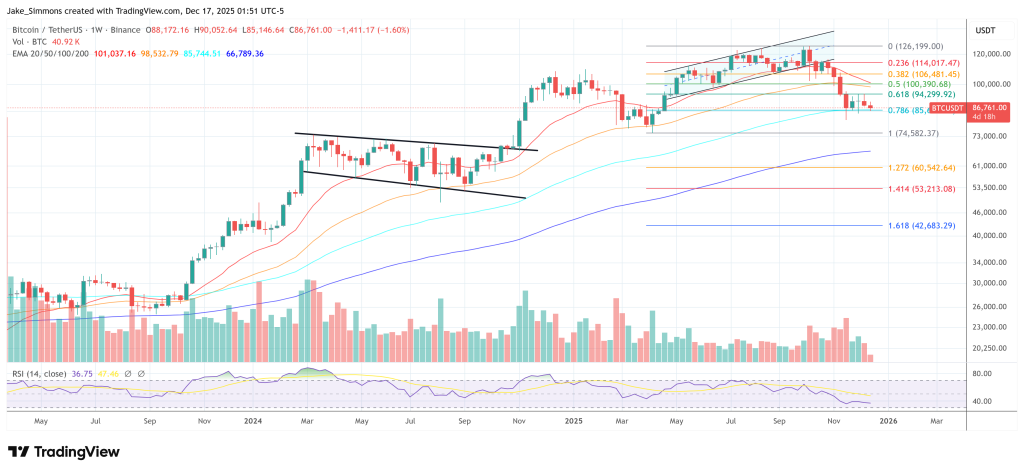
At the time of this writing, Bitcoin traded at $86,761. 💹📈
Read More
- Netflix’s Little House On The Prairie Reboot: Release Date, Cast & Everything We Know
- Off Campus Season 1 Soundtrack Guide
- Silver Rate Forecast
- Prime Video’s New R-Rated Spy Thriller Is Officially No.1 On Streaming Despite Poor Reviews
- Gold Rate Forecast
- Brent Oil Forecast
- EUR ZAR PREDICTION
- 币安人生 PREDICTION. 币安人生 cryptocurrency
- EUR USD PREDICTION
- KPop Demon Hunters Meets Avatar: The Last Airbender In Netflix’s 3-Part Fantasy Series
2025-12-17 15:00