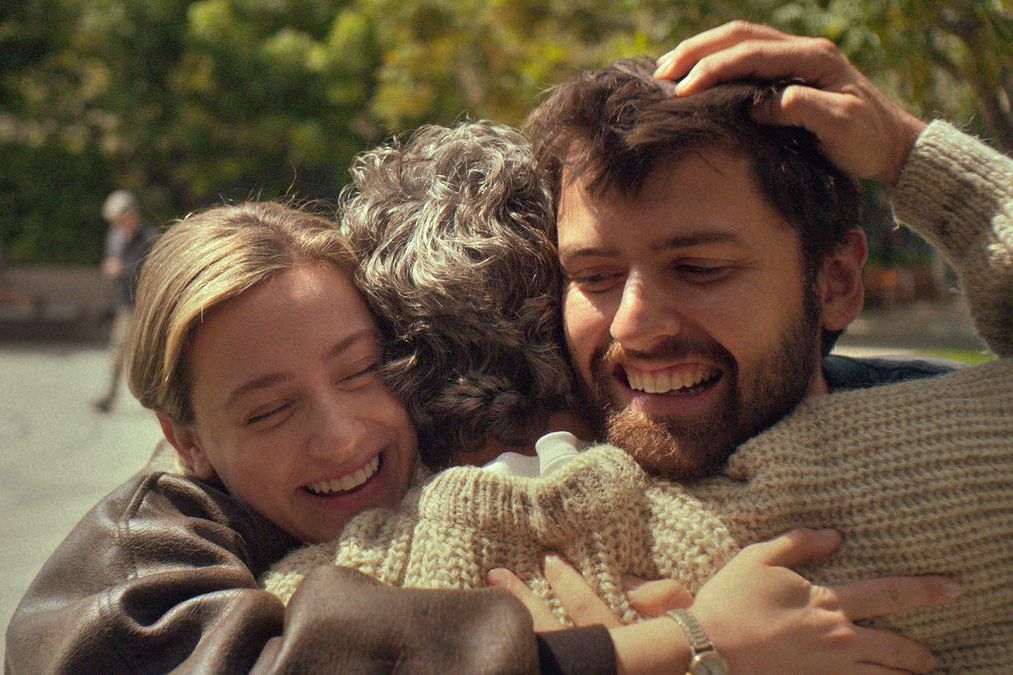
Mark Ruffalo plays a single father driving his daughters, Hal and Harper, home from school. It’s been five years since their mother died, and he’s starting to move past his grief and connect with his kids. In one scene, he awkwardly tries to engage them with questions he found online, like, “Who makes you happy at school?” Hal responds with honest confusion, while Harper silently rolls her eyes – a perfect snapshot of their dynamic. The scene highlights the father’s attempt to be strong for his children, and it’s both touching and funny to see him relying on a parenting worksheet for guidance. Interestingly, the roles of Hal and Harper are played by adult actors, Cooper Raiff and Lili Reinhart.
Raiff wrote and directed Hal & Harper, which started as a simple idea he explored in a web series during his college years. The series, featuring him and his then-girlfriend, focused on siblings reflecting on how their father’s actions forced them to mature quickly. He expanded this into a show that jumps between their childhood and adult lives, revealing the origins of their unhealthy, overly-reliant relationship. (Adult and childhood versions of Hal and Harper are played by Cooper Raiff and Madelyn Cline, with Cline sporting a beard for the younger scenes.) The show beautifully captures tender moments between characters who genuinely care for each other but struggle to express it, and features strong performances from Cline, Mark Ruffalo, and Betty Gilpin, who plays the father’s current pregnant partner, Kate. Raiff believes this kind of realistic, character-driven storytelling is lacking in today’s entertainment. He explains, “The goal of filmmaking is to show relatable people and experiences. It can be hard to confront ourselves, so it’s sometimes easier to see our own struggles reflected in a movie without realizing it.”
After his 2020 film Shithouse gained attention, Raiff began developing Hal & Harper for FX, but disagreements over the show’s direction led him to leave the network. They wanted to turn it into a typical college show and even suggested following the format of Greek, but Raiff was determined to stay true to his original vision. He secured funding from Lionsgate TV and, with the help of well-known actors, independently produced the entire eight-episode season. While Hal & Harper premiered at Sundance to positive reviews, streaming services weren’t interested in picking it up. Fortunately, Mubi, a smaller film platform, made a last-minute offer, saving the project. The first – and probably only – season concluded on November 30, eight years after Raiff first started writing it. He believes the experience proved that creating independent TV is incredibly difficult. While the show will eventually turn a profit, he admits the journey was extremely challenging.
You began working on this show in 2017, while you were in your second year of college. Since then, other shows have been released that some people might think inspired your work. A common comparison is to Pen15, which also uses adults to play children. When you see something similar appear after you’ve already started developing your own project, how do you react? I remember initially being annoyed when Pen15 came out, but then I watched it and really enjoyed it. However, it feels more like an SNL sketch – and I don’t mean that as a criticism. Both Pen15 and your show share the ability to be emotionally impactful even while being funny. But like an SNL sketch, Pen15 primarily aims to be comedic. The reason you used adults playing kids in your show is to highlight how quickly childhood can be lost. With Hal & Harper, it’s about capturing a sense of world-weariness, like a cynical third-grader smoking a cigarette. It comes from a place of genuine emotion, rather than simply trying to be funny.
I was watching Sharp Objects recently and realized it must have subconsciously influenced my work. The editing style—the quick cuts and flashes—really resonated with me. And the main character feels like a mix of my characters, Hal and Harper.
When deciding which memories to show, I focused on the year this family started to grow apart and become individuals. It was five years after their mother passed away, a time I call ‘the year their dad woke up.’ It was also when Hal and Harper began to rely on each other. I took some creative liberties with the flashbacks, using them to explore what should have happened rather than just what did happen. The finale gives them the resolution they needed, even if it didn’t happen exactly as it did in reality. It’s similar to EMDR therapy – we revisit the past to address what’s needed emotionally, not necessarily to recall the exact details of a memory.
How clear do you want to make your message to the audience? I prefer to keep things open to interpretation. My goal was to portray authentic people and tell a story that resonated with me, and I believe that honesty will naturally connect with viewers and encourage them to reflect on their own lives through the characters. Ultimately, I have to trust that approach will work.
A big part of the show’s success is the connection between our characters, and that really comes down to the chemistry between me and Lili Reinhart. We actually worked on building that connection by taking a trip to Mount Shasta to see a spiritual healer. It was a unique experience! I’ve tried healing methods before, but this was different – it didn’t involve any medication. The healer mostly used drumming, and you just close your eyes. She even burped a lot, but she was incredibly genuine. I specifically remember her telling me my dad was present, which unexpectedly made me burst into tears. It was surprisingly emotional and helpful. Interestingly, I didn’t experience this with Lili directly; it was a one-on-one session. We’d share our individual experiences with each other afterward, which is how we really bonded.
The show features many emotionally raw moments, with characters often breaking down in tears. As a director, I focus on creating the right environment for actors to access those feelings. Surprisingly, much of the crying wasn’t actually written into the script; it happened organically. While some key scenes, like the finale and a specific scene with Alyah Chanelle Scott, were scripted for tears, my approach is to let the actors fully commit and then ask what they need to get there if the initial takes don’t capture the emotion. Actors aren’t often asked what would help them, so it tends to be very effective. For Alyah’s scene, we moved on to the next location, but I asked the cinematographer to stay behind. With just her and the camera, she delivered a powerful performance in a single take. I avoid the typical, awkward setup of lining everyone up for an emotional scene. I believe actors are capable of these moments, but it’s crucial to create a comfortable and natural setting.
A common praise for your writing is how natural your dialogue feels, especially considering how difficult it can be to write realistic emotional scenes. People often struggle to express themselves clearly when they’re dealing with strong feelings. How do you strike that balance?
Honestly, it doesn’t feel like a challenge for me. I think it’s because I don’t have any preconceived notions about how people should talk. Writers often consume a lot of TV and film, but I don’t watch much, so I’m not trying to copy anyone. I just focus on the characters and write what feels true to them. I listen to their voices in my head and let that guide me. It’s actually frustrating to me how often scripts sound so artificial. The fact that I get complimented for writing characters who sound like real people says a lot about the state of movies and TV, and it honestly bothers me.
Were you trying to blame someone in particular? No, I won’t do that. But I often get feedback about the tone of my work – people say it’s both funny and serious. However, when I watch a really sad movie with no humor, I think, “The filmmakers haven’t met people who’ve actually lived through hard times.” Because people going through devastating experiences are often incredibly funny – you have to find the humor in it to cope! Life is messy, and sometimes the saddest things are also the funniest.
It reminds me of the scenes where the dad abandons his pregnant girlfriend to mope around in the house he’s selling. It seems sad – a man lying on the floor – but there’s a darkly comedic element to it. Mark and I discussed how it shows him acting like a child, almost punishing himself. It’s like he feels he has to lie on the floor as a consequence for his actions – he wasn’t there for his children, so now he’ll just stay put. But it’s also hilarious to see him eating McDonald’s and watching basketball while lying there for days. There’s a scene where his son, Hal, calls and asks him to apologize to Kate, and he just mumbles “Kate, sorry” into the air. Then Hal tells him to go to another room so Kate doesn’t overhear, and he awkwardly rubs the phone against his shirt. It’s a really funny and sad moment, but ultimately it feels incredibly real.
I’m most passionate about films that show relatable people and experiences, because I believe that’s the true purpose of storytelling – to help us understand ourselves. It can be difficult to be self-reflective, so movies offer a way to explore our own lives indirectly. I often find myself rewatching older films, but I really crave something that speaks to the present moment. We’re facing so many challenges right now, and I want to see stories that offer healing and address what we’re going through. While I appreciate classic films, especially from the 70s, they don’t quite resonate with my experiences today. I’m drawn to those films because they feel genuine and focus on humanity, and I often wonder if we have filmmakers like Hal Ashby working today.
Could a director like Hal Ashby get funding for a film today? Perhaps if a popular actor like Jacob Elordi signed on – I’m a big fan, and I’d love to have him in my movie!
Those in charge of money and business decisions seem completely out of touch. They’re always trying to jump on trends after they’ve already started. There’s been a lot of discussion about the state of movie theaters lately, but the real issue isn’t the theaters themselves – it’s the quality of the movies being shown. Are these films something people actually want to see, and do they connect with audiences on a meaningful level?
I recently watched Sentimental Value, and it’s instantly become my all-time favorite movie! I’m really passionate about finding and sharing films like this, especially because they feel so unique and hard to come by. I’ve loved five movies lately, and I hope they’re seen as examples of what great filmmaking can be, not just lucky exceptions. Palestine 36 was fantastic, and I highly recommend Manas – it’s truly amazing. I’m really looking forward to seeing Hamnet, and I have a feeling it will be incredible. It feels like we just need to keep making movies like these! It’s surprising that financiers don’t seem worried about taking risks, and I think Sentimental Value will prove to be financially successful. It was made on a reasonable budget and will likely be a talking point for months. The same goes for Hamnet and Train Dreams! People connect with authentic, emotional stories, and it’s important to support and champion those kinds of films. These movies will demonstrate that you can be both artistically fulfilled and financially successful by creating something truly great.
You know, I wasn’t at all surprised that Roofman didn’t do well in theaters. I’ve been thinking about it a lot, and it really highlights a problem I see with how films are made and marketed today. Derek Cianfrance is a brilliant director – his work, including Blue Valentine and the I Know This Much Is True series with Mark Ruffalo, really resonates with people. Seeing Blue Valentine and then Roofman feels like a clear illustration of how things have changed. It’s like people now expect Cianfrance to make movies only in a certain way, relying on a specific kind of marketing. I actually think Roofman is a fantastic film, and Channing Tatum gives an incredible performance. But we’ve gotten to the point where it feels impossible to release a movie like Blue Valentine – a raw, emotionally honest film – and sell it the same way. There are still filmmakers out there who want to make those kinds of movies – Roofman is that kind of movie – but they’re constantly battling expectations about what it has to be – you know, Channing Tatum in sunglasses running around, all that stuff. It’s just… strange.
You know, when we were at Sundance with ‘Hal & Harper,’ everyone was buzzing about whether it could pave the way for a new kind of independent TV. Now that it’s all settled, honestly, it didn’t go as planned. I wouldn’t call it a complete failure yet, but the experience really opened my eyes. Trying to sell the show, I got a behind-the-scenes look at how all these streaming services operate. It’s a weird system – a bunch of executives pushing their own ideas, and it’s really hard to break through. It’s different from independent film. With movies, streamers have scouts looking for that next great thing at festivals like Sundance. They’re actively searching for a vibe that fits their brand. But with independent TV? No one was doing that. There wasn’t a single person at Sundance actively looking to buy a TV show, which was a real surprise.
I didn’t go to Sundance to get noticed by streaming services. My goal was to prove there was an audience for our show. We created a press kit with positive reviews, hoping to convince a streamer that people would actually watch it if they picked it up. But even with that, they weren’t interested, which was incredibly disappointing and made me question my judgment. Luckily, Mubi was willing to take a chance. They’re flexible and don’t have a rigid format, which is exactly what we needed. We were fortunate that Mubi existed, because a few years ago, we’d likely have ended up releasing it on YouTube.
Mubi doesn’t publicly release how many people watch its films. However, they expanded the film’s availability to more countries after just a few weeks, which suggests it’s performing successfully for them.
We heard the series cost around $10 million to make, which seems amazing considering the large cast, the show’s quality, and the popular music used. How did you manage to pull it off? Actually, the total budget was closer to $6 million. It was incredibly challenging! We filmed a lot each day – about ten or eleven pages – and we had to shoot scenes from the first and last episodes back-to-back whenever we were at a specific location. It was really exhausting, but thankfully, Mark was a fantastic and understanding actor. He often checked in with me, asking where we were in the schedule, because jumping between the beginning and end of the series was confusing for everyone.
Music is a really important part of my films, and I always integrate it directly into the script. I’m lucky to work with an incredible music supervisor, Rob Lowry, who knows everyone in the industry. I’ve found that great music can really lift a film, even if it’s made on a small budget. For example, we started Cha Cha Real Smooth with a Lupe Fiasco song, “The Show Goes On,” even though people thought it was too expensive. We made cuts elsewhere to make it work, but it immediately signaled that the film felt bigger and helped everyone get on board. I used a similar approach with Hal & Harper, opening with “Please Please Please.” It’s a fantastic song that perfectly matched the mood of the opening montage. I wanted to use something recognizable to ground the audience, especially because the show starts with a pretty unusual scene – two adults talking about their dad leaving them at school. Using a familiar, impactful song helped to balance that out.
As a film and TV lover, I’ve been asked if the show was financially successful, and the answer is yes – it is profitable, and I truly believe it has the potential to be even more so. I’ve had filmmakers ask me if they should try making something similar independently, and honestly, my advice is to hold off. I think things are about to change. It just makes sense to me that the big streaming services will eventually realize they should be hiring people who already know how to create great independent television. Why pay a fortune for a pilot that might flop when you could buy a fully formed, proven concept for half the price? It’s a no-brainer from a business perspective, but someone needs to be the first to take the leap and set that precedent.
If the opportunity arose and everyone involved was on board, I’d definitely be open to making another season. I really enjoy the characters, and while I felt like I’d said goodbye to them, I could revisit them again.
Read More
- Off Campus Season 1 Soundtrack Guide
- Euphoria Season 3’s New R-Rated Sydney Sweeney Scene Proves The Show Is Trolling Us
- Gold Rate Forecast
- DoorDash responds after customer uses AI to make food look bad and get a refund
- Jon Bernthal Explains Why Marvel Let Him Make The Darkest Punisher Story Ever
- Olympian Says Heated Rivalry Tugged At His Heartstrings
- All Golden Ball Locations in Yakuza Kiwami 3 & Dark Ties
- Dutton Ranch Review: Paramount+’s New Western Takes All The Best Parts Of Yellowstone & Makes Them Better
- ETH Holders Cash In: Is the Party Over, or Just Getting Started?
- Oh My God, It’s Her?
2025-12-02 18:58