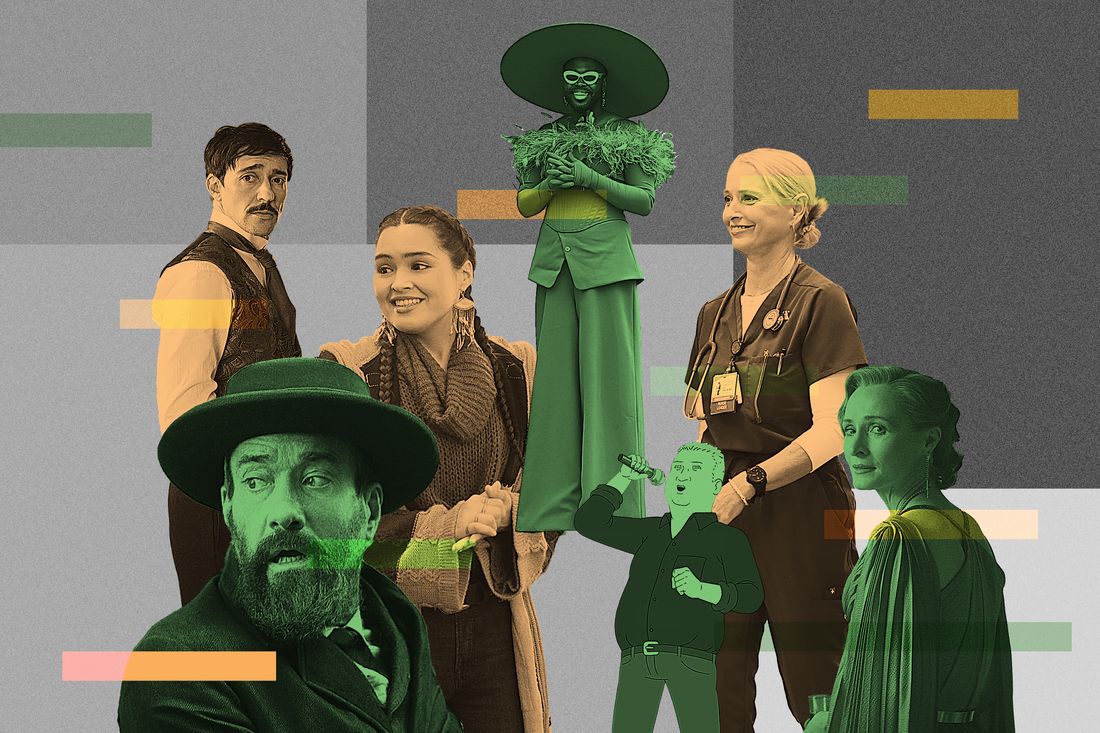
Television offers endless creative possibilities, and that means there are many ways for performers to truly shine. A talented actor can deliver a memorable performance in any type of show – from a serious drama to a reality competition, animated comedy, or variety show. The following 18 performances showcase just a fraction of this variety, spanning different genres, formats, and storytelling approaches. This selection includes both leading actors carrying entire series and supporting players who make a big impact with smaller roles, as well as rising stars and seasoned veterans. We’ve largely focused on less-discussed performances, though we couldn’t resist including a few widely celebrated ones. This list represents our personal favorites and isn’t meant to be exhaustive – and the fact that we had so many great options proves what a fantastic year it’s been for television. —Nicholas Quah
Pamela Adlon, King of the Hill
It always felt wonderfully unexpected to hear Pamela Adlon, with her distinctive New York voice, play Bobby Hill, a goofy kid growing up in Texas. That contrast is a key reason why her delivery of the line, “That’s my purse! I don’t know you!” became so famous. In the new King of the Hill revival, Adlon doesn’t drastically change Bobby’s voice – he still sounds like Bobby – but both the actress and the character have evolved. Now in her late 50s, Adlon brings a deeper, more mature warmth to the role, as Bobby, now in his early 20s, tackles adulthood with the same innocent enthusiasm he had as a child. What’s impressive is how skillfully Adlon balances the old and the new. Bobby still has the unique, slightly quirky rhythm that made him so memorable, but there’s a newfound gentleness and understanding beneath the surface. Adlon manages to make Bobby feel fresh and updated while staying true to the character we all loved.
Bob the Drag Queen, The Traitors
While The Traitors makes for captivating television, the gameplay itself can be surprisingly weak. The ‘Faithful’ players are supposed to identify the ‘Traitors,’ but they often rely on gut feelings since there’s little actual evidence. Success in the game often comes down to performance during roundtable discussions, and Bob the Drag Queen excelled at this in the show’s third season. Using humor and charisma, Bob quickly gained the trust of other players, including both Faithfuls like Gabby and fellow Traitor Danielle. However, when challenged by Dylan Efron and Boston Rob Mariano, Bob responded aggressively, even making outlandish claims and insults. Bob played to make a memorable impact, and though he was the first Traitor eliminated, he certainly left his mark. —Joe Reid
Farah Bsieso, Mo
Most discussions about the show Mo have centered on its creator and star, Mo Amer, since the series is based on his life. However, the final season truly highlighted Farah Bsieso’s performance as Mo’s mother, Yusra. Yusra is a complex character, torn between Palestinian traditions and her life as an American entrepreneur, wanting the best for her sons while struggling to understand their choices. Bsieso skillfully portrayed Yusra not as simply anxious, but as deeply compassionate—a belief in the value of life that allows her to accept Mo’s partner, connect with unexpected people, and grapple with difficult news from her homeland. According to Roxana Hadadi, Bsieso’s heartfelt performance resonated with many Middle Eastern viewers who saw their own mothers reflected in Yusra’s struggles and strength.
Babou Ceesay, Alien: Earth
Noah Hawley’s ambitious take on the Alien universe didn’t quite work for me, but the acting was often excellent, including a memorable performance by Samuel Blenkin. However, Babou Ceesay truly stands out as Morrow. He plays a high-ranking employee of Weyland-Yutani who is weary, haunted by his past, and consumed by self-doubt. Morrow is a more compelling character than the show’s other strange creations – adult bodies inhabited by children’s minds – and Ceesay’s performance is the reason why. He portrays Morrow as watchful, efficient, and deeply exhausted, making him surprisingly relatable as someone stuck in a dead-end job, desperately trying to maintain a sense of purpose. Despite being a ruthless and intimidating figure, Ceesay makes Morrow someone you can almost sympathize with, even understand.
Cliff Curtis, Chief of War
Cliff Curtis is one of those actors you recognize but can’t always place, and he finally gets a starring role he deserves in the Hawaiian epic Chief of War. He plays Keōua, a warrior prince and rival to Jason Momoa’s character, and is incredibly powerful on screen. Curtis portrays Keōua as a physically imposing figure who seems to thrive on conflict. The character is often shown against a dramatic, volcanic backdrop and is full of intense stares and angry expressions. In a particularly striking scene, Keōua violently punches himself in the face as an act of defiance, and later forces an enemy to do the same. Curtis brings a compelling mix of raw aggression and surprisingly human flaws like pettiness and jealousy to the role, making Keōua a truly memorable villain. —R.H.
Patti Harrison, Poker Face
It’s a shame that Poker Face is ending, at least for now, especially since it perfectly positioned Patti Harrison as a fantastic counterpart to Natasha Lyonne. The highlight of the second season was revealing that Harrison wasn’t just playing Alex, a quirky but kind New Yorker who becomes one of Charlie’s first real friends and discovers her lie-detecting ability. The finale then shocked viewers by revealing Harrison was also playing the Iguana, a legendary assassin who befriended Charlie to find a mob informant. Harrison brilliantly shifts from Alex’s energetic silliness to a powerful, commanding persona, making you wonder if Poker Face is playing another trick. The contrast between Harrison’s over-the-top energy and Lyonne’s more subdued anxieties was wonderful, and it’s disappointing we likely won’t see that chemistry again in future iterations of the show. Hopefully, Patti Harrison gets to play more villains soon!
Ethan Hawke, The Lowdown
Ethan Hawke delivers a captivating performance as Lee Raybon, a complex character who feels more like a song than a typical role. Hawke has a remarkable ability to fully embody diverse characters – from horror films like The Purge to historical dramas like The Good Lord Bird and the intimate Before trilogy – while maintaining a recognizable emotional core. Lee, much like Hawke’s character Jesse Wallace, is a man who deeply appreciates the world and its beauty, making it impossible to see him as a hardened cynic, even after facing hardship. However, Lee’s intense passion sometimes leads to unintended consequences. Hawke masterfully portrays this duality, allowing the audience to simultaneously love, pity, and even dislike Lee. Despite often appearing worn and weathered, Hawke’s charisma shines through, making Lee a truly compelling and unforgettable character. —N.Q.
Derek Hinkey, American Primeval
Like many modern westerns, American Primeval occasionally falls into familiar tropes about Native Americans, initially presenting Derek Hinkey’s character, Red Feather, as a stern and intimidating warrior. However, the Netflix series is surprisingly complex. It portrays the Mormon church as a harmful influence that encouraged violence and used negative stereotypes against Indigenous people. Within this context, Red Feather’s desire to remain separate from white society feels understandable, not simply romanticized. Hinkey delivers a nuanced performance, showing both Red Feather’s strength and his pain, and conveying the sense of a man watching his way of life disappear. While the show features strong performances from Shea Whigham, Irene Bedard, and Taylor Kitsch, Hinkey particularly stands out by avoiding clichés and creating a fully realized character.
Sabrina Impacciatore, The Paper
While the first season of The Office struggled because audiences found Michael Scott’s desperate need for attention hard to watch, The Paper’s first season falters by overcompensating in the opposite direction. The show starts by introducing a similarly outlandish boss, Esmeralda Grand, played by Sabrina Impacciatore, but quickly sidelines her in favor of the less interesting Ned Sampson, played by Domhnall Gleeson. It’s possible the writers didn’t anticipate how captivating Impacciatore’s performance would be—she’s unpredictable, emphasizing the wrong parts of words, making exaggerated facial expressions, and gesturing dramatically with every line. This makes the rest of the show’s humor feel surprisingly subdued, but the problem isn’t that Impacciatore should be less over-the-top; it’s that the rest of the cast doesn’t match her energy. —Hershal Pandya
Show Kasamatsu, The Narrow Road to the Deep North
Show Kasamatsu truly shines in his role as Major Nakamura in Justin Kurzel’s miniseries, a character vastly different from the cool gangster he played in Tokyo Vice. Where Sato was effortlessly stylish, Nakamura is a conflicted and ambitious officer immediately faced with an impossible task: forcing Australian prisoners of war to build a railway through the jungle for the Japanese emperor with little to no supplies. Kasamatsu brilliantly portrays Nakamura’s internal struggle – the character tries to motivate the POWs with talk of honor, but is clearly aware of the horrific conditions and the inevitable consequences of his actions. The performance is marked by a growing sense of desperation, conveyed through Kasamatsu’s tense demeanor and sharp delivery, culminating in a powerful breakdown that echoes the suffering of the prisoners. This role demonstrates Kasamatsu’s impressive range and highlights the destructive nature of rigid hierarchies, showing how they ultimately impact everyone involved.
Troy Kotsur, Black Rabbit
Jude Law and Jason Bateman are compelling in their roles as the Friedkin brothers in Black Rabbit, but whenever they share a scene with Troy Kotsur, he completely captivates the audience. Kotsur plays Joe Mancuso, a New York City loan shark, with an unforgettable presence. His eyes powerfully convey his disappointment, frustration, and weariness with his ambitious son, the Friedkin brothers who constantly test him, and the way New York City is changing, leaving people like him behind as gambling moves online. Even when the show uses effects to show a younger version of his character, Kotsur’s natural charisma and ability to portray a calculating mind still shine through. —R.H.
Anna Lambe, North of North
Shows that rely on a single actor need a truly captivating lead, especially with binge-watching becoming so common. If the performance doesn’t immediately grab viewers, the show risks getting lost in the vast world of streaming. Luckily, North of North features Anna Lambe, a talented Canadian Inuk actress. Her warm and relatable portrayal of Siaja draws you into the story of her growth and challenges. While there are echoes of shows like Parks and Recreation and Schitt’s Creek in Siaja’s decision to leave her unsatisfying marriage and pursue a new career, Lambe’s performance is uniquely charming, and the series’ focus on Indigenous culture gives it its own distinct identity. Lambe perfectly balances optimism with realism; her bright smile feels both genuine and protective, as Siaja navigates a traditional culture that expects her to be only a wife. The conflict between wanting the best for Siaja and the resistance she faces from her community is central to the show’s appeal, and Lambe’s strong performance is what holds it all together. —R.H.
Katherine LaNasa, The Pitt
What makes The Pitt so effective is its consistently skillful and compassionate approach, even when it’s fast-paced and chaotic. While Noah Wyle and the supporting cast of doctors often take center stage, the show relies on a solid foundation, and that foundation is Katherine LaNasa as Nurse Dana Evans. Dana is frequently at the heart of the action, both physically and in terms of the story, guiding everything that happens around her. She’s the central point where storylines converge and develop. LaNasa’s performance consistently anchors the show’s emotional tone. She portrays a character who is practical, calm under pressure, and just slightly cynical, effectively holding all the different elements together. —Kathryn VanArendonk
Gabriel Luna, Devil in Disguise: John Wayne Gacy
Michael Chernus delivers a chillingly convincing performance as John Wayne Gacy in Devil in Disguise, perfectly capturing Gacy’s talent for deception. This makes Gabriel Luna’s portrayal of detective Rafael Tovar all the more impressive. Tovar is the first to suspect something is off about Gacy, and Luna skillfully shows the character becoming increasingly consumed by the case. He conveys this primarily through physical acting—his body language subtly shifts as he investigates, becoming more tense and conveying his growing obsession. We see it in the way he hunches over while searching under Gacy’s floorboards, the tightness in his posture while driving Gacy to court, and his forceful stride after Gacy’s execution. While it’s hard to say how accurate Luna’s performance is compared to the real Tovar, who isn’t a major focus in the series’ archival footage, it doesn’t matter. Luna brilliantly portrays Tovar’s growing disgust and exhaustion, offering a powerful perspective on the Gacy story that complements Chernus’s captivating performance.
Matthew Macfadyen, Death by Lightning
It’s usually hard to root for supporting characters. Stories typically focus on heroes and villains, leaving others to simply move the plot forward. However, Matthew Macfadyen has a remarkable talent for portraying flawed individuals and making them compelling protagonists. His performance as Charles Guiteau in Death by Lightning completely transcends any simple label of “presidential assassin.” He’s a complex character – ambitious, cruel, and calculating, yet also naive, unable to grasp the impact of his actions, and surprisingly hopeful. While Michael Shannon delivers a dignified performance as James Garfield and Betty Gilpin provides a grounded and perceptive presence, Macfadyen’s portrayal of Guiteau as a frightening, tragic, and surprisingly understandable figure is truly exceptional. —K.V.A.
Wendi McLendon-Covey, St. Denis Medical
I’ve been a fan of Wendi McLendon-Covey ever since she started popping up in sitcoms back in 2003 – from her regular role on Reno 911! to becoming a beloved part of The Goldbergs, she’s always been hilarious. But her role as Joyce, the wonderfully stressed-out director in St. Denis Medical, really showcases everything she’s learned over the years. She’s just a master of comedy! She can be wildly over-the-top one moment and then deliver a perfectly timed, deadpan line the next. It’s amazing how she can convey both insecurity and cluelessness with just a look, and her physical comedy is flawlessly done. Honestly, and the show is full of fantastic actors like David Alan Grier and Mekki Leeper, Wendi McLendon-Covey truly shines – it’s clear how much skill and experience she brings to the part.
Genevieve O’Reilly, Andor
It’s truly disappointing that Emmy voters didn’t recognize any of the incredible actors from Andor in the main acting categories. Diego Luna, Stellan Skarsgård, and Elizabeth Dulau all deserved nominations, but the biggest snub was Genevieve O’Reilly. While the first season focused on Cassian Andor’s transformation, the second season truly belonged to O’Reilly as Senator Mon Mothma. She brilliantly portrayed Mothma’s growing frustration with the Senate’s inaction and the Empire’s oppressive rule. O’Reilly takes Mothma from a poised and determined politician to someone disgusted by the corruption around her. Her powerful speech about the Ghorman genocide perfectly captures the show’s unflinching look at morality and showcases O’Reilly’s exceptional talent. She masterfully portrayed Mothma as a complex woman constantly striving to uphold the ideals of democracy, making her one of the most compelling characters on television. —R.H.
Edi Patterson, The Righteous Gemstones
Despite its cancellation, The Righteous Gemstones managed to end on a relatively satisfying note. It’s a shame Emmy voters won’t have another opportunity to acknowledge Edi Patterson’s brilliant performance as Judy Gemstone. In the show’s final season, Patterson continued to showcase her exceptional comedic talent, brilliantly portraying Judy’s anger through a feud with a support animal and her inappropriate desires in a clumsy blackmail attempt. One memorable scene features her exclaiming, “Miss Lori, quit!” while weakly struggling against her father’s new girlfriend, followed by a shocking, “Quit raping me!” Patterson is a rare talent, seamlessly blending broad physical comedy with nuanced emotional depth within the same scene, and her work on Gemstones proved that. —H.P.
Blake Ritson, The Gilded Age
One of the great things about The Gilded Age is how well it works despite the actors all approaching their roles with very different styles. Louisa Jacobson plays her part realistically, while Morgan Spector leans into the over-the-top aspects of the era. Blake Ritson delivers a wonderfully dramatic performance, and Oscar Van Rhijn, with his villainous mustache and way of speaking, seems like he’s up to no good – though the show avoids making him a simple villain. He’s a complex character, a somewhat pathetic heir struggling with the loss of his mother’s fortune. Ritson portrays Oscar as a man constantly holding himself back, his eyes revealing a mix of longing, fear, and self-disgust. This tension reaches a peak when the show throws a particularly strange plot twist at him: his lover is suddenly and unexpectedly struck by a carriage. The scene is both shocking and bizarre, but Ritson manages to ground Oscar in genuine grief, almost making you forget how outlandish the situation is. —N.Q.
Rhea Seehorn, Pluribus
Rhea Seehorn delivers a captivating performance as Carol, a fiercely independent and deeply unhappy woman who appears to be one of the last truly free individuals on Earth. She essentially carries the entire weight of Vince Gilligan’s unique new series, and does so effortlessly. While the show features exciting moments – like navigating the quiet apocalypse or reclaiming a grocery store as a defiant act – it’s the subtle details of Seehorn’s performance that truly shine. She masterfully conveys Carol’s constant sorrow through small expressions – a sharp glance, a tense lip, a hint of desperation – making her internal state remarkably clear to the audience. Pluribus explores complex themes, and without Seehorn’s ability to communicate so much through her face and body language, the show wouldn’t succeed. —N.Q.
Tramell Tillman, Severance
Tramell Tillman’s portrayal of Mr. Milchick in the second season of Severance is a standout performance, uniquely blending sadness and comedy. While other characters grapple with the show’s central mysteries, Milchick’s story feels separate, exploring his own path within Lumon’s bizarre world. Unlike the often-flawed characters against the show’s stark setting, Tillman presents Milchick as both a strict enforcer and a victim of Lumon’s dehumanizing practices. Though the image of him leading the marching band in the finale is iconic, his most compelling moments come from a smaller storyline where his fascination with unusual words connects to his thoughts on how Lumon portrays race. His expressions during these scenes—filled with anger and self-blame—make Milchick the most intriguing and complex character in Severance. —K.V.A.
Read More
- Netflix’s Little House On The Prairie Reboot: Release Date, Cast & Everything We Know
- Off Campus Season 1 Soundtrack Guide
- Silver Rate Forecast
- Prime Video’s New R-Rated Spy Thriller Is Officially No.1 On Streaming Despite Poor Reviews
- Brent Oil Forecast
- Gold Rate Forecast
- EUR ZAR PREDICTION
- YouTuber arrested after viral AI bodycam videos spark real police complaints
- 币安人生 PREDICTION. 币安人生 cryptocurrency
- Bulgakov’s Take: Koreans Bet the Farm on Chips, Crypto, and Chaos
2025-12-01 19:59