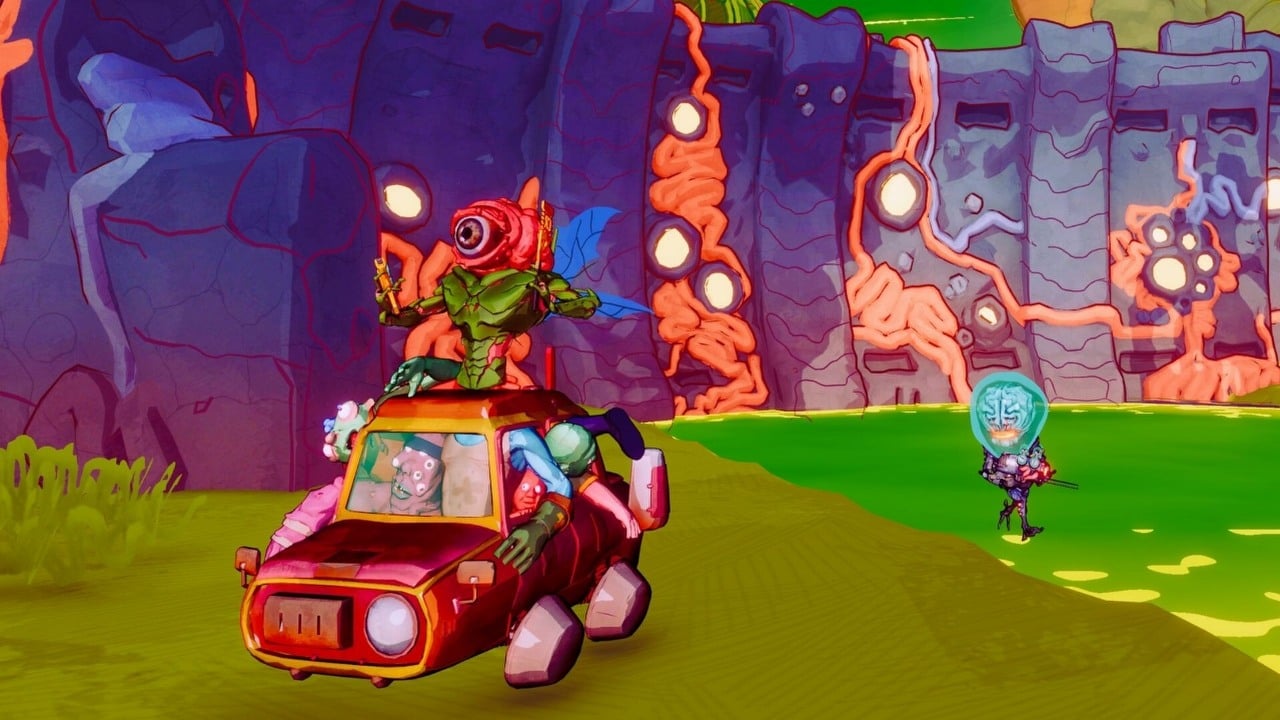
I recently got to try out a demo of SWAPMEAT, a wild third-person shooter roguelike. It’s a chaotic game for up to four players where you swap body parts with the enemies you defeat – and it’s as crazy and messy as that sounds, but surprisingly enjoyable! Since I played the demo, SWAPMEAT has officially launched in Early Access on Steam, meaning you can play it now. There’s also a free demo available if you want to try before you buy.
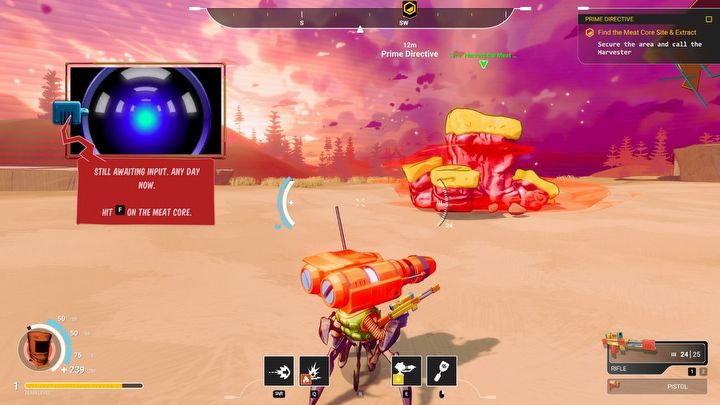
As soon as I started the demo, I was thrown right into the thick of it! Seriously, I had a gun in one hand and a spatula in the other – it was wild! Before I could even figure out what was going on or what I was supposed to do, I was blasting spiders, and then things got really strange when I suddenly had eight legs instead of two! It didn’t take me long to understand what the game was all about, though – the idea clicked instantly.
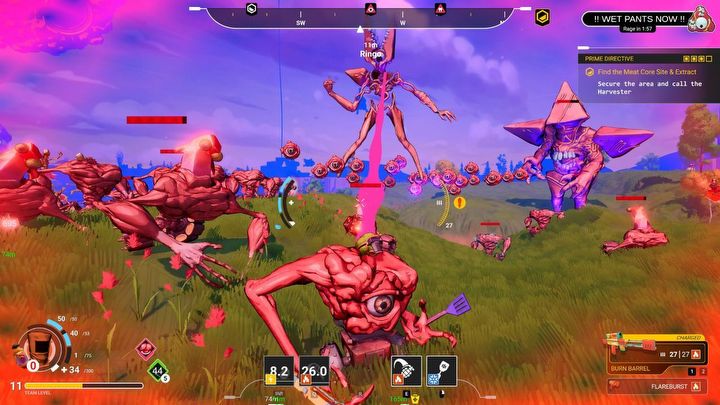
Even in the short demo, I experimented with tons of different body parts, and the game had plenty to offer. I discovered a head that let me spit acid, legs that were replaced with wheels for super-fast movement, and all sorts of other crazy combinations. Swapmeat feels similar to Risk of Rain 2, but with a delightfully grotesque twist.
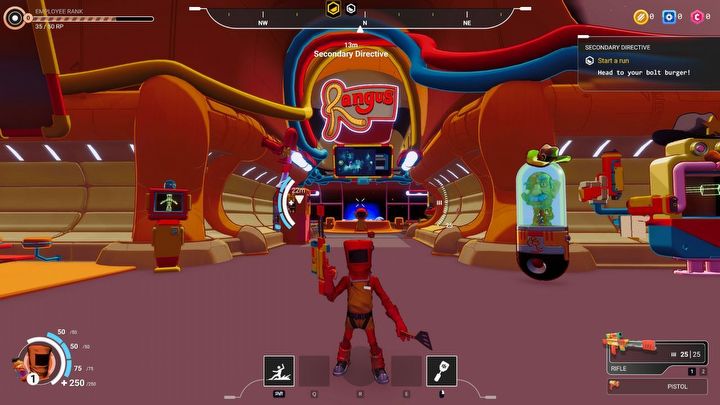
After trying out the demo, I spoke with Jamie Stormbreaker, co-founder of One More Game, the developers of Swapmeat. We discussed the story behind the studio’s name and how it influences their approach to game development. I was particularly interested in learning about the origins of the game’s unique mechanic, and Jamie was happy to explain it.
My interview with Jamie Stormbreaker, the co-founder of One More Game, developers of Swap Meat
Matt Buckley from Gamepressure: Hi Jamie, it’s a pleasure to meet you. Thanks for making time to chat.
Jamie Stormbreaker, One More Game: Great to meet you, too.
MB: How has your convention experience been so far?
We’ve been using the show as more than just a way to display the game – it’s been like a live playtest. We watch people play every night, and then use what we learn to update the game. I often work until 1 a.m. making those changes.
That’s a good starting point. Can you tell me about things players have been doing that have impacted the game?
We showcased the game at Gamescom and noticed players found it challenging, but not in a straightforward way. Individual enemies weren’t very difficult – we designed it that way – but the combination of enemies proved to be a problem. We realized that how the game felt to us as developers was different from the experience of new players.
I’ve been following this game’s development for a year and a half now, and it’s been amazing to see how much it’s grown! The developers have been really open, letting us playtest new versions every couple of months. They roll out an update, then open it up for us to try, and give us a chance to give them feedback. It’s a really cool process to be a part of!
For gamescom, we made several improvements based on feedback from our last public playtest. Seeing players experience these changes on the show floor for the first time was great. We took detailed notes and fixed issues with things like movement being slowed down, large groups of enemies overwhelming players, and players feeling stuck or bogged down. By Friday, we were happy to hear that those problems had been resolved.
MB: Okay.
We really enjoyed the new challenges we created! They were our favorites, actually. The idea behind letting people explore the game at events is to test how easily players can figure things out on their own – we’re deliberately not offering a tutorial to see if the game feels natural and intuitive.
Players would start the game, get their bearings, and immediately notice a green marker pointing to the health station. About one in eight would head straight for it. I realized this was a problem and needed to be addressed. Then I quickly realized I was overthinking it – the marker itself wasn’t the issue, it just needed to be placed on the correct location.
We shifted our focus to the main priorities – the tasks we needed to tackle next. Once we knew which one to address, we went ahead and did it. The following day, we updated the equipment on the show floor. I monitored it for about an hour, and it turned out the issue was resolved. It’s great that we finally fixed this, especially since it had been ongoing for about a year.
MB: It’s funny how the little things can make such a big difference.
It’s funny, you’re really good at what you do, but also make some big mistakes. Honestly, game design and development are all about understanding what makes people tick, and that’s a really good thing.
MB: So, there’s already been a few public playtests?
Yes, that last one is the seventh test. We’ve kept everything open – all our tests are public, with no non-disclosure agreements. You’re free to stream them, make videos, or do anything you want with the footage. The earlier tests weren’t as fully developed, though.
At One More Game, we value your time, both as someone who plays our games and someone considering trying them. While we can’t promise you’ll love the game, we can promise it will be functional. When you test a One More Game title, you can expect it to work, and if it doesn’t, we’ll address the issue immediately. We’re committed to improving the game throughout the testing period, with updates released daily.
We use automation to quickly identify and resolve crashes. As soon as we detect an issue, we fix it and then release an update, depending on how serious the problem is.
The game will eventually be enjoyable, but getting feedback from players early on is crucial, especially for a unique game like Swapmeat. Because it features a gameplay mechanic unlike anything else, player input is especially valuable during development.
MB: Right, yeah. It’s very unique.
We spent a lot of time figuring out how the body parts would work. We had to decide how often players could swap them, what each part should be – like whether to include legs, a torso, and a head – and what abilities could be attached to them. We also needed rules for those abilities. For example, we decided legs would always be related to movement, but not just a simple dash. Some legs, like the ‘Squat Daddy’ legs, would let you jump high and slam down, similar to a wrestler’s move.
MB: Wow. Squat Daddy. [laughter]
JS: Yeah. We think we’re funny. We think we’re very funny.
MB: Video games are such a great place for humor. But I didn’t mean to interrupt.
Sometimes when attacking, especially with the body, it doesn’t need to directly target an enemy – it’s like a self-cast ability, similar to how it works in World of Warcraft. Attacks aimed at the head, however, generally do require precise targeting.
We aimed for controls that felt natural and similar to those in popular hero shooter games, but without letting the unique gameplay get in the way. We considered how different body parts would interact – what happens when you combine certain legs with a specific torso? Unlike RPGs, we don’t have traditional set bonuses, but certain ability combinations work particularly well together. Many of these effective combinations involve movement abilities paired with different torso types – for example, you can even fly in the game, though you might not have discovered that yet.
I once came across a body with wings, but I never got around to testing if they allowed me to fly.
Okay, so here’s something really cool about working with players: they find problems, and that helps us improve the game – either by fixing bugs or adding new features. Early on, we made it easy to get parts like spider legs and wasp bodies. We spent over a year trying to figure out how to implement flight, but we didn’t want it to be as simple as pressing a button. We were inspired by the Super Mario World Cape and wanted players to earn the ability to fly through skill and mastery, just like getting that iconic raccoon tail.
We initially discovered a bug with the “spider legs” that allowed players to travel extremely far when jumping and dashing in the air. We fixed this, but instead of removing it, we turned it into a controllable feature. Another issue was with the “Wasp torso” and its wings – using it in the air also caused extended jumps. Both the spider legs and wasp torso granted an extra jump, giving players a total of four, and also reduced the cooldown times for abilities. Ultimately, we enabled true flight by allowing certain torsos, like the wasp, to reset a player’s jump count. This means you can jump, dash, use all your jumps, then activate the wasp torso to reset them and continue flying.

MB: Ok. That’s really fun.
As a fan, I totally get what they’re saying about big co-op games! It’s awesome when things are just over-the-top powerful. Honestly, when you’re playing with friends, who cares about balance? It’s way more fun when things are a little broken and you can just wreak havoc. They’re right – nobody wants a game where someone’s always trying to nerf the fun!
I’m really glad this game focuses on PvE! Honestly, as I’ve gotten older and busier, I’m just not as into the competitive PvP scene anymore. It takes so much time and dedication to really get good, and I don’t always have that. I was curious – was the decision to go with a purely PvE experience a deliberate design choice? Did you guys consider other options, like adding PvP, or was it always planned this way?
We made the decision about this project very early on. This is actually our second attempt at a title; we began prototyping two years ago and continued developing prototypes throughout the summer of 2023. Our main goal with these prototypes was to create a game with seamless cooperative play – supporting one to four players. We wanted players to be able to switch between single-player and multiplayer without any interruption or need to choose a mode. We also knew we wanted to make a shooter, and weren’t concerned with whether it was first or third-person. Ultimately, we felt we could create something special within the roguelike genre.
Let’s talk about cooperative gameplay. We’re aiming for a really smooth, seamless experience. Our team has a strong background in this area – we’ve all worked on popular online games like Guild Wars, Guild Wars 2, and League of Legends. In fact, my business partner, Patrick Wyatt, was one of the very first employees at Blizzard and even roomed with Mike Morhaim. He was a key designer and programmer on classics like StarCraft, Warcraft, and Diablo, and later founded ArenaNet, the company behind Guild Wars. So, we have a lot of experience building successful competitive online games.
We made this decision because, particularly after the COVID-19 pandemic, players really started prioritizing playing games with their friends. They enjoyed it and realized the benefits of cooperative gameplay. So, we shifted away from focusing on competitive games and instead concentrated on making it easy for players to team up and play together. This approach simplifies a lot of things – we don’t have to worry about complex in-game economies or balancing issues that come with player-versus-player combat or even ability balancing.
MB: You can make them broken.
As a fan, I love that the developers aren’t making every body part equally powerful! They’ve said they want some parts to feel weaker or less useful in certain situations. It’s all about context – like, if you find the squid legs, you’re incredibly fast in water, but they won’t be as helpful on land. It makes things way more interesting than just having everything be perfectly balanced all the time.
The company, One More Game, is named after that feeling you get when you’re having fun with friends – it’s late, like 1 AM on a Friday night, and everyone wants to play ‘just one more game.’ We designed our games to capture that feeling and to be enjoyable for all types of players, whether they’re skilled or new to shooters. We want everyone in the group to have a good time and for the game to be a great excuse to hang out with friends.
I grew up playing massively multiplayer online games, and EverQuest was the game that inspired me to become a game developer. One thing that always frustrated me in MMOs was level restrictions – not being able to play with friends who weren’t at the same level. That’s why we wanted to create a game where anyone can join in and play together, regardless of their skill level. Imagine seeing a friend online in Discord and instantly being able to jump into their game. We’ve built a system that dynamically adjusts the difficulty based on how many players are involved – more players mean a tougher challenge, fewer players make it easier. Our boss battles are inspired by raids in games like World of Warcraft and Final Fantasy XIV, but we’ve designed them to be fun and engaging whether you’re playing solo or with a group of four. Everything scales to ensure a good experience no matter how many people are playing.
And then, you know, there’s a campaign in the game with a narrative.
That was actually my next question. It can be tricky to tell a strong story in a roguelike game, but some, like Hades, have done it really well.
We were heavily inspired by the game Hades. We really wanted to create a strong narrative experience, and honestly, this game is over-the-top! We felt it was crucial to share a really engaging and wild story with players. Because of the game’s drop-in/drop-out nature, the story doesn’t have to progress linearly. Even if you join a game where someone is further along in the story, anything you accomplish together will be saved to your own game file. It’s similar to how quests worked in Diablo 2 – you have a quest log and can tackle things in any order. For example, you might encounter a situation where ‘the minions of Hell have gotten stronger,’ and that becomes part of your ongoing story. Making this system actually work was a significant challenge.
That’s fantastic! I really enjoy roguelike games. It’s amazing how they can still tell a compelling story even with all the restarts and repeated playthroughs. So, I’m curious – what sparked the idea for the body-part swapping mechanic? It’s a really original concept.
When I explain the initial concept for a project, it’s usually very basic, appealing to a small group. We start by figuring out what makes it special – what’s the core idea we can quickly explain to someone? Imagine you’re at a bar or the gym and have just 60 seconds to describe this unique game – what would you say? That’s what defines our ‘hook.’ Our director, Jason Stone, had a prototype inspired by the game Contra, where you could take parts from enemies to gain new abilities. We thought that was exactly the kind of thing that would work. But then we had to figure out how that would actually look and feel in a 3D environment, so we started building prototypes. We already had a base game and began adding these mechanics on top of it. From the beginning, the focus was on visualization – ‘What does this look like?’ – and then answering the questions that arose. Importantly, we’ve been careful to ensure this isn’t just a flashy feature, but a core part of the gameplay, and I think we’ve succeeded.
MB: Having just played it for 20 minutes, I think so. It’s very fluid and it’s very fun.
Thanks! That initial idea sparked everything. The game’s name actually reflects the core gameplay mechanic, which fits the comedic tone we’re going for. We wanted players to immediately get a sense that this game is going to be weird and unpredictable. We drew a lot of inspiration from shows like Rick and Morty, Invader Zim, the Adult Swim programming of the 2000s, and Tim and Eric. That’s really where the whole concept came from.
People are curious about the level of detail in the game – specifically, how many distinct body parts or combinations of parts there are. Do you happen to know that number?
So, I was asking about how many different ability and body part combinations there are, and apparently they have about 12 of each right now. That’s not the final number, they’re always adding more! It’s cool because that means there are potentially a ton of different builds you can make – 12 to the power of 3, actually! They don’t really plan everything out in advance, though. What they try to do is create each ability and body part so it feels awesome and useful, something that makes you go, ‘Ooh, what does that do?’ Then, when players start using it and find something really powerful, they don’t usually nerf it. Instead, they just make other things even better to balance it out, which I think is a really smart approach!
MB: That’s the beauty of the PvE.
JS: Exactly.
MB mentioned they’d previously discussed the overall story and asked if I could quickly summarize what it’s about.
Okay, so the game starts with your character being ‘born’ from a meat-growing mold – think something like the character Meatwad from Aqua Teen Hunger Force, but you’re a biological creation. You begin as a worker for a company called Rangus Meat Co., and you’re on a spaceship traveling through space. The CEO, Carl Rangus, has a goal for the company: to expand throughout the galaxy. As you play, you’ll uncover the purpose of your existence and the company’s true motives.
The game starts with you arriving on a planet. Your mission is to remove its core – which, naturally, is made of meat! It’s a well-known fact in this universe, just basic meat science. Each planet has a meaty core, and extracting it lets you progress. You’ll use the core to locate and defeat the first boss, unlocking either the path or the fuel needed to travel to the next planet.
As you play, you’ll encounter characters and gradually discover the story behind everything. Much of it is strange and doesn’t have a clear explanation, but those are the core ideas.
MB: Cool. And then there were maybe like two or three planets in the demo, or was it just two?
In the game, there are two solar systems to choose from, and each one represents a single playthrough or ‘run’. Each solar system contains three planets, followed by a boss planet. Each planet has three objectives to complete, culminating in a final objective. While the campaign missions are generally fixed, there’s also randomization involved. We developed the randomization technology early on, and we want to ensure both the structured campaign and the randomized elements are working well. We’re focusing on testing the campaign first because it’s easier to manage and control compared to letting players experience everything randomly.
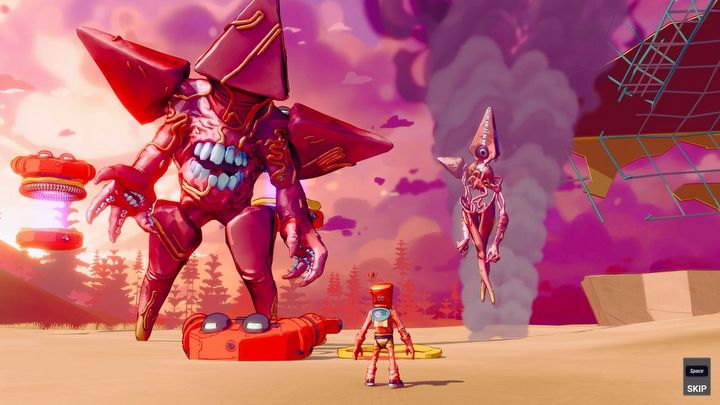
There are actually two main bosses in the game. The first is Franken Beans – a huge, four-legged monster that looks like a hot dog! The second part of the game introduces mutants, and their boss battle is a wrestling match, like something you’d see in WWE. You’ll fight a tag team called the Pounding Fathers inside a destroyed Capitol Building – it’s a bit like the movie Idiocracy, they really made a mess of things.
Each boss fight features unique challenges that make use of the game’s swapping ability. We really focused on how this ability could be integrated into a raid setting, and we’ve designed each boss with one or two specific mechanics that players will need to master. It’s been a really enjoyable design process.

MB: Any plans to come to consoles or anything like that?
We want this product to be widely accessible, meaning it should appeal to as many people as possible and work on the devices they already use. That’s why we made it compatible with Mac OS – I’m familiar with Mac programming.
MB: Yeah, that is great. It’s not often you can play a game like this on a Mac.
There are definitely a lot of us who feel this way, right? We try to make the game accessible to everyone for a reason. It’s frustrating when I’m limited in how I can play – if I prefer a controller, I should be able to use one.
Right now, we’re really focused on PC and Mac. It’s just way faster for us to make changes and test things out – a new version takes about 30 minutes to build, which is awesome! We’ve been getting asked a lot about consoles, and honestly, I don’t have any announcements to make about them just yet. But don’t think we haven’t considered it – we’ve definitely been preparing for the possibility of bringing the game to consoles if we decide to go that route. There’s nothing technically stopping us, really.
MB: Well, that wraps up most of what I have to ask. So, we can leave it there.
JS: Yeah, Matt, thank you very much for. Thanks for coming by and checking out the demo.
Thanks for having me, it was really nice meeting you and I had a lot of fun! I’m excited to play the full game. If people want to support Swapmeat, what’s the best way to do that?
Honestly, the best thing people can do to support us is add our game to their wishlist. It really makes a huge difference, especially with so many remakes, sequels, and updated versions of old games out there. A lot of people don’t realize how important wishlists are for developers like us.
Read More
- Netflix’s Little House On The Prairie Reboot: Release Date, Cast & Everything We Know
- Off Campus Season 1 Soundtrack Guide
- Infinity Nikki Candlelight Reverie Challenge and Rewards Guide
- Silver Rate Forecast
- Brent Oil Forecast
- Prime Video’s New R-Rated Spy Thriller Is Officially No.1 On Streaming Despite Poor Reviews
- Gold Rate Forecast
- Bulgakov’s Take: Koreans Bet the Farm on Chips, Crypto, and Chaos
- EUR ZAR PREDICTION
- Dua Lipa and Callum Turner Had a Town Hall Wedding
2025-12-01 12:09