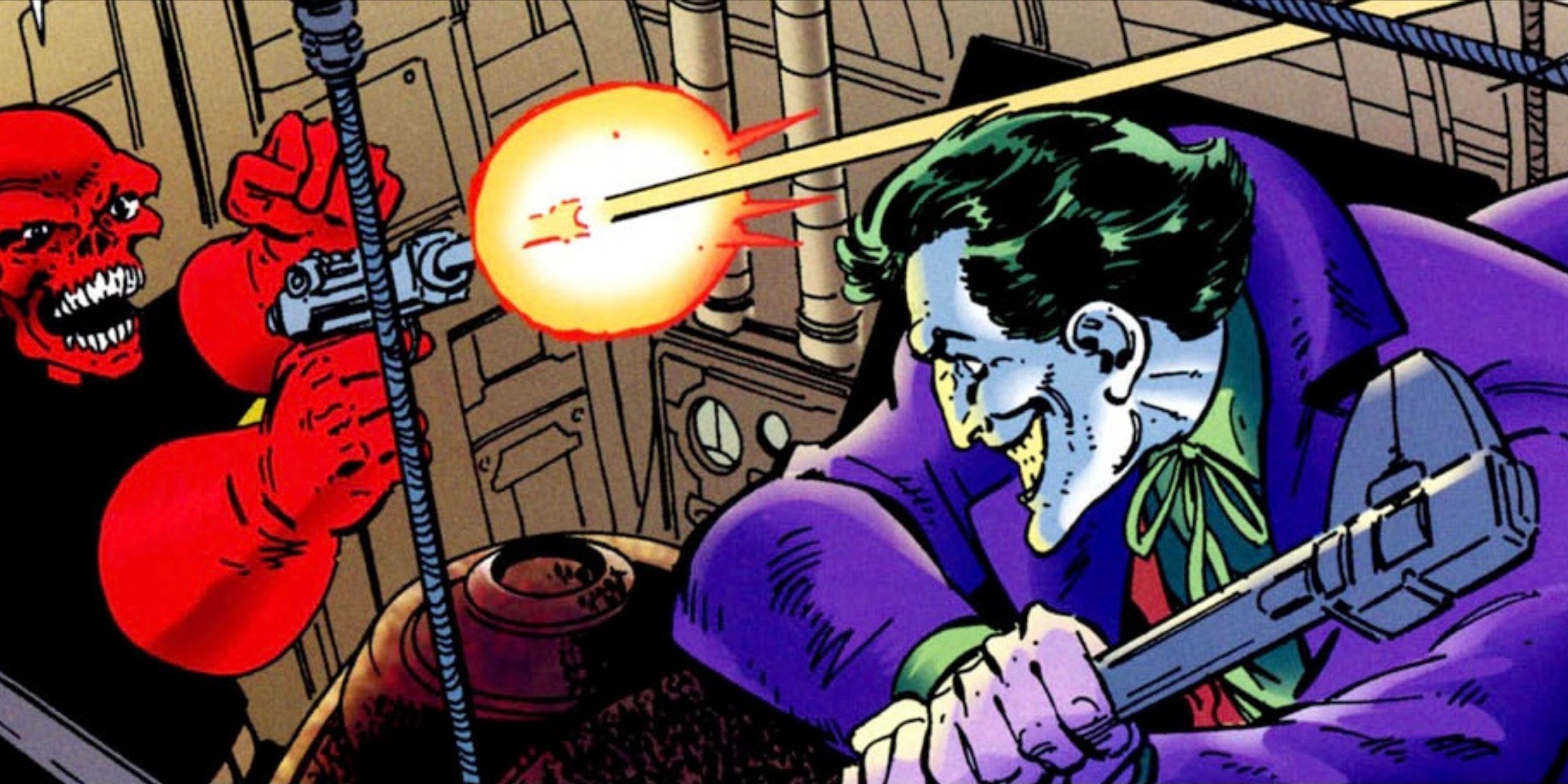
First appearing in Batman #1, created by Bob Kane and Bill Finger, the Joker has become known as the most unpredictable villain in DC Comics over the last eighty years. As Batman’s greatest enemy, also known as the Clown Prince of Crime, the Joker’s enduring popularity stems from the ambiguity surrounding his past and his complete lack of moral boundaries. While a line was seemingly crossed in a 1996 story, fans have been arguing about whether it truly represented his ultimate evil act for the past thirty years.
The Joker, a notorious villain from Gotham City’s comic books, is responsible for a staggering number of deaths. Over the past eighty-six years, he’s committed acts ranging from mass poisoning to all-out war against Batman and his allies. Attempts by writers to give him sympathetic traits often spark debate among fans.
Batman/Captain America Challenged Joker’s Patriotism
In 1996, John Byrne created the comic book Batman/Captain America. The story begins with Captain America and Bucky Barnes flying home to America after fighting in Europe during World War II. Before they can land, they learn a plane has been hijacked, and Batman arrives to help. Together, they save Robert Oppenheimer from danger and discover that The Joker and Red Skull are working together to undermine both heroes.
The story reaches its peak when the Joker discovers Red Skull is a true Nazi, not just a strange criminal. Outraged, the Joker famously declares his loyalty to America, despite being a criminal himself. He and Red Skull then try to kill each other using their trademark poisons. Filled with patriotic fury, the Joker attempts to disrupt Germany’s war efforts while Batman and Captain America pursue them in a plane. During a fight in the plane’s weapons compartment, they accidentally open the bomb bay doors and plummet to their deaths in a nuclear explosion over the ocean.
As a longtime comics fan, it’s impossible to avoid that panel of The Joker punching Hitler – it’s become a real symbol of the ’90s and how comics have always been against fascism, going all the way back to Captain America’s beginnings. But honestly, the more I see it shared as this powerful statement, the more I wonder if it actually makes sense when you think about the characters involved. It’s a cool image, but does it really fit how these villains would act?
Why Readers Are Still Skeptical About Joker’s Moral Dilemma
Joker’s unexpected turn against Red Skull was a popular moment for many comic fans in the ’90s, but it also sparked debate. While everyone agrees Joker rightfully despises Nazis, some questioned the logic of his actions and whether it felt genuine. Red Skull even pointed out the hypocrisy, suggesting Joker would have fit right in with the Nazi regime – a comparison the villain didn’t like. The irony is that Joker had no problem teaming up with someone looking like a Nazi, but drew the line when he discovered Red Skull was an actual member of Hitler’s party.
Okay, so the idea of the Joker teaming up with Nazis kind of makes sense – he’s all about chaos, and a super-strict, controlled Nazi regime wouldn’t fly with that. He’d probably be one of the first they’d try to get rid of! But honestly, the way the story tries to paint him as having some sort of moral reason, like he’s doing it for his country, always felt really weak. It just doesn’t add up – this guy commits a massive, brutal attack and then wants a pat on the back for being a “patriotic” killer? It feels totally forced.
While it’s an interesting creative decision, trying to portray a villain as secretly good feels like rewriting history. When fans really love a villain, they often look for any excuse to believe the character has changed for the better, even if it doesn’t quite fit the story.
Ultimately, The Joker’s change of heart feels unearned. He didn’t object to the massive casualties Red Skull intended, and willingly participated in the plan until a specific ideology came into play. While his betrayal of the Nazis was dramatic and even admirable, the trend of villains becoming heroes has made this moment less impactful for many fans. It’s not that the decision itself is bad, but that repeatedly giving even the most ruthless villains heroic motives diminishes the meaning of true evil in comics.
The Joker’s Twist Was Done Better in a 1991 Disney Movie
The controversial scene where the Joker suddenly changes course clearly takes inspiration from the film The Rocketeer. In that movie, based on the 1980s comic hero, a captured hero named Cliff Secord exposes a Nazi spy to a group of mobsters. The mob boss, Eddie Valentine, immediately turns against the spy, famously declaring his patriotism: “I may not be honest, but I’m 100% American. I don’t work for any Nazi.” Many viewers felt this moment felt more genuine to the character than the Joker’s similar display of principles.
Many comic book fans enjoy seeing displays of patriotism, often through the actions of classic heroes like Captain America, Superman, and Batman. While John Byrne’s Batman/Captain America story offered a surprisingly sympathetic portrayal of The Joker, it also started a trend of comic book villains being presented in a more complex, and sometimes controversial, light.
Found an error? Send it so it can be corrected.
Read More
- United Airlines can now kick passengers off flights and ban them for not using headphones
- Solo Leveling’s New Manhwa Chapter Revives a Forgotten LGBTQ Story After 2 Years
- The Boys Season 5 Spoilers: Every Major Character Death If the Show Follows the Comics
- Grok’s ‘Ask’ feature no longer free as X moves it behind paywall
- ‘Timur’ Trailer Sees Martial Arts Action Collide With a Real-Life War Rescue
- TikToker’s viral search for soulmate “Mike” takes brutal turn after his wife responds
- How to Get to the Undercoast in Esoteric Ebb
- Invincible Season 4 Episode 6 Release Date, Time, Where to Watch
- All Itzaland Animal Locations in Infinity Nikki
- Nintendo Officially Rewrites Princess Peach After 41 Years
2026-04-13 19:14