Ah, the thrilling world of cryptocurrency! SENT made its grand debut on January 22 and immediately started doing a rather impressive impression of a rollercoaster ride. This little gem opened at around $0.010 and somehow managed to leapfrog its way up by about 140%-all while the broader market was doing its best impression of a nervous cat on a hot tin roof. But hey, don’t let that shiny number fool you; there’s an alarming undercurrent lurking just beneath this newfound glory.
You see, this price movement is reminiscent of a group of toddlers at a birthday party: lots of energy and excitement, but not much in the way of real commitment. For now, SENT resembles a momentum playground, where the swings are swinging, but nobody knows who’s on them.
15-Minute Chart: The Fast and the Curious
On the ever-so-reliable 15-minute chart, we see a classic double-bottom formation post-launch. The neckline sits snugly around $0.030, which traders are watching more closely than a cat watches a laser pointer. A break above that level would typically suggest a continuation, but alas, there’s a hitch!
The volume behavior is like that of a shy teenager at a dance: it starts off strong but quickly fades away. After the initial post-TGE surge, Sentient’s volume decided to take a nap, with only one bold green pillar showing up before being followed by a smaller, but no less meaningful, red pillar. Talk about a classic case of “oops, I made a mistake!”
If you fancy more token insights like this, why not sign up for Editor Harsh Notariya’s Daily Crypto Newsletter? It’s like a warm hug for your inbox.
The green candle indicates aggressive buyers, likely in hot pursuit of a price breakout or a quick cash grab. The red candle that followed? That’s the sound of fast profit-taking, akin to a kid snatching their hand back from a hot stove. This scenario is typical of short-term trading behavior, driven by scalpers or those oh-so-smart money folks. Buyers push the price, sellers pounce, and before you know it, the whole thing comes to a grinding halt.
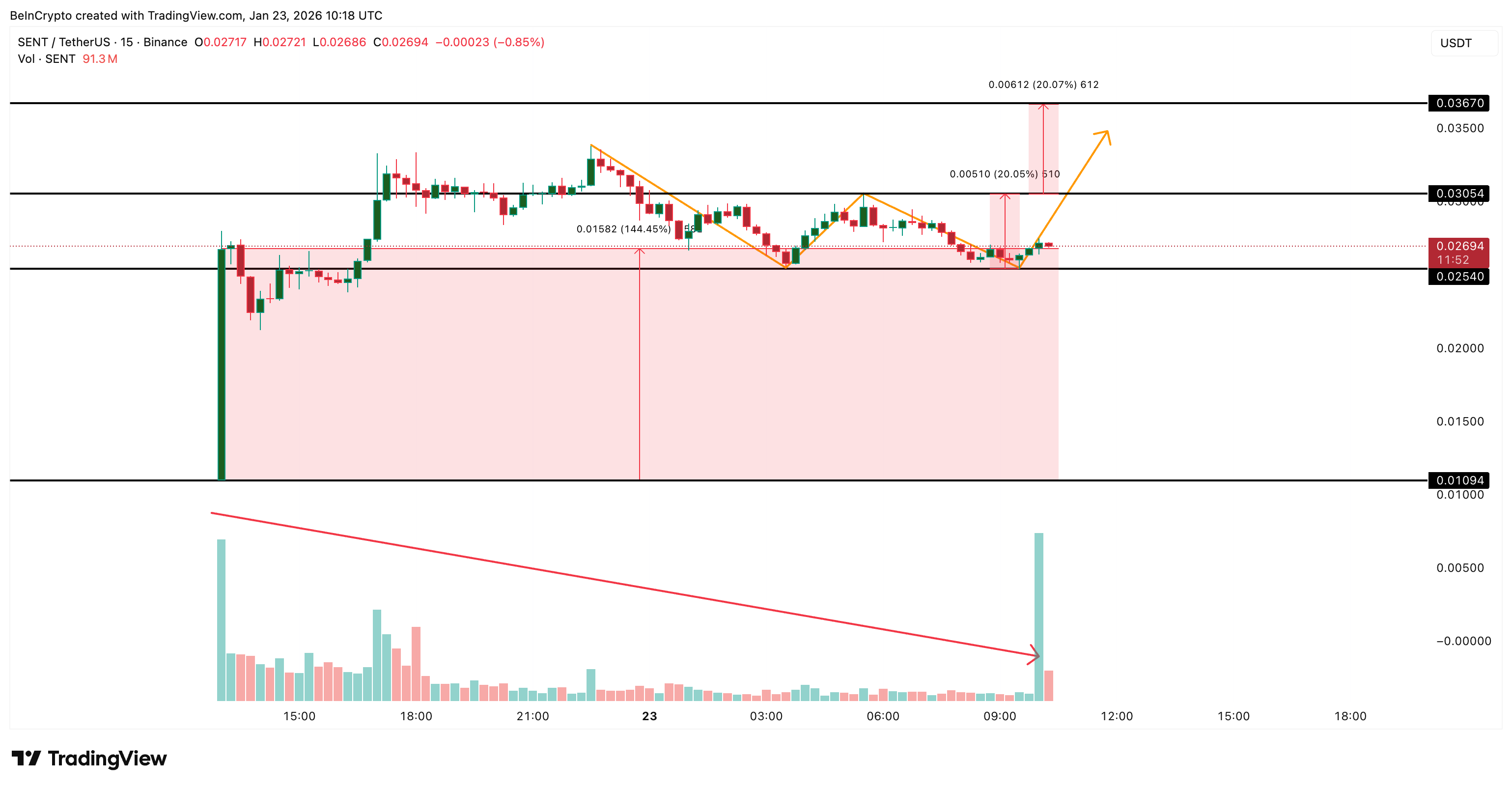
In layman’s terms, while there’s some momentum, it’s being sold off faster than you can say “crypto crash.” This leads to sideways movements rather than the exciting upward trajectory we all dream about. Perfect for scalpers, but risky for those hoping for a smooth ride.
30-Minute and 1-Hour Data: The Plot Thickens
As we pull back the curtain a bit, the picture becomes clearer.
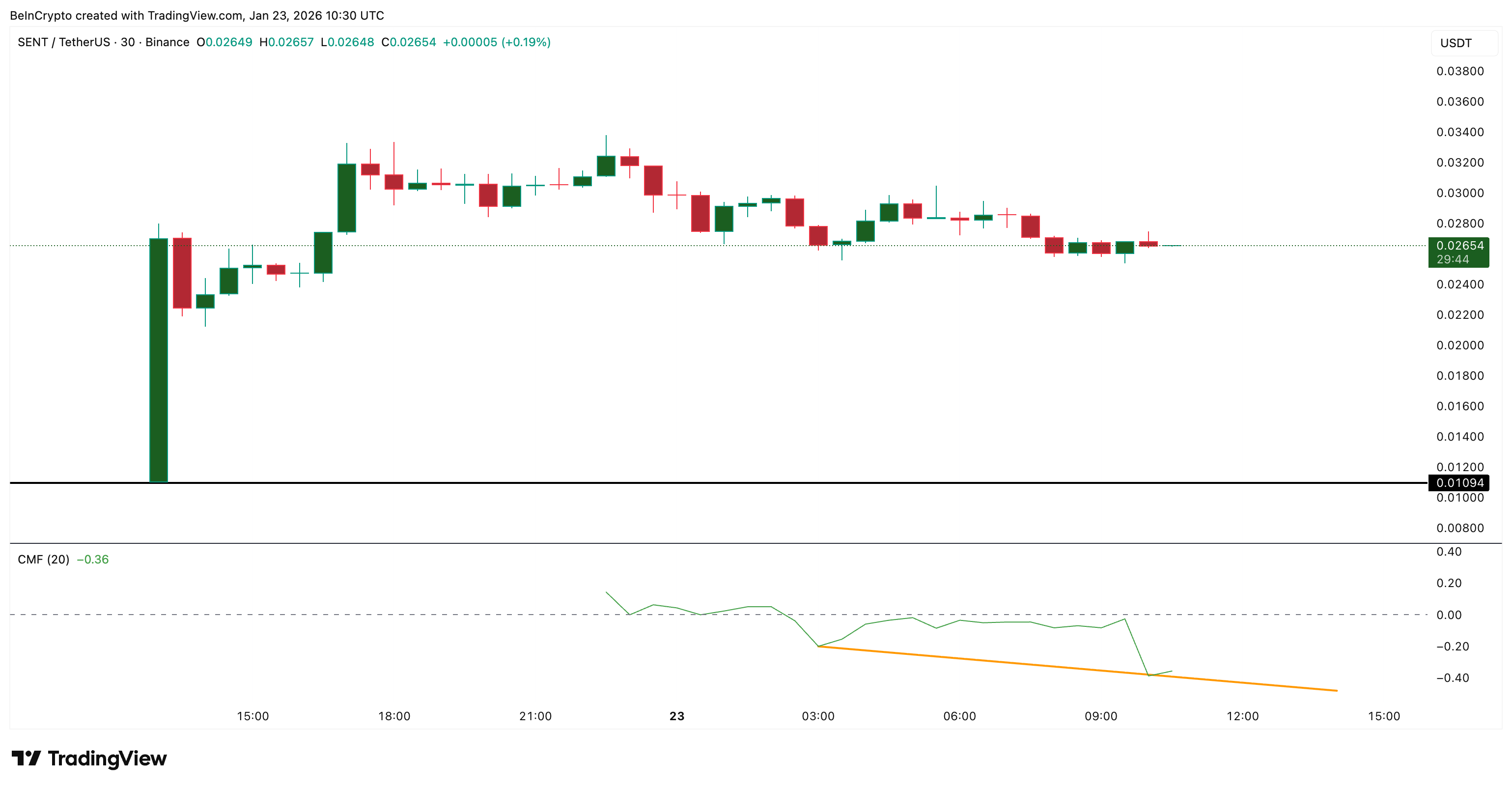
On the 30-minute chart, the Chaikin Money Flow (CMF), which tracks the big bucks, has taken a nosedive below the zero line, indicating that more cash is leaving the party than arriving. Even though prices are holding steady, the big SENT wallets are still playing hard to get.
Currently, CMF needs to stay above the descending trendline to avoid a dramatic exit stage left.
Meanwhile, the 1-hour On-Balance Volume (OBV) is attempting to break above a descending trendline. OBV is like the referee in this game, tracking whether the volume is actually backing up the price. Right now, OBV is on the rise (thank you, buyers!), but it still needs to breach around 1.09 billion to really convince everyone that the buyers are in control. Until then, the breakout is as tentative as a first date.
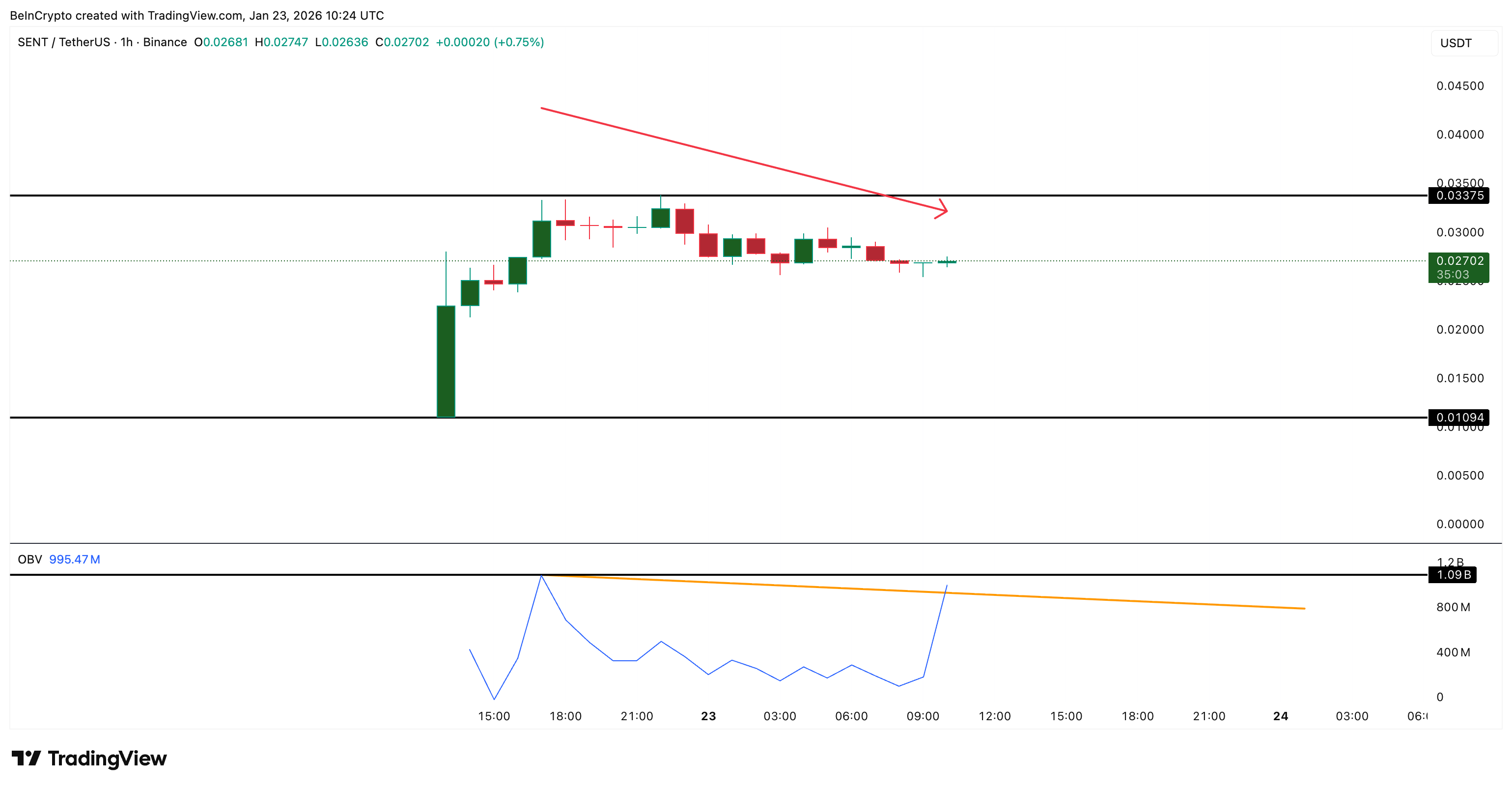
When CMF is weak but OBV tries to make a move, it usually means that while short-term buying is happening, bigger fish aren’t quite ready to jump in yet. There’s even a chance they’re selling that airdrop stash into strength, which explains the drop below the zero line.
Adding another layer to this already delightful complexity is the Smart Money Index. As the price meanders downwards, the smart money line keeps inching up-a classic signal of quick entries and exits. This also explains those frantic volume spikes on the 15-minute chart.
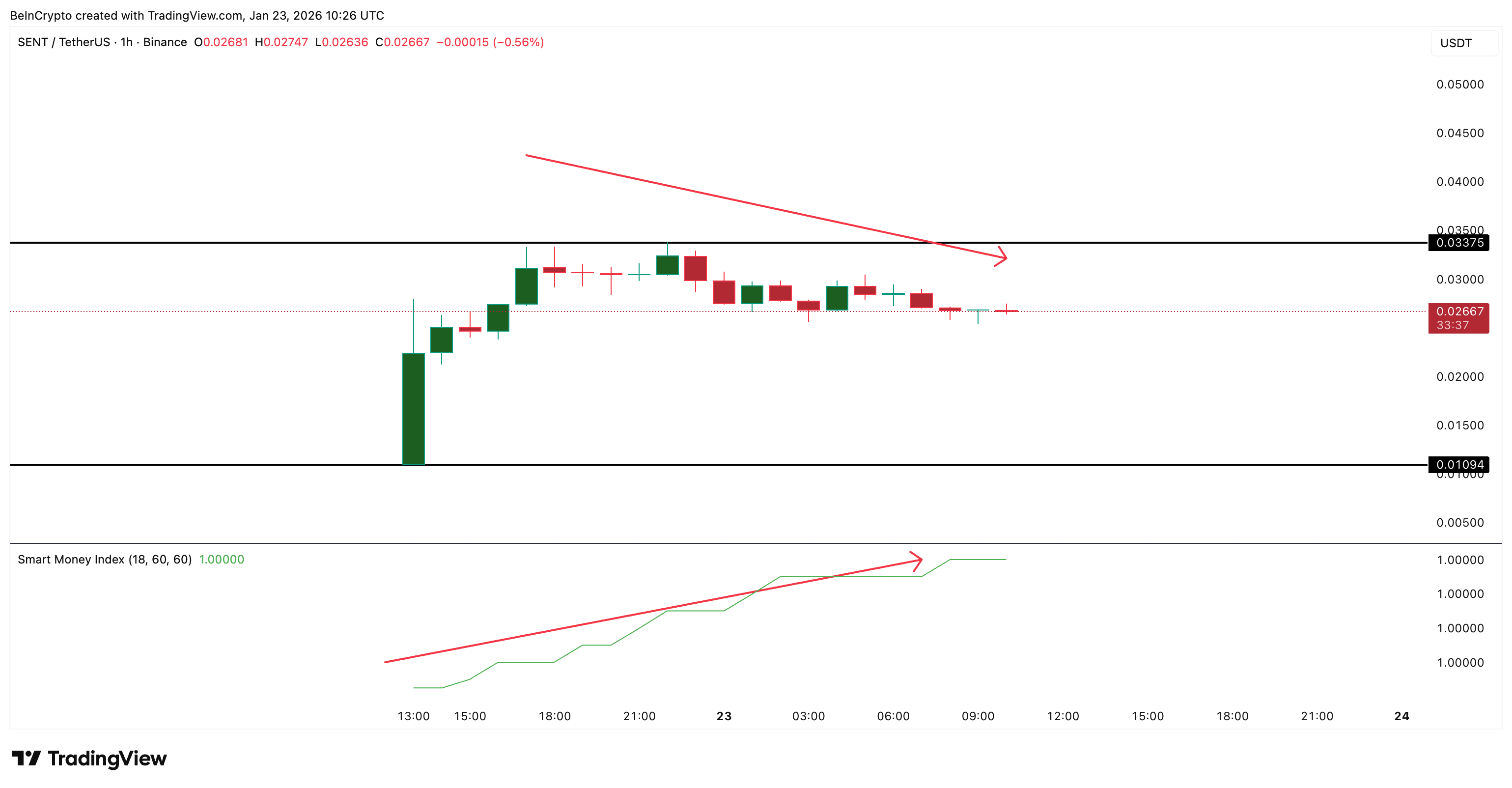
These momentum-driven theories align nicely with exchange data. In the last 24 hours, exchange volume jumped by a whopping 384%. Such a frenzy of activity hints at heavy rotation, as rising OBV signals buying, while exchange inflows indicate selling intent-and probably a dash of profit booking from those airdrops.
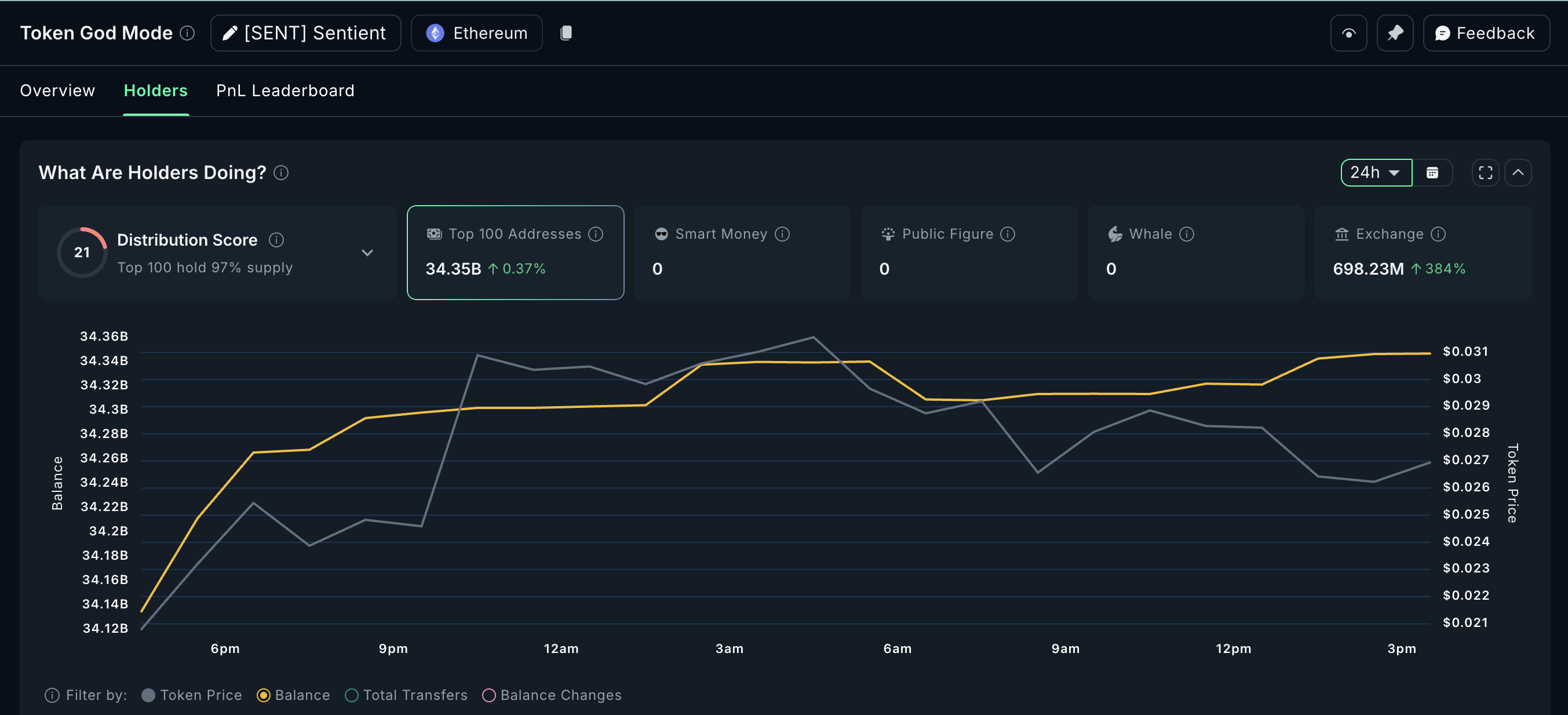
Together, these signals suggest that SENT is being tossed around like a beach ball at a summer picnic, but solid conviction buying hasn’t quite taken over yet.
2-Hour SENT Price Trend: What’s Next?
Now, let’s get serious for a moment.
On the 2-hour chart, SENT is still riding the wave of an uptrend since its post-launch low. That trend hasn’t broken yet, which is good news. As long as it holds, our hopes for upside attempts remain alive and kicking.
The first key support is hovering around $0.025, which has been tested more times than an overcooked spaghetti. If the price dips below $0.025 with volume, we could be looking at a downward target near $0.021. And if selling pressure ramps up and CMF continues its descent, don’t be surprised if we see a deeper plunge toward $0.010.
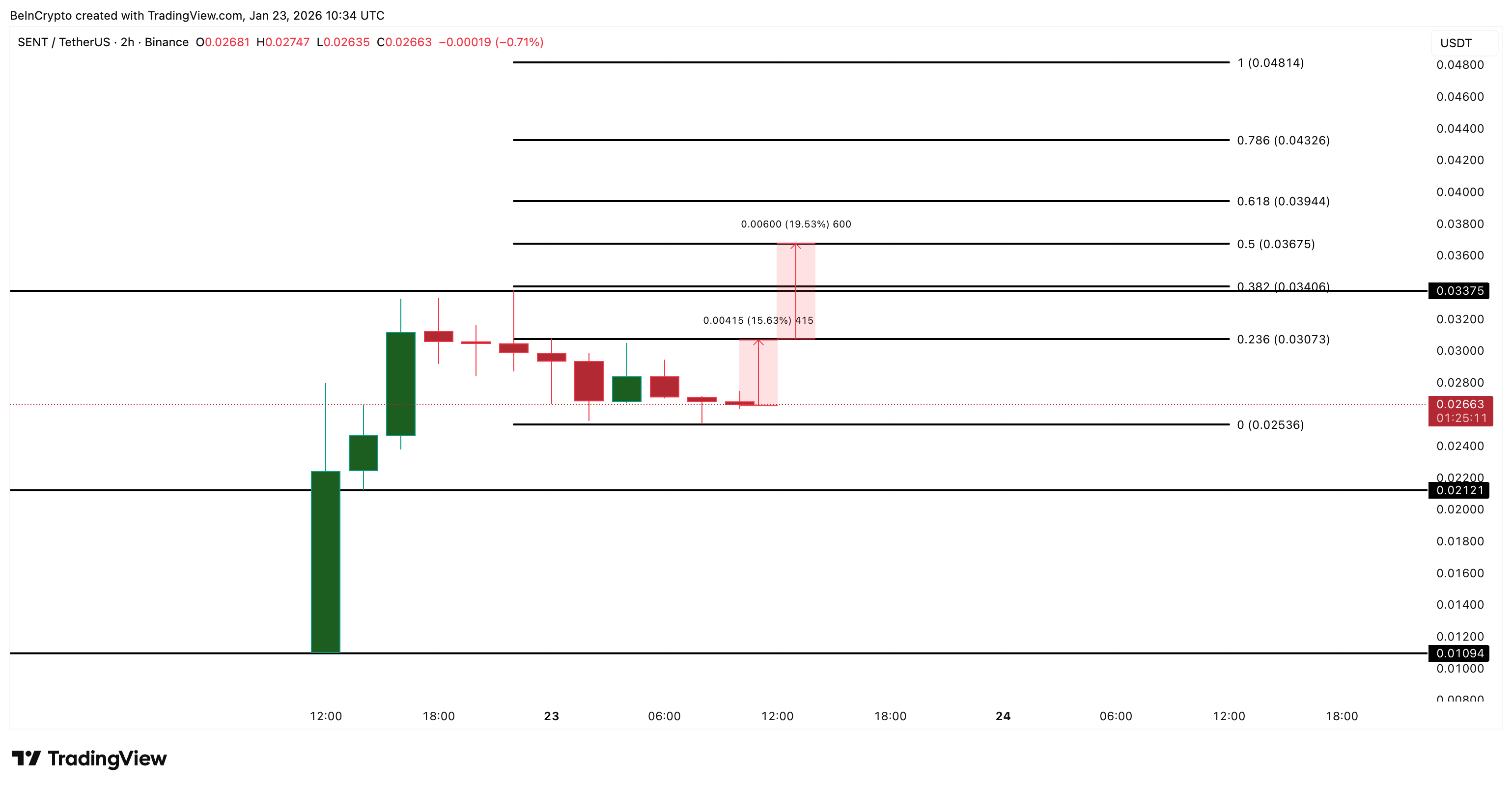
On the brighter side, everything hinges on breaking above $0.030. SENT needs both a 15-minute and a 2-hour close above that magical number. Just peeking above it won’t cut it-we need expanding volume too!
If that confirmation happens, the measured move from the 15-minute structure points toward $0.036 (which also makes an appearance on the 2-hour chart), translating to about a 20% increase from the breakout zone. Beyond that, we’ll encounter resistance levels around $0.043 and $0.048.
Until that day arrives, we’re stuck in this fast-paced range-bound dance.
Bottom line: SENT’s post-TGE strength is real, but right now, prices are dictated by speed rather than conviction. The next movement won’t be decided by mere hype or flashy patterns alone; it will be volume that dictates whether SENT breaks higher or remains the favorite plaything of scalpers.
Read More
- United Airlines can now kick passengers off flights and ban them for not using headphones
- How to Complete Bloom of Tranquility Challenge in Infinity Nikki
- Gold Rate Forecast
- How to Solve the Glenbright Manor Puzzle in Crimson Desert
- All Itzaland Animal Locations in Infinity Nikki
- All Golden Ball Locations in Yakuza Kiwami 3 & Dark Ties
- 8 Actors Who Could Play Blackbeard In One Piece Live-Action Season 3
- All 10 Potential New Avengers Leaders in Doomsday, Ranked by Their Power
- A Dark Scream Theory Rewrites the Only Movie to Break the 2-Killer Rule
- Star Trek: Starfleet Academy Season 1 Unanswered Questions: Exploring The Plot Holes
2026-01-23 16:02