Okay, let’s be real – everything we love about the minigun in games is basically a fun illusion! That awesome, run-and-gun weapon we all carry? The real thing is a massive 100-pound machine that needs a car battery and a whole crew to even work. It’s not that game developers are trying to fool us, they’re intentionally choosing gameplay over realism. They’re prioritizing fun and fast action! But honestly, it works. So, I want to explore why this fantasy is so great – looking at all the things that aren’t quite accurate and appreciating the clever design choices that turned a complicated piece of military tech into a gaming legend.
Key Takeaways
- Embrace the Hollywood Power Trip: The minigun’s iconic status in gaming comes directly from over-the-top action movies, not reality. Developers lean into this fantasy because it delivers an unmatched feeling of power, letting you become the unstoppable hero you saw on screen.
- Fun Comes First, Physics Comes Second: A truly realistic minigun would be slow, clunky, and stationary—the opposite of fun in a fast-paced shooter. Game designers intentionally ignore real-world limitations like weight and power needs to ensure the gameplay stays fluid, fast, and exciting.
- Strategic Limits Create More Satisfaction: While total realism would be a drag, small, thoughtful limitations make the minigun more engaging. Mechanics like overheating, significant recoil, and finite ammo add a layer of strategy that makes mastering the weapon feel earned and far more rewarding than just holding down a button.
Why Are Miniguns a Gaming Icon?
The minigun isn’t just a weapon in games—it’s a symbol of immense power. Finding one instantly makes a player feel incredibly strong and capable of destroying anything in their way. It embodies the ultimate power fantasy – unleashing a relentless barrage of bullets. However, this iconic image didn’t originate in video games. It comes from the wild, action-packed movies of the 80s and 90s, a legacy that games readily adopted.
We all love seeing a character effortlessly handle a weapon that should be impossible to wield – like a minigun normally attached to a helicopter. It’s completely unrealistic, but that’s part of the fun! The minigun has become a gaming icon because it’s incredibly powerful and completely defies logic. That iconic spinning sound instantly signals that things are about to get crazy. Game developers know this, and they use the minigun to create unforgettable, action-packed moments. It’s not about careful aiming; it’s about pure, exhilarating chaos. That’s why, even though it’s wildly inaccurate, the minigun remains a favorite in so many games – it delivers a unique and thrilling experience.
The Minigun’s Pop Culture Legacy
The idea of a single soldier running into battle with a minigun is a movie fantasy, popularized by the film Predator. Jesse Ventura’s character wielding “Old Painless” created a powerful image of firepower, but it wasn’t realistic. In reality, a minigun requires a large power source and a team to operate. That one scene, however, stuck with audiences and created the enduring, though inaccurate, idea of the minigun as the ultimate individual weapon.
From Action Movies to Your Favorite FPS
Game designers quickly recognized how cool the Hollywood version of the minigun was and realized it would be a hit in games. Why worry about what’s realistic when you can let players feel incredibly powerful? Miniguns have been a popular weapon in first-person shooter games for years, appearing in classics like Duke Nukem 3D and newer games like Call of Duty. Movies like Terminator 2 also helped solidify this idea, suggesting that only a powerful character could even manage such a heavy, powerful weapon. While some games try to make their miniguns feel more realistic by fixing them in place, most games prioritize fun. They choose to let players enjoy the over-the-top experience of being a walking, heavily-armed turret, even if it isn’t realistic.
How a Real Minigun Works
To understand why miniguns are often misrepresented in games, it’s helpful to know how they actually work. The miniguns we see on screen – often portrayed as lightweight weapons you can quickly deploy – are very different from their real-world counterparts. In reality, a minigun is a powerful, rapidly firing Gatling-style cannon. It’s a military weapon built for delivering massive firepower from a fixed, stable position. Its main focus is a very high rate of fire, even if that means sacrificing portability and ease of use. Let’s look at the key features that make a real minigun so formidable – and so difficult for a single soldier to manage.
The Mechanics Behind the Mayhem
A minigun isn’t like a regular rifle. Instead of manually firing each bullet, it uses electricity – often from a vehicle – to spin a set of barrels. As the barrels rotate, they automatically load, fire, and eject bullets, allowing for an incredibly high rate of fire – thousands of rounds per minute. When video games accurately portray details like recoil and reloading, it enhances the feeling of immersion. However, the complex, real-world mechanics of a minigun are usually simplified in games.
The Surprising Truth About Weight and Portability
Ever notice how slow your character moves when using a minigun in a game? That’s a simplified way of showing how heavy these weapons actually are. A real M134 Minigun weighs close to 100 pounds without bullets, and a fully loaded one can weigh over 200 pounds! That’s why you typically see them attached to vehicles like helicopters, boats, and trucks. They’re built to be set up in one place, not carried and fired by a single person. Trying to run, jump, or even walk normally while firing one is unrealistic – it would take incredible strength just to hold and aim the weapon.
Understanding Spin-Up Time and Power Needs
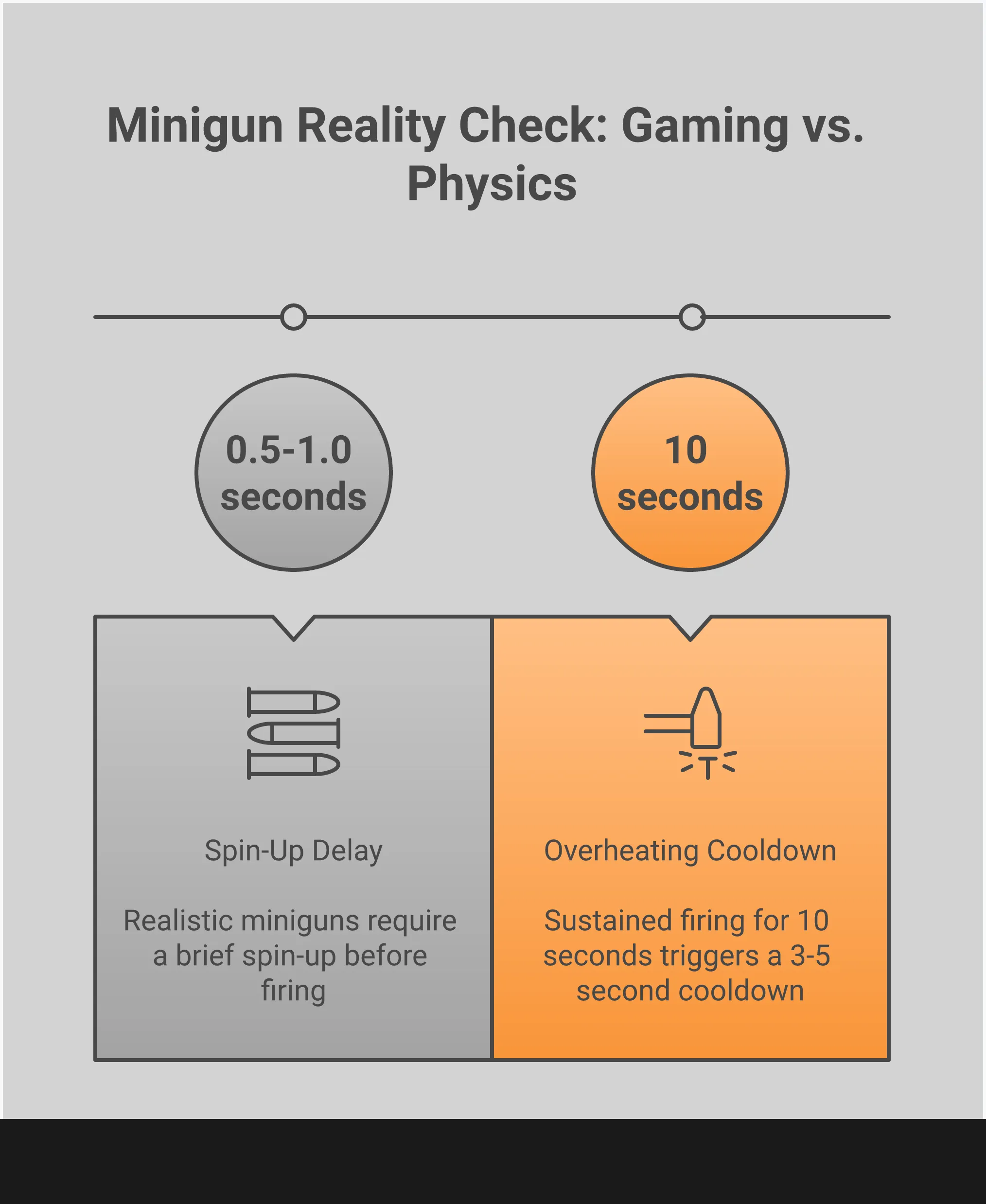
Video games often leave out realistic details like the time it takes for these weapons to actually fire. Because the barrels are powered by a motor, there’s a brief delay between pulling the trigger and the gun firing – the motor needs a moment to spin up to full speed. Even a fraction of a second would significantly change how the weapon feels in a fast-action game. Also, powering these weapons would be a major challenge. You wouldn’t simply reload with a new magazine; they’d require a large battery pack or a direct power connection to a vehicle. While the Terminator makes it seem effortless, realistically, you’d need superhuman strength to manage the weight and power requirements.
Why Games Bend the Rules for Miniguns
Have you ever thought about how video game characters can run, jump, and slide all while carrying huge weapons like miniguns? It seems unrealistic, and it is! Game developers are always trying to balance realism with making a game enjoyable. When it comes to weapons like the minigun, making it fun to use is usually more important. In real life, a minigun would be too heavy and bulky to move easily. But in games, it’s designed to be a powerful, portable weapon – and that’s intentional, giving players a feeling of incredible power.
Trading Realism for Better Gameplay
If games aimed for total realism, the minigun wouldn’t be much fun. In reality, it’s a heavy weapon that needs to be fixed to the ground or a vehicle, and doesn’t allow for much movement. Some games, like Left 4 Dead, show this more accurately. However, most game developers prioritize fun over realism with miniguns. They let you carry this incredibly powerful weapon, even though it’s unrealistic, because it makes for much better gameplay. Being able to run and gun down waves of enemies is far more exciting than being stuck in one place as a turret.
Keeping the Pace of Combat High
First-person shooter games rely on quick reactions and smooth movement. Realistic physics, like the weight and handling of a heavy weapon, would slow everything down. Think about trying to spin around quickly with a 100-pound gun – it wouldn’t be possible! Game developers purposely avoid these limitations to keep the action fast and exciting. The ability to quickly aim or dodge attacks is essential for the thrilling experience in games like Warzone. Prioritizing realism over fluid movement would ruin the fast-paced combat, making it slow and frustrating.
Why Player Movement Trumps Physics
As a gamer, I get why miniguns aren’t realistic in most games. Seriously, those things are heavy – almost 100 pounds empty! Trying to actually use one while running, sliding, or even crouching would be a nightmare. That’s why developers usually simplify things. Modern games are all about moving freely – ducking for cover, sliding around corners, sprinting when you need to. If a minigun felt like it actually weighed a ton and was super awkward to handle, it would totally ruin the flow of the game. At the end of the day, smooth, responsive movement is way more important than perfectly realistic physics. It just feels better to play that way.
Which Design Choices Shatter Realism?
Everyone enjoys the power fantasy of using a minigun in games, but the way they’re depicted is usually far from realistic. Game developers often choose exciting gameplay over accurate physics, which is fine – it’s more fun that way! However, this often means ignoring how a real minigun would actually function. Things like unrealistic strength requirements and endless ammunition turn this complex weapon into something that’s just about pointing and shooting. Here’s a look at the most common ways games sacrifice realism for the sake of fun with miniguns.
The Myth of Instant Firing
Video games often take liberties with how miniguns work. In reality, these weapons, also known as Gatling guns, don’t instantly fire when you pull the trigger. They need a moment to spin up to full speed. A Reddit user pointed out that games rarely show this realistic delay, making the weapons seem much faster than they would in real life. While this keeps the gameplay exciting and immediate, it sacrifices accuracy. Some more realistic, tactical shooters include this spin-up time, requiring players to predict enemy actions. However, most action-focused games allow for instant firing.
Running and Gunning with a 100-Pound Weapon
Ever notice how easily characters in video games run, slide, and jump while carrying a huge minigun? It looks cool, but it’s not realistic. A real M134 Minigun weighs almost 100 pounds before you add ammunition or a power source. It’s designed to be mounted on something stable, like a helicopter or vehicle, because it’s so difficult to handle. The idea of a soldier running with one like a regular rifle doesn’t make sense. But games like Call of Duty let you equip a powerful, heavy machine gun and still move quickly, all to make the game fun and balanced.
The Fantasy of Unlimited Ammo
Real miniguns fire bullets incredibly fast, requiring a huge amount of ammunition – so much that it would be extremely heavy to carry. Video games often give characters unlimited ammo, though. Game developers do this to help new players compete with experienced ones. Giving a minigun a large ammo supply lets players focus on the action without worrying about running out of bullets. It’s a way to make players feel powerful, but it also means they don’t have to think strategically about each shot.
Why You Can’t Wield a Minigun One-Handed
One of the most common unrealistic tropes is a character effortlessly firing a minigun with one hand. Unless they’re a robot, it’s simply not possible. These weapons are incredibly heavy and have such strong recoil that they’re impossible to control accurately. People joke about this, pointing out that even a character like The Terminator – a machine – needs to be built to handle one. When a normal human character pulls this off in a game or movie, it’s a clear sign that the creators cared more about making it look cool than about realism. It’s visually impressive, but totally unbelievable.
How Different Genres Treat the Minigun
Games approach the minigun in many different ways. It’s not always just a bigger version of an assault rifle. Developers have to decide how to balance the exciting idea of a powerful, rapid-fire weapon with what’s actually possible in the game world. Whether it’s a fast-paced, chaotic arcade game or a more realistic military simulation, the minigun plays a very different role. How a game uses this famous weapon often reveals a lot about its overall design – is it focused on fun and excitement, or realism and detail?
Arcade Shooters: Embracing the Power Fantasy
In arcade-style shooting games, the minigun is the most coveted weapon – it’s all about causing massive destruction! These games aren’t concerned with realism; they’re designed to let you experience over-the-top action, like in games such as Payday 2, where the focus is on excitement. The minigun isn’t meant to be a realistic weapon; it’s there to make you feel incredibly powerful as you defeat endless enemies. This genre values fun and dramatic action above all else, making the minigun central to the feeling of being an unstoppable force that keeps players hooked. It’s about the pure joy of feeling like a one-person army.
Tactical Shooters: The Mounted-Only Approach
Unlike more action-packed shooters, tactical shooters aim for realism. You won’t typically find powerful weapons like miniguns that you can easily carry around. Instead, they’re usually fixed in place, like in Left 4 Dead, where they’re bolted to the floor and used to defend a specific area. This reflects the fact that miniguns are incredibly heavy and require setup, making them more like military equipment than individual weapons. This design encourages players to focus on strategy, teamwork, and positioning, rather than simply running and shooting, which adds a deeper level of tactical gameplay.
Simulators: Getting as Close to Reality as Possible
Simulation games offer a realistic take on weapons like the minigun. Titles such as the VR game Hot Dogs, Horseshoes & Hand Grenades (H3VR) meticulously recreate the experience of firing one, including its complex mechanics. These games accurately model how a minigun behaves – the time it takes to spin up, its incredibly fast firing rate, and the powerful recoil that makes it difficult to control. The goal is to immerse players in a realistic and informative experience, demonstrating the actual physics and challenges of operating such a powerful weapon. While these games don’t focus on action-packed combat, they provide a greater understanding of why the minigun is so effective in real-world scenarios.
What Features Make In-Game Miniguns More Realistic?
Most players don’t want a super-realistic simulation, but adding a few realistic touches can make in-game miniguns feel much more satisfying and powerful. It’s not about making the game harder, but about making the weapon feel earned and impactful. A little realism can turn a minigun from a simple, mindless weapon into a tool that requires skill and strategy. These details encourage players to appreciate the weapon’s power, rather than just treating it as an easy win. It’s the difference between feeling like a capable hero and simply exploiting a game glitch. Simple things like managing heat or controlling recoil can significantly improve the experience.
Adding Overheating and Cooling Mechanics
To make miniguns feel more realistic in games, a common solution is to add an overheating feature. Real-life miniguns get extremely hot when firing rapidly, so they can’t be fired continuously. Including this in a game adds a simple but smart tactical element. Players would need to fire in short bursts and watch a heat meter, instead of just holding down the trigger. This makes them think more about when and where to shoot. Overusing the weapon could leave you exposed while it cools down. Many gamers believe this overheating feature would increase realism, changing constant firing from the norm to a risky choice.
Making Ammunition a Real Concern
While unlimited ammo can be enjoyable, it takes away the excitement and challenge of combat. A minigun is designed to burn through bullets quickly, and a game should reflect that to make each shot feel important. When ammo is limited, players become more strategic, thinking like a skilled heavy weapons operator. They’ll carefully consider when to use their minigun – on weaker enemies now, or save it for a tougher boss battle later? Many realistic shooting games build challenges around managing ammunition. By making players search for ammo or limiting resupplies, the minigun transforms from an everyday weapon into a devastating tool saved for truly overwhelming situations.
Simulating Authentic Recoil and Stability
The idea of someone running and firing a minigun accurately is unrealistic – it’s a movie trope. These guns are incredibly heavy and kick powerfully when fired. To make a game feel authentic, the gun should be difficult to control – accuracy should decrease while firing continuously, and the player should need to brace themselves or crouch to stay on target. Movement should also be significantly slowed down while the gun is firing. Realistic recoil makes a game more immersive, giving the player a sense of the weapon’s weight and power, and making successful shooting feel earned and satisfying.
Showing the Weapon’s Impact on the Environment
A weapon that fires 3,000 rounds a minute shouldn’t just eliminate enemies – it should completely tear up the surroundings. Expect concrete to crack and fall apart, metal barriers to be ripped to shreds, and the air to fill with dust and wreckage. This level of environmental damage gives players a strong visual sense of their weapon’s power. Seeing the world react to your firepower makes the experience much more intense and rewarding. The most memorable minigun moments in games are when you can visibly destroy the environment, turning ordinary areas into scenes of total destruction.
Why We Love Unrealistic Miniguns Anyway
We all know video game miniguns aren’t realistic – they’re about as believable as a friendly dragon! But honestly, that doesn’t matter. It’s ridiculous to imagine running around with a weapon designed for a helicopter, and yet, they’re incredibly fun. The very features that make miniguns unrealistic are actually what make playing with them so enjoyable.
This isn’t due to a lack of effort from the game creators. They intentionally play with reality to create pure fun. We enjoy feeling incredibly powerful, pulling the trigger, and watching the exciting results. It’s a great combination of fun gameplay, living out a power fantasy, and everyone agreeing to simply enjoy the ride.
Choosing Fun Over Authenticity
Ultimately, games should be enjoyable. If developers focused solely on realism, many of the most fun parts of gaming would be bogged down by complicated and repetitive actions. For example, imagine needing a whole team just to operate a single weapon – it would ruin the fast-paced excitement of a battle. As one player pointed out, making games too realistic would make them unbalanced and, frankly, not fun. Developers recognize this, so they prioritize keeping the gameplay smooth and exciting over creating a perfect simulation. That’s why games like Palworld aren’t afraid to be silly and even a little dark, creating unique and memorable experiences that players adore.
Fulfilling the Ultimate Power Fantasy
The image of Arnold Schwarzenegger easily firing a minigun in Terminator 2 is famous for a reason: it embodies the ultimate power fantasy. Video games capture this same feeling, allowing players to become incredibly powerful. When you wield a minigun in a game, you’re not just a soldier – you’re a force of nature, able to defeat waves of enemies with ease. This feeling of being overwhelmingly strong is a major reason why people enjoy these games. It’s similar to the satisfaction of perfecting your strategy in a game like Warzone and winning convincingly. The minigun provides the most immediate and exciting way to feel invincible, and that’s why it’s so beloved.
Our Willingness to Suspend Disbelief
When we play games, there’s an understanding between us and the game itself. We willingly put aside what we know is realistic to fully enjoy the experience. For example, we accept unrealistic things, like a character carrying tons of ammo, because constantly needing to reload would be frustrating. This willingness to believe in the unbelievable makes games easier to pick up, especially for newcomers who can jump right in and compete. It’s a core part of what makes gaming so engaging. You see it everywhere, like when fans react excitedly to a new game trailer – everyone gets invested in the game’s world, story, and rules, no matter how fantastical they are.
How Player Feedback Shapes Weapon Design
Game creators don’t develop weapons in isolation. They closely follow what players are saying on platforms like Reddit, Discord, and other social media. This constant feedback is essential for a game’s continued success after its release. It leads to a dynamic interaction between player desires, the developers’ vision, and what genuinely makes the game enjoyable. When dealing with a famous weapon like the minigun, these conversations become particularly complex, requiring developers to carefully manage player expectations regarding strength, authenticity, and fairness.
The Casual vs. Hardcore Player Debate
When designing weapons for games, developers constantly face a challenge: pleasing both serious and casual players. Hardcore players want realistic weapons that are difficult to master, while casual players simply want to have fun without needing extensive knowledge. It’s important to strike a balance, as many games include beginner-friendly weapons that let new players compete with experienced ones. Without this, new players could become discouraged and stop playing, which would hurt the game’s community.
Miniguns and similar weapons often focus on creating a sense of overwhelming power because most players aren’t familiar with the complex mechanics of how these weapons actually work. While some players strongly desire perfect realism, the majority care more about how fun and satisfying a weapon is to use. Game developers constantly try to strike a balance – making weapons easy for new players to enjoy, but still offering enough complexity for experienced players to truly master.
How Developers Respond to Community Demands
Players are quick to share their opinions about weapons in games, and developers often hear about issues directly from the community – especially on platforms like Reddit. Players provide detailed feedback, pointing out exactly how a weapon feels unfair or difficult to use compared to others. This kind of specific input is incredibly valuable to developers, not because they’re aiming for perfect realism, but because they want weapons to be fun, effective, and well-balanced within the game. Ultimately, developers want to know if a weapon is enjoyable to use and if it fits well into the game’s overall design.
As a player, it’s awesome to know that our feedback actually matters! The developers are always adjusting things – like making weapons stronger or weaker, or even completely changing how they work – based on what we’re saying. It’s a really cool back-and-forth. Honestly, if they didn’t listen to us when a lot of players are unhappy, they’d quickly lose us. Seeing how everyone reacts to updates just shows how much we all care about these games and want to see them improve!
Balancing Realistic Mechanics with Accessibility
Realism in games is about finding the right balance. Including realistic details can definitely improve a game. For example, believable gun behavior – like recoil, how bullets travel, and reload animations – helps players feel more connected to the game world. These details add depth and make it satisfying to learn and master weapons. Consider competitive shooters where understanding a rifle’s spray pattern is what distinguishes skilled players from the best.
As a gamer, I’ve definitely noticed that games don’t need to be totally realistic to be awesome. If developers tried to copy real life exactly, things would get broken fast – it just wouldn’t be fun anymore. Like, imagine a minigun needing two people to operate and its own generator? That’s useless in a fast-paced shooter! Instead, designers create the feeling of realism. They might give a gun a spin-up time to hint at how complicated it is, or make it kick like a mule to show off its power, but they always make sure it works within the game. That sweet spot between feeling real and actually being fun? That’s what makes a weapon truly great.
Should Realism Ever Trump Fun?
As a gamer, this whole discussion really makes me think about how game developers walk this really tricky line. It’s all about finding the sweet spot between making things feel real and just being plain fun, right? They want to build worlds we can get lost in, but also need to make sure the game is actually enjoyable to play. For me, the minigun is a perfect example. If they made it totally realistic, it wouldn’t be something you could run around with in Warzone – it’d be a huge, complicated weapon that needs a whole team to operate! That wouldn’t be very fun at all.
There isn’t one single answer to how realistic a game should be. It really depends on what the game is trying to achieve. For example, a fast-paced arcade game like Borderlands benefits from exaggerated action – a huge, powerful minigun fits perfectly. But a realistic military simulator like Arma focuses on accuracy, so its weapons behave more like the real thing. The point isn’t to perfectly copy reality, but to build a believable and fun experience that matches the game’s overall design. Great games carefully choose when to be realistic and when to take creative liberties.
Finding the Sweet Spot for Gameplay
Ultimately, games should be enjoyable. If they perfectly mirrored reality, they’d often become frustrating. As one player explained, a game that’s too realistic would become unbalanced and lose its fun. Think about trying to carry a heavy machine gun, find power, and constantly reload in a fast-paced battle – you’d be an easy target! Game developers deliberately avoid these real-world constraints to let players feel powerful and keep the action exciting. The key is to capture the sense of a weapon’s strength without burdening players with practical difficulties.
When Realism Actually Makes a Game Better
While complete realism isn’t always necessary, it can significantly enhance a game when used well. Believable details, like realistic gun recoil, bullet physics, and smooth reload animations, help players feel more connected to the game world and make their actions more meaningful. Instead of simply clicking a button, firing a weapon can feel like operating a powerful machine. Games like Hot Dogs, Horseshoes & Hand Grenades (H3VR) are celebrated for their accuracy – for example, perfectly replicating the sound and firing rate of a minigun. These details demonstrate a dedication to authenticity that many players value, ultimately proving that a touch of realism can actually improve the overall fantasy experience.
Related Articles
- Deus Ex LFG: Connect with Other Augs in LFG Feature on Z League App
Frequently Asked Questions
Ever wonder why you can’t just carry a minigun like in video games? It’s because they’re incredibly heavy and require a lot of power. A real M134 Minigun weighs almost 100 pounds before you add any bullets, and the ammunition can easily double that weight. These weapons are made to be attached to vehicles like helicopters or trucks, which also provide the electricity needed to spin the barrels. Even for a strong person, lifting and using one effectively – running, jumping, and aiming – would be nearly impossible.
It’s not that developers are lazy when they don’t make miniguns perfectly realistic. It’s a deliberate choice to prioritize fun. A truly realistic minigun would be so unwieldy it would slow down the fast action of most video games. Instead, developers tweak how the weapon works to give players a powerful, exciting experience – essentially letting you feel like a walking tank. They’re choosing exciting gameplay over perfect realism, and that’s what keeps players engaged.
It’s tough to say if any games perfectly capture the feel of a minigun, as it varies depending on what the game is trying to achieve. Games like Left 4 Dead aim for realism by making the minigun a stationary weapon. On the other hand, simulators like Hot Dogs, Horseshoes & Hand Grenades meticulously recreate the weapon’s realistic features, such as the time it takes to spin up and the strong kickback. Most games strike a balance, using the minigun’s iconic appeal without making it too difficult to handle.
It doesn’t make sense to focus on realistic details if a weapon isn’t believable in the first place. However, even small touches of realism can make weapons more fun to use. Things like weapons overheating, limited ammo, or strong recoil force players to think strategically. Instead of just rapidly firing, you need to be more careful with your shots. These details make powerful weapons feel more rewarding and less like an easy advantage, turning them into tools that take skill to use effectively.
Beyond being too light in games, the biggest unrealistic thing about how miniguns are shown is the instant firing. Real miniguns use an electric motor to spin up the barrels, so there’s a short delay between pulling the trigger and actually firing bullets. Games usually skip this “spin-up” time to keep the action quick, but in reality, it would require players to predict where their target will be, instead of simply reacting to where they are.
Read More
- United Airlines can now kick passengers off flights and ban them for not using headphones
- Movie Games responds to DDS creator’s claims with $1.2M fine, saying they aren’t valid
- SHIB PREDICTION. SHIB cryptocurrency
- Scream 7 Will Officially Bring Back 5 Major Actors from the First Movie
- These are the 25 best PlayStation 5 games
- The MCU’s Mandarin Twist, Explained
- Server and login issues in Escape from Tarkov (EfT). Error 213, 418 or “there is no game with name eft” are common. Developers are working on the fix
- Rob Reiner’s Son Officially Charged With First Degree Murder
- MNT PREDICTION. MNT cryptocurrency
- Gold Rate Forecast
2025-12-11 14:44