Bitwise Investments has taken the grown-up step of filing an S-1 with the US SEC to launch a spot Uniswap ETF. It’s the kind of paperwork that makes you wonder if coffee should be considered a securities risk factor.
The announcement feels like a milestone pushed into shoulder-high hedges: institutions might finally pretend to care about UNI, while the price continues to wobble like a weather vane in a hurricane of confusion.
Bitwise Piles into a Spot Uniswap ETF as Daily UNI Burn Hits a New High
Bitwise recently registered the “Bitwise Uniswap ETF” entity in Delaware, a procedural move identical to previous spot ETF filings.
“With the regulatory clouds cleared and Bitwise leading the charge, $UNI is about to become a staple in every institutional portfolio,” Whale Factor remarked.
If approved, the fund would track UNI’s spot price, excluding expenses, with Coinbase Custody serving as the custodian.
At launch, staking would be off the table, which is bureaucratic code for: you get exposure without the thrilling chaos of earning rewards-just enough to pretend you’re not gambling in a ball pit.
📰 Bitwise files for first Uniswap-focused ETF@BitwiseInvest has filed an S-1 with the @SECGov to launch the Bitwise Uniswap ETF, seeking direct exposure to UNI, the governance token of @Uniswap, reported by @TheBlock__.
If approved, the fund would track UNI’s price (excluding…
– ME Group (@MetaEraHK) February 6, 2026
The filing coincides with notable on-chain activity. Daily UNI burns have surged sharply in February, according to Dune Analytics, alongside higher Uniswap trading fees.
As of early February, over 100 million UNI tokens have been burned, valued at approximately $597 million, with the annualized burn rate exceeding $36 million.
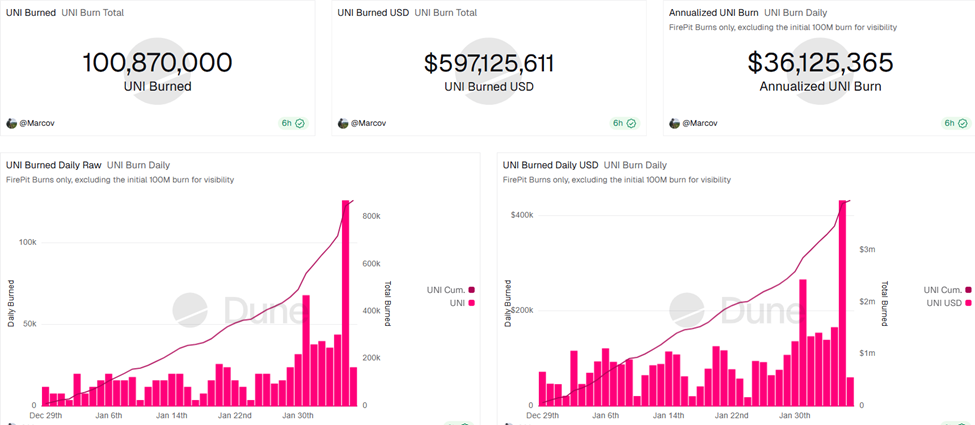
Daily charts indicate that the pace of UNI burning is accelerating, reflecting strong trading activity and the impact of the protocol’s Fee Switch, which converts a portion of trading fees into burned UNI.
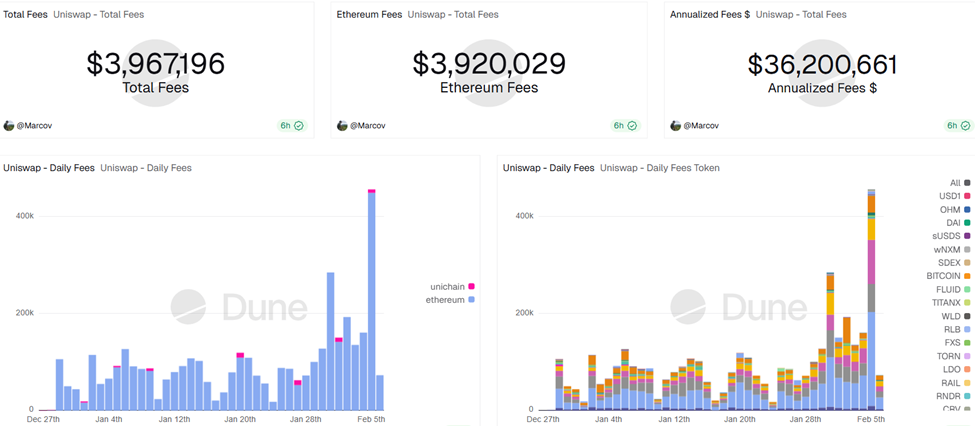
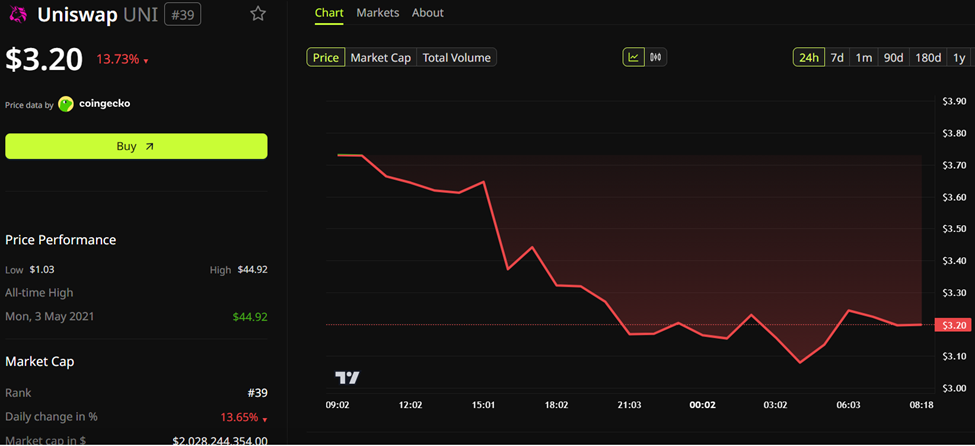
Despite these metrics, UNI’s price has remained relatively subdued, down by almost 15% over the last 24 hours.
As of this writing, the UNI token was trading at $3.20, down 13.73% amid broader market bearish sentiment.
Whales Accumulate UNI Amid Fee Switch Uncertainty and Rising Exchange Flows
Notwithstanding, on-chain data shows that large investors are strategically accumulating the token. Lookonchain reported that whale address 0x9671 sold 242 XAUT ($1.19 million) and 461 ETH ($985,000) to purchase 682,087 UNI worth $2.58 million.
Whale 0x9671 sold 242 $XAUT($1.19M) and 461 $ETH($985K), then bought 682,087 $UNI($2.58M).
– Lookonchain (@lookonchain) February 5, 2026
This highlights confidence in UNI’s medium-term upside. However, analysts remain divided on whether the Fee Switch’s early performance justifies optimism.
BeInCrypto reported in December that initial revenue from the Fee Switch fell short of governance expectations, with some analysts questioning whether the early data reflects flawed assumptions or simply incomplete rollout effects.
Uniswap founder Hayden Adams cautioned that “conclusions are premature and based on misleading assumptions,” suggesting the protocol’s long-term revenue potential may not yet be fully realized.
Nah the analysis is just wrong, overeager and misleading
1) treasury burned uni approx equal to what would have been the case if it had been on the whole time
2) only a subset of fee sources have turned on so far. Also lots of parameters that can be tuned in future proposals…
– Hayden Adams 🦄 (@haydenzadams) December 29, 2025
At the same time, the amount of UNI flowing to exchanges continues to rise, signaling potential selling pressure.
CryptoQuant data shows that Uniswap reserves on exchanges have climbed, raising concerns that price support could be tested if selling intensifies.
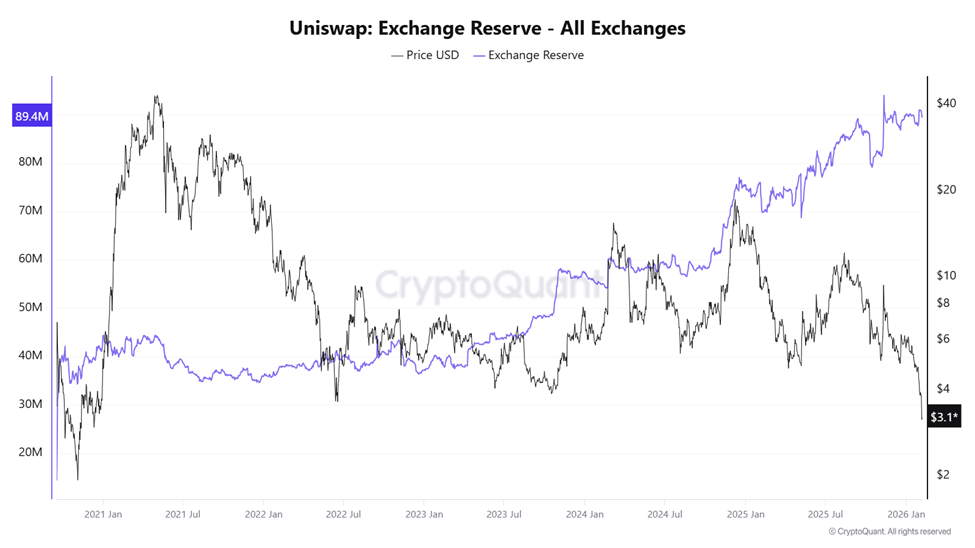
Historical trends illustrate that higher exchange inflows often precede short-term volatility, even amid strong protocol fundamentals.
Overall, the Bitwise spot Uniswap ETF filing and the accelerating UNI burn indicate growing institutional interest and protocol activity.
While on-chain metrics signal strong engagement and active fee generation, market forces, such as increased UNI inflows to exchanges and ongoing price weakness, suggest volatility could remain elevated in the near term.
As the SEC reviews the ETF application, investors will be watching closely to see if this product opens the door for wider mainstream adoption of UNI, potentially providing a bridge between DeFi liquidity and traditional capital markets.
In the end, perhaps this is what a finance-related Sedaris moment looks like: a stack of acronyms, a few burnt coins, a price that acts shy, and the feeling that I should have bought a notebook for all the questions I didn’t ask at the conference.
Read More
- United Airlines can now kick passengers off flights and ban them for not using headphones
- Crimson Desert: Disconnected Truth Puzzle Guide
- All 9 Coalition Heroes In Invincible Season 4 & Their Powers
- The Boys Season 5 Spoilers: Every Major Character Death If the Show Follows the Comics
- Mewgenics vinyl limited editions now available to pre-order
- Invincible Season 4 Episode 6 Release Date, Time, Where to Watch
- Grok’s ‘Ask’ feature no longer free as X moves it behind paywall
- Assassin’s Creed Shadows will get upgraded PSSR support on PS5 Pro with Title Update 1.1.9 launching April 7
- Grey’s Anatomy Season 23 Confirmed for 2026-2027 Broadcast Season
- Nintendo Officially Rewrites Princess Peach After 41 Years
2026-02-06 13:23