This week, the market for digital representations of real-world assets (RWAs) exceeded $27 billion in value recorded on blockchains. This growth confirms that RWAs are one of the quickest expanding areas in the crypto world, with institutions increasingly adopting and driving its development.
Tokenized Asset Market Sees Massive Growth
As of Tuesday, March 17, 2026, data from rwa.xyz shows distributed onchain value — excluding stablecoins — hitting an all-time high of $27.14 billion, up 8.83% over the past 30 days. The broader represented asset value, which includes off-chain backing, stands at $346.79 billion, signaling a much larger pipeline behind the scenes.
This growth is significant and rapid. The industry has increased almost fourfold in the past year, and its expansion is now accelerating quickly. What began as an experimental idea is now becoming a core part of the financial system.
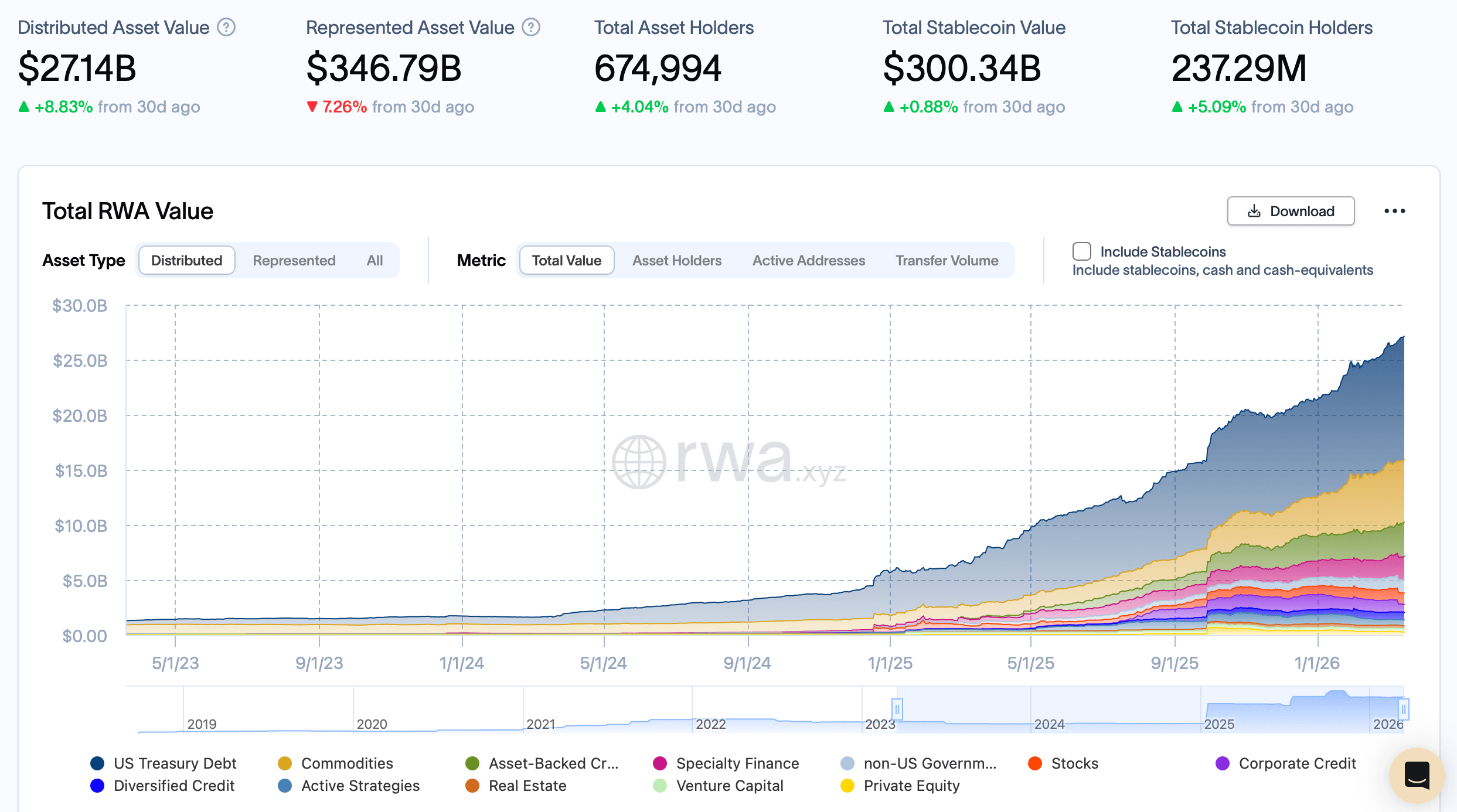
The holder base is expanding alongside capital. Total RWA holders reached 674,994, up just over 4% month over month, while stablecoin holders climbed to roughly 237.29 million. Participation is widening, but the capital concentration still leans heavily institutional.
At its core, tokenization converts ownership of real-world assets — such as U.S. Treasuries, private credit, gold, and real estate — into blockchain-based tokens backed by legal structures like trusts or special-purpose vehicles. These tokens can be transferred, fractionalized, and integrated into decentralized finance ( DeFi), effectively turning traditional assets into programmable instruments.
The composition of the market reveals where the real demand sits. Tokenized U.S. Treasuries dominate, accounting for roughly $11.3 billion of the total. Commodities follow at about $5.7 billion, while private credit and asset-backed lending collectively represent several billion more. Smaller but growing segments include equities, corporate credit, and venture exposure.
Ethereum remains the primary network, holding about $15.5 billion in tokenized assets and roughly 57% market share. BNB Chain has grown to approximately $3 billion, while networks like Liquid, Solana, and Stellar continue to carve out smaller but notable positions. The spread suggests competition, but not fragmentation — yet.
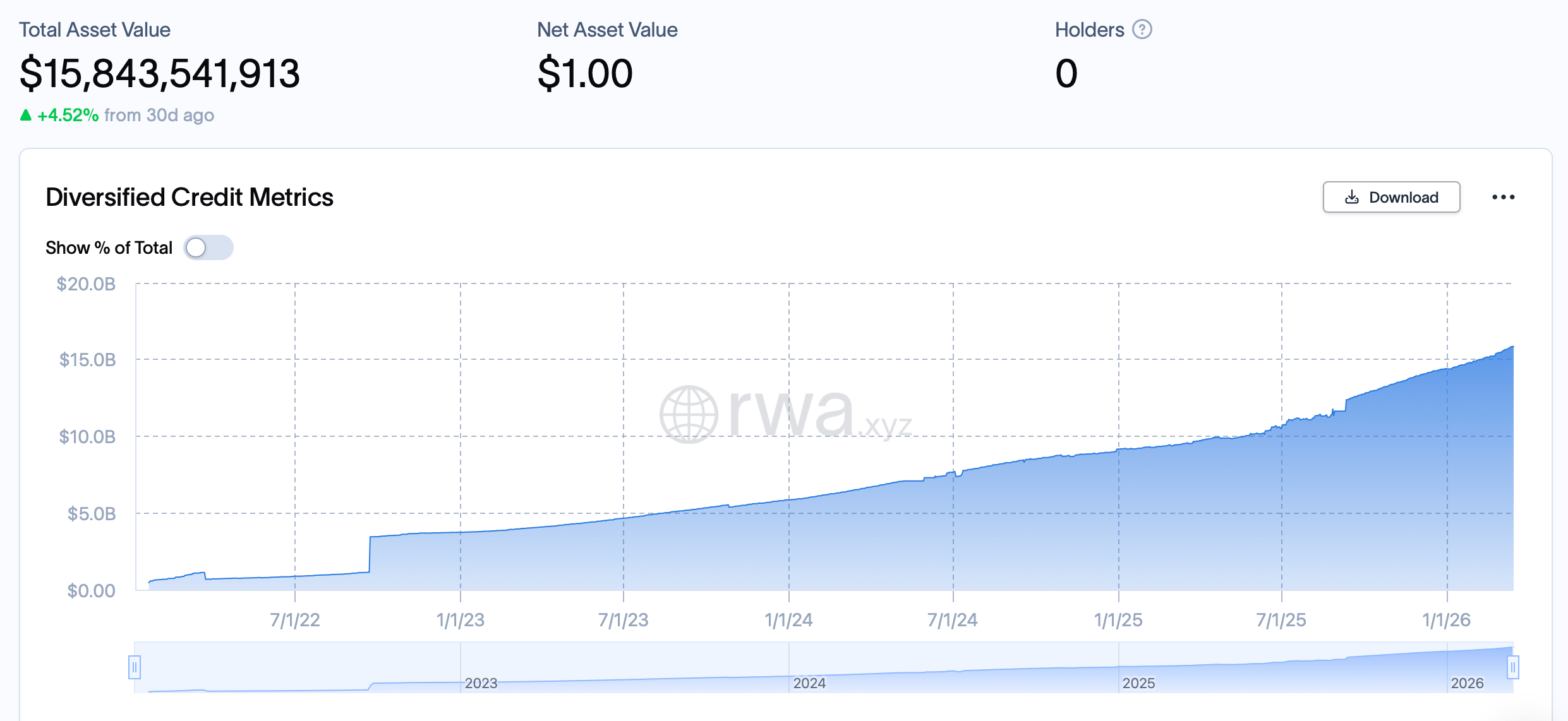
Among individual assets, Figure Technologies’ tokenized HELOC exposure leads in represented value at about $15.84 billion, pointing to how private credit is scaling onchain at industrial levels. Meanwhile, treasury-backed products are battling for dominance in the more liquid, lower-risk category.
Circle’s USYC has emerged as the current leader among tokenized Treasury products, with roughly $2.29 billion onchain and rapid monthly growth exceeding 40%. It recently overtook BlackRock’s BUIDL fund, which sits near $2 billion, highlighting how quickly market leadership can rotate when yield and accessibility align.
Besides Circle’s USDC, Ondo Finance’s USDY (around $1.21 billion) and Franklin Templeton’s BENJI fund (just over $1 billion) are also significant. These offerings form the core of a growing market for tokenized Treasury bills, which now totals over $11 billion. This growth is driven by investors looking for better returns in a higher interest rate environment.
Outside Treasuries, commodity-backed tokens remain a significant pillar. Tether gold (XAUT) and Paxos’ gold token PAXG together account for more than $5 billion, offering blockchain-based exposure to physical gold with relatively straightforward redemption mechanics.
Private credit protocols such as Maple and Centrifuge continue to build out onchain lending markets, while infrastructure providers like Securitize handle issuance and compliance. Behind the scenes, oracles and custodians ensure pricing and asset backing remain aligned — an unglamorous but critical layer.
As a crypto investor, it’s easy to see why tokenized assets are gaining traction. They offer benefits traditional finance just can’t easily deliver – things like super-fast settlements, the ability to trade around the clock, owning just a piece of an asset, and even earning yield automatically. For bigger players like institutions, it’s less about completely changing the system and more about making things work better and more efficiently.
Still, risks remain. Off-chain backing introduces counterparty exposure, and liquidity in secondary markets can be thin outside the largest products. Smart contract vulnerabilities and operational dependencies also persist.
Despite current challenges, the future looks promising. Experts predict the market will exceed $100 billion in onchain value by the end of 2026, and could eventually reach the trillions as more traditional assets like real estate and stocks begin to utilize this technology.
As a researcher tracking this space, reaching $27 billion in tokenized assets feels like a real turning point. The conversation has moved beyond *if* tokenization is viable – it’s now all about *how fast* the broader financial world will adopt it. We’re no longer proving the concept, but measuring the speed of change.
FAQ 🔎
- What are tokenized real-world assets ( RWAs)?
RWAs are traditional assets like Treasuries, loans, or commodities represented as blockchain-based tokens backed by legal ownership structures. - Why is the RWA market growing in the U.S.?
Rising interest rates and demand for yield are driving institutional adoption of tokenized Treasury and credit products. - Which blockchain dominates the RWA market?
Ethereum leads with about 57% market share and roughly $15.5 billion in tokenized assets. - What is the outlook for RWAs in 2026?
Analysts expect the sector to exceed $100 billion as more financial assets move onchain.
Read More
- United Airlines can now kick passengers off flights and ban them for not using headphones
- Crimson Desert: Disconnected Truth Puzzle Guide
- All 9 Coalition Heroes In Invincible Season 4 & Their Powers
- Mewgenics vinyl limited editions now available to pre-order
- Grey’s Anatomy Season 23 Confirmed for 2026-2027 Broadcast Season
- Grok’s ‘Ask’ feature no longer free as X moves it behind paywall
- Viral Letterboxd keychain lets cinephiles show off their favorite movies on the go
- Assassin’s Creed Shadows will get upgraded PSSR support on PS5 Pro with Title Update 1.1.9 launching April 7
- All Golden Ball Locations in Yakuza Kiwami 3 & Dark Ties
- What happened to Tech Jacket in Invincible? Showrunner explains Season 4 change
2026-03-18 03:27