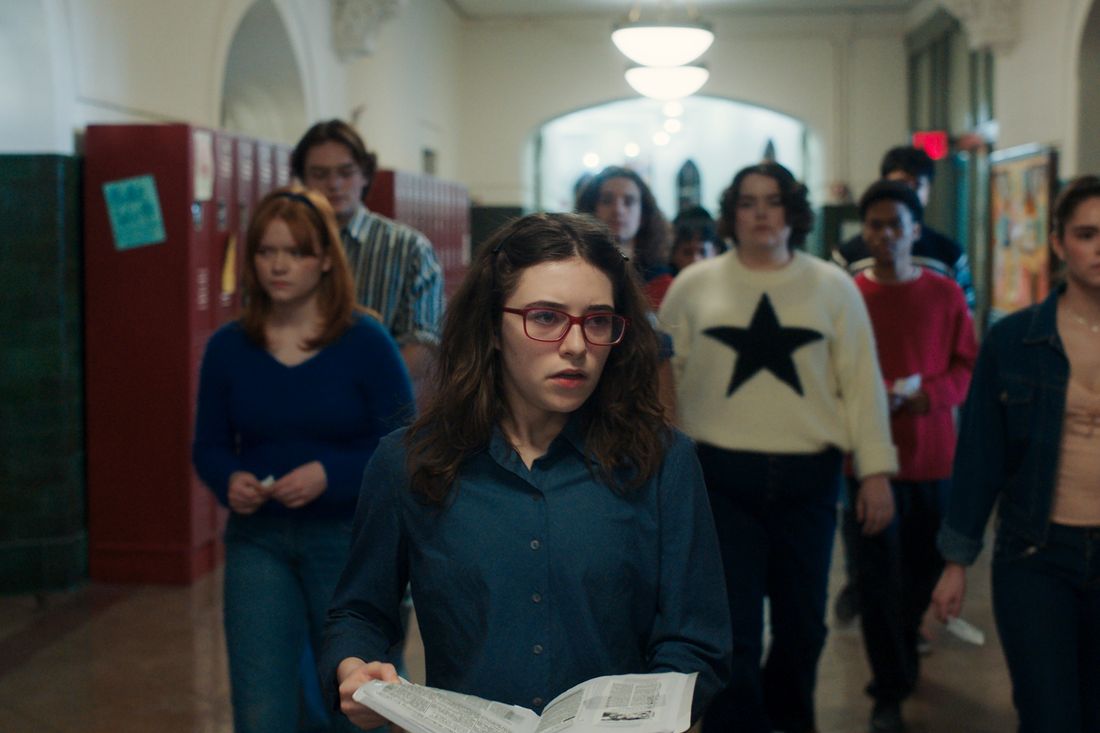
A particularly striking scene early in N.B. Mager’s Run Amok depicts a group of high school students revisiting the site of a school shooting that occurred ten years prior. Led by Meg (Alyssa Marvin), who lost her mother in the tragedy, they plan to create a musical about the event. As they walk the hallways, scripts in hand, they mark where the shootings took place and practice the scenes, almost like a preliminary rehearsal. The atmosphere is mostly serious and focused; Meg prioritizes accuracy, carefully noting the order of events and the locations of the victims and shooter. While some students overact or even show genuine fear, others try to lighten the mood with jokes. It’s difficult to discern a clear emotional response from the group. The shooting happened so long ago—and they’ve had so many lockdown drills since—that it feels distant, lacking the immediacy of trauma, either collectively or individually. It’s simply an event they want to document with precision.
While the rest of Run Amok doesn’t hit quite as hard as this particular scene, its unsettling atmosphere lingers throughout the film. What’s striking is that the adults are the ones most deeply affected by the tragedy, not the children—even Meg, who eventually learns she was at school during the shooting. The teachers carry orange toy guns and some are disturbingly quick to use them. Mr. Hunt, the woodworking teacher (Bill Camp), obsessively shoots at squirrels to protect the birds in a birdhouse he built, a heavy-handed symbol that becomes even more obvious as the film goes on. Mr. Shelby (Patrick Wilson), who lost his hand and killed the shooter, is overly supportive of Meg, seemingly trying to atone for what he feels he failed to prevent. Ultimately, all the adults are haunted by their inability to protect the children.
Meg is living with her cousin Penny (played by Sophia Torres) and her family, and she came up with the idea for their musical performance. Both girls are gifted musicians – Meg plays the harp like her mother, and Penny is a wonderful singer. When their teacher suggests performing “Amazing Grace,” they take it in a surprising new direction, turning it into a large-scale, modern show with pop music and dance that reflects a difficult historical event. While the musical doesn’t fully come together, it’s because it tries to do too much. The film hints at a more experimental and ambitious production, but ultimately focuses on the relationship between Meg and Penny, showing them arguing and then reconciling. However, this falling out feels forced and doesn’t quite ring true. Despite this, the two young actresses, Marvin and Torres, deliver such strong performances that the story is still compelling.
Both Run Amok and The Musical – two films at this year’s Sundance – center around school productions that raise questions about adult responsibility. But more broadly, many films at the festival explore our collective struggle to keep children safe. Whether it’s the story of a girl testifying in a rape case (Josephine), a father struggling with his daughter’s anxiety (Carousel), adults complicating a middle school musical (The Musical), or a refugee family torn apart by abuse (One in a Million), these films often show adults failing the children they’re trying to help. This pattern suggests a larger issue: perhaps we’re so focused on protecting kids that we’ve overlooked our own shortcomings, ultimately leaving them with a broken world. It’s a troubling trend, and it feels like a reflection of the increasing darkness and uncertainty in the world around us.
Let’s revisit the hallway scene in Run Amok. While the scene feels calm and matter-of-fact, what really stands out is the feeling of unsettling discovery. As Meg reads the details in her script, she becomes increasingly puzzled. Each piece of information feels fresh and she struggles to understand what it all means. It’s clear no one has ever explained this to her before. Noticeably, the adults are absent from the hallway – and throughout much of the film, they’re either withdrawn and unresponsive, stuck in a daze at their homes or offices, or they’re acting aggressively, brandishing toy guns. They’re limited to either doing nothing or resorting to violence; they can’t communicate, only freeze or shoot. Consequently, the children – in this film and others at Sundance – are left to simply try and make sense of the broken world around them.
Read More
- United Airlines can now kick passengers off flights and ban them for not using headphones
- Crimson Desert: Disconnected Truth Puzzle Guide
- All 9 Coalition Heroes In Invincible Season 4 & Their Powers
- Mewgenics vinyl limited editions now available to pre-order
- Grey’s Anatomy Season 23 Confirmed for 2026-2027 Broadcast Season
- Viral Letterboxd keychain lets cinephiles show off their favorite movies on the go
- Assassin’s Creed Shadows will get upgraded PSSR support on PS5 Pro with Title Update 1.1.9 launching April 7
- The Boys Season 5 Spoilers: Every Major Character Death If the Show Follows the Comics
- How to Get to the Undercoast in Esoteric Ebb
- Does Mark survive Invincible vs Conquest 2? Comics reveal fate after S4E5
2026-02-02 21:54