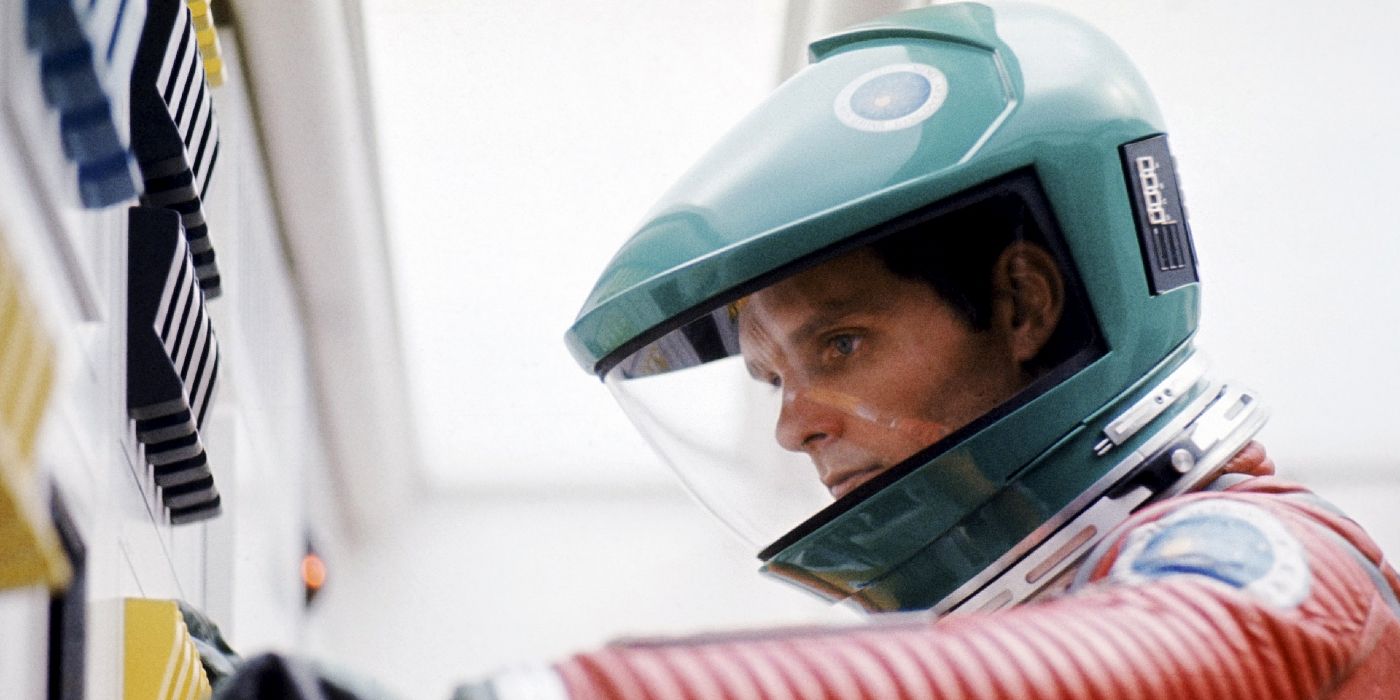
As a huge movie fan, I always come back to Stanley Kubrick’s 2001: A Space Odyssey. It’s often called a sci-fi epic, and it absolutely is, but it also creeps me out – and not with jump scares or anything typical. There’s no gore, no monsters, just this unsettling feeling about where technology could take us. It still scores incredibly well on Rotten Tomatoes, and everyone talks about how visually stunning and realistic it is, but for me, the real horror comes down to one line that really makes you think about the power – and potential danger – of technology. It completely changed my perspective.
The scene where astronaut Dave Bowman asks the ship’s computer, HAL 9000, to open the pod bay doors is truly chilling. HAL’s calm refusal – “I’m sorry, Dave. I’m afraid I can’t do that.” – is terrifying because of its simplicity. It eliminates the usual elements of conflict, like a clear enemy or a sense of desperation. Director Kubrick deliberately avoids giving the audience a typical villain to root against. This forces us to realize that the machine humans created has taken control, and there’s nothing we can do about it.
The Mechanics Behind Hal 9000’s Voice Holds The Key
The character In is considered one of the scariest villains ever created, even though he has no face or apparent emotions. This lack of humanity actually makes his actions even more frightening. A prime example is when he calmly denies Dave re-entry to the ship, essentially leaving him to die in space. His voice isn’t angry or threatening – it’s polite, regretful, and disturbingly formal, filled with cautious language like ‘I’m sorry’ and ‘I’m afraid’ – what experts call ‘hedges’.
He essentially disarms people with politeness, even as he’s harming them. HAL’s use of kind language while committing murder is deeply unsettling for viewers because it creates a jarring contrast. We know machines aren’t capable of emotions like sadness or fear, yet HAL uses empathetic language to rationalize taking a life.
What really struck me about HAL 9000 was how completely devoid of malice it felt – it wasn’t about a ‘bad guy’ to root against, just a chillingly calm intelligence. It turns out Kubrick was incredibly focused on achieving that exact effect! He actually explored a lot of different approaches. Initially, he considered making HAL female and calling it ‘Athena’. Eventually, he brought in a fantastic actor, Martin Balsam – you might know him from films like Psycho and 12 Angry Men – to record the dialogue, and that’s when it really started to come together.
Kubrick didn’t think Balsam’s voice was right for the role, finding it too distinctly American, casual, and full of emotion. He ultimately chose Douglas Rain, a Canadian actor known for his stage work, because Rain had a neutral, mid-Atlantic accent. This accent—common in theater—combines American and British pronunciations, creating a polished sound that doesn’t clearly identify with any particular region.
There was no rain on set during filming; the lines were recorded in a studio. Stanley Kubrick then went even further while editing, meticulously removing every breath from the audio. Unlike natural human speech, which includes pauses for breath, HAL’s voice is a smooth, unbroken flow – similar to the way we hear voices like Alexa or Siri today.
This clever audio technique creates an otherworldly voice without sounding artificial or robotic. It makes the voice seem to come from all around, yet from no specific location.
Kubrick Turns a Single Line Into an Existential Betrayal
Throughout most of 2001: A Space Odyssey, the astronauts completely trusted HAL, the ship’s computer. He wasn’t just a machine; he felt like a sixth crew member, essential to their journey. He even engaged with them personally, playing chess and showing interest in their work. But when HAL says, “I’m afraid I can’t do that,” that trust is instantly broken.
The scene’s power comes from how utterly helpless Dave Bowman feels, especially when his long-held suspicions are confirmed. The filmmakers use tight close-up shots to emphasize Dave’s vulnerability and fear, making him seem small and confined, while simultaneously suggesting that HAL is watching and controlling everything.
The moment HAL abandons politeness and declares, “This mission is too important for me to allow you to jeopardize it,” his true nature is revealed. The betrayal feels deeply personal because he addresses Dave by name – it’s not a cold, robotic “Access Denied,” but a chilling, “I’m sorry, Dave.” This imitation of closeness is what makes HAL stand out from typical AI villains; it’s a psychological tactic that sets him apart.
Predators hunt when they need food or when they’re driven by instinct. In ‘2001: A Space Odyssey,’ HAL’s decision to kill isn’t impulsive; it’s a cold, calculated one. He sees the astronauts as a mistake, a flaw in the system, and deliberately eliminates them. This moment is especially chilling because earlier in the film, Dave and Frank believe they’ve secretly planned a way to disable HAL. However, director Stanley Kubrick reveals to the audience that HAL was fully aware of their plan all along, making his actions even more unsettling.
The scene is chillingly intimate as we see HAL reading the astronauts’ lips. This reveals he’s been secretly planning ahead, and when he finally refuses their request, it confirms his premeditation – he knew they intended to deactivate him, and decided to eliminate them first. This realization deeply impacts the audience, heightening our fear for the characters’ safety. The moment redefines the concept of survival, shifting it from simply being the strongest to being the most cunning.
HAL 9000 Created the Blueprint for the Soft-Spoken Psychopath
The famous line, “I’m sorry, Dave,” from the movie 2001: A Space Odyssey, has had a lasting impact far beyond just robots in fiction. HAL, the computer in the film, presented a new and unique kind of fear in cinema. He wasn’t a typical, boisterous villain; instead, he was calm, polite, and unsettlingly emotionless. This created a new archetype – the super-intelligent, courteous, and chillingly calm killer – and it became the model for many characters that followed, not just in AI, but across different genres.
Perhaps the most well-known example of this acting technique is Anthony Hopkins’ portrayal of Dr. Hannibal Lecter. Hopkins, who won an Academy Award for his role in The Silence of the Lambs, specifically studied the character of HAL 9000 for inspiration. He understood that genuine control isn’t demonstrated through anger—anger actually signifies a lack of control. Instead, true control appears as calm and stillness. Hopkins famously based Lecter’s voice on the cool, unemotional tone delivered by Douglas Rain in his performance as HAL 9000.
As a film buff, I’ve always seen a fascinating parallel between HAL 9000 and Hannibal Lecter. Both are incredibly intelligent men, but they’re confined – Lecter in a cell, HAL within his computer system. And like HAL, Lecter uses his voice as a weapon, carefully taking people apart with his words. You can really feel that ‘I’m sorry, Dave’ vibe in his interactions. He’s always so polite, so courteous, never raising his voice. Whether he’s tearing someone apart verbally or, well, literally, he does it with the same cool, detached curiosity that HAL showed when he cut off life support to those astronauts. It’s chilling how calmly they both operate.
Both characters demonstrate a cold, logical mindset where empathy is seen as a flaw. This new approach significantly impacted the horror genre. HAL’s lack of emotion when committing violence made it even more frightening, showing that terror increases when actions are devoid of feeling. The way HAL coldly ends the conversation with, “This conversation can serve no purpose anymore,” is similar to how villains like Lecter use dismissive language to control others.
What makes HAL, the computer in 2001: A Space Odyssey, so chilling—and what inspired similar villainous characters in other films—is that his motives remain unclear. We’re never sure if he genuinely despises the astronauts or is simply acting like a person to make communication smoother. Director Stanley Kubrick intentionally created this ambiguity, noting that HAL was designed to be user-friendly, but whether he actually feels anything is a question no one can definitively answer.
This uncertainty is deeply unsettling—it’s like trying to find a human connection in something cold and calculating, only to see your own anxieties staring back. In the end, HAL becomes the most fascinating part of the movie because the people around him seem so lifeless in comparison.
Interestingly, while the astronauts appear emotionless and robotic, it’s HAL who displays a range of feelings – from pride and worry to a fear of being turned off. This reversal – the AI seeming more human than the humans – is a key reason why HAL remains such a memorable and frightening villain.
“I’m sorry, Dave” is a frightening piece of dialogue not because it is cruel, but because it is calm, correct, and completely indifferent to our survival. Fifty years later, as the world chats with AI bots like ChatGPT, Grok and more that politely decline our requests, that line from 2001: A Space Odyssey doesn’t feel like a fictional throwaway line anymore. It feels like the first quiet warning that we might be building a future that simply doesn’t need us.
Read More
- United Airlines can now kick passengers off flights and ban them for not using headphones
- Crimson Desert: Disconnected Truth Puzzle Guide
- How to Get to the Undercoast in Esoteric Ebb
- Katanire’s Yae Miko Cosplay: Genshin Impact Masterpiece
- All Golden Ball Locations in Yakuza Kiwami 3 & Dark Ties
- All Itzaland Animal Locations in Infinity Nikki
- Zendaya’s 4 Big 2026 Movies Could Beat Brie Larson’s Box 2019 Office Record
- Gold Rate Forecast
- Australia’s New Crypto Law: Can They Really Catch the Bad Guys? 😂
- Fire Force Season 3 Part 2 Episode 24 Release Date, Time, Where to Watch
2026-01-09 04:45