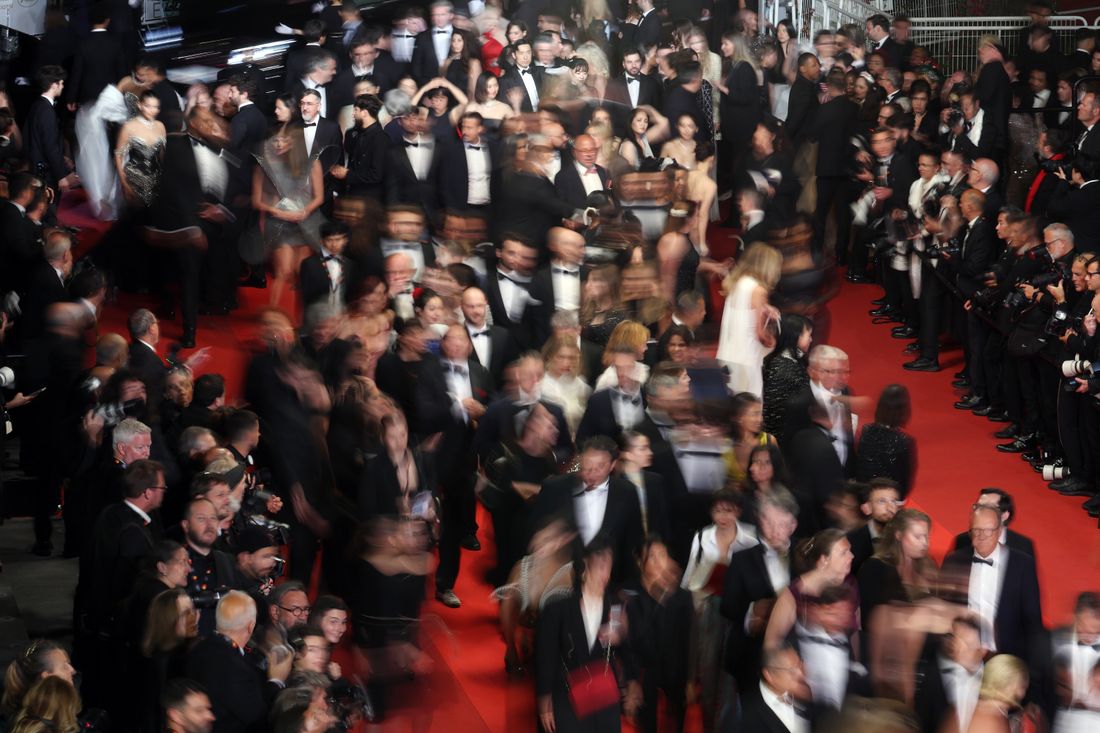
Okay, so Cannes this year felt…off. It wasn’t just Meta’s heavy presence, it was like a weird curse was hanging over everything. It started with Jacob Elordi breaking his foot and having to step down from the jury, which was a bummer. Then, at one of the parties, a part of the roof actually collapsed! A lot of the really good movies ended up screening outside of the main competition, which felt strange. Personally, someone actually ate my dinner while Sharon Stone was yelling at me to give a stranger a hug! And to top it all off, Barbra Streisand couldn’t even fly in to accept her award because of a knee injury. Honestly, the only thing everyone was talking about, besides all the chaos, was AI. It was a truly bizarre festival.
Demi Moore kicked off the festival by sharing her thoughts on AI during a press conference. When asked about protecting human creativity, she explained that opposing AI is likely futile. “AI is here to stay,” she said, “and instead of fighting it, we should explore how to collaborate with it.” Unfortunately, the discussion didn’t go well after that.
The second day of the festival, I headed to Meta House, a temporary installation inside the Majestic Hotel in Cannes. It was clearly set up for Mark Zuckerberg to showcase his smart glasses to attendees. The entire room was surprisingly painted blue, even the carpet. I started talking to a group of young French men, all dressed sharply in white shirts and black pants, along with their manager, who reminded me of something from the show Entourage. They told me they made comedy videos – I later found out they had a huge following on Instagram and TikTok. Throughout the room, pairs of Meta Ray-Ban glasses were displayed in glass cases. I picked up a pair, but couldn’t figure out how to turn them on. One of the French men tried to help, showing me a small button on the side, but we still couldn’t get them to work.
He smiled and said, “I’ve got a pair.” He explained that he and his comedy group were all 21 years old. I admitted I thought the glasses were unsettling and felt like a breach of privacy. He quickly dismissed that concern, saying they used them for pranks. He showed me a video he’d taken with the glasses of a woman on the street who initially looked confused, but eventually played along. He insisted they always asked people for permission before posting the videos and that everyone agreed. He also mentioned Meta had recently sent the group new Ray-Bans, describing them as “really cool” with built-in headphones for listening to music.
Look, I have a really unsettling feeling about the Meta House. I’ve been filmed there without my consent more than once, and I’m pretty sure it’s going to come back to haunt me – I can just picture my face plastered on a billboard advertising some future Meta-run prison. I asked a staff member to show me how the glasses worked, thinking I could maybe document what’s really going on there. He explained they had this “AI function” – microphones everywhere, the ability to play music, make calls, even translate languages. Basically, a whole lot of features that could easily be used to incriminate me, and potentially even future generations. He then led me into this weird, dark room with flashing lights meant to simulate being surrounded by paparazzi, and suggested I record myself with the glasses, pretending to be famous. I did, and now I’m worried about what that footage will be used for.
I questioned whether he worried about making it acceptable to record people in public with the glasses, which looked harmless. He compared them to phones, explaining there was a small light to show when recording was happening. I noticed the light was indeed there, but wondered if everyone would notice it. I mentioned comedians had used the glasses to play tricks on people. He acknowledged that many wouldn’t know about the light, but believed people would start looking for it once they knew about the glasses. He argued the glasses were better for society than phones because they allowed people to be more aware of their surroundings. I returned the glasses and then realized I’d been holding my phone the whole time. After he playfully pointed it out, we both laughed. He joked that the phone had become an extension of me.
A few days later, I watched Steven Soderbergh’s new documentary, John Lennon: The Last Interview, without my glasses. The film uses audio from a lengthy interview with John Lennon and Yoko Ono recorded just hours before Lennon’s death. Soderbergh had been open about his use of artificial intelligence in making the film, explaining that about 10% of it was created using Meta’s AI video tool. He noted that creating those sections with traditional visual effects would have been far too costly and would have taken a year, compared to the five weeks it took with AI. He described how the creative process would have been different without AI, explaining that he’d ask his team for specific, sometimes unusual, visuals – like a vintage radio appearing on screen with glowing rings – and then give them feedback to refine the effects, slowing things down or changing sizes until he got the look he wanted. He admitted this process likely frustrated his team.
As a fan of Steven Soderbergh, it’s disappointing to say this film feels like something you’d stumble across on an older person’s Facebook feed. It’s filled with clashing visuals – old footage of John Lennon and Yoko Ono mixed with bizarre images that seem to have been created by literally interpreting their conversations. For example, when Lennon discusses men’s ‘primitive’ instincts, the film shows scary, muscular cavemen. When he talks about being a present father, we see a baby crawling through an office. And when he describes artists as reflections of society, we’re shown a strange series of people holding or walking past mirrors.
The film reaches a particularly weak point when Lennon discusses the decline of countercultural politics, mocking those who felt the movement hadn’t delivered on their promises. This is accompanied by images of crying babies dressed in hippie clothes. Despite plenty of real protest footage from the 1970s being available—some of which is used—the film relies heavily on staged scenes with fake protesters, generals, and kings. There are also bizarre, visually jarring elements like artificial oil spills, people floating in the air, and peacocks wandering through fake city streets. Recurring images, like a black rose changing into different objects and a distracting light effect, add to the film’s issues. The Cannes screening saw a significant number of walkouts, and critics have largely condemned it.
Look, I couldn’t get into the super-exclusive Anthropic party at the Hotel du Cap – apparently, the press wasn’t welcome. It felt a little too on-the-nose, honestly, like it was just a gathering of billionaires figuring out their escape plans after… well, you can imagine. But I did get invited onto a yacht to see something truly strange: a “film” entirely made with AI, costing a hefty $500,000 and created by a team of 15 in just two weeks. And it wasn’t alone. The festival was full of AI-generated content, from a short adult film built from vintage magazine photos to a Prada-sponsored piece by Nicolas Winding Refn and Hideo Kojima. There were startups everywhere pitching the idea that this is all ethical and affordable. On the yacht, a familiar director from the 90s and the CEO of the AI company talked about the “movie” in a short discussion. Honestly, I’m hesitant to even mention names, because I don’t want to give this whole thing any credibility it doesn’t deserve.
One panelist noted that while many people are used to short videos online, this new content stands out due to its high quality and length – lasting over 90 minutes. The panelists repeatedly emphasized that AI should be seen as a helpful “tool.” One panelist, speaking with excitement, encouraged filmmakers, especially those from underrepresented groups, to embrace these tools and use them to gain an advantage.
One of the filmmakers explained that while the core of making movies remains the same, AI tools can give creators a significant advantage – and some in Hollywood aren’t thrilled about that. They discussed how AI could replace traditional elements like physical sets, costumes, and even actors, primarily to cut costs. However, they emphasized that it’s not just about saving money. The goal is to use this technology to create more visually stunning, grand-scale films and ultimately provide a better experience for audiences.
We were shown a trailer playing on a TV near the front of the yacht. It opened with a voice-over, accompanied by visuals that resembled a low-budget version of Final Fantasy. A woman’s voice asks, “Do you ever wonder what happens next?” A man responds, “What do you mean, next?” She replies, “After everything stops.” The trailer then shows an AI character, a man, kneeling in a forest surrounded by blue flowers.
The trailer suddenly stopped working because of a technical problem, and everything went silent. One of the executives said they wouldn’t waste time trying to fix it if it was hopeless. They tried starting it up again.
“Do you ever wonder what comes next?” “What do you mean, next?” “After we’re done.” The trailer fell silent, then the sound played once more.
“You ever think about what happens after?” “After what?” “After we stop.”
The latest preview started with a quick rundown of the story, which felt very similar to a Marvel movie like Infinity War: apparently, gods created six incredibly powerful objects, three of which were taken by demons and three hidden on Earth. Then, an AI-powered demon caught a bomb, and… well, it let out a loud fart. At that point, the people showing the trailer just stopped – they seemed to have lost their momentum.
The discussion continued with little enthusiasm. The director shared his reasoning for focusing on AI rather than traditional filmmaking. He explained that his daughter questioned the long wait times for movie sequels, prompting him to explore faster production methods. He aims to create animated films comparable to popular movies within a year, believing this is the future of creating and maintaining intellectual property. He argued that releasing sequels quickly—within a year—is crucial to keep a young audience engaged, as waiting longer risks them outgrowing the content.
He addressed the audience with a smile, explaining his vision for the future: leveraging AI to enhance content creation. He believes the key is to empower audiences, allowing them to interact with and even build upon existing content, ultimately fostering a more collaborative and engaging experience.
Read More
- Netflix’s Little House On The Prairie Reboot: Release Date, Cast & Everything We Know
- Off Campus Season 1 Soundtrack Guide
- Silver Rate Forecast
- Prime Video’s New R-Rated Spy Thriller Is Officially No.1 On Streaming Despite Poor Reviews
- Gold Rate Forecast
- Brent Oil Forecast
- EUR ZAR PREDICTION
- 币安人生 PREDICTION. 币安人生 cryptocurrency
- EUR USD PREDICTION
- KPop Demon Hunters Meets Avatar: The Last Airbender In Netflix’s 3-Part Fantasy Series
2026-05-22 19:58