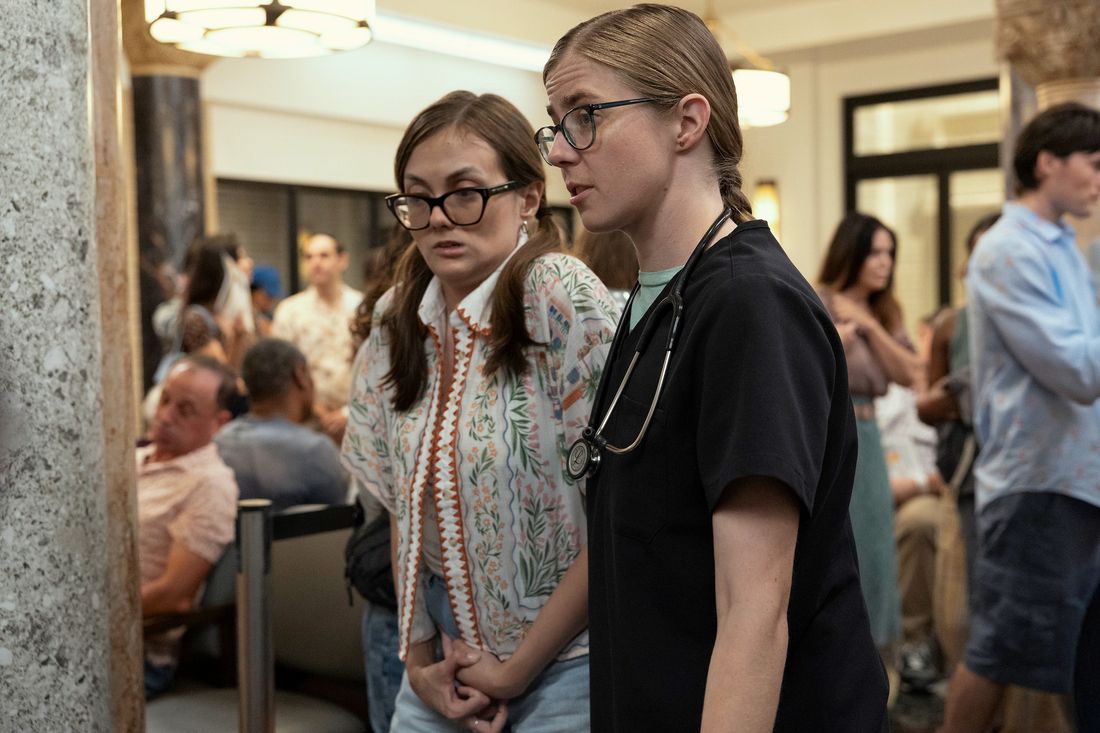
When Becca King, a patient at The Pitt, goes to the emergency room with a stomachache, she finds out she has a urinary tract infection. Dr. Langdon assures her it’s easily treated with antibiotics. However, Becca is more upset by her sister Mel’s reaction. Mel, usually very caring, becomes distressed when she learns the infection might be due to Becca’s secret relationship with a fellow care facility resident. They’ve been dating for six months and are very close. Mel is hurt that Becca kept this hidden, worries about being alone, and fears this new boyfriend, Adam, might be taking advantage of her. Becca, however, sees things differently – she’s an adult with her own desires. When Mel gets upset during their argument, it’s unusual for these normally close twins.
Children’s book author Anderson, who strongly believes in realistic portrayals of autism, saw this storyline as a chance to show a character with autism having a normal sex life – something rarely seen. She explains that disabled people are often treated like children, and there’s a real need to support the right of disabled adults to make their own choices about relationships and intimacy.
I didn’t know my storyline would include a visit to Mel’s workplace until I received the offer for episode seven – at that point, I only knew Becca would return for the second season. I’ll admit, I was hoping for a more dramatic return for her, like a serious illness requiring a hospital visit! It wasn’t until I got the script for episode nine that I learned I’d be going to the emergency department, but I still didn’t know what would happen after that.
I really enjoyed filming in the emergency room setting. The set was incredibly realistic – even though it was a soundstage, it truly felt like a busy ED. The waiting room, in particular, felt exactly as you’d expect: crowded, hot, and full of people. Shawn Hatosy, who directed one of the episodes, was a great help in making my movements through the space feel natural and authentic – it was almost like choreography.
Damian Marcano directed the tenth episode, and it featured a scene with Patrick Ball that was unexpectedly complex – it’s actually one of my favorites. Uta Briesewitz directed the eleventh episode, and she guided me through a crowded, sweaty maze of a lobby. It was deliberately chaotic, but a really effective kind of chaos.
The show portrays realistic ways to support autistic patients, like Langdon being mindful of his approach and asking Mel to dim the lights. Many autistic viewers have reached out to say these small details are meaningful to them. Personally, I always appreciate it when people are aware of accommodations – in a hospital or anywhere else – and are willing to ask how they can best support someone.
Honestly, dimming the lights doesn’t really bother me at the doctor’s, but I know it can make a huge difference for a lot of people on the autism spectrum. If a doctor asked me my preference, I’d probably say I’m fine with them on. But the simple fact that they asked would be enough to show me they’re considerate. It’s really thoughtful to offer that choice, instead of just assuming what everyone needs when it comes to sensory stuff. I truly value that level of respect.
It’s unusual to find professionals who are truly considerate of personal needs, even doctors I’ve known for years. Generally, I’ve found people don’t go above and beyond, particularly in healthcare. However, I do remember one positive experience: when I was cast in a TV show, the costume department called before my fitting to ask if I had any preferences or dislikes regarding fabrics or how clothes fit. It turned out they were checking for sensitivities to textures or if I’d prefer looser clothing. At the fitting itself, they were careful to ask if everything felt comfortable and if I needed a different size.
Many neurodivergent people are very sensitive to touch, so when someone asked me about my preferences, I understood they were trying to be thoughtful. I definitely experience this – I really dislike scratchy clothes, especially sweaters. Glitter or sequins are the worst because I can feel every little thread and hard piece against my skin, and I usually need to wear silk underneath anything with those details. It means a lot when someone notices and asks, because I often worry about being a bother or making things difficult for them.
I’ve really enjoyed working with Taylor Dearden this season. We had a lot more face-to-face time, and she’s incredibly supportive of Becca and Mel’s relationship, always making an effort to connect with me. Taylor is also neurodivergent, which gives her a unique understanding of how I think. She’s great at anticipating my needs and often explains things or brings up potential questions before I even realize I have them.
Becca revealed to Mel that she has a boyfriend and a very active sex life, sharing this information shortly after discovering she had a urinary tract infection. This was the moment that deeply upset Mel.
I was completely surprised when Taylor told me what happened in the next episode – she was bursting to share it with me! I hadn’t read the script yet, and my immediate reaction was, “Oh my God, really?” I was so thrilled that my character, Becca, was going to have such a powerful moment and represent something so important.
Why did Becca keep her relationship with Adam a secret from Mel? It’s a tricky situation. Becca would say she didn’t want to upset Mel and wanted her to find a boyfriend first. But that’s not the full explanation. Becca also seemed to want to enjoy the new relationship privately. Having a boyfriend is a big deal for Becca, who doesn’t have a lot of experience with dating, and she wanted to savor the moment. Despite wanting to share the news with Mel, she held back. Becca and Mel are very close and usually share everything, so this secrecy is new and uncomfortable for both of them, and it already feels strained.
In this episode, Mel’s actions clearly bother Becca, and it’s more than just her getting upset. As the actor playing Becca, I really focused on understanding her perspective, and that’s why accurate representation matters so much. While my own life is different from Becca’s, I can relate to feeling reliant on others and having a life shaped by those dependencies. Becca is an adult woman with a disability who knows what she wants and what will make her happy, and right now, Adam is part of that happiness. So, when Mel reacts strongly, it throws Becca off balance – she dislikes conflict, and she’s not used to Mel acting that way towards her. Mel is usually calm, which makes it even more surprising. But Becca also recognizes that Mel is both her sister and her caregiver, and on some level, she understands Mel has the power to influence the situation, even to potentially change things with Adam.
In her final scene with Mel, Becca seems conflicted when Mel asks for Adam’s parents’ number. Becca has become accustomed to having her life closely managed, and she’s now trying to establish her independence. While she loves and appreciates Mel – they were each other’s only family before Adam – she’s starting to want more control over her own life. She’s figuring out who she is as an adult and learning to assert herself, and she’s beginning to question how much Mel needs to be involved in her personal relationships. It’s a difficult situation for both of them, as Mel is trying to balance being a sister and a caregiver, and Becca is navigating her newfound independence.
It’s rare to see realistic portrayals of neurodivergent people and their experiences with sex, both in real life and in media. As a disabled person, I can say that many of us are often treated like children. We’re even seeing this play out online right now with discussions about a recent show. While many people are glad to see a character asserting her independence, some only approve of her having a romantic relationship if it’s with another disabled person – which feels prejudiced to me.
There’s still a lot of work to be done to support the right of disabled adults to make their own choices. It’s a complex issue, and there aren’t any easy answers. A common misunderstanding is that autistic people don’t experience relationships like anyone else – they absolutely do! Autistic individuals fall in love, have families, get married, and find partners both within and outside the autistic community. Everyone is different, and the key question here is whether Becca can make these decisions independently, or if she needs some help. What’s clear is that she’s eager to be more independent and is actively working towards that goal.
In ‘The Pitt,’ I was able to portray aspects of the autistic experience that I hadn’t before. I really connected with my character, Becca, because, like her, I manage independent living with help from others. Playing Becca allowed me to show audiences that adults should have the freedom to make their own choices, but sadly, that’s not always the case for disabled adults. It’s fascinating how the twins, Mel and Becca, have different support needs yet still help each other. Their relationship feels very real and demonstrates how respect, love, and support can lead to a fulfilling connection for both people. It’s incredibly meaningful to see Mel protect Becca’s dignity and accept her vulnerabilities. Mel provides such good care that Becca grows and finds her own happiness, which is wonderful, but ironically, this independence makes Mel uneasy.
I was wondering how often you and Taylor discussed portraying neurodivergence on screen, either in the first or second season. We’ve talked about it some, and also about what it’s like to be a neurodivergent actor working in the industry. Taylor shared a really insightful point with me when we met – she explained how learning lines and figuring out movement can be different for neurodivergent people. Usually, actors memorize their lines and then learn where to move, and they can easily put it all together. But for us, the words are there, but when we start physically acting out the scene, we need to focus on the movement first, especially if it’s complicated. Then, our brains can connect the movement with the lines we’ve memorized. It’s not the same for everyone, but that’s one example of how neurodivergence can show up in a practical, everyday work situation – at least for Taylor and me.
This narrative allows Becca to be a driving force, rather than simply existing within Mel’s story. As someone who champions understanding and writes stories yourself, how can portrayals of autism empower characters on the spectrum? A great starting point is to remember that autism is diverse. Trying to represent every possible experience or stereotype in one character is unhelpful and creates someone unrealistic. It’s also important to remember that autistic people are simply people – our neighbors, teachers, colleagues, and family members. We can give autistic characters more agency by writing them as everyday individuals, sharing their unique perspectives as part of the story, rather than making autism the sole focus.
As a movie lover, I’ve been thinking a lot about how we portray autistic characters, and honestly, it’s often pretty limited. We so frequently see the same type – a young, white male – and it doesn’t reflect the beautiful diversity within the autistic community. I’d love to see characters who are married, raising families, or who are diagnosed as adults. Let’s show autistic people navigating life independently, with the support they need, and those who don’t speak. And it’s crucial we see more representation of autistic people of color – especially AAPI and Indigenous individuals – as well as nonbinary autistic characters. Seeing this wider range of stories would really change the conversation and give everyone a more realistic understanding of what autism looks like.
Read More
- United Airlines can now kick passengers off flights and ban them for not using headphones
- Gold Rate Forecast
- All Golden Ball Locations in Yakuza Kiwami 3 & Dark Ties
- How to Solve the Glenbright Manor Puzzle in Crimson Desert
- How to Get to the Undercoast in Esoteric Ebb
- 8 Actors Who Could Play Blackbeard In One Piece Live-Action Season 3
- Netflix’s 4-Part Crime Thriller Is One Of Its Very Best
- How to Complete Bloom of Tranquility Challenge in Infinity Nikki
- Is Wuthering Heights a romance? Update on Margot Robbie movie controversy
- $2B AI cow collars use “cowgorithm” to herd cattle with no fences
2026-03-24 15:56