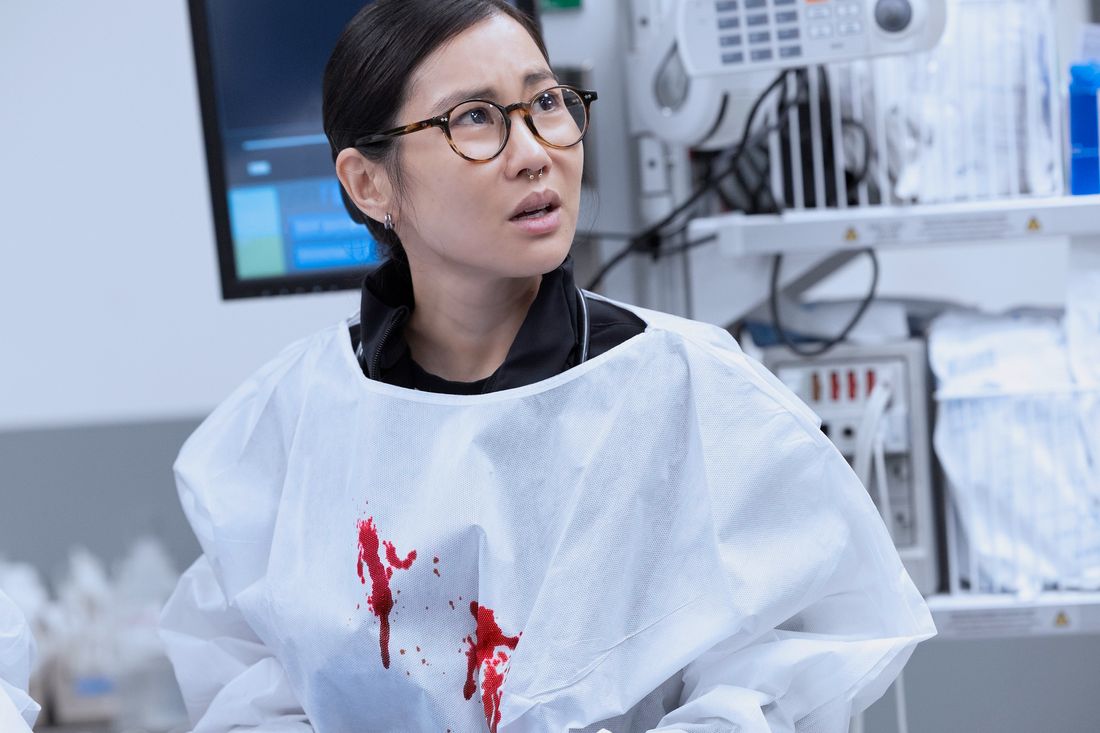
After twelve hours of the second season of The Pitt, the day shift is done. However, for many of the doctors and nurses in the emergency room, the workday isn’t over yet. Dr. Langdon (Patrick Ball) explains to medical student Joy Kwon (Irene Choi) that putting in extra hours is typical, but Joy isn’t convinced. She counters with a statistic: 62% of ER doctors experience burnout, and she doesn’t want to become one of them.
This isn’t the first time Joy has politely declined to go above and beyond, especially when compared to her classmate James Ogilvie, who always tries to impress. On a team of highly motivated students, Joy is noticeably relaxed and seems almost uninterested. As one colleague put it, she openly doesn’t pretend to care. While Joy’s lack of enthusiasm might stem from a disinterest in emergency medicine – it’s her first experience, and she admits her grandmother’s death from leukemia made her question wanting to work around dying patients – there’s likely more to it. Having immigrant parents, like herself, led one colleague to consider Joy’s reserved nature. She explained that daughters of immigrant families often feel a strong sense of responsibility for their parents’ well-being, including helping them navigate a new system, which can create significant pressure and lead to burnout, a struggle both Joy and another student, Mohan, seem to share.
I found out about The Pitt through my agents when I was starting to feel discouraged about the industry. It seemed like everyone was having to adjust – movie actors were taking TV roles, and even those with steady jobs on shows were only getting occasional appearances. It’s tough for actors in general, but especially for someone like me, growing up as the child of immigrants with no connections or inside access. Progressing in my career had become really difficult, and the audition came at a time when I wasn’t sure what the future held.
I really connected with the character. Usually, for important auditions, I work with a coach or rehearse with others, but I didn’t have that opportunity this time. I don’t want to sound pessimistic, but I was at a point in my life where I wasn’t putting too much pressure on myself. My approach was simply to do my best to portray the character honestly and authentically, and if it didn’t work out, that was okay. I had an in-person callback – that used to be the norm before COVID – and it felt almost too good to be true, like a perfect first date.
I immediately connected with Joy because of her background as the daughter of immigrants, something the show later confirmed. What really stood out to me was how she maintained strong personal boundaries and didn’t feel the need to constantly express herself. As an actor, I’m trained to look for moments to react and display emotion, but Joy’s authenticity came from her quietness and reserved nature. A challenge for me was to subtly portray her inner thoughts and feelings without overacting.
We often think of boundaries as being clearly stated – someone directly telling others what they won’t accept. I personally struggle with directly confronting people, so I tend to create boundaries by putting up emotional walls. When someone described me as having strong boundaries despite being quiet, it made me realize I express my limits through these protective layers. Later, Noah told us to expect a moment where everyone’s defenses would come down, revealing the personal struggles each doctor was carrying.
Does Joy reveal her true self? Throughout the season, Joy has generally avoided quick judgments, but the situation with the toddler experiencing heatstroke seems to break that pattern – she acts impulsively, much like Santos. This raises the question of how many layers Joy has, and whether removing one mask simply reveals another barrier.
When I first read the scene where her character reacts suspiciously to the child’s mother, it really affected me emotionally. However, when we filmed it, I decided to play it more subtly because a strong emotional reaction would have been out of character for her. I wanted to ensure her reaction was different from another character’s, even though their actions might seem similar. I decided the source of her reaction stemmed from past neglect and a lack of a stable family, while the other character’s reaction was rooted in a difficult or toxic family upbringing. These were choices I made on my own, without discussing them with the other writers.
Her accusatory tone immediately made me dislike her. It brought up some strong feelings in me. She quickly assumed the situation was a case of excessive punishment, and that felt like the only logical explanation. Learning about Joy’s background – growing up without access to healthcare or insurance – helped me realize she likely experienced a childhood where harsh discipline was common. I wanted to emphasize that Joy was more upset with the mother than she was sympathetic towards the child, because there were already plenty of people feeling sorry for the kid.
In the final scene, Joy firmly prioritizes her personal life and leaves work on time. It’s refreshing to see a character who genuinely wants to finish her shift and go home. This was a key part of her character from the beginning – she’s always aware of the time and eager to leave at 7 p.m. This really establishes her boundaries; she’s determined to stick to her schedule. I hesitate to focus on race, but this felt incredibly realistic. I rarely see someone who looks like me portrayed as someone who prioritizes leaving work on time. In a way, she reminds me of Stanley from The Office – it’s a surprisingly unique portrayal. Many people, especially Asian women, have told me they’re thrilled to see a character like this, because she’s not the type of role usually written for us.
Is Joy’s insistence on leaving work on time a sign she’s growing up, or does it suggest immaturity? Like many people, Joy has both strengths and weaknesses. Mohan pointed out to Robby the importance of separating work and personal life, and Joy is usually good at that. However, it seems she might be prioritizing her personal life too much, not allowing enough flexibility for when work needs her. She tends to focus on her own priorities, saying she has ‘her own stuff to deal with’.
Learning to set boundaries is a powerful way to protect your energy and well-being. We can all benefit from taking a cue from Joy and occasionally disconnecting to say, “I need to prioritize myself right now, because pushing myself further will only lead to me not being at my best later.”
This season is emotionally draining for everyone, and Dr. Ogilvie’s outlook on emergency room work is changing. The question is whether Joy will learn and grow from this experience, or if she’ll remain stuck in her patterns. This marks the beginning of an internal journey for Joy, who believes she’s already done the work to heal. She relies on medication and a set of coping strategies – things like staying calm, conserving energy, and avoiding overexertion – believing they’re enough for her. She’s not interested in pushing herself beyond her limits.
As a movie buff, I’ve been watching this character’s arc, and it’s really interesting. At first, she’s super hesitant to offer her help with the outage, even though she has this amazing photographic memory. It’s like she’s afraid that if she is useful, she’ll be expected to do a ton of work – a pattern from her past, maybe. Initially, she seemed to be approaching it like a student – just observing and not really getting involved. But then, you start to see her realize that holding back doesn’t actually help anyone. It’s like she’s figuring out that simply trying makes a difference, and that maybe she can step up and contribute even more.
Are we going to see Joy return to the emergency room? I’m hoping this marks the beginning of her recovery. We need to understand the reasons behind her behavior – why she seems so withdrawn and why she’s so keen to leave. Ultimately, I’d like her to discover something meaningful that would make her want to come back, even to the ER.
She definitely has a different approach on the show than the other doctors who are constantly striving to do more. That’s what the executive producer, John Wells, told Lucas and me when we first started. He described a common type of medical student – someone who feels intensely competitive and like there aren’t enough opportunities. While that’s a common stereotype, it doesn’t apply to everyone. I developed a storyline for my character based on that: she’s in medical school not necessarily because she loves it, but because of her family situation and because she’s capable of succeeding.
I really connected with this part of the story because it reminded me so much of my own family. There was this unspoken pressure, like, “If you’re capable of becoming a doctor, you should become a doctor.” I saw it a lot with people I went to school with who were also Asian American. So many of them ended up in medical school, not necessarily because it was their passion, but because they felt like they had the potential and should take advantage of it. But then they weren’t always happy. That’s where Joy seems to be. It feels like she might have been pushed into it. It’s so clear that Ogilvie is living his childhood dream, but Joy never really says if being a doctor was her dream. She mentions wanting to go into pathology, and honestly, a lot of Asian parents wouldn’t be thrilled with that as a career choice after all the sacrifices. So maybe it was a compromise. I’m really hoping she figures out that she deserves to be there, that she’s good enough and has something valuable to offer.
Read More
- United Airlines can now kick passengers off flights and ban them for not using headphones
- Crimson Desert: Disconnected Truth Puzzle Guide
- How to Get to the Undercoast in Esoteric Ebb
- All Golden Ball Locations in Yakuza Kiwami 3 & Dark Ties
- All 9 Coalition Heroes In Invincible Season 4 & Their Powers
- Katanire’s Yae Miko Cosplay: Genshin Impact Masterpiece
- All Itzaland Animal Locations in Infinity Nikki
- HBO’s Harry Potter Is Already Breaking My Heart
- Zendaya’s 4 Big 2026 Movies Could Beat Brie Larson’s Box 2019 Office Record
- Fire Force Season 3 Part 2 Episode 24 Release Date, Time, Where to Watch
2026-04-03 01:56