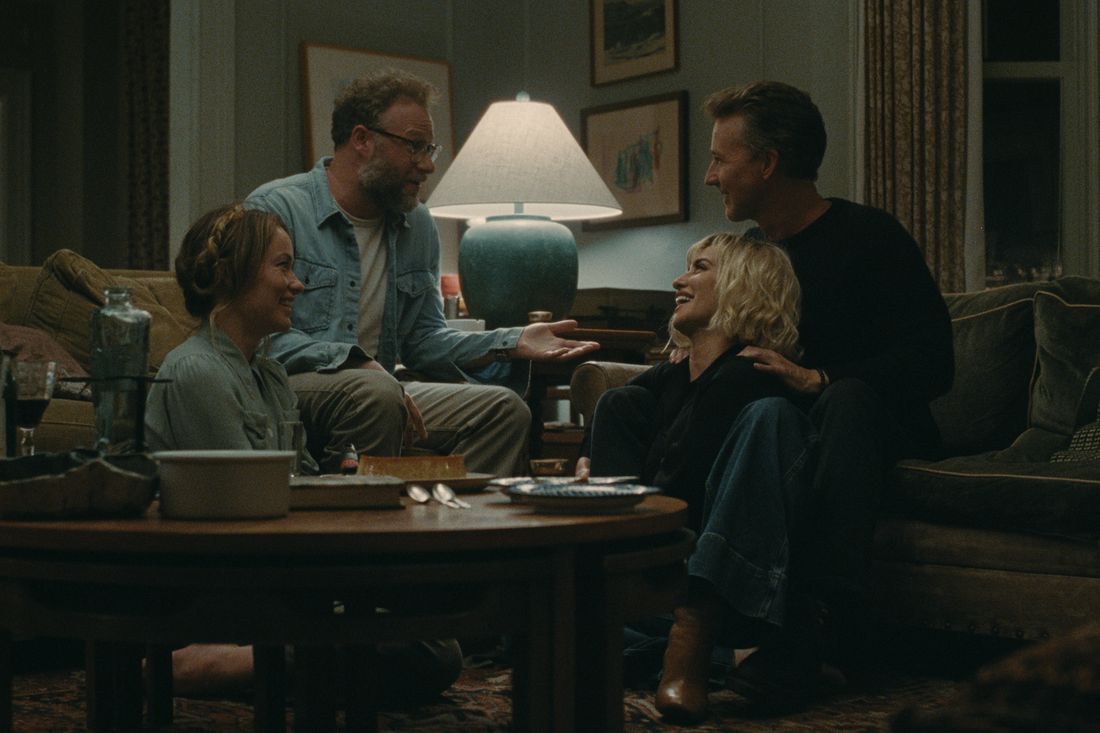
After the intense experience of directing Don’t Worry Darling, it’s understandable that Olivia Wilde would choose a smaller, more intimate project like The Invite. This film, adapted from Cesc Gay’s 2020 movie The People Upstairs (and originally a play), centers on a troubled couple hosting a dinner party for their neighbors, and the evening takes an unexpected turn. It’s a character-driven story that likely offered a welcome change of pace after the drama surrounding her previous film.
The story immediately feels like a play, starting with Joe, a disheartened music teacher, returning home to find his meticulous and worried wife, Angela, busy preparing a dinner party for their neighbors upstairs. Joe is caught off guard, especially since he and Angela dislike these neighbors, who disturb them with loud noises at all hours. Their constant arguing early on hints that their neighbors might actually be more stable than they are. When Hawk and Pina arrive, they seem calm and perceptive, even revealing they overheard Joe and Angela’s fight before knocking. He’s a former firefighter, she’s a sex therapist, and suddenly, the neighbors are in control of the situation, mentally and emotionally.
The movie The Invite is mostly a comedy, and it definitely has some funny moments. However, the way the characters interact sometimes feels forced and unnatural. We learn Angela is anxious and overly cautious – she even called the host of her daughter’s sleepover to confirm no men or weapons were present – and supposedly stays up-to-date on current social issues through podcasts. While this is amusing, she ironically prepares an entire meat and cheese meal without checking if her neighbors have any dietary restrictions (it turns out Pina can’t eat it). These little inconsistencies build up and make the characters feel less realistic. Unlike a drama like Who’s Afraid of Virginia Woolf, where flawed characters drive the intense plot, this movie feels like the characters are just a collection of jokes, with their actions existing solely to create laughs.
What’s particularly troubling is that the film’s dramatic, stage-like dialogue only feels natural when it has a musical flow and a good pace. However, the director uses overly strong music cues that actually diminish this effect – it’s almost as if she doesn’t have confidence in the script, which was written by Rashida Jones and Will McCormack. Despite this, the actors are all very talented and each brings something special to their roles. Wilde, who also shines in another Sundance film this year called I Want Your Sex, is excellent at bold, over-the-top comedy – her timing is perfect, and she isn’t afraid to exaggerate for laughs. Rogen, meanwhile, relies on his typical, playful style – he stumbles over his words, repeats himself nervously, and sometimes misses the punchline.
When Norton and Cruz appear on screen, they each bring a distinct personality – he’s calm and collected, while she has a free-spirited, bohemian quality. This contrast seems deliberate; the filmmakers clearly wanted these actors to express their individuality. And sometimes it works well – for example, when Hawk and Pina discuss the apartment’s atmosphere, Joe dryly remarks they were focused on ‘capturing energy,’ as if it were possible. However, it requires skillful writing and direction to make such diverse performances feel unified, and ultimately, the actors don’t quite blend together seamlessly.
Wilde emphasizes comedy throughout the film, using visual gags whenever possible. When it works best, The Invite effectively uses the apartment setting to highlight the distance between characters, then gradually brings them closer together. However, the film’s shifting tone sometimes undermines itself. While the movie takes some unexpected turns, these developments feel unearned because the characters aren’t fully believable, and the story loses momentum. The lighthearted humor that dominates the first hour clashes with the overly serious and drawn-out emotional confessions in the finale, which are accompanied by an inappropriately sentimental score. In fact, the film serves as a prime example of how not to use music.
Olivia Wilde’s first film, Booksmart (2019), was successful because she brought a fresh and creative approach to the well-worn story of teenagers coming of age, using her filmmaking skills to manage the story’s shifts in mood. Her second film, Don’t Worry Darling, felt overly restrained and predictable, as if Wilde was holding back her natural style. The Invite, however, feels like the opposite problem – it’s rambling and doesn’t quite work as a focused, intimate film. Though not long, it feels slow at times, and doesn’t allow Wilde to showcase the strong directing abilities she demonstrated in Booksmart.
Read More
- United Airlines can now kick passengers off flights and ban them for not using headphones
- Katanire’s Yae Miko Cosplay: Genshin Impact Masterpiece
- How to Complete Bloom of Tranquility Challenge in Infinity Nikki
- All Itzaland Animal Locations in Infinity Nikki
- Gold Rate Forecast
- How to Get to the Undercoast in Esoteric Ebb
- A Dark Scream Theory Rewrites the Only Movie to Break the 2-Killer Rule
- Australia’s New Crypto Law: Can They Really Catch the Bad Guys? 😂
- Fire Force Season 3 Part 2 Episode 24 Release Date, Time, Where to Watch
- All Golden Ball Locations in Yakuza Kiwami 3 & Dark Ties
2026-01-25 20:54