Ever struggled to explain a game you love to your friends, getting lost in details? It’s often easier to play a great game than to explain it. Being able to quickly and clearly summarize a game – its core idea and what makes it fun – is a valuable skill. It’s what convinces people to try it, helps you win arguments online, and makes your reviews actually engaging. Learning to capture the heart of a complex game in a concise, exciting way will make you a better communicator overall. This guide will show you how to write those kinds of impactful summaries.
Key Takeaways
- Capture the Vibe, Not Just the Specs: A great summary tells you how a game feels to play. Focus on the core conflict, key character journeys, and overall emotional tone to give others a real sense of the experience.
- Be Ruthless with Words, Not with Meaning: The goal is to be concise, not vague. Cut out repetitive fluff and filler words, but always keep the essential context that explains why a change or feature is important.
- Tailor Your TL;DR for the Situation: How you summarize dense patch notes should be different from how you summarize a game review. Adapting your approach for the type of content makes your summary more useful and your point more effective.
What is Text Summarization? (And Why Gamers Should Care)
Ever found yourself overwhelmed by long game reviews or patch notes and wished someone would just give you the quick summary? That’s where text summarization comes in. It’s about taking a lot of information and simplifying it to the most important points – a real game-changer for players.
Text summarization generally works in one of two ways. One method identifies and extracts the most important sentences directly from the original text, similar to highlighting key information. The other approach creates a new, shorter version of the text, expressing the main ideas in a different way – almost like getting a summary from a friend. Both methods aim to deliver the essential information concisely.
Why is this important? In gaming, knowing what others think is crucial. Instead of reading lengthy reviews, a good summary quickly tells you if a game is fun, has a satisfying story, and avoids unfair spending. It helps you understand what players like and dislike, so you can decide if a game is right for you.
Let’s face it, nobody wants to wade through lengthy patch notes. You just want to quickly see if your preferred weapons have been adjusted. Clear summaries get straight to the point, highlighting the changes that actually impact how you play. Whether you’re searching for top Warzone setups or deciding if an update is beneficial, it’s all about getting the essential information fast.
Nail the One-Sentence Summary
Your game’s one-sentence summary should be its most compelling pitch – what you’d say to instantly get a friend to play with you. Crafting this takes skill; it’s not just about being short, but about making a strong impression. A great summary can grab attention on busy platforms like Discord, help your review get noticed, or clearly explain your game in a discussion. It’s what sparks curiosity and turns someone browsing into someone who wants to learn more.
Want to write a great game summary? Focus on the main conflict and the characters involved. By highlighting these key elements, you can effectively capture the essence of even a lengthy game in just one sentence. This helps you get straight to the point and share what’s truly important about the experience, whether you’re discussing strategies or plot details. A strong summary isn’t about listing features; it’s about capturing the heart of the game.
Capture the Core Conflict
Every great game revolves around a central problem or challenge for the player to overcome. This could be anything from a large-scale war to a personal quest, or even just trying to survive in a dangerous environment. To effectively describe a game, you need to pinpoint this core conflict – what’s the main obstacle the player faces, and what’s at stake? The trailer for Diablo 4‘s expansion is a great example, showing humanity’s fight against a powerful evil to save their world. Highlighting this central struggle is crucial to explaining what makes a game so engaging.
Summarize Character Arcs
Though a central conflict introduces a game’s story, it’s the characters who truly make it engaging. Many games gain emotional impact from showing how characters develop and change. This transformation—whether it’s a shy character becoming brave, a tough soldier learning to trust, or a comical character revealing hidden layers—is called a character arc. When describing a game, focusing on a key character’s growth can be very effective, giving your audience a sense of the emotional journey they can expect. Consider how the character starts the game compared to how they end – that difference is the story.
How to Summarize a Paragraph
Let’s talk about how to condense long texts effectively. Whether it’s a detailed game review, a lengthy online discussion, or complex patch notes, the aim is to shorten it while preserving the most important information. It’s like carefully selecting valuable items from a treasure trove – keep the best parts and discard the rest. The goal isn’t just brevity, but clarity and impact. Improving this skill will make your own writing and contributions much more focused and effective.
Pinpoint the Main Idea
Each paragraph in a review has a specific purpose. First, try to understand what that purpose is. Is the writer highlighting something positive, like good sound? Or are they pointing out a problem, like a bug? Focus on the most important thing the writer wants you to know. A good way to find this is to look for the topic sentence, usually at the beginning of the paragraph, which often states the main point. Studies on summarizing game reviews show that finding this core message is the most important step. If you’re unsure, ask yourself: “If I had to pick just one sentence to explain this paragraph, which one would it be?” That sentence is likely the main idea.
Cut the Fluff, Keep the Context
After you’ve identified the central idea, simplify your writing by removing unnecessary words and phrases. This includes repetition, excessive adjectives, and examples that don’t add new information. Be direct, but avoid cutting so much that you lose important context. For instance, saying “the SMG was weakened” is concise, but “the SMG’s close-range damage was weakened, changing the game’s strategy towards assault rifles” is better because it explains why the change matters. Focus on the most important details – like how the game plays or what happens in the story – that support your main idea. This creates a much stronger summary than simply listing random facts.
Tell a Story, Briefly
An effective summary isn’t just a collection of facts – it should read like a mini-story. After identifying the key information and removing unnecessary details, organize the remaining points into a clear and logical flow. The goal is to create a summary that feels complete and makes sense as a whole. For example, instead of listing points like ‘Good graphics, bad story, fun combat,’ try combining them into a sentence like, ‘Despite a weak story, the game offers visually impressive graphics and engaging, fast-paced combat.’ This creates a concise and compelling overview of the experience.
What Makes a Good Gaming Summary?
A good gaming summary is like a compelling quest description – it grabs your attention, gives you a taste of what’s in store, and makes you want to play without revealing everything. It’s about more than just shortening a long piece of text; it’s about capturing the heart of the game or conversation in a few impactful sentences. Whether you’re writing a review, sharing on a forum, or trying to get your friends to play with you, a well-crafted summary is incredibly useful.
Effective summaries are considerate of people’s time. With so many games to play and articles to read, it’s important to get straight to the point. A good summary quickly explains how a game plays, what it’s like, and why people would be interested. When you do that well, you’re not just providing information – you’re encouraging others to try the game. The best summaries, like those our community creates for trailers like the recent Diablo 4 one, share both the important details and the excitement that makes gaming so enjoyable.
Focus on Key Gameplay and Features
Before diving into a new game, players want to quickly understand what they’ll be doing. Your game description should focus on the main ways you play – is it a fast-action shooter with special moves, or a strategy game where you build characters? A good summary will clearly explain the core gameplay and what makes the game unique. For example, when describing Palworld, you’d mention building and catching creatures, but also its distinctive dark humor. This helps players decide if the game is a good fit for them.
Convey the Vibe and Player Feelings
While details matter in games, what really draws people in is how a game feels. A good description should capture that feeling – is it scary and action-packed, peaceful and comforting, or funny and unpredictable? The best summaries focus on the emotional experience and what it’s like to play, helping others truly understand the game. For example, simply listing the features of Diablo 4 – its classes and dungeons – doesn’t do it justice. You need to talk about its dark, gothic world and the grand battle against evil, especially how the music enhances that atmosphere.
Keep it Short for Maximum Impact
People usually just want the main idea, not a long explanation. Keep your summaries short and sweet – that’s what a TL;DR is for! Aim to create a summary someone can quickly understand – a few seconds is ideal. Try to keep it under eight sentences, or even shorter if possible. Write everything down first, then cut out anything unnecessary. The goal is to give readers a quick, impactful overview that makes them want to learn more.
AI Summarization Tools That Actually Work
Let’s face it, most of us don’t have the time to read lengthy articles or endless online discussions. Whether it’s a long developer blog or a huge Reddit thread, you just want the key information and overall feeling without spending hours scrolling. That’s where AI summarization tools can help. They quickly condense large amounts of text, letting you spend more time enjoying the game itself.
AI tools vary greatly in quality. Some simply string together keywords, while others truly understand the meaning of the text. The best tool depends on what you’re reading – whether it’s detailed technical information or enthusiastic opinions. We’ll explore a few good choices and explain how they work, helping you find the one that suits you best.
QuillBot
QuillBot’s summarizer is like having a really helpful assistant that highlights the most important parts of a text. It works by finding and pulling out the key sentences directly from the original content – it doesn’t try to reword things. Because of this, it’s especially good at summarizing factual information accurately.
Okay, so when a new season drops and there’s a HUGE patch note dump? I just paste the whole thing into QuillBot. Seriously, it’s a lifesaver! It instantly grabs all the important stuff – like what got buffed, what got nerfed, and any new features. It gives me a super clean list of what actually matters, so I don’t have to wade through tons of text and try to figure it out myself. It’s perfect for getting right to the good stuff without any confusion.
Paperguide
Paperguide, like other summarization tools, excels at pinpointing the most important words and phrases within a text. It analyzes how often words appear and how relevant they are to quickly give you a general idea of what the document covers. It’s designed to help you grasp the main themes quickly, rather than provide a detailed, sentence-by-sentence summary.
This tool is really helpful for anyone who creates content or wants to quickly understand what people are saying about a topic. For instance, if you’re looking at reviews for a video game, it can instantly show you the most discussed aspects, like the ‘open world,’ any ‘bugs,’ or the ‘story.’ This lets you get a quick overview of the main ideas before spending time reading everything in detail.
Extractive vs. Abstractive: What’s Best for Gaming?
These summarization tools work in one of two main ways: by extracting or abstracting. Extractive summarization, like what QuillBot does, simply pulls the most important sentences directly from the original text – it’s essentially copy-and-paste. Abstractive summarization is more sophisticated; it actually understands the text and then creates new sentences to summarize it, similar to how a person would.
When it comes to game updates, like patch notes and technical details, it’s usually best to simply pull key information directly from the source. This avoids mistakes and ensures accuracy. In fact, studies on summarizing game reviews have found that this straightforward approach works just as well as more complicated methods for conveying the main ideas.
Use Summaries to Improve Your Game Discussions
Being able to summarize information is a valuable skill, especially when talking about games. Whether you’re writing a review, sharing your thoughts online, or arguing a point in a forum, a good summary helps you get your message across quickly and effectively. It can be the difference between people ignoring your opinion and actually engaging with it. By getting straight to the point, you show respect for others’ time and make your own ideas clearer and more persuasive. It’s like writing a compelling introduction that immediately grabs attention.
Structure Your Reviews
If you’re writing about a game, start with a quick summary! Reviews have a lot of details, so a short “too long; didn’t read” (TL;DR) at the beginning lets readers instantly understand your main opinion. For example, if you thought the gameplay was great but the story was weak, mention that right away. This summary grabs attention, helps people decide if they want to read the full review, and also helps you focus on the most important parts – things like how the game plays, its art, and how well it runs. This makes your review clearer, more professional, and easier for everyone to understand.
Adapt Your Content for Any Platform
Long-form content isn’t always ideal for every platform. A good summary lets you share the key ideas from your blog posts or videos on platforms like Twitter, Reddit, or Discord. You can quickly pull out the most important information to create engaging posts – like a short, attention-grabbing tweet or Reddit post – that then link back to your original, longer piece. For instance, an in-depth review of the Diablo 4 soundtrack could be turned into a tweet showcasing the three best songs and why they’re great. This helps you reach more people by sharing content where they already are, without having to start from scratch each time.
Build Stronger Arguments on Forums
Have you ever skipped a long, unbroken block of text online? It’s likely you did. When discussing updates or plot points, getting straight to the point makes your argument more convincing. Begin your post with a quick, one- or two-sentence summary of what you’re trying to say. This immediately tells readers where you stand. A good rule of thumb is to keep your summary to five lines or less. Starting with a clear, concise argument encourages thoughtful discussion and shows you value everyone’s time. It also demonstrates you’re confident in your position.
How to Summarize Different Gaming Content
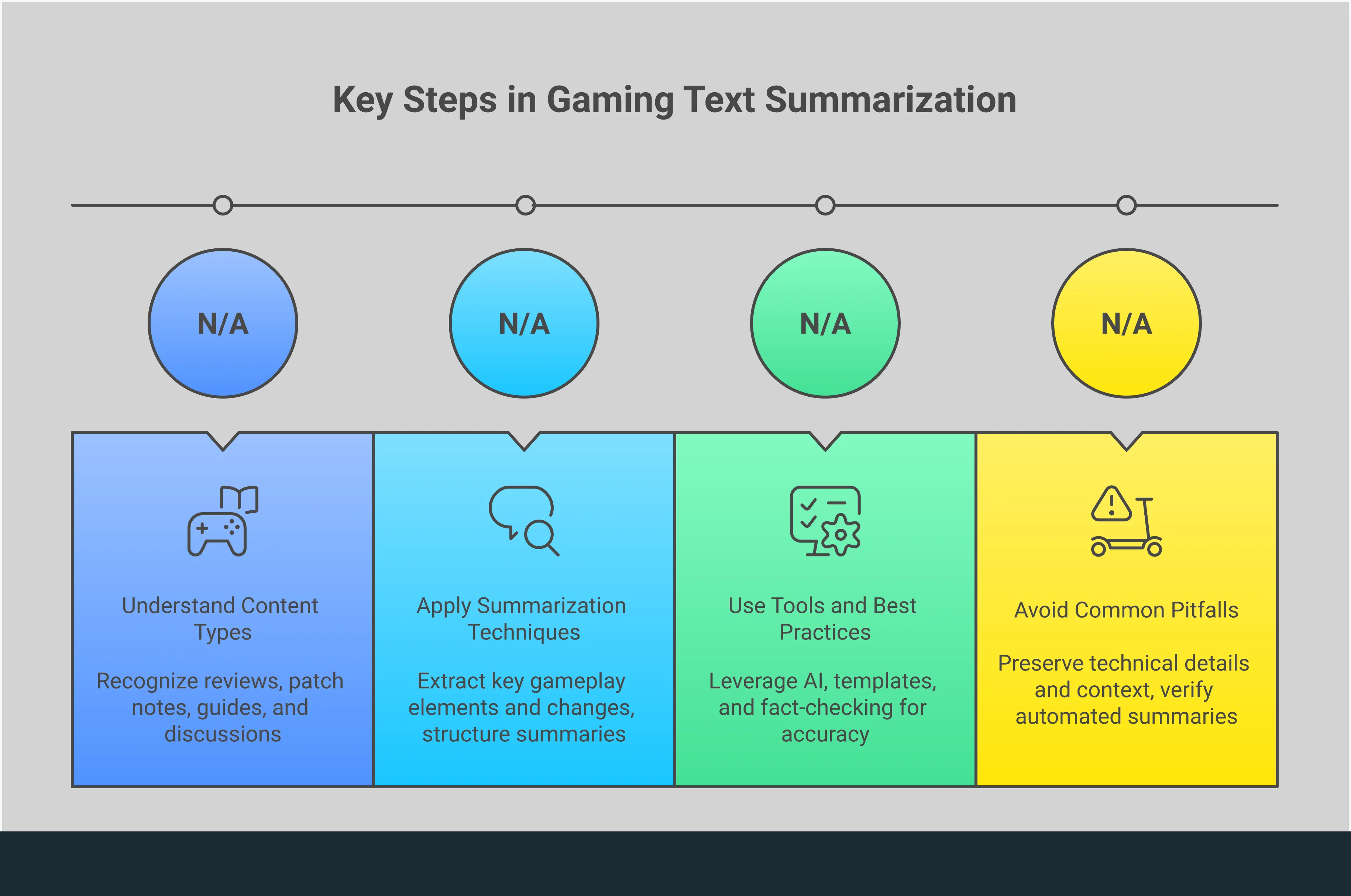
Different types of gaming content require different approaches to summarizing. A brief overview for a game review serves a different purpose than a summary of complicated patch notes. It’s important to consider what your audience – whether it’s a reader or someone you’re discussing with online – actually wants to know. Are you aiming to convey the excitement of a new game, or just pinpoint which item was weakened?
I’ve been thinking about how we summarize things, and it’s really about playing different roles. When I write a review, I try to be like a critic, hitting the main points of what something is all about. For patch notes, I’m a news person, just giving you the important stuff. And when I’m looking at what fans are saying, it’s like being a detective, figuring out what everyone generally feels. It’s all about how you look at the information. Like, when a new trailer drops, I don’t want to just repeat every comment – I want to give you a sense of what the whole community thinks. Getting good at these different ways of summarizing makes everything way better and more helpful, I think.
Game Reviews and First Impressions
Game reviews are full of opinions, which can be really helpful for figuring out what players enjoy and dislike. When you summarize a review, focus on the main ideas and overall feelings it expresses. Don’t just list what the game has; explain why things work well or don’t. For example, why is the fighting fun, or why didn’t the story connect with players? This process of finding these important points is often called aspect extraction and helps you understand the review’s main message.
A helpful game review summary quickly covers the core idea of the game, its best features, and any major flaws. It then gives a clear overall opinion. By hitting these key points, you can give potential players the information they need to decide if the game is right for them.
Patch Notes and Updates
Let’s face it, players don’t want to wade through long lists of small fixes. When writing patch notes summaries, focus on the most important changes. Players need to quickly see what’s really new or different in the game. Specifically, call out major balance changes – things that significantly impact how the game is played – and any new content like characters, maps, or modes.
Okay, so when I’m reading patch notes, I basically try to translate all the tech stuff into what actually matters for gameplay. I always look for summaries with bullet points – those are the best! They quickly tell me what’s changed, like what’s been improved or fixed, so I can tweak my Warzone loadout and jump right back into the action without getting lost in a ton of details.
Community Discussions and Feedback
Pulling together a summary of a busy Reddit thread or long forum discussion takes skill. You’re trying to capture the main ideas – and sometimes the confusion – of the whole community. Pay attention to what people keep mentioning and what opinions are most common. If several users are reporting the same problem, or if a particular theory is gaining traction, those are the important points to focus on.
Okay, so basically, I’ve been checking out what everyone’s saying about the game, and I’m trying to get a feel for the overall vibe. It’s not about listing out every single person’s opinion, but more about figuring out what most players are thinking and what the big discussions are. I’m aiming to give a quick rundown of how the community feels – kind of like a ‘what’s everyone talking about?’ guide, especially for anyone new jumping in. It’s all about capturing the general mood and highlighting the main points people are debating.
Common Summarization Mistakes to Avoid
You understand the fundamentals, but effective summarizing takes practice. It’s surprisingly easy to do poorly – a weak summary can distort information about a game, dampen excitement for an update, or weaken your point in an online discussion. The key is to be brief while still capturing the important details. Let’s explore common mistakes to help you create summaries that really deliver.
Cutting Too Much Gameplay Info
Think about reading a game review that simply says, “The guns are cool.” That’s not very helpful, is it? Players want to know specifics – does the game feel realistic? How quickly can you eliminate enemies? These details are crucial. Removing too much information from a summary makes it unhelpful. Studies show that game reviews should inform players, and that means including details about how the game actually plays. Don’t just say something is “powerful”; explain why. For example, a good guide for a game like Warzone would detail the specific attachments or abilities that make a certain build effective. While what a game offers is important, gamers truly need to understand how it works.
Losing the Original Tone and Hype
Games aren’t just about numbers and how they work—they’re about how they make you feel. It’s the joy of victory, the annoyance of glitches, or just the fun of silly jokes. A good summary should capture that feeling. If you’re summarizing a funny discussion about game bugs, your summary should be funny. If you’re shortening an enthusiastic review, your summary should show that excitement. Removing the original tone makes a summary dull and can even be inaccurate. The best summaries keep the energy of the original, whether it’s the community laughing at memes or getting hyped about new content.
Forgetting Key Context
Understanding the background is crucial. Simply stating something like “The developers weakened the main character” doesn’t tell the whole story. You need to know why – was the character too powerful in the game, or were players asking for changes? Without this context, the information feels incomplete and the summary misses the bigger picture. It’s the difference between just reporting facts and truly understanding what’s happening. When you summarize something, be sure to include the surrounding details that explain why it matters, like how a trailer is received based on fans’ existing knowledge of the story.
Sharpen Your Summarization Skills
Summarizing information is a skill you can improve with practice. It’s not just about shortening text; it’s about carefully identifying the most important points and presenting them clearly. The more you practice summarizing things like long game reviews, updates, or online discussions, the better you’ll become at creating concise and impactful summaries. Being a good summarizer will help you share game recommendations effectively, write more persuasive reviews, and make stronger arguments online. Want to get better? Here are some tips to help you refine your skills and find the right level of detail for your summaries.
Practice Drills for Gaming Writers
If you want to improve your summarizing skills, practice consistently. Here’s a simple workout to start with: First, find a detailed review of a game you’re familiar with—perhaps one of our in-depth analyses, like the one on the Diablo 4 soundtrack. Your first task is to identify the 3-5 main points the article covers (like gameplay, story, or sound) and write a single sentence summarizing each. Then, try to condense a lengthy list of patch notes. Focus on the important changes and create a few bullet points that tell a regular player everything they need to know. These exercises will help you quickly find the key information and filter out unnecessary details.
Balance Speed, Accuracy, and Engagement
Effective summaries hit three key points: they’re quick to create, factually correct, and interesting to read. It’s tempting to rush and prioritize speed, but a summary that gets the details wrong isn’t helpful. Getting the facts right is the most important part – readers are perceptive and will quickly spot inaccuracies. Once you’ve established accuracy, you can work on making the summary captivating. Use lively language and strong verbs to make it stand out. This is important because well-written summaries attract readers and can even help people find your content through search engines, leading to more engagement. With practice, you’ll be able to write accurate, engaging summaries efficiently.
When to Summarize vs. When to Read It All
Let’s face it, nobody has time to read every single detail in patch notes, reviews, or online forums. Quick summaries are a gamer’s lifesaver, but relying on them alone can mean missing important information that could really impact your gaming experience. Figuring out when to quickly scan for updates and when to read everything carefully is a valuable skill.
It’s all about using the right resource for what you need. A summary gives you the main points quickly, like a small map for a quick look, while the complete text is like a detailed map you use when you need every detail. Here’s how to figure out which one is best for you.
Go for the Summary When…
Use a summary when you need information quickly and the details aren’t crucial. It’s a great way to get the main idea without spending a lot of time on specifics.
Grab the summary if you’re:
- Getting a first impression. Wondering if a new indie game is even in your wheelhouse? A summary of a review can give you the vibe and core gameplay loop in seconds.
- Catching up on minor updates. For weekly patches or minor balance changes in a game you know well, a summary will give you the key buffs and nerfs without the fluff.
- Skimming community drama. If a forum thread is 50 pages long, a summary of the main arguments will get you up to speed so you can jump into the conversation. Summaries are great for quickly accessing information and categorizing the main points of a discussion.
Read the Full Thing When…
Often, it’s the small details that matter most, and a brief overview isn’t enough. When making big decisions or dealing with complicated subjects, you need all the information to truly understand things.
Commit to the full read if you’re:
- Making a purchase. Before you drop $70 on a new AAA title, you need more than a one-paragraph summary. Reading full reviews helps you get a deep and nuanced understanding of player opinions, not just a single score.
- Learning a new meta or build. Trying to master a new character or understand a major meta shift? Summaries often skip the subtle interactions and specific item choices that define a powerful Warzone loadout.
- Appreciating the finer points. Topics like a game’s score or narrative themes require a deeper dive. You wouldn’t get the full impact of an analysis of Diablo 4’s underrated soundtrack from a summary alone. Some things just need the full context to be appreciated.
Related Articles
- Deus Ex LFG: Connect with Other Augs in LFG Feature on Z League App
Frequently Asked Questions
You might wonder if summarizing is worth the effort when you can quickly skim an article. While skimming can help you locate specific information, summarizing truly makes you understand the main point. Think of it like this: you can see the word “nerf” in a game update, but understanding how that change impacts your strategy is much more valuable. A strong summary gives you the core idea and important details, helping you make better choices about what to play or how to adjust your approach.
As a gamer, I’ve noticed the biggest problem with a lot of summaries is they just state what happened, but not why it matters. Like, it’s cool to know a weapon got nerfed, but a really good summary tells you how that affects the game – does it change which characters are best? Does it shake up the whole strategy? Without that ‘why,’ you’re missing the important stuff. I always try to focus on how a change, new feature, or even something in the story actually impacts how we play the game.
Gamers often have a lot of reading to do – things like developer updates and lengthy patch notes. AI summarization tools can really help with this by quickly giving you the main points. They won’t replace your own understanding, but they’re a fast way to get the key information and save time. Think of them as a first step in understanding complex content.
Want to explain technical updates, like patch notes, in a clear way? The trick is to focus on how the changes affect the actual gameplay. You can skip most of the small bug fixes and concentrate on big adjustments to things like weapons, characters, or key abilities. Don’t try to list everything – just highlight the changes that will really change how players experience the game.
Want to make a strong impression in a forum or on Discord? Start with a quick summary! Begin your post with one or two sentences explaining your main point. This immediately grabs attention and makes your argument easy to understand, encouraging others to join the conversation instead of being overwhelmed by long paragraphs.
Read More
- United Airlines can now kick passengers off flights and ban them for not using headphones
- Crimson Desert: Disconnected Truth Puzzle Guide
- How to Get to the Undercoast in Esoteric Ebb
- All 9 Coalition Heroes In Invincible Season 4 & Their Powers
- All Golden Ball Locations in Yakuza Kiwami 3 & Dark Ties
- Warframe Voruna Prime access begins on April 8 for all platforms, new deluxe cosmetic Warframe skins revealed
- Katanire’s Yae Miko Cosplay: Genshin Impact Masterpiece
- Dakota County’s plan to end hunger involves locking mayors in escape rooms
- Zendaya’s 4 Big 2026 Movies Could Beat Brie Larson’s Box 2019 Office Record
- All Itzaland Animal Locations in Infinity Nikki
2026-01-06 15:51