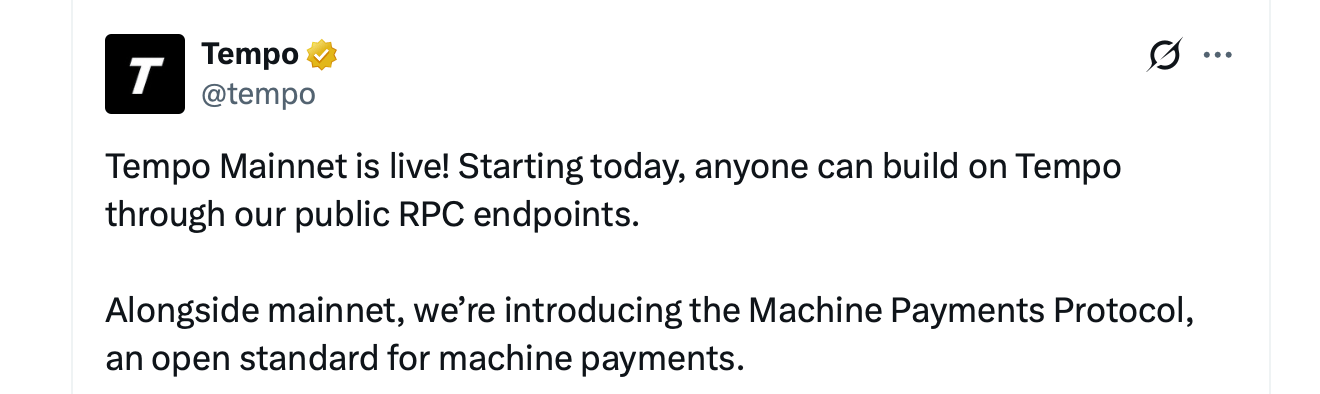
Tempo, a Stripe- and Paradigm-backed layer-1 blockchain, has launched its mainnet alongside a new Machine Payments Protocol designed to let AI agents transact autonomously across the internet.
AI Agents Now Handle Your Money-And They’re Not Asking for a Raise
The debut positions Tempo as infrastructure built specifically for payments, not general-purpose blockchain activity, with a focus on instant settlement, predictable fees and high throughput. Moreover, decentralized finance ( DeFi) oracle firm Redstone will provide the network with real-time data.
“Real-time FX data for global payments is now available on the blockchain built for money movement. From block one,” the oracle company posted on X.
Tempo’s pitch is straightforward: if stablecoins are becoming a core layer of internet commerce, then the rails moving that money should actually behave like payment systems. That means fewer fee surprises, more reliability and the ability to handle large volumes without choking.
Most existing blockchains, the company argues, were not designed for high-frequency, low-value transactions. That limitation becomes more obvious as AI systems begin to transact in real time, often executing dozens or even hundreds of payments within a single workflow.
That’s where Tempo is leaning in-squarely at the intersection of payments and agentic AI. As software agents increasingly purchase data, compute and services, payments shift from occasional clicks to continuous, programmatic flows.
To support that shift, Tempo introduced the Machine Payments Protocol (MPP), an open standard co-authored with Stripe. The protocol provides a uniform way for machines to request, authorize and settle payments without reinventing billing systems for every service.
MPP is designed to be payment-rail agnostic, already supporting stablecoins and extending to traditional methods. Partners including Visa and Stripe have integrated card and wallet functionality, while Lightspark has added bitcoin payments over the Lightning Network.
A key feature is the use of “sessions,” which allow continuous payments after a one-time authorization. Instead of triggering a new transaction for every API call or compute request, agents can stream payments within predefined limits, bundling thousands of microtransactions into a single settlement.
Think of it as OAuth, but for money-authorize once, and let the system handle the rest while staying within guardrails.
Tempo is also rolling out a payments directory at launch, offering a catalog of more than 100 services that agents can interact with automatically. Early integrations include platforms such as Alchemy, Dune Analytics and various compute and data providers.
The goal is simple: make services discoverable and monetizable in a machine-first economy, where agents-not humans-initiate transactions.
While AI-driven payments are the headline act, Tempo is also targeting more traditional financial use cases. These include global payouts, cross-border remittances, embedded finance and tokenized deposits-all areas where current systems still rely on multiple intermediaries and delayed settlement.
Tempo claims its infrastructure allows payouts to settle instantly at scale, remittances to clear in seconds with auditability and embedded finance flows to integrate directly into applications without separate ledger systems.
The project has been working with a wide range of partners, including Anthropic, Doordash, Mastercard, Nubank, OpenAI, Ramp, Revolut, Shopify, Standard Chartered and Visa, signaling early interest from both fintech and enterprise players.
Since its public testnet launch in December, Tempo has focused on refining these payment-specific capabilities, aiming to bring real-world workloads onto stablecoin-based rails.
Developers can now access the network through public RPC endpoints, create wallets and begin integrating MPP to enable autonomous agent payments.
If Tempo delivers on its promises, it could quietly reshape how money moves online-not with flashy features, but by making payments as seamless and programmable as the software they power.
FAQ 🔎
- What is Tempo?
Tempo is a layer-1 blockchain designed specifically for high-throughput, low-cost payments using stablecoins. - What is the Machine Payments Protocol (MPP)?
MPP is an open standard that allows AI agents and services to request, authorize and settle payments automatically. - Why does Tempo focus on AI payments?
AI agents increasingly transact for data, compute and services, requiring fast, continuous and programmable payment systems. - What use cases does Tempo support?
Tempo targets AI commerce, global payouts, remittances, embedded finance and tokenized financial assets.
Read More
- United Airlines can now kick passengers off flights and ban them for not using headphones
- Crimson Desert: Disconnected Truth Puzzle Guide
- All 9 Coalition Heroes In Invincible Season 4 & Their Powers
- Mewgenics vinyl limited editions now available to pre-order
- Assassin’s Creed Shadows will get upgraded PSSR support on PS5 Pro with Title Update 1.1.9 launching April 7
- Invincible Season 4 Episode 6 Release Date, Time, Where to Watch
- Grok’s ‘Ask’ feature no longer free as X moves it behind paywall
- The Boys Season 5 Spoilers: Every Major Character Death If the Show Follows the Comics
- Grey’s Anatomy Season 23 Confirmed for 2026-2027 Broadcast Season
- Viral Letterboxd keychain lets cinephiles show off their favorite movies on the go
2026-03-18 17:27